For any South African business dealing with international suppliers, clients, or partners, moving money across borders is just part of the daily grind. You might be paying an invoice to a manufacturer in China, settling up with a software developer in Europe, or investing in a US-based venture. In every case, you need a reliable way to get your funds where they need to go.
For years, the go-to method has been a direct bank-to-bank transfer, a system that relies on a sprawling global network of financial institutions.
This has been the bedrock of international trade for decades, handling everything from funding overseas projects to bringing profits back home. But because it’s a legacy system, it comes with some serious drawbacks that can eat into your profit margins and slow down your operations.
The Headaches You Know All Too Well
Trying to manage international payments can feel like a constant juggle. You're trying to keep costs down, get money there quickly, and stay on the right side of the rules, often feeling like you have to sacrifice one for the others. The traditional banking route, while secure, is famous for a few key pain points that we'll unpack and solve in this guide:
- Frustrating Delays: Let's be honest, international bank transfers are never instant. It can take anywhere from two to five business days—and sometimes even longer—for the money to actually land. That kind of uncertainty can create cash flow gaps and strain relationships with your suppliers.
- Hidden Costs: The fee you’re quoted upfront is rarely the full picture. Hidden charges, like fees from intermediary banks and less-than-ideal foreign exchange (FX) markups, can quietly chip away at the amount that actually arrives.
- Confusing Compliance: Getting all the paperwork right for the South African Reserve Bank (SARB) and other international bodies can be a nightmare. One wrong form or a missed reporting deadline can get your payment rejected, sending you right back to square one.
Think of this guide as your practical roadmap to navigating international payments. We want to demystify the bank-to-bank transfer, show you how it really works, expose the true costs, and give you solid strategies to manage your payments far more effectively.
Once you understand the mechanics, the challenges, and the alternatives out there, you can start making smarter decisions that save your business real time and money. It’s about moving beyond just making payments to strategically managing your global cash flow.
Let’s start by pulling back the curtain on how your money actually travels from your bank account in South Africa to one on the other side of the world.
How an Overseas Bank Transfer Actually Works
Sending money overseas through your bank can often feel a bit like a "fire and forget" mission. You hand over the details, approve the transaction, and cross your fingers that it arrives safely on the other side. But what’s really happening behind the curtain is less of a direct flight and more of a complex international relay race.
Think about it like this: you want to send a parcel from your office in Johannesburg to a small village in rural Italy. You can’t just hire one person to drive it the whole way. Your local courier collects it and takes it to a major airport hub. From there, an international airline flies it to Rome. Once it lands, a regional Italian courier takes over for the final delivery.
That's almost exactly how traditional international bank transfers operate. Your South African bank doesn't have a direct line to every other bank on the planet. To connect the dots, it relies on a web of correspondent and intermediary banks—huge global financial institutions that act like those major airport hubs, passing your money along until it reaches its final destination.
The SWIFT Network: The Global Financial Postman
So, how do all these different banks coordinate this handover? They talk to each other through the SWIFT network.
It’s a common mistake to think that SWIFT itself moves your money. It doesn't. SWIFT (which stands for the Society for Worldwide Interbank Financial Telecommunication) is basically a super-secure messaging service for banks. It’s like the air traffic control system for global payments.
It sends encrypted, standardised messages that act like flight plans, telling each bank in the chain exactly where the money has come from, where it’s going, and how much to send. The money is settled between the banks later, but the SWIFT message is the instruction that gets the ball rolling. Of course, each bank handling the message and the funds along the way takes a small slice for their trouble, which is why those transfer fees can start to stack up.
This multi-step journey is the source of the three biggest headaches in international payments: delays, high costs, and compliance hurdles.
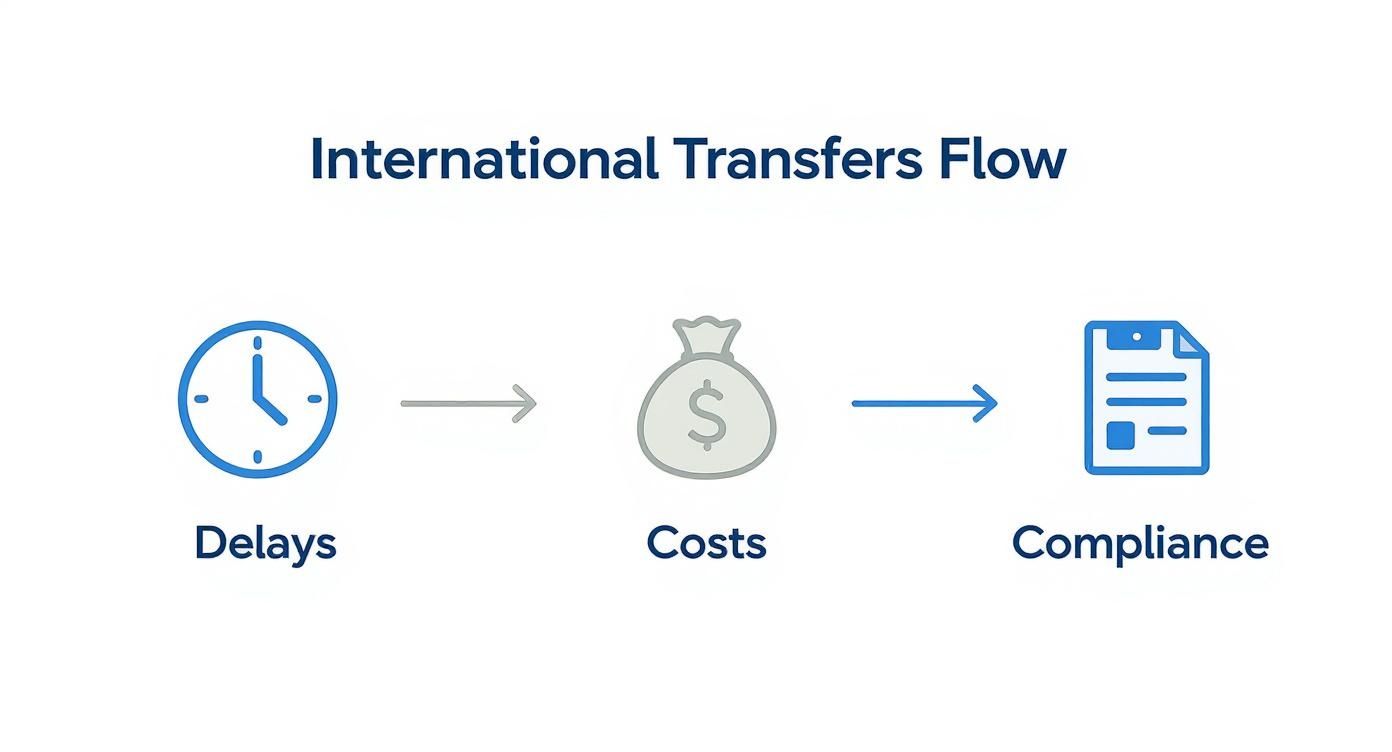
As you can see, every stop on the journey adds a potential bottleneck, making the whole process slower and more expensive than it needs to be.
Decoding the Essential Transfer Codes
To make sure your financial "parcel" doesn't get lost in transit, you need the right address. For a bank-to-bank transfer overseas, this address is a precise combination of codes. Getting these details wrong is one of the top reasons transfers fail or get stuck in limbo.
Here’s what you absolutely must have correct:
- SWIFT/BIC Code: An 8- or 11-character code that’s like a unique postal code for the recipient's bank. It tells the global banking system exactly which institution to send the money to.
- IBAN (International Bank Account Number): This is the standard in Europe and many other regions. An IBAN combines the country code, bank identifier, and individual account number into one long string, dramatically cutting down on manual errors.
- Routing Number: If you're sending money to the United States, you'll need this nine-digit code. Also known as an ABA number, it identifies the specific American bank that will receive the funds.
Think of it this way: without these exact codes, you’re sending your money on a journey with an incomplete address. A single wrong digit can send it to the wrong bank or have it bounce all the way back to you, costing you time and racking up frustrating reversal fees. Getting this information right the first time is non-negotiable.
The True Cost of Sending Money Internationally
When you set up a bank-to-bank transfer overseas, the fee your bank shows you feels straightforward. But that upfront charge is just the tip of the iceberg. The total cost is often much higher, cleverly tucked away inside the transaction itself. Getting to grips with these hidden expenses is the first step to protecting your profit margins.
The real price tag of an international transfer has two parts. First, there's the visible transfer fee your bank charges for processing the payment. Second, and much more costly, is the foreign exchange (FX) markup. This is the hidden charge that quietly eats into your money.
So, what is this markup? It’s the gap between the exchange rate your bank gives you and the real, live mid-market rate. Think of the mid-market rate as the true exchange rate—the midpoint between what buyers and sellers are offering for a currency. Banks, however, rarely give their customers this rate.

Unpacking the FX Markup
Instead of the fair mid-market rate, banks offer you a less favourable one and simply pocket the difference. A markup of 1-3% is pretty standard. That might not sound like a lot, but on large business payments, it quickly turns into a substantial sum. This is where most businesses lose money without even realising it.
Let's walk through a real-world example. Imagine your South African business needs to pay a UK supplier an invoice for £4,250.
- The Real Mid-Market Rate: Let's assume it’s ZAR 23.50 to £1.00. At this rate, the transfer should cost you ZAR 99,875.
- Your Bank's Quoted Rate: Your bank applies a 2% markup, offering you a rate of ZAR 24.00 to £1.00.
- The Actual Cost to You: At the bank's inflated rate, the transfer now costs ZAR 102,000.
In this simple scenario, the hidden FX markup has cost your business an extra ZAR 2,125 on a single payment. That’s pure profit for the bank, skimmed directly off your bottom line—and that's before you even count the standard transfer fees.
This isn't just a problem for big global deals. High transaction costs are a serious issue across many payment corridors in Southern Africa. Take the critical South Africa-Zimbabwe route, where remittance costs can soar to as high as 12.7 percent of the transaction value. That’s a world away from the global target of 3 percent. These steep fees are often the result of structural inefficiencies and a lack of access to better financial tools.
Calculating the Full Financial Impact
To really understand the dent these transfers make, including all the hidden fees and currency swings, you have to think about effective cash flow management. If you’re making several of these payments a month, the hidden costs can easily spiral into tens of thousands of Rands lost every year. That’s capital that could have been ploughed back into growing the business, marketing, or buying new stock.
To make this crystal clear, let’s compare how the costs stack up between a traditional bank and a modern fintech specialist that works on a completely different model.
Cost Breakdown of a R100,000 Transfer to the UK
The table below shows a side-by-side comparison for sending R100,000 to a supplier in the UK. Notice how a small percentage difference in the exchange rate has a massive impact on the final amount received.
| Cost Component | Traditional Bank | Fintech Specialist (e.g. Zaro) |
|---|---|---|
| Transfer Amount | R100,000 | R100,000 |
| Upfront Fee | ~R450 | R0 (or a small, fixed fee) |
| Exchange Rate (ZAR/GBP) | 24.00 (with a 2% markup) | 23.50 (real mid-market rate) |
| Amount Received by Supplier | £4,147.92 | £4,255.32 |
| Total Hidden Cost | ~R2,000 | R0 |
The numbers don't lie. That seemingly small difference in the exchange rate leads to a significant shortfall for your supplier. By simply choosing a provider that gives you access to the real mid-market rate, you can eliminate the single biggest hidden cost in your international payments and ensure more of your money arrives where it’s supposed to.
Navigating South African Compliance Requirements
Making an overseas payment from South Africa isn't just about having the right bank details. For any local business, compliance is a non-negotiable part of the process, strictly governed by the South African Reserve Bank (SARB). It might feel like a mountain of paperwork, but these regulations are what keep our financial system stable and help stop illegal activities like money laundering.
Getting this right from the start is the key to a smooth transfer. A simple compliance error can get your payment flagged, delayed, or even sent back, causing major headaches for your supply chain and potentially souring a good business relationship.
KYC and KYB: The Ground Rules for Every Transfer
Before any bank or payment provider touches your money, they have a legal duty to confirm exactly who you are. This is where Know Your Customer (KYC) and Know Your Business (KYB) come in.
Think of it as the financial world’s way of shaking hands and checking IDs. For an individual, KYC is straightforward—usually just an ID book or passport. For a business, KYB digs a little deeper to prove your company is legitimate. You'll typically need to provide:
- Company registration documents, like your CIPC papers.
- Proof of your business address.
- ID documents for all directors and major shareholders.
This initial step builds a transparent record, ensuring that everyone involved is above board and protecting the financial system from being misused.
SARB Reporting: Why Your Payment Needs a "Reason Code"
A crucial compliance step for South African businesses is Balance of Payments (BOP) reporting. Every time a rand leaves the country, the transaction must be reported to the SARB. This isn't just bureaucracy; it gives the government a clear picture of the country's economic activity and helps manage foreign currency reserves.
The good news is you don't file this report yourself—your bank or payment partner handles it. Your job is to give them the right information to do so.
The single most important piece of information you'll provide is the BOP category code. This code tells the SARB the precise reason for the payment. Are you paying for imported goods? Settling an invoice for software services? Making an investment? Each has its own code, and using the wrong one is a surefire way to get your transfer rejected.
Your Recipient Information Checklist
A tiny typo can cause a huge problem. Before you even log in to make a payment, run through this checklist and confirm every detail with your recipient. It needs to be perfect.
- Full Beneficiary Name: The person's or company's complete legal name. No abbreviations or "trading as" names.
- Beneficiary's Physical Address: Their full street address is required, not a P.O. Box.
- Bank Name and Address: The official name and branch address of their bank.
- Account Number / IBAN: The recipient's specific account number. For payments heading to Europe or the UK, this will be an International Bank Account Number (IBAN).
- SWIFT/BIC Code: This is the 8 or 11-character code that uniquely identifies their bank in the global system.
Treating this checklist with care is your best insurance policy against failed payments. One wrong digit can leave your money in limbo for weeks, only for it to be returned to you minus a chunk of fees. Getting the details and compliance right from the beginning is what separates a successful international transfer from a costly mistake.
Exploring Smarter Alternatives to Bank Transfers
For decades, the traditional bank transfer has been the go-to for global trade. It’s the workhorse we’ve all come to rely on. But let’s be honest, it’s built on an ageing network of correspondent banks that makes it painfully slow, surprisingly expensive, and often a black box in terms of transparency.
The delays and hidden fees we’ve talked about aren't just small frustrations. For a South African business trying to compete on the world stage, they’re genuine operational headaches that can strain supplier relationships and eat into profits.
Thankfully, the financial world hasn't been standing still. A new generation of fintech payment specialists has popped up, designed from the ground up to fix the exact problems that make the old system so clumsy. These modern platforms aren't just a prettier digital front for your bank; they run on a fundamentally different, and frankly, much smarter model.
How Modern Payment Platforms Actually Work
So, what's their secret? Instead of sending your money on a complicated, multi-stop journey across the globe, these specialist providers use their own network of local bank accounts in different countries. It’s a powerfully simple idea that neatly sidesteps the entire correspondent banking mess.
Here’s what a bank to bank transfer overseas looks like with a modern provider:
- You Fund Locally: You simply make a local EFT in ZAR to the provider's South African bank account. It's quick, easy, and usually free.
- They Pay Out Locally: The provider then uses their own funds sitting in a bank account in the destination country—say, the UK, USA, or Germany—to pay your supplier directly in their local currency.
Did you catch that? Your money never technically crosses a border. It's more like a clever currency swap. By taking in Rands here in South Africa and paying out Pounds from their UK account, they completely cut out the need for intermediary banks, SWIFT messages, and all the fees and delays that come with them.
This shift from a global relay race to a simple local-in, local-out model is the core innovation. It removes the middlemen, cuts through layers of complexity, and creates a direct and efficient path for your funds.
This approach is part of a much bigger movement to modernise payments across Africa. The continent's cross-border payments market is booming, receiving over $96 billion in annual remittances. The wider market is valued at around $329 billion as of 2025 and is projected to hit an incredible $1 trillion by 2035, all driven by new systems designed to bypass old hurdles. You can discover more insights about the evolution of African payments and see how they are changing business.
The Real-World Benefits for Your Business
Switching from your old bank to a specialist payment platform isn't just about saving a few Rands here and there. It's a strategic upgrade for your entire financial operation, with advantages you’ll feel on your bottom line almost immediately.
Here’s what you can actually expect:
- Better Exchange Rates: These platforms handle enormous currency volumes, which means they get access to the real mid-market exchange rate—the one banks use between themselves. They pass this rate on to you, which means you avoid the 1-3% FX markup that banks quietly build into their quotes.
- Transparent Fees: Their business model is built on being upfront. You’ll usually see a small, fixed fee (or sometimes no fee at all), with zero nasty surprises from intermediary banks popping up weeks later. The price you see is the price you pay.
- Seriously Faster Payments: Without having to navigate the clunky SWIFT network, payments are dramatically faster. While a bank transfer can take 2-5 business days, a fintech solution can often get the money there within 24 hours, and sometimes even on the same day.
- A Seamless Digital Experience: These platforms were born in the digital age. You get a clean, intuitive dashboard where you can manage suppliers, track payments in real-time, and handle all your compliance docs in one place. No more faxing forms.
At the end of the day, these alternatives turn international payments from a frustrating, unpredictable cost centre into a streamlined part of your business. This gives you the power to manage your global cash flow with confidence, keep your suppliers happy with prompt payments, and ultimately, hold onto more of your hard-earned revenue.
How to Make Your First Overseas Transfer
Sending money overseas for the first time can feel like a big step, but it doesn't have to be complicated. If you break it down into a few manageable parts, you’ll find the process is quite straightforward. Let's walk through it together, step-by-step, to make sure your first bank to bank transfer overseas is a success.
Your first move? Don’t just default to your regular business bank. The smart play is to get a real-time quote from a specialist payment provider first. Look past the advertised transfer fee and focus on the exchange rate they're offering. That's where the hidden costs often lie, and it's where you'll find the biggest savings.
Once you’ve chosen your provider, it’s time to get your paperwork in order. Getting all the details right from the start is the secret to avoiding frustrating delays or, worse, having the payment rejected.
Your Payment Information Checklist
Take a moment to carefully gather and double-check every detail with your supplier or partner abroad. A single typo in an account number can send your money on a long, expensive detour back to you.
Here’s exactly what you’ll need:
- Recipient’s Full Name and Address: This needs to be the full legal name of the person or business, plus their physical address.
- Bank Name and Branch: The full, official name of their bank.
- Account Number/IBAN: The specific account number for the beneficiary. For payments to Europe and many other countries, you'll need the longer IBAN (International Bank Account Number).
- SWIFT/BIC Code: This is the bank’s global address—a unique 8- or 11-character code that directs the payment to the right institution.
With this information ready, you're set to initiate the transfer. You will also need to have supporting documents handy, like the supplier's invoice. This is a standard part of the process to comply with SARB regulations.
Executing and Tracking Your Transfer
After you’ve hit 'send', your job isn't quite done. One of the best things about using a modern payment platform is the ability to see exactly where your money is. You should receive notifications as your transfer moves through the system and, most importantly, when it lands in the recipient's account.
This kind of transparency is great for your own peace of mind and helps you keep your supplier in the loop.
Final Checkpoint: Before you confirm anything, take one last look at the transfer summary. Check the recipient's details, the amount, the exchange rate, and the total cost. This simple habit can save you a world of trouble.
Lastly, always think about timing. Remember to factor in weekends and any public holidays, both here in South Africa and in the destination country, as they can slow things down. By following these steps, what seems like a daunting task becomes just another smooth, routine part of doing business.
Common Questions About Overseas Bank Transfers
Even when you know the steps, sending money overseas can feel a bit nerve-wracking. A few last-minute questions always seem to pop up right when you’re about to hit ‘send’.
To help you feel confident about every bank to bank transfer overseas, we’ve answered some of the most common queries we hear from South African businesses.
How Long Does an International Transfer Actually Take?
While banks often estimate 2 to 5 business days for a standard SWIFT transfer, it's smart to treat that as a best-case scenario. The reality is, a few things can easily slow your payment down.
Here’s what can add extra time to the clock:
- The Destination: Payments to major financial hubs are often quicker, while other countries might have slower local banking systems.
- The Journey: If your money has to hop between multiple correspondent banks, each stop adds time.
- Public Holidays: This is a big one. A holiday in South Africa, the recipient's country, or even the country of a correspondent bank can bring everything to a halt for a day or more.
- Simple Mistakes: A typo in an account number or name is the most common culprit for major delays. The payment gets rejected and sent back, a process that can sometimes take weeks to resolve.
What's the Difference Between an IBAN and a SWIFT Code?
It’s easy to mix these up, but they play two very distinct roles in getting your money to the right place.
Here’s a simple analogy: The SWIFT code acts like the address of the main post office in a city. It gets your payment to the correct bank, no matter where it is in the world.
The IBAN (International Bank Account Number) is like the specific PO Box number inside that post office. It pinpoints the exact individual account you want the money to land in. You’ll need both for transfers to many parts of the world, particularly Europe and the UK.
A SWIFT code gets your money to the right bank. An IBAN gets it into the right account. Just remember, not all countries use IBANs. The USA, for example, uses routing numbers instead to identify individual bank branches.
Is it Possible to Cancel or Reverse a Transfer?
Once the money has landed in the recipient’s account, reversing an international transfer is incredibly difficult, and often, simply not possible. This is one of those situations where speed is everything.
If you realise you’ve made a mistake, contact your bank or payment provider the second you spot it. If the payment is still waiting to be processed, they can usually cancel it. If it’s already on its way, they’ll have to issue a recall request. This is essentially asking the other banks in the chain to send the money back, but there’s no guarantee they will cooperate. You’ll likely face extra fees for the attempt, with no promise of success.
Ready to move beyond the delays and hidden fees of traditional bank transfers? Zaro offers South African businesses access to real exchange rates, zero SWIFT fees, and lightning-fast payments. Manage your global finances with the speed and transparency you deserve. Get started with Zaro today.