
For South African exporters and BPOs, picking the right foreign exchange partner isn't just an admin task—it's a critical decision that directly hits your bottom line. This guide digs deep into two very different options: the well-established, bank-led approach of Bidvest Foreign Exchange versus the nimble, digital-first model of fintech player, Zaro. We’re going to look past the advertised rates and get into what each service really costs and delivers.
Choosing the Right Forex Partner in South Africa
When your business operates on the global stage, your choice of forex partner shapes how efficiently you move money and how much you keep. The market basically boils down to a classic showdown: the traditional banks versus the new wave of fintech platforms. Each has its own way of doing things, catering to very different business priorities.
Bidvest is the old guard, a familiar name in the South African financial scene. Its currency services history goes way back to when it acquired Rennies Foreign Exchange in 1998. This eventually grew into the fully licensed Bidvest Bank in 2007, which now boasts over 140 retail branches. For businesses that value face-to-face service and the perceived security of a traditional bank, this long history builds a solid foundation of trust.
On the flip side, you have fintechs like Zaro. They were born online, built from the ground up to be fast, transparent, and cheaper. They skip the brick-and-mortar overhead and pass the savings on.
To make a smart choice, we need to compare them on what actually matters to a modern business:
- The Real Cost: What are you actually paying? We’ll look at spreads, SWIFT fees, and any other hidden markups.
- Speed of Payment: How long does it really take for your money to land where it needs to be?
- Onboarding & Compliance: How much paperwork and admin pain is involved in getting set up?
- Flexibility: Can the service keep up with fast-paced, digital workflows?

Core Differentiators at a Glance
Getting a quick handle on their fundamental differences is the best place to start. And as you weigh your options, it's always smart to keep an eye on how the market is changing, for instance, with developments like Wise's fintech expansion in South Africa, which signals a bigger shift in the industry.
| Feature | Bidvest Foreign Exchange | Zaro |
|---|---|---|
| Service Model | Traditional Bank | Digital Fintech Platform |
| Primary Interface | Branch network & relationship managers | Web platform & API integrations |
| Pricing Structure | Spreads, SWIFT fees, admin charges | Zero spread, no SWIFT fees |
| Best For | Businesses valuing in-person service and established banking relationships. | Businesses prioritising speed, cost transparency, and digital workflows. |
This comparison is all about giving you the practical insights you need to choose a partner that truly fits your company's international payment needs and helps you grow.
When you peel back the layers, the core difference between Bidvest Foreign Exchange and Zaro is a classic tale of old school vs. new school. You're essentially choosing between a traditional, brick-and-mortar bank and a nimble, digital-first fintech. This single distinction colours every part of the user experience, from signing up to sending money.
Bidvest runs on a model most of us grew up with. It's all about physical branches, dedicated relationship managers, and the established, often paper-heavy, protocols of a major bank. This is a massive draw for companies that put a premium on face-to-face service and want a guiding hand through their financial dealings. The entire service is built around human interaction, where a complex FICA issue or a large transfer is sorted out with a phone call or a meeting.
This deep-rooted presence is central to the Bidvest foreign exchange brand. With an asset base last reported at ZAR 10.3 billion and an annual turnover hitting around ZAR 77.2 billion back in mid-2019, you're dealing with a financial heavyweight. That scale brings a sense of institutional stability that many business owners and CFOs find reassuring. You can dig into the numbers yourself in the Bidvest Bank financial report.
The Digital Fintech Alternative
Zaro, on the other hand, is a pure fintech play. Their entire world exists on a self-service digital platform. Forget about branches or having a specific person to call for every little thing; the system is designed for you to be in the driver's seat. The goal here is efficiency and autonomy, letting you manage your international payments on your own terms.
This digital-first model is built around a few core pillars:
- Digital Onboarding: You get your account sorted entirely online. The Know Your Business (KYB) process is slick, cutting out the mountains of paperwork and weeks of waiting you might expect elsewhere.
- Self-Service Portal: Lock in rates, fire off payments, and see exactly where your money is in real-time, all without having to pick up the phone or send an email.
- API Integration: If your business is more tech-forward, Zaro offers APIs. This means you can plug their payment system directly into your own accounting or ERP software, automating a huge chunk of your international payments workflow.
To get a quick overview of how these two fundamentally different approaches stack up, here’s a high-level comparison.
Bidvest vs Zaro Key Service Model Comparison
| Feature | Bidvest Foreign Exchange | Zaro |
|---|---|---|
| Primary Interface | Branches, Relationship Managers, Online Banking Portal | Self-Service Digital Platform & API |
| Onboarding Process | In-person/document-heavy, relationship-manager led | Fully digital, online Know Your Business (KYB) |
| Support Model | Dedicated Relationship Manager, call centres, branch staff | Centralised online support (chat, email), help centre |
| Ideal User | Businesses valuing traditional banking relationships and in-person support | Tech-comfortable businesses seeking efficiency, control, and automation |
| Core Value Prop | Stability, established reputation, personalised human guidance | Speed, cost transparency, self-service efficiency, automation |
This table really highlights the philosophical divide. Neither approach is inherently "better"—it all depends on what your business needs and how your finance team operates.
Key Takeaway: The decision really boils down to your company's culture. If your team is used to the rhythms of traditional banking and values having a dedicated person to call, Bidvest is the familiar, trusted path. But if your team is all about digital efficiency, transparent costs, and automating workflows, Zaro's model will feel like a breath of fresh air.
Ultimately, Bidvest offers a service grounded in the trust and deliberate pace of conventional banking. Zaro offers a solution built for the speed and agility that modern global businesses demand. This difference in DNA is what drives everything else, from their pricing to how quickly your money moves, which we'll get into next.
A Detailed Feature and Cost Analysis
Let's move past the high-level philosophies and get down to what really matters: the practical features and, most importantly, the actual costs. For any South African business sending money abroad, the gap between the exchange rate you’re quoted and the final amount that lands in the beneficiary's account can make or break your profitability. This is where we'll dig into the details of Bidvest Foreign Exchange and Zaro, looking at the factors that directly impact your bottom line and how efficiently your business runs.
We’ll dissect their pricing models, uncovering how things like FX spreads and a host of different fees determine the true cost of every single transaction. We'll also stack them up on critical metrics like payment speed and settlement times, which are vital for keeping your cash flow healthy and your international partners happy. This breakdown is designed to give you total clarity on what you’re paying for and what you can genuinely expect.
This image really helps to visualise the core difference in their approaches.
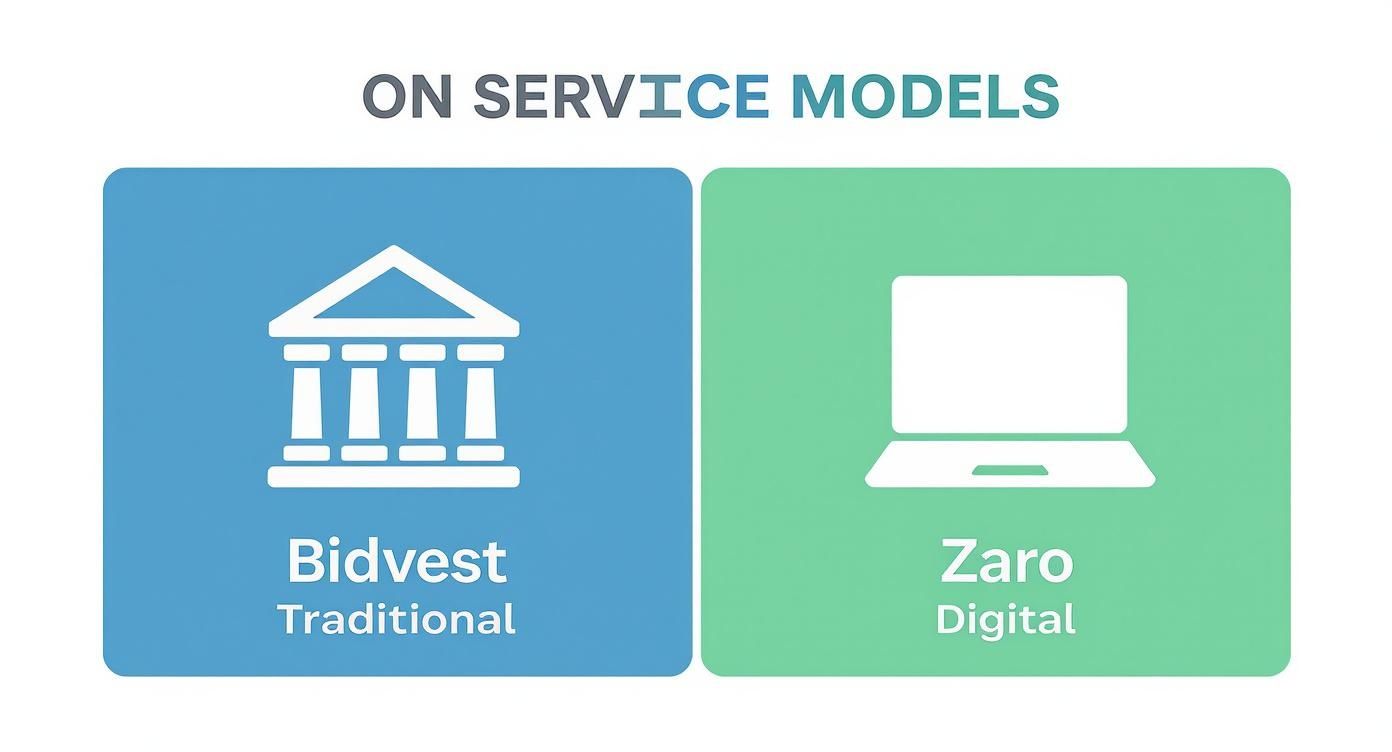
It neatly separates the two worlds: Bidvest's traditional, branch-based model versus Zaro's modern, laptop-driven digital platform.
Pricing and FX Rate Mechanics
The biggest point of difference—and the one that will hit your wallet hardest—is how each provider structures its pricing. Getting your head around this is the key to calculating what your international payments are really costing you.
Bidvest, like most traditional banks, works on a spread-based model. The foreign exchange spread is simply the difference between the wholesale interbank rate (what banks pay to trade currencies with each other) and the retail rate they offer you. That margin is a primary source of their revenue.
On top of the spread, businesses using Bidvest will almost always run into other fees:
- SWIFT Fees: These are charges for using the global SWIFT network that banks rely on to send payment messages. Expect to pay anywhere from R250 to over R700 for each transaction.
- Administration or Commission Fees: This might be a flat fee or a percentage tacked on, just for the service of processing the payment.
- Correspondent Bank Fees: Sometimes, an intermediary bank is needed to get your money from A to B. They’ll often take their own cut, meaning your recipient gets less than you sent.
Zaro’s entire model is built on radical transparency, aiming to strip away these variable costs. They operate with zero spread on the exchange rate. What you see on Google or Reuters is the rate you get. Better yet, Zaro charges no SWIFT fees or hidden admin costs on transfers.
The core financial difference boils down to predictability. With Bidvest, your total cost is a mix of a marked-up exchange rate and a collection of potential fees. With Zaro, the cost is clear and simple, giving you a straightforward view of the transaction without any nasty surprises.
Transaction Speed and Settlement Timelines
How quickly your money arrives isn’t just about convenience. It affects your supplier relationships, project deadlines, and your business's ability to move quickly.
With Bidvest, transactions generally follow standard banking timelines. An international payment sent via the SWIFT network can take anywhere from 2 to 5 business days to land in the beneficiary’s account. This can be stretched out by different time zones, the complexity of correspondent banking networks, and compliance checks at every stop along the way.
Fintech platforms like Zaro, on the other hand, often use more modern payment rails that sidestep the slower, clunkier parts of the traditional system. The result is much faster settlement times. Many payments arrive within 24 to 48 hours, and some routes even allow for same-day delivery. For a business needing to pay international freelancers or settle an urgent supplier invoice, that speed is a huge operational advantage.
Of course, the scale of Bidvest's operations is a testament to its long-standing market power. Back in the day, its annual turnover grew an incredible 80%, from R14.6 billion in 1999 to R26.4 billion in 2000, which shows the phenomenal expansion of its trading and forex divisions. This history proves the company's ability to handle massive financial volumes, something many established businesses still place a high value on. You can read more about the Bidvest Group's financial history.
Onboarding and Compliance Processes
Getting set up with a new forex provider can be a real administrative headache. The onboarding experience you'll have with Bidvest versus Zaro perfectly reflects their different ways of operating.
The process with Bidvest is typically driven by a relationship manager and involves a mountain of paperwork. Businesses have to provide extensive documentation for FICA (Financial Intelligence Centre Act) and KYB (Know Your Business) compliance. This often means in-person visits or getting copies of documents certified, and the whole affair can take several weeks from the day you apply to your first transaction.
By contrast, Zaro offers a fully digital onboarding process. All your KYB and FICA verification is handled online through a secure portal where you upload documents directly. The system is designed for efficiency, with most business accounts verified and ready to go within a few business days—not weeks. This digital-first approach massively reduces the admin burden on your finance team.
Limits and Scalability
As your business grows, so will your international payment needs. You need a forex partner that can grow with you. Both Bidvest and Zaro are set up to handle large-value transactions and high volumes, but their flexibility and approach are quite different.
As a major bank, Bidvest can facilitate very large transactions, often with the personalised support of a relationship manager to guide you through compliance. However, if you need to set up recurring payments or pay multiple suppliers at once (batch payments), it might require some manual work or special arrangements with your manager.
Zaro’s platform was built for scalability right from the start. It handles batch payments with ease, letting you pay hundreds of international suppliers or freelancers in one go. The platform also offers API integration, which is a game-changer for businesses looking to connect their accounting or ERP systems directly to Zaro for a fully automated payment workflow. For high-volume businesses like BPOs or e-commerce platforms, this is crucial for cutting down on manual data entry and boosting efficiency.
Putting It All to the Test: Real-World Scenarios for SA Businesses
Features and fee tables are one thing, but how do these services actually perform when the rubber hits the road? The real value of a foreign exchange provider is only clear when you see how it handles day-to-day business operations.
Let's walk through three common situations South African businesses face. We'll look at a BPO paying its global team, an exporter bringing US dollars home, and a tech startup juggling software subscriptions. These examples show just how much your choice of provider can impact your efficiency, costs, and bottom line.

Scenario 1: The BPO Paying International Freelancers
Picture a Cape Town BPO with a team of 50 freelance contractors spread across Europe and Asia. Each month, the finance team has to send out individual payments, anything from €500 to €3,000. It's a classic high-volume, low-value payment run where every rand and every minute counts.
If they’re using a traditional service like Bidvest Foreign Exchange, the process is a grind. Each of those 50 payments is a separate wire transfer. That means a mountain of admin and a SWIFT fee for every single transaction. If we say the SWIFT fee is R400, that’s an immediate R20,000 hole in their budget before we even talk about the FX spread.
The time cost is just as damaging. The finance team is stuck for hours capturing beneficiary details, chasing approvals, and manually reconciling each payment. That's time they're not spending on strategic financial planning.
Now, let's run that same payment through Zaro, a platform built for exactly this kind of work.
- Batch Payments: The finance team uploads a single spreadsheet with all 50 payments. The system takes care of the rest, turning hours of mind-numbing data entry into a few clicks.
- Cost Savings: With zero SWIFT fees, that R20,000 goes straight back to the bottom line. Plus, by using the real exchange rate with no hidden spread, the total cost of paying their team is drastically lower and, crucially, completely predictable.
- Speed: Payments typically land within 24-48 hours. This keeps their international talent happy and builds the BPO’s reputation as a reliable partner.
Situational Recommendation: For any business doing high-volume, multi-recipient international payments (like BPOs or companies with global contractors), Zaro is a no-brainer. The batch payment feature and fee-free model are tailor-made to eliminate the pain of manual wire transfers, delivering massive savings in both time and money.
Scenario 2: The Exporter Receiving USD Payments
Let's shift to a Durban-based manufacturer exporting to the US. They receive monthly payments of around $100,000, and their main goal is simple: get the most rands possible for their hard-earned dollars.
With Bidvest, the USD payment first lands in a customer foreign currency (CFC) account. When it's time to convert those funds to ZAR, the company gets a rate that includes Bidvest's spread. On a $100,000 transaction, a seemingly small 1.5% spread means $1,500 (roughly R28,000) simply vanishes compared to the mid-market rate.
On top of that, correspondent bank fees are often skimmed off the top before the money even hits the Bidvest account. The amount that lands is already less than what the client sent, making it impossible to accurately forecast revenue.
Using Zaro, the process is clean. The exporter receives the full $100,000 into their Zaro USD account with no intermediary bank deductions. When they decide to convert, they get the live, spot exchange rate with zero spread. The entire $100,000 is converted at the rate they see on the screen, meaning they pocket the full rand value of their export earnings. It's completely transparent and predictable.
Situational Recommendation: For exporters where every basis point counts, Zaro's zero-spread model provides a clear financial edge. The ability to receive and convert funds at the real exchange rate directly translates into higher revenue and much cleaner cash flow forecasting.
Scenario 3: The Tech Startup Paying for SaaS Subscriptions
Finally, think of a Johannesburg tech startup. They rely on a dozen international SaaS tools to run their business, with monthly bills adding up to about $5,000. These are recurring, smaller payments where ease and speed are the top priorities.
Using a corporate card from a provider like Bidvest means every transaction is hit with the bank's daily retail exchange rate, which always has a markup baked in. Reconciliation is a headache, too, with each payment showing up as a separate line item with a different rand value depending on the day's rate. Trying to set up recurring international payments via a traditional bank can also be a painful, paper-heavy affair.
With Zaro, the startup uses a Zaro-issued USD debit card funded directly from their Zaro account. This lets them pay their SaaS bills directly in USD, bypassing exchange rate conversions on every single payment. They can top up their USD account when the rate looks good and then spend from a stable pool of funds. This drastically simplifies their accounting and gives them real control over their currency exposure.
Situational Recommendation: For tech startups or any business managing multiple recurring international payments, Zaro offers far better control and simplicity. Holding and paying directly from a USD account with a debit card removes all the friction and hidden costs of traditional card payments.
Evaluating Security and Regulatory Compliance
When you’re moving serious money across borders, trust is everything. Businesses need total confidence that their funds are secure and that their provider operates under strict regulatory oversight. A traditional bank and a modern fintech might get there differently, but both have to play by the same tough rules.
For many South African businesses, the Bidvest Foreign Exchange name brings an immediate sense of bank-grade security. As a fully licensed banking institution, they are directly supervised by the South African Reserve Bank (SARB). This isn't just a formality; it means they’re held to the same high standards for capital adequacy, anti-money laundering (AML) checks, and consumer protection as any major bank in the country.
Their entire security framework is built on decades of institutional experience. Think time-tested fraud detection systems and secure transaction processing through established channels like SWIFT. For companies used to the old way of doing things, this creates a strong sense of safety grounded in a long track record and a physical presence.
A Modern Approach to Financial Security
Zaro may have a different operating model, but they are just as serious about security and compliance. As a licensed Financial Services Provider (FSP), they also answer to South Africa's financial regulators. The key difference is their security architecture was built from the ground up for a digital world.
This fintech approach puts data protection and user-level security front and centre, using several layers of defence:
- End-to-End Encryption: All your data, whether it’s being sent or just sitting on a server, is encrypted to the highest industry standards. This makes it completely unreadable to anyone without authorisation.
- Multi-Factor Authentication (MFA): Getting into an account requires more than just a password. This simple step adds a crucial barrier against someone trying to gain unauthorised access.
- Segregated Client Funds: Your money is held in special, safeguarded accounts at Tier-1 banks, entirely separate from Zaro’s own operating cash. It's a critical measure to protect client capital.
The real distinction isn't about one being more secure than the other. It’s a difference in philosophy. Bidvest’s security is institutional and built around established processes. Zaro’s is architectural and user-focused, designed with modern data protection in mind.
Navigating the Regulatory Landscape
Both providers must meet strict Know Your Business (KYB) and Financial Intelligence Centre Act (FICA) requirements. There are no shortcuts here.
Bidvest often manages this with a hands-on, document-heavy process handled by their relationship managers. Zaro, on the other hand, leverages a digital system to verify business identities and check all the compliance boxes. This makes the onboarding process quicker without cutting any regulatory corners.
When you're vetting a new forex partner, it's vital to understand how they handle risk. A good guide to compliance risk assessment can give you a deeper look into the frameworks that providers like these are legally required to follow.
In the end, it boils down to what your company is comfortable with. Some leaders will always feel safer with a bank that has been around for decades and has physical branches. Others will find the advanced encryption and digital-first safeguards of a fintech to be a more practical and equally secure solution. Both Bidvest and Zaro offer regulated, secure environments for your international payments—they just take different routes to get there.
Making the Switch: Your Forex Migration Checklist
Changing your primary foreign exchange provider is a big move. It’s not just about finding a better rate; it’s a core operational shift that needs careful planning to avoid any hiccups in your cash flow. Whether you're moving from a traditional bank like Bidvest Foreign Exchange to a fintech platform, or just exploring better options, a solid plan is non-negotiable.
This checklist breaks down the process into practical steps. Think of it as a roadmap to ensure your switch is smooth, organised, and doesn't interrupt the flow of your international payments.
Phase 1: The Pre-Migration Audit
Before you even look at new providers, you need to look inward. The goal here is to build a rock-solid business case for making a change, backed by real data from your own operations.
- Get a True Picture of Your Costs: Pull at least six months' worth of your international transaction statements. For each payment, calculate the effective exchange rate you actually got. Dig into all the fees – the spread, SWIFT charges, and any "admin" costs that sneak in. This gives you a clear baseline of what you're truly paying.
- Map Out the Frustrations: Sit down with your finance team and ask them what’s not working. Are they spending hours processing batch payments? Is it a nightmare to reconcile accounts? Or is it the simple frustration of never knowing exactly where a payment is? These pain points are just as important as the hard costs.
- Define Your Must-Haves: Now, turn those pain points into a checklist of non-negotiables for your next provider. You might need API integration to automate payments, a simple batch upload tool, or multi-user access with different permission levels. Transparent, fee-free pricing should probably be on that list too.
A detailed internal audit is your most powerful tool. It transforms the desire to switch from a vague feeling of "we could be saving money" into a data-backed decision, making it much easier to get buy-in from everyone involved.
Phase 2: Vetting and Onboarding Your New Partner
With a clear list of what you need, you can start assessing potential providers. You’re not just looking for a service; you're looking for a partner that genuinely solves your problems and fits how your business works.
- Insist on a Real-World Demo: Don’t settle for a generic sales pitch. Ask for a live demonstration that walks through your specific scenarios, like paying 50 international contractors at once or receiving funds from a US client.
- Check Their Credentials: Make sure any provider you consider is a licensed Financial Services Provider (FSP). Ask tough questions about their security. How is your data encrypted? How are client funds held and protected?
- Get Onboarded: Once you’ve made a choice, it’s time for the Know Your Business (KYB) process. With modern digital providers, this is usually done online and can be wrapped up in a couple of days. That’s a world away from the weeks of back-and-forth you might be used to.
Phase 3: Implementation and Going Live
The safest way to make the switch is a phased rollout. Running both your old and new systems side-by-side for a short period lets you iron out any wrinkles without bringing your international payments to a halt.
- Run a Parallel Test: Start small. Process a handful of non-urgent payments through the new platform. This gives your team a chance to get comfortable with the new workflow in a low-risk environment.
- Communicate Clearly: Get ahead of any potential confusion by letting your international suppliers and clients know about your new banking details. Give them clear instructions and a firm cut-over date to avoid delayed or misdirected payments.
- Decommission the Old System: Only after you’ve run a few successful payment cycles and are completely confident in the new provider should you formally close your old forex account.
Following this structured approach helps your business move to a more efficient and cost-effective forex solution without the chaos. You minimise the admin headaches and start seeing the benefits in speed and savings right away.
Frequently Asked Questions
When you're weighing up a trusted name like Bidvest against a modern fintech, a few big questions always come to mind. Let's tackle the most common concerns for South African businesses head-on.
Is a Fintech Platform as Secure as a Bank for Large Transactions?
It’s a fair question, and the short answer is yes. The security models are just different. A major institution like Bidvest leans on its deep-rooted institutional framework and time-tested protocols. It's a system built on decades of trust.
A licensed fintech like Zaro, on the other hand, is built from the ground up with digital-first security in mind. This means things like end-to-end encryption and keeping client funds segregated in Tier-1 banks are standard practice, not an afterthought.
Ultimately, both are bound by the same strict SARB and FICA regulations. Your money is protected either way. It really boils down to whether you prefer a traditional, process-driven security model or a modern, technology-led one.
What Are the Main Hidden Costs to Look For?
This is where you can really lose money on international payments. The sneaky costs that eat into your profits are usually found in a few key places with traditional providers:
- The FX Spread: This is simply the markup on the real exchange rate. It might look like a tiny percentage, but on large volumes, it can cost you thousands.
- SWIFT Fees: You'll almost always see a standard fee for sending money through the global banking network. Expect to pay anything from R250 to over R700 for every single payment.
- Correspondent Bank Fees: This is the one most people miss. Intermediary banks that handle the payment along its journey often shave off their own fees, so your recipient ends up with less than you sent.
Key Insight: True cost transparency is the real game-changer here. Modern fintechs are built on the idea of showing you the real exchange rate and eliminating all these variable charges. This makes budgeting and financial planning incredibly straightforward.
How Difficult Is Switching Forex Providers?
Moving from a provider like Bidvest foreign exchange to a digital platform is far less painful than you might think. We’ve all been through traditional bank onboarding—it can take weeks, with mountains of paperwork. Fintechs have turned that whole process digital.
Know Your Business (KYB) and FICA checks are all handled online. This means you can often get an account approved and ready to transact within a couple of business days. A smart approach is to start small. Test the new platform with a few smaller payments before moving everything over. This way, you get a feel for the system without any disruption to your day-to-day operations.
Ready to see how much your business could save by eliminating spreads and SWIFT fees? Zaro offers transparent, fee-free international payments at the real exchange rate. Get started with Zaro today.