Whether you're planning an overseas trip, paying a supplier in the States, or looking to diversify your investments, you'll need to turn your Rands into US Dollars. But buying USD in South Africa isn't just a simple transaction; it means dealing with ever-changing exchange rates and the rules set by the South African Reserve Bank (SARB).
Getting this right comes down to choosing the right partner. Pick the wrong one, and you could lose a significant chunk of your money to hidden fees and poor rates before you even start.
Why You Need a Smart Approach to Buying US Dollars
For many South Africans, exchanging Rands for Dollars feels like a routine financial task. The reality is that it’s a process governed by specific regulations and influenced by global economic shifts that can really sting if you're not prepared.
Knowing what you’re up against is half the battle. Without a clear plan, you risk getting a bad deal and paying far more than you should in administrative costs.
What to Consider Before You Exchange
Before you jump in, it’s crucial to understand the main factors at play. Each one directly affects how many dollars you end up with.
- SARB Rules: The South African Reserve Bank has strict limits on how much foreign currency we can buy. For personal use, your Single Discretionary Allowance (SDA) lets you send up to R1 million abroad each year without needing a tax clearance certificate from SARS.
- The Volatile Exchange Rate: The USD/ZAR rate is always on the move. It can be swayed by anything from our local inflation numbers to political news from overseas. Even a small dip or spike can make a big difference, especially when you're moving a large sum.
- Hidden Fees and Spreads: The rate you see on Google isn't the rate you'll get. Banks and forex providers add a markup to the real exchange rate, which is called the "spread." This is essentially their fee, and when combined with other admin charges, it determines the true cost of your transaction.
Think about it this way: on a R500,000 transfer, a 2% difference in the exchange rate between your bank and a specialist provider could mean you lose out on R10,000. That’s a holiday flight or a serious chunk of your investment gone.
This guide is designed to cut through all that noise. It’s a practical playbook to help you confidently buy US Dollars and make sure you’re getting the most bang for your buck.
Understanding the USD/ZAR Exchange Rate
Before you even think about buying US dollars, it’s crucial to get a handle on why the price you see today will be different tomorrow, or even in the next five minutes. The USD/ZAR exchange rate isn't some fixed price tag; it's a living, breathing number that’s constantly reacting to a whole host of economic pressures, both here at home and thousands of kilometres away.
Think of it as a tug-of-war. On one end, you have the South African Reserve Bank (SARB). If they hike interest rates to get inflation under control, it can make holding Rands more attractive to foreign investors, pulling the currency's value up. On the other end, you have the US Federal Reserve. When they raise their rates, the Dollar suddenly looks like a better bet, and the Rand often takes a knock.
What Really Moves the Needle on the Rand's Value?
It’s never just one thing, but a mix of factors that influence the rate you get on any given day:
- Economic News: Keep an eye on reports about inflation, job numbers, and GDP growth. A surprise announcement of higher-than-expected inflation in South Africa, for example, can spook investors and weaken the Rand almost instantly.
- Global Mood: When there’s instability or uncertainty in the world, big money tends to rush towards "safe-haven" currencies. The US Dollar is the ultimate safe haven, so during a crisis, demand for it skyrockets, pushing its value up against currencies like ours.
- Commodity Prices: South Africa is a powerhouse for commodities like gold and platinum. When the global prices for these metals are strong, our economy benefits, and the Rand usually strengthens along with it.
This isn't just theory—it has a real impact on your wallet. We’ve seen the Rand fluctuate wildly, hitting a high of around 19.93 ZAR per USD during times of economic stress, only to claw back ground when conditions improve. Getting familiar with these patterns can make a huge difference. For a deeper dive, it's worth checking out a detailed history of the USD to ZAR exchange rate on Wise.com.
Paying attention to these drivers helps you move from being a passive buyer—just taking whatever rate you're given—to a savvy one. You start to see the bigger picture, which can help you time your exchange to get more bang for your Rand.
Comparing Your Options for Currency Exchange
Where you decide to buy your US Dollars in South Africa can make or break your budget. It’s not just a simple transaction; the provider you choose directly impacts your bottom line through the rates they offer and the fees they charge. For businesses dealing with regular international payments, these differences can quickly add up to thousands of Rands.
You’ve really got three main paths you can go down, each with its own pros and cons.
Your first thought might be your trusty high-street bank, like FNB, Absa, or Standard Bank. It’s the obvious choice for many. The process feels familiar and secure, as it’s all tied into your existing business banking setup. But that convenience usually comes with a price tag—often in the form of wider exchange rate spreads and a laundry list of admin fees that quietly chip away at your funds.
Finding the Right Provider for Your Needs
Then you have the dedicated forex bureaus you see at airports and in shopping centres. They're great in a pinch, especially if you need a small amount of cash urgently. But let's be honest, their rates are rarely competitive enough for serious business transactions. They’re really geared towards tourists, not a company looking to get the best possible value on a large payment.
The game has changed significantly with the arrival of online forex platforms and specialised fintech companies. Because they operate digitally with lower overheads, they can pass those savings on to you. This translates into much tighter spreads and more transparent fee structures. For your business, that means getting a rate much closer to the real market rate and potentially saving a small fortune on larger transfers.
This simple decision tree can help you visualise when might be the best time to make your purchase.
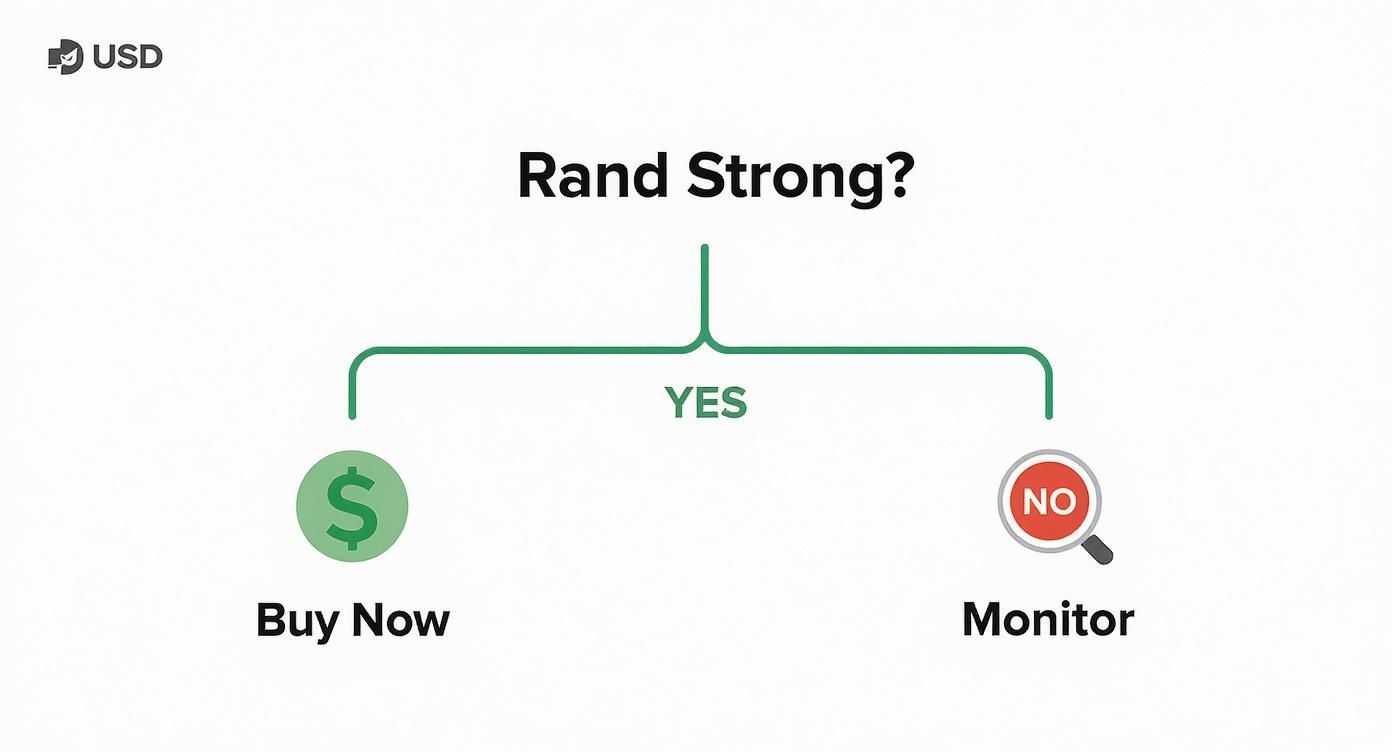
The infographic gets to the heart of a key currency strategy: buying your dollars when the Rand is performing well means you get more bang for your buck.
Always look beyond the headline rate and focus on the effective exchange rate—that's the final amount you get after every single fee and spread has been taken off. A provider might shout about "zero commission," but if their spread is a hefty 2-3%, you're paying a significant hidden cost.
To help you see things clearly, here's a side-by-side look at what each type of provider typically brings to the table.
Comparison of USD Providers in South Africa
This table breaks down the typical features of different foreign exchange providers in South Africa, helping you weigh up the best option for your business needs.
| Provider Type | Typical Exchange Rate Spread | Common Fees | Best For |
|---|---|---|---|
| Traditional Banks | Wide (2% - 5%) | SWIFT fees, admin charges | Convenience and existing relationships |
| Forex Bureaus | Very Wide (3% - 7%) | Often commission-based | Small, urgent cash exchanges |
| Online Platforms | Tight (0.2% - 1%) | Low or no transfer fees | Cost-effective business payments |
As you can see, for any business making regular or sizeable international payments, the tighter spreads offered by online platforms often present the most financially sound choice.
A Practical Checklist for Buying US Dollars
Trying to buy US dollars in South Africa can feel like navigating a maze, but it doesn't have to be that complicated. The secret is breaking it down into a few clear, manageable actions.
Your first move, before you even think about exchange rates, is to get your paperwork in order. This isn't just bureaucratic box-ticking; it’s a strict legal requirement to keep everything compliant with South African financial regulations. Think of it as proving the legitimacy of your transaction, whether you're paying an overseas supplier or booking international travel.
Get Your Documents Ready
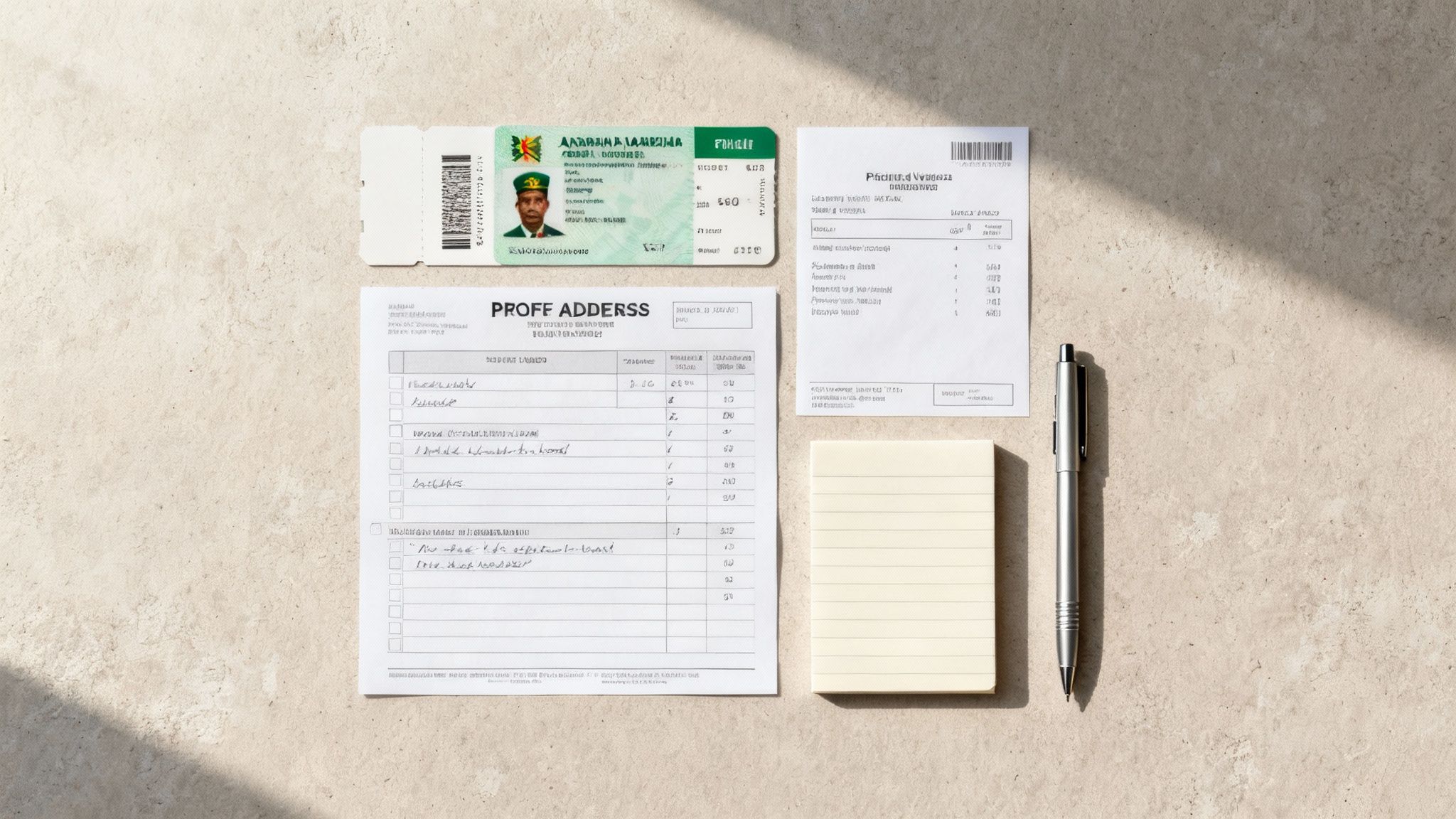
Before you even approach a bank or a forex provider, do yourself a favour and get everything together. Having all your documents on hand from the start saves a massive amount of time and shows that your payment is completely above board.
You’ll typically need:
- Proof of Identity: A certified copy of your green bar-coded ID book, smart ID card, or a valid passport. This is non-negotiable.
- Proof of Address: A utility bill or bank statement from the last three months that clearly shows your business or residential address.
- Supporting Invoices: If it’s a business payment, you’ll need the supplier’s invoice. It must detail the exact USD amount and the beneficiary’s complete banking details.
- Travel Itinerary: Buying dollars for a trip? You’ll need a copy of your flight ticket to use your travel allowance.
The entire process is governed by the South African Reserve Bank (SARB). Individuals can use their single discretionary allowance to send up to R1 million abroad annually. For businesses, the rules are tied to authentic trade activities.
A Quick Tip from Experience: Triple-check the beneficiary's bank details on the invoice. I’ve seen it happen—one wrong digit in an account number and your payment gets rejected. In a worst-case scenario, it ends up in the wrong account, causing headaches, delays, and potential financial loss.
Making the Exchange Happen
With your paperwork sorted, it’s time to actually make the trade. This is where you lock in a rate and get the transfer finalised. For any business dealing with foreign currencies, learning how to open a bank account that can hold multiple currencies can make your life a lot easier in the long run.
Your first step is to get a quote from your provider. Remember, these quotes are live and can change in minutes because the currency market is always moving.
Once you’re happy with the rate and you’ve accepted the quote, you’ll fill out the provider’s application forms. This usually includes a declaration confirming what the funds are for.
After your application is approved, you’ll transfer the ZAR amount into the provider’s account. They then handle the exchange and send the USD on its way to your beneficiary. Always make sure you get a SWIFT copy or some form of payment confirmation for your records—it’s your proof that the transfer is done.
Advanced Strategies to Get the Best Exchange Rate
Once you've got the basics sorted, it’s time to stop just accepting whatever the rate is on the day you need to pay. To really get smart with your money when you buy US dollars in South Africa, you need to think ahead—especially if your business makes regular international payments.
Lock in Your Rate With a Forward Exchange Contract
One of the best tools in your arsenal is a Forward Exchange Contract, or FEC. Think of it as a way to lock in today's exchange rate for a payment you know you'll need to make in the future, whether that's in three months or even six.
Let's say you have a US supplier invoice for $50,000 due in three months. Today's rate is a decent R18.20/USD, but you’ve got a feeling the Rand might weaken by the time payment is due. An FEC lets you secure that R18.20 rate right now. This gives you absolute certainty on your costs, no matter what the market does between now and then.
How to Calculate Your True Cost
The rate you see advertised is almost never the final rate you pay. To make a smart decision, you need to work out the effective exchange rate. This is your all-in cost once every single fee and hidden markup has been added to the bill.
The calculation is straightforward: divide the total ZAR you paid by the total USD you received. That one number cuts through the noise and makes it easy to compare different providers apples-to-apples.
One provider might quote you R18.30 but slap on a R500 admin fee. Another might offer R18.35 with zero fees. The only way to know which deal is actually better for your specific transaction is to calculate the effective rate.
Looking back, the Rand has always been a bit of a rollercoaster against the US Dollar. Between 2020 and 2024 alone, the Rand weakened by nearly 11.1%, shifting from around 16.49 ZAR/USD to 18.33 ZAR/USD. You can dig into historical currency trends on the FRED blog to see this for yourself.
This long-term volatility is exactly why strategies like FECs are so critical. They help you move from being reactive to proactive, protecting your business and its profit margins from the unpredictable swings of the currency market.
Got Questions About Buying US Dollars? We’ve Got Answers
When you're looking to buy US dollars in South Africa, a few questions always pop up. Let's tackle the most common ones we hear from businesses and individuals, so you can move forward with confidence.
How Many Dollars Am I Actually Allowed to Buy?
South African residents have two main avenues for moving money offshore. First, there’s the Single Discretionary Allowance (SDA), which gives you a straightforward R1 million allowance per calendar year. The best part? You don't need to get tax clearance from SARS for this.
If your needs are bigger, you can tap into the Foreign Investment Allowance (FIA). This lets you send up to an additional R10 million offshore annually. The key difference is that for the FIA, you’ll need a valid Tax Compliance Status (TCS) PIN from SARS to prove your tax affairs are in good standing.
Should I Go to My Bank or Use a Forex Specialist?
It's a classic dilemma. While heading to your local bank feels familiar, you'll almost certainly get a better deal from a dedicated forex provider or a modern online platform.
Banks are convenient, sure, but they often build their profit into wider exchange rate spreads and tack on hefty admin fees. In plain English, that means you get fewer dollars for your Rands.
Pro Tip: Don't just look at the advertised rate. Always ask for the "effective exchange rate"—the final rate after all fees and charges are baked in. This one question can expose hidden costs and save you a small fortune.
What Paperwork Do I Need to Buy USD for a Trip?
The documentation is pretty standard, but it pays to be prepared. Whether you're at a bank or a bureau de change, you'll likely need to show:
- Your green bar-coded ID or a valid South African passport.
- Proof of your residential address (a utility bill from the last three months usually works perfectly).
- Your flight ticket or a copy of your travel itinerary as proof of travel.
It's always smart to give your chosen provider a quick call beforehand just to double-check their specific requirements. A five-minute call can save you a lot of hassle.
Can I Keep US Dollars in My South African Bank Account?
Absolutely. Most major banks in South Africa offer what's known as a Foreign Currency Account (FCA).
These accounts are incredibly useful. They let you hold, send, and receive US Dollars without having to convert back and forth to Rand every time. An FCA is a fantastic tool for businesses that deal with international clients or for anyone wanting to hedge against the Rand's volatility.
Ready to simplify your global transactions? With Zaro, you get the real exchange rate with zero spread and no hidden fees. See how much more you can get when you buy US Dollars with us. Learn more and get started today.