If you're looking to send money overseas or handle international business payments, Capitec Bank offers a set of forex services designed to make the process less of a headache. True to its brand, Capitec’s approach aims to simplify foreign exchange for everyday people and small to medium-sized businesses (SMEs).
What Exactly Are Capitec Bank Forex Services?
At its core, Capitec's philosophy for forex is all about stripping away the usual banking complexity. You won’t find a baffling menu of financial instruments. Instead, they offer a handful of focused tools that get the job done, whether you’re sending cash to family living abroad or a small business paying an invoice to a supplier in another country.
This straightforward approach seems to be working. Capitec has become a major player in South Africa's forex scene, especially for businesses and SMEs. They reported a massive 92% growth in forex transactions for the financial year ending February 28, a clear sign that their services are hitting the mark. You can dig into these figures in their annual results overview.
Core Offerings for Different Needs
To really get a feel for what they offer, it helps to break it down by who it's for. Capitec tailors its services for personal and business clients, making sure the right tools are available for the right job.
For individuals, it's all about convenience, with most of the action happening right in their mobile app. This means you can make international payments quickly from your phone without ever stepping into a branch. For businesses, the offering is a bit more comprehensive, with tools to help manage the risks that come with currency fluctuations and to make trade payments more efficient.
The screenshot below from Capitec’s website shows their "Send cash" feature, which is the heart of their international money transfer service for individuals.
As you can see, the interface is clean and simple, reinforcing the bank’s goal of making powerful financial tools accessible to everyone.
Key Takeaway: Capitec’s forex services are built on a simple idea: make sending money internationally just as easy as making a local payment.
To give you a quick snapshot, the table below summarises what Capitec offers, who it's for, and how it's typically used.
Capitec Forex Services at a Glance
| Service | Primary User | Common Use Case |
|---|---|---|
| International Payments (App) | Individuals & Sole Proprietors | Sending money to family, paying for online goods, freelance payments. |
| Business Forex Solutions | Small to Medium Enterprises (SMEs) | Paying international suppliers, receiving export payments, managing currency risk. |
| Foreign Currency Accounts | Businesses with Global Operations | Holding foreign currency to hedge against rate fluctuations or simplify payments. |
This table neatly lays out the main ways Capitec helps its customers navigate the world of foreign exchange.
Sending Money Abroad with Capitec: A Personal Guide

Sending money to family overseas or paying for an online course from a foreign university used to feel like a major task. Capitec has worked hard to change that, aiming to make international payments feel almost as simple as a local EFT. The entire system is built around their mobile app, putting your global finances right in your pocket.
This app-first approach is a game-changer. It cuts out the need for trips to a branch or dealing with stacks of paperwork for most everyday transfers. Everything from setting up a payment to checking its status happens on your phone, making Capitec bank forex services incredibly convenient for personal use.
A Step-by-Step Guide to Sending Money Abroad
When you make an international payment in the Capitec app, it feels like the bank is guiding you by the hand. They've clearly designed the process to be intuitive, walking you through each step to make sure you get all the details right.
Here’s how it typically works:
Start the Payment: First, log into your Capitec app. Head to the "Transact" tab and tap on "International payments," then choose the option to "Make a payment."
Add Recipient Details: You’ll need the person's full name, physical address, and phone number. Getting this spot-on is key to avoiding any hold-ups.
Enter Their Bank Info: This is the critical part. You'll need the recipient's bank account number or their IBAN (International Bank Account Number), plus their bank's SWIFT code. Think of a SWIFT code as an international post code for banks—it's what directs your money to the correct financial institution anywhere in the world.
Set the Amount and Currency: Punch in the amount you want to send. The app handles major currencies like the US Dollar (USD), British Pound (GBP), and the Euro (EUR).
Review and Send: The last screen gives you a final summary of everything: the exchange rate you're getting, the transfer fee, and all the details you've entered. Give it a final check, and once you confirm, your money is on its way.
The Rules of the Road: Regulations and Limits
Whenever you send money out of South Africa, you’re working within the framework set by the South African Reserve Bank (SARB). The main rule for personal transfers is the Single Discretionary Allowance (SDA).
The SDA is your personal allowance. It lets every South African resident send up to R1 million abroad per calendar year for almost any legitimate reason—without needing a tax clearance certificate. This covers gifts, travel, paying for education, and even overseas investments.
Capitec handles the compliance side of this for you. Every international payment you make is automatically logged against your annual R1 million allowance. This is why the app asks for the reason for the payment—it's a mandatory regulatory step to ensure the funds fall under the SDA rules.
What You'll Need to Make a Payment
For most personal transfers that fit within your R1 million SDA, the process is refreshingly simple and light on paperwork.
Just make sure you have this information handy:
- Sufficient Funds: Your account needs to have enough to cover the transfer amount plus Capitec's flat international payment fee of R175.
- Beneficiary's Bank Details: You must have their bank's name and the correct SWIFT code. An incorrect SWIFT code is one of the most common reasons for a payment to fail or be delayed.
- Reason for Payment: You’ll need to select the purpose from a list, like "gift to family" or "payment for online services."
This streamlined approach makes using Capitec bank forex for personal needs incredibly efficient. If you ever needed to send more than your SDA, you'd be looking at a more complex process involving tax clearance certificates. But for the vast majority of people, keeping it under the R1 million limit means you can manage everything quickly and easily right from the app.
How Capitec Helps Businesses Handle Forex
For any South African business dipping its toes into the global market, the opportunity is massive. But so is the risk. The moment you start dealing with international trade, you’re up against a huge variable that can either boost or crush your profits: currency volatility. Capitec Bank has put together a handful of business forex tools aimed at giving you some much-needed control over your international payments.
These aren't complicated financial instruments reserved for massive corporations. They're practical, everyday solutions for real-world business challenges. Maybe you’re an importer paying a supplier in China, or an exporter waiting on a payment from a client in Europe. Either way, getting a handle on these tools is key to protecting your bottom line.
Capitec’s whole approach is about making these services accessible, even for businesses that don't have a big finance team. It’s about shifting from just making a payment to strategically managing your exposure to foreign currency. Let's dig into the main products Capitec offers to get your business ready for the world stage.
Securing Today's Rate with Spot Contracts
Picture this: your business owes a US software supplier an invoice for $10,000. We all know the ZAR/USD exchange rate can swing wildly from one day to the next—sometimes even hour to hour. If you wait a week to pay, a dip in the Rand could mean that $10,000 suddenly costs you thousands more.
This is exactly where a Spot Contract comes in.
It’s the most straightforward forex tool you can get. A Spot Contract lets you lock in the exchange rate right now for a payment that needs to happen immediately (usually settled within two business days). By using one, you completely sidestep the immediate risk of the rate moving against you.
What you get is certainty. You know precisely how much that transaction will cost in Rands, which makes your cash flow planning far more reliable and protects the profit margin on that deal. It’s the perfect solution for any urgent, one-off international payment.
Locking in Future Rates with Forward Exchange Contracts
Okay, now let's look at another common situation. Your company has just ordered a shipment of raw materials from Germany and you’ve agreed to pay the supplier €50,000 in three months. A lot can happen to the ZAR/EUR rate in 90 days. If the Rand weakens over that period, your cost of goods could shoot up and wipe out your entire profit.
This is the exact headache a Forward Exchange Contract (FEC) is built to solve. An FEC lets you lock in an exchange rate today for a payment that will only happen on a set date in the future.
Think of an FEC as an insurance policy against currency risk. You and Capitec agree on a rate now, guaranteeing you’ll get that exact rate in three months, no matter what the market does between now and then.
This takes all the guesswork and risk out of your future-dated payments. You can price your own products with confidence, knowing your import costs are fixed. For any business that imports or exports on delayed payment terms, FECs are an absolute must-have for financial stability.
Managing Foreign Currency with Customer Foreign Currency Accounts
What if your business is in a position where you both receive payments in US Dollars and also have to pay suppliers in US Dollars? Constantly converting USD to ZAR, only to have to convert ZAR back to USD a week later, is a massive waste. Every single conversion comes with fees and exposes you to rate movements.
A Customer Foreign Currency (CFC) Account is a far more elegant solution. It’s an account that lets your business hold foreign currency—like USD or EUR—directly with Capitec. When you get paid by an international client, the money lands straight in your CFC account in its original currency.
You can then use those funds to pay your own international suppliers without ever touching Rands. This gives you a few major advantages:
- Reduced Conversion Costs: You slash the number of forex transactions you have to make, which means saving on fees and not losing money on the buy/sell spread each time.
- Natural Hedging: You have a built-in, or "natural," hedge against currency swings. If you hold USD to cover your USD expenses, what the ZAR/USD rate is doing has far less impact on your day-to-day operations.
- Simplified Operations: It just makes managing your international cash flow so much cleaner and more direct.
To help you decide which tool fits your needs, here's a quick comparison of these three core products.
Comparing Capitec Business Forex Products
This table breaks down the main business forex solutions from Capitec, showing you what each one is best for and how it helps manage risk.
| Product | Best For | Key Feature | Risk Management Level |
|---|---|---|---|
| Spot Contract | Immediate, one-off payments and receipts. | Secures the current exchange rate for a transaction settled within two days. | Low (Eliminates immediate risk) |
| Forward Exchange Contract (FEC) | Future-dated payments and receipts. | Locks in an exchange rate today for a transaction up to 12 months in the future. | High (Protects against future volatility) |
| Customer Foreign Currency (CFC) Account | Businesses with regular foreign income and expenses. | Allows you to hold and transact in foreign currencies without converting to ZAR. | Medium (Provides a natural hedge) |
By getting comfortable with these Capitec bank forex tools, South African businesses can step onto the global stage with much more confidence and control. They help turn the chaotic world of foreign exchange into a predictable part of your business plan.
Understanding Capitec's Forex Rates, Fees, and Limits
When you’re moving money across borders, the number that catches your eye is usually the transfer fee. But the real cost, the one that often goes unnoticed, is buried in the exchange rate. Getting a handle on how Capitec’s forex rates, fees, and limits work is crucial to making sure you aren't paying more than you need to.
The Hidden Cost: It's All in the Exchange Rate
Think of it like buying fruit from a farmer versus buying it at a fancy grocery store. The farmer has a base price (this is the mid-market rate in the forex world), but the store adds its own markup to cover costs and make a profit. You end up paying the store's retail price.
Foreign exchange works the same way. The mid-market rate is the ‘true’ exchange rate that banks use when they trade massive amounts of currency with each other. It’s the rate you’ll see on Google or Reuters. But the rate you, the customer, get from Capitec (or any bank) will have a small margin added on top. This is called the exchange rate spread, and it's essentially a hidden fee.
The big takeaway here is that the exchange rate itself is a fee. A few cents difference on the rate might not sound like much, but on a large transfer, it can easily add up to hundreds or even thousands of Rands.
For instance, if the mid-market rate for the Rand to the US Dollar is R18.50, a bank might sell you dollars at R18.70 or buy them from you at R18.30. That 20-cent difference on either side is their spread. Multiply that by a transfer of a few thousand dollars, and you can see how quickly it becomes a significant cost.
Capitec's Forex Fees: Simple and Straightforward
One of Capitec’s strengths is its transparent fee structure for the actual transaction. You know exactly what you’re paying for the service itself, which is a big plus.
Here’s a quick breakdown of their standard fees:
- Sending Money Overseas: You’ll pay a flat fee of R175.00 for any outgoing international payment made through the app. It doesn’t matter if you’re sending R1,000 or R100,000; the fee stays the same.
- Receiving Money from Abroad: For incoming payments, a fixed fee of R50.00 is deducted from the amount you receive.
This fixed-fee model is great for budgeting, especially for smaller amounts. Just keep in mind that sometimes other banks in the global SWIFT network might take a small fee while the money is in transit. It’s a standard industry practice, but something to be aware of.
Staying Within the Lines: Transaction and Regulatory Limits
When you use Capitec bank forex services, you’re not just dealing with the bank’s rules; you also have to follow the regulations set by the South African Reserve Bank (SARB). These limits are in place to manage the flow of money in and out of the country.
For Individuals:
- Single Discretionary Allowance (SDA): Every South African resident gets an annual allowance of R1 million. You can send this amount abroad each calendar year for any legal reason without needing to get a tax clearance certificate from SARS. Capitec handles the reporting for you.
- Foreign Investment Allowance (FIA): Need to send more? You can use your FIA to send an additional R10 million offshore per year. For this, you’ll need a Tax Compliance Status (TCS) PIN from SARS. Capitec’s forex team can guide you through this process.
For Businesses:
Business payments work a bit differently. They aren't tied to a simple annual allowance but are based on the reason for the payment.
- Trade Payments: If you’re paying for imported goods or services, you’ll need the proper documents, like a commercial invoice. As long as the transaction is legitimate and you have the paperwork to prove it, there isn’t a specific upper limit.
- Balance of Payments (BOP) Reporting: Every business transaction has to be categorised correctly for SARB. Capitec’s system is designed to help you choose the right category, ensuring you stay compliant.
Getting to grips with these rates, fees, and limits is the first real step to managing your international payments smartly. While Capitec offers the convenience of a simple, fixed fee, remember the total cost is always a mix of that visible fee and the spread tucked away in the exchange rate.
Choosing Between Capitec and Forex Alternatives
Picking the right service for your international payments is a bigger deal than you might think. Do you stick with your familiar bank, like Capitec, or explore a specialised forex provider? The answer can seriously affect your costs, the transfer speed, and your overall stress levels. It’s not about finding one "best" option for everything, but about knowing which tool is right for the job at hand.
For anyone already banking with Capitec, the convenience is a huge plus. Being able to handle Capitec bank forex transactions right inside the app you use every day is undeniably simple. There are no new accounts to create or platforms to learn. You just log in, make the payment, and you're done. This seamless integration is perfect for those occasional, straightforward personal transfers where you just want to get it done without any fuss.
But that convenience can come at a price. While Capitec has a simple, flat fee, the total cost of your transfer is also shaped by the exchange rate spread. This is the gap between the mid-market rate (the "real" rate you see on Google) and the rate you actually get. It's how most banks build in their profit, and it can be a significant—and often hidden—cost.
Comparing Key Factors
When you're weighing your options, it really comes down to what matters most to you. Is it the comfort of an all-in-one banking app, or are you after the lowest possible cost and total transparency?
Here’s a breakdown of what you should be looking at:
- Rate Transparency: Capitec, like most banks, typically adds a markup to its exchange rate. In contrast, modern fintechs like Zaro give you the mid-market rate with zero spread, making it crystal clear what you're paying.
- Fees: Capitec’s flat R175 fee for sending money is easy to understand. Specialised services might have different fee models, but they often cut out other hidden costs, like SWIFT network fees, which can sometimes chip away at the amount your recipient gets.
- Transfer Speed: Capitec transfers usually take between 2 to 5 business days through the SWIFT network. Some alternatives can get your money there faster by using more modern payment systems.
- User Experience: Capitec’s app is built for simplicity and familiarity. Fintech platforms, however, are often designed specifically for forex, offering better tracking, multi-user access for businesses, and more specialised support.
This infographic gives a great visual summary of what personal and business users should think about when looking at Capitec's forex costs.
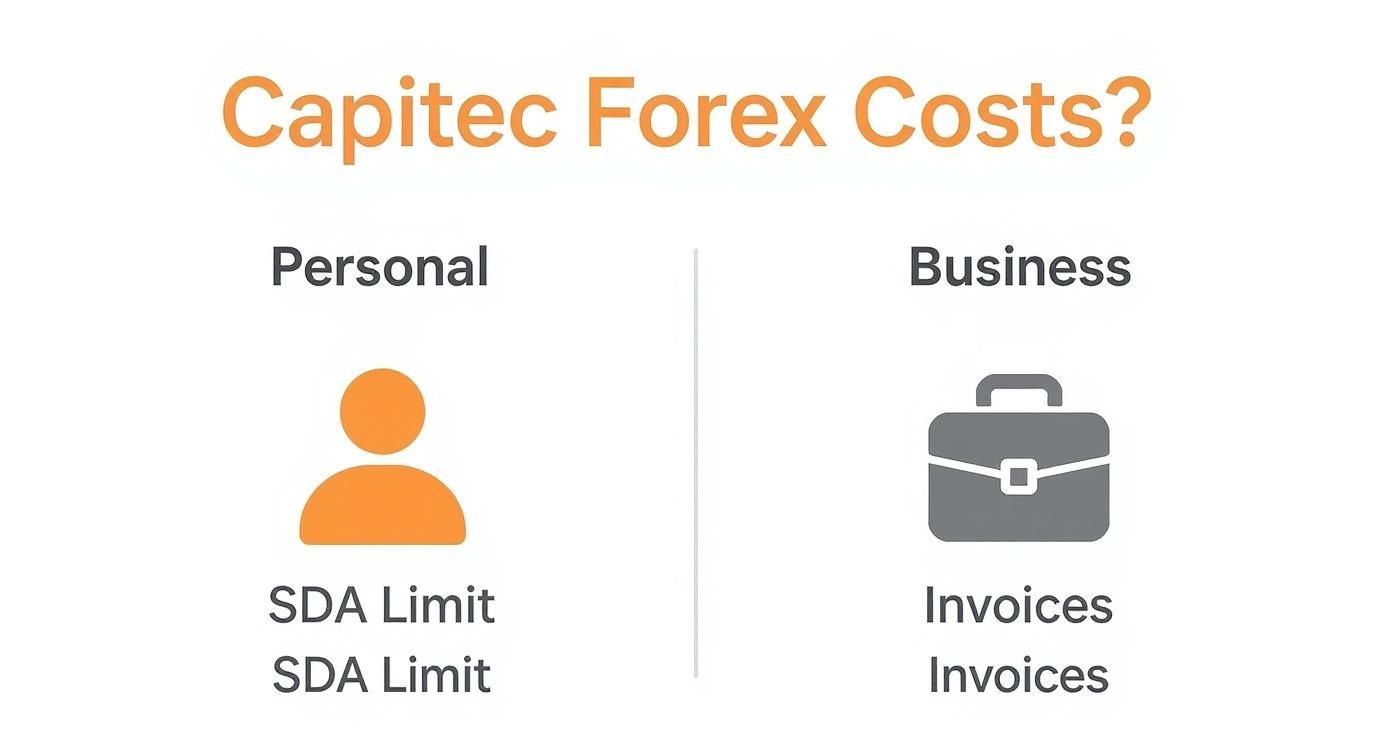
As you can see, while compliance is a must for everyone, the main concerns are different. Personal users are often focused on their allowance limits, whereas businesses need to make documented, trade-related payments.
When to Stick with Capitec
So, when does using your Capitec bank forex service make the most sense? There are a few situations where its strengths really come through.
If you're an existing Capitec customer sending a relatively small, non-urgent personal payment, the convenience of using the app you already know is tough to beat. The process is quick, familiar, and doesn't require any extra effort.
This is especially true for things like:
- Sending a one-off birthday gift to a relative overseas.
- Paying for an online course or a small purchase from an international store.
- Any time where ease-of-use is more important than squeezing every last cent out of the exchange rate.
When to Consider an Alternative Like Zaro
On the flip side, if your main goal is to get the absolute most value out of your transaction, it’s smart to look at specialised alternatives. This is especially true for businesses or individuals making larger or more frequent payments.
A platform like Zaro was built to solve the classic problems with traditional forex. By giving you access to the real mid-market exchange rate with no markup, it offers complete transparency. You see the true cost upfront—a massive advantage for businesses trying to protect their profit margins on international invoices.
You should consider an alternative when:
- You're a business paying international suppliers and need to know your costs with certainty.
- You frequently send large amounts of money and don’t want to lose a chunk of it to the exchange rate spread.
- You need business-focused features like multi-user permissions or detailed financial controls.
At the end of the day, the choice is yours. Capitec offers a solid and incredibly convenient service for its customers. But for anyone focused on cutting costs and getting full transparency, checking out a dedicated fintech solution could lead to some serious savings and give you more powerful tools to manage your global payments.
Your Capitec Forex Questions, Answered
Diving into foreign exchange can feel a bit overwhelming, and it's natural to have questions. To make sure you're comfortable and clear on the process, we've gathered the most common queries about using Capitec bank forex services. This is your go-to spot for those last-minute details before you send or receive money.
What Documents Do I Need for an International Payment?
For most day-to-day personal transfers, Capitec keeps it simple. If you're sending money that falls within your R1 million Single Discretionary Allowance (SDA), all you typically need is your South African ID and to state the reason for the payment right inside the app. It’s designed to be a hassle-free process.
Things change a bit for larger amounts or business payments. If you go beyond the SDA limit or are transacting for your business, you'll need to provide some paperwork. This usually means an invoice or other official documents that the South African Reserve Bank (SARB) requires to confirm the payment is legitimate. Don't worry, the Capitec app will guide you and let you know exactly what’s needed for your specific transfer.
How Long Does a Capitec International Transfer Take?
When sending money across borders, a little patience goes a long way. A standard international payment with Capitec typically takes between 2 to 5 business days to land in the recipient's account. Keep in mind that this can shift slightly based on the destination country and any public holidays they might have.
Capitec sends money through the global SWIFT network, which is the standard for most banks. Because this network often involves other banks along the way (called intermediary banks), it can sometimes add a day or two to the total time. You can track your payment's journey and see status updates directly in the Capitec app.
Key Insight: That 2-5 day window isn't just a Capitec thing; it's the industry standard for SWIFT transfers. Your money is hopping between different banking systems, which explains the processing time.
Can I Receive Money from Overseas into My Capitec Account?
Yes, you certainly can. Getting international payments into your Capitec Global One account is straightforward. To make sure the process is smooth, you just need to give the sender a few crucial details.
Here's what the person sending you money will need:
- Your full name exactly as it appears on your Capitec account.
- Your 10-digit Capitec account number.
- Capitec's SWIFT code: CABLZAJJ.
Once the money arrives in South Africa, Capitec will pop you a notification. You'll then need to log into the app and fill out a quick declaration about why you're receiving the funds. This is a mandatory regulatory step, and the money will be released into your account as soon as you’ve done it.
Does Capitec Offer a Dedicated Forex Card for Travel?
Right now, Capitec doesn't have a separate prepaid forex or travel card. But that doesn't mean you're stuck when you travel! Your everyday Capitec Global One debit or credit card works perfectly fine for international use.
You can use your card to pay at tills or withdraw cash from ATMs pretty much anywhere in the world. A really good tip is to let Capitec know your travel dates before you leave. This simple step helps their fraud-detection systems recognise your transactions as legitimate, preventing your card from being unexpectedly blocked while you're enjoying your trip. It's also a good idea to check their international transaction fees so you know what to expect.
For South African businesses looking for more control, better rates, and total transparency, Zaro is a powerful alternative. You can sidestep the hidden markups and get the real mid-market exchange rate on all your international payments.
Learn more at https://www.usezaro.com.