Sending money across borders can feel like a headache waiting to happen, but it doesn't have to be. Think of the Capitec foreign exchange service as a direct bridge from your ZAR bank account to someone else's in a different currency. It’s built right into the Capitec app, letting you send money out of South Africa or receive it from overseas without a fuss.
How Capitec Foreign Exchange Really Works
At its heart, Capitec's forex service is a secure way to swap your South African Rands for another currency—like US Dollars, British Pounds, or Euros—and get it where it needs to go. It's a bit like ordering a product online; you specify the currency you need, and Capitec handles all the tricky logistics to deliver it to the right person or business.
This comes in handy more often than you'd think. Maybe you're paying for an online course from a UK university, helping out family back in Zimbabwe, or you're a freelancer getting paid by a client in the States. For all these situations, Capitec steps in to handle the currency conversion and the actual transfer, all from the app on your phone.
Key Functions of the Service
What you're really doing is tapping into a regulated system that knows how to move your money correctly through the maze of global banking networks. Capitec basically takes care of the complicated stuff for you.
Here's a simple breakdown of what the service lets you do:
- Send International Payments: Pay for goods, cover service fees, or just send cash to friends and family abroad, straight from your Capitec account.
- Receive International Payments: The service gives you the details (like a SWIFT code) that people overseas need to send foreign currency directly to you.
- Manage Currency Conversion: When you send money, the app does the math for you, converting your ZAR into the recipient's currency based on whatever the exchange rate is that day.
The whole point is to take the mystery out of cross-border payments. By building this feature into the app you already use, Capitec removes the need to stand in a queue at a branch for most international transfers.
What You Need to Get Started
Before you even think about hitting 'send', you need to get some details from the person you're paying. Getting this right from the start is the single best way to avoid delays or, worse, a rejected payment that could cost you money. A little prep work goes a long way.
Make sure you have these details on hand:
- The recipient’s full name and their physical address.
- Their bank account number or IBAN (International Bank Account Number).
- The full name and address of their bank.
- Their bank's SWIFT/BIC code—this is like an international post code that directs money to the exact right bank.
Once you've got this information lined up, you're all set to look at the actual steps and costs.
The True Cost of Sending Money with Capitec
When you’re sending money overseas with Capitec, it’s easy to focus on the upfront transfer fee. But that’s only one part of the story. The total cost is actually made up of a few different components, and understanding them is the key to knowing exactly how much you're paying.
Let's break down the two main costs you’ll encounter: the obvious one and the one that’s a bit more subtle.
The first is the transfer fee. This is the straightforward admin charge Capitec takes for handling the transaction. It's easy to spot. The second, and often bigger, cost is the exchange rate markup, which isn’t always as clear.
The Hidden Cost in the Exchange Rate
Ever heard of the mid-market rate? Think of it as the 'real' exchange rate—the one you see on Google or financial news sites. It’s the wholesale rate banks use to trade currencies with each other. But it's almost never the rate you, the customer, actually get.
Instead, most banks add a small percentage on top of this rate. This is the exchange rate markup, and it’s how they make a profit on the currency conversion.
This infographic shows some of the most common reasons South Africans send money abroad, from paying for a child's education to supporting family members back home.
No matter the reason, every single one of these transfers is affected by the exchange rate you’re offered.
Key Takeaway: The exchange rate markup means the rate you get is always slightly less favourable than the mid-market rate. It might only be a few cents on the rand, but on larger transfers, that small difference can add up to a significant amount of money.
This practice is standard for most banks, including Capitec. If you want to dive deeper into how their rates stack up, it's worth exploring the different forex options available in South Africa to see the full picture.
How Markups Impact Your Transfer
Let's make this real. Say you need to send ZAR 20,000 to a family member studying in the United Kingdom.
Here’s a hypothetical look at how the costs could break down:
Capitec Forex Cost Breakdown Example (Sending ZAR 20,000)
| Cost Component | Description | Example Cost |
|---|---|---|
| Upfront Transfer Fee | The flat fee Capitec charges to process the payment. | R160 |
| Exchange Rate Markup | The difference between the mid-market rate (e.g., R23/£1) and the rate you get (e.g., R23.50/£1). | R425.53 (lost value) |
| Total Cost | The combined total of the fee and the hidden cost from the markup. | R585.53 |
In this scenario, over R400 is lost simply due to the less favourable exchange rate. It's a "hidden" cost because it’s not listed as a separate fee—it’s just baked into the rate itself. That's money that never even leaves the country.
Watch Out for Intermediary Bank Fees
Just when you think you’ve got all the costs figured out, there’s one more potential fee to keep on your radar: intermediary bank fees.
Sometimes, your money doesn’t travel directly from Capitec to the recipient's bank. If it’s going to a less common destination, it might have to pass through one or more 'middle-man' banks along the way. These intermediary banks often take their own processing fee right out of the money being transferred.
This means the amount that finally lands in your recipient's account could be even less than you calculated. It’s an unwelcome surprise for everyone. So, when you're planning your transfer, it's a smart move to ask if any intermediary fees are likely to apply.
A Step-by-Step Guide to International Payments
Sending money overseas with the Capitec app for the first time might seem daunting, but it’s actually quite straightforward. Once you have the recipient's details handy, the app walks you through the process, helping you avoid those easy-to-make mistakes. Let's break down exactly how it works.
It's clear that easy-to-use digital forex is something South Africans are embracing. Between March and August 2025 alone, Capitec clients made a staggering 1.9 million international card payments. That's a 24% jump from the year before, showing just how much we're relying on these tools for everything from paying for services abroad to sending money to family. You can read more about these payment trends on Capitec's blog.
Locating the Forex Feature
First, you need to navigate to the right spot in the app. It's tucked away under the main transaction hub.
- Open your Capitec app and log in.
- From the home screen, tap the Transact button.
- Scroll down until you see the International section.
- Tap on Pay an international beneficiary to get started.
This is your launchpad for every international transfer you'll make.
Adding a New Recipient
Before any money can be sent, you have to add the person or business you’re paying as a beneficiary. This is where attention to detail is non-negotiable. A single wrong number can send your money on a wild goose chase or get the payment flat-out rejected.
- Enter Personal Details: You’ll need to type in the recipient’s full name and their physical address. Make sure this matches what their bank has on file for them.
- Input Banking Information: This is the most crucial step. You'll need their account number (or IBAN for Europe and other regions), the name of their bank, and the bank’s SWIFT/BIC code.
Think of a SWIFT/BIC code like an international postal code for a bank. It’s a unique identifier that tells the global banking system exactly which financial institution to route your money to. Without the right one, your payment is essentially lost in transit.
The app’s interface is designed to make adding these details as painless as possible, prompting you for the right information at the right time.
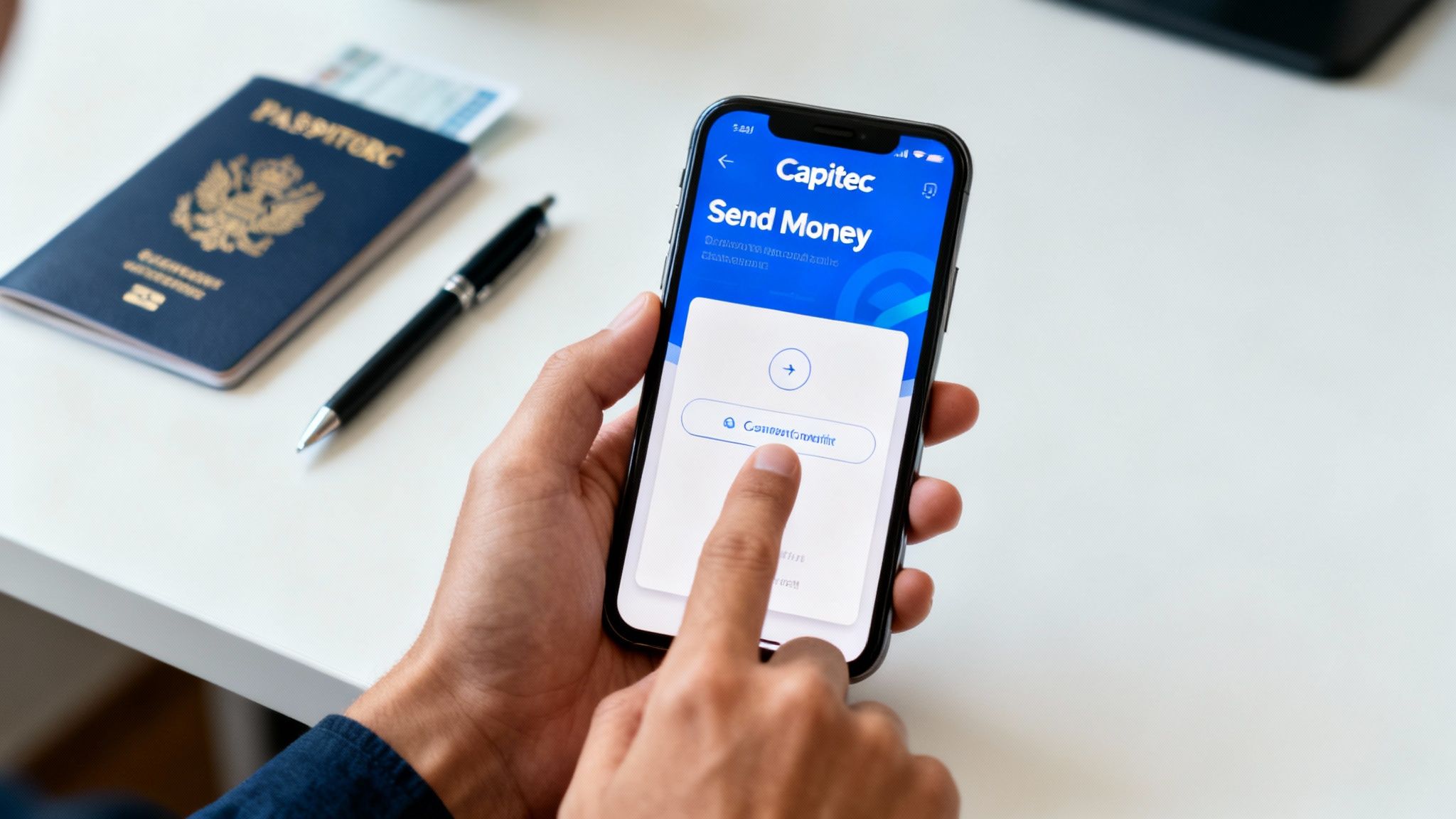
As you can see, the layout guides you step-by-step, which really helps minimise the chances of a typo when you're setting up a new payment.
Finalising and Confirming Your Payment
With your beneficiary saved, you're ready to send the funds. You can either enter the ZAR amount you want to send or specify the exact foreign currency amount you want the recipient to receive. Capitec will then show you the live exchange rate and the total cost, including their fee.
Take a moment to review everything one last time—the name, account number, and the final amount. Once you hit confirm, the payment is on its way, and you'll get a confirmation. It's a good idea to understand what is a transaction ID, as this unique reference number is your key to tracking the payment if there are any hiccups.
After your final approval, the money enters the global SWIFT network. From there, you can expect it to land in the recipient's account within 3 to 7 business days, though this can vary depending on the destination country and any intermediary banks involved in the process.
Receiving Money from Overseas into Your Account
Getting paid from another country is a bit different from sending money out. Instead of you doing the work, the sender needs a very specific set of instructions from you to make sure the funds land safely in your Capitec account.
Think of it like giving someone directions to your house. If you get a street name wrong or forget the house number, they’ll get lost. It's the same with international payments; one small mistake can send the money on a detour.
The Essential Information to Share
To avoid any frustrating delays, you need to give the sender a clear checklist of your banking details. This information is non-negotiable—it’s how the international banking system pinpoints your specific account among millions of others.
Here’s exactly what the person sending you money will need:
- Your Full Name and Address: Make sure this matches what’s on your Capitec account perfectly. No nicknames or old addresses.
- Your Capitec Account Number: Double-check this before you send it.
- Capitec Bank's SWIFT Code: For Capitec, the code is CABLZAJJ. This is the key that tells the global banking network to route the funds to Capitec here in South Africa.
- Capitec Bank's Full Name and Address: Capitec Bank Limited, 5 Neutron Road, Techno Park, Stellenbosch, 7600.
Getting this right the first time is the single best thing you can do for a smooth transfer.
Understanding the Mandatory Reporting Mandate
Once the sender has done their part, there’s one final, crucial step you need to take. South African regulations require that every single incoming international payment is "cleared" by the person receiving it. This is done by completing what’s called a reporting mandate.
This is basically a declaration you make to the South African Reserve Bank (SARB) through Capitec. You’ll state the reason for the funds—is it payment for freelance work, a gift from family, or something else? It’s a legal requirement to help track foreign currency coming into the country.
Don't skip this step! The reporting mandate is not optional. Capitec will hold your money and won’t release it into your account until you’ve completed the declaration.
The good news is that Capitec has made this really straightforward. You’ll get a notification on the app as soon as the funds arrive. Just follow the prompts, declare the reason for the payment, and the money will be cleared and pop into your account. The quicker you do it, the quicker you get your cash.
Navigating South Africa's Forex Allowances

Sending money out of South Africa isn't as straightforward as a local EFT. The whole process is governed by the South African Reserve Bank (SARB), which has a set of rules called exchange controls to manage how much capital leaves the country.
You can think of it as a national budget for foreign currency. The SARB decides how much money individuals can legally move abroad each year. This is split into two main allowances, each with a specific purpose and its own limit.
Getting a handle on these allowances is crucial before you even think about a Capitec foreign exchange transaction. As a licensed dealer, Capitec is legally bound to make sure your payment plays by the SARB's rules. Knowing them yourself will just make everything go that much smoother.
Your R1 Million Discretionary Allowance
First up is the one most people use: the Single Discretionary Allowance (SDA). Every South African resident over the age of 18 gets an annual allowance of R1 million to send abroad. The best part? You don't need any special tax clearance for it.
This allowance is meant for your personal use and covers a whole host of common scenarios, such as:
- Sending a cash gift to family living overseas
- Paying for your holiday accommodation abroad
- Donating to an international charity
- Making alimony or child maintenance payments
The SDA is your go-to for pretty much all everyday international payments. It resets every calendar year, from January to December, so you get a fresh R1 million allowance to work with annually.
The R10 Million Investment Allowance
What if you need to send a much larger amount for an investment? That's where the Foreign Investment Allowance (FIA) comes in. This lets you move up to an additional R10 million out of the country each calendar year.
But there’s a catch. Unlike the easy-to-use SDA, the FIA requires you to be in good standing with the taxman. To tap into this allowance, you first need to apply for a Tax Compliance Status (TCS) PIN directly from SARS. This PIN is essentially SARS giving you the green light, confirming your tax affairs are all in order.
This allowance is specifically for big-ticket items like buying property overseas or investing in foreign stock markets. As an Authorised Foreign Exchange Dealer, Capitec is equipped to handle these larger, more complex transfers. Beyond personal payments, the bank also provides services for businesses trading internationally. You can get more details about how Capitec supports business forex needs on their website.
Capitec vs. Modern Fintech Alternatives
Not so long ago, your bank was your only real option for sending money overseas. But that's changed. The financial world has been shaken up by a new breed of tech-focused companies, and they’ve completely rewritten the rules for international payments. So, when you put Capitec’s forex service side-by-side with these newcomers, what you choose really comes down to what matters most to you.
With Capitec, you get the comfort of the familiar. It’s all handled through the banking app you already know and trust, with the backing and security of a major South African bank. There’s a lot to be said for that kind of convenience, especially if you like having all your finances in one place. The process feels straightforward because it follows the banking rules we’ve all grown up with.
Where Fintechs Pull Ahead
Fintech platforms like Wise or our own Zaro, on the other hand, were born to do things differently. They saw the old system was slow and expensive, and they built their entire businesses around fixing it. They typically shine in three key areas.
- The Real Cost: Fintechs are often radically transparent about their pricing. Many use the real mid-market exchange rate (the one you see on Google) and just add a small, clearly stated fee. This can often work out much cheaper than the bundled-in costs and rate markups common with traditional banks.
- Speed is Everything: Instead of relying on the decades-old SWIFT network, these platforms use smarter, modern payment rails. The result? Your money can arrive in hours, sometimes even minutes, not days.
- A Smoother Ride: Built from scratch for a digital world, their apps and websites are usually incredibly slick and easy to use. Their sole focus is getting your money from A to B with the least amount of fuss.
The biggest difference comes down to focus. For a traditional bank, forex is just one of many products they offer. For a fintech, making international transfers cheap, fast, and easy is their entire reason for being.
This doesn't mean one is automatically better. A bank like Capitec offers a reliable, all-in-one financial home. Fintechs offer a specialised service that’s often faster and more cost-effective.
To see how these two approaches stack up at a glance, here’s a quick comparison.
Capitec vs. Fintech Forex Services: A Quick Comparison
| Feature | Capitec Bank | Fintech Platforms (e.g., Wise, Zaro) |
|---|---|---|
| Exchange Rate | Typically includes a markup over the mid-market rate. | Often uses the mid-market rate for maximum transparency. |
| Fees | A single transfer fee, but the full cost is in the rate. | A small, upfront, and transparent transfer fee. |
| Transfer Speed | Usually 1-3 business days via the SWIFT network. | Can be anywhere from minutes to a few hours. |
| Convenience | Integrated into your existing banking app. | Requires a separate app and account setup. |
| User Experience | A familiar but often more traditional banking interface. | Modern, streamlined, and designed for ease of use. |
| Trust Factor | High, backed by a major, regulated banking institution. | Varies; look for established, regulated platforms. |
Ultimately, there's no single "best" choice for everyone. The right service really depends on what you need for a specific transfer. If you're sending a large, non-urgent payment and prefer the security of your main bank, Capitec is a solid choice. But if you need to send money quickly and want to squeeze every last Rand out of the exchange rate, a fintech is probably your best bet.
For those wanting a broader view of how different financial services compare, you might want to explore various investment platform comparisons to understand the landscape better.
Got Questions? We’ve Got Answers
When you’re dealing with international money transfers, a few questions are bound to pop up. Let's tackle some of the most common ones about using Capitec's foreign exchange service.
What is Capitec Bank’s SWIFT Code?
The SWIFT code for Capitec is CABLZAJJ.
Think of it as a global address for the bank. You’ll need to give this code to anyone sending you money from an overseas account to make sure the funds find their way to Capitec in South Africa without a hitch.
How Long Does a Capitec International Payment Usually Take?
You can generally expect the money to land in the recipient's account within three to seven business days.
Keep in mind that this isn't set in stone. The final timing can be influenced by a few things, like the destination country, how quickly the receiving bank processes payments, and whether other banks are involved along the way.
Can I Use Capitec for My Business’s Forex Needs?
Absolutely. Capitec offers foreign exchange services for business clients, particularly those involved in importing and exporting. They provide tools like spot contracts to lock in exchange rates and other solutions geared for trade.
For the full rundown, it’s best to connect directly with Capitec’s business banking team.
Is There a Limit on How Much Money I Can Send Abroad?
Yes, there are limits, which are governed by South Africa's exchange control regulations.
As an individual, you have a Single Discretionary Allowance of up to R1 million per calendar year. The good news is you don’t need a tax clearance certificate from SARS to use this allowance.
For businesses looking for a smarter way to handle international payments—one without hidden markups or hefty SWIFT fees—Zaro offers the real exchange rate. See how you can improve your company's global transactions at https://www.usezaro.com.