If you're using your Capitec card for international payments, you'll come across a bit of a mixed bag when it comes to fees. The good news? Capitec has scrapped the currency conversion fee for card swipes at shops or online, which is a massive win for travellers.
But it's not all free. If you're pulling cash from an international ATM or sending money overseas, you'll definitely run into some Capitec foreign exchange fees. Getting a handle on these is crucial to keeping your costs down.
Getting to Grips with Capitec's Foreign Exchange Fees
Trying to figure out foreign exchange can sometimes feel like you're aiming at a moving target. There are all sorts of fees and rates flying around, and they’re not always straightforward. Before we get into the nitty-gritty of exchange rate spreads and transfer costs, let's start with a simple, high-level look. This quick breakdown will give you a solid footing for understanding exactly what you're paying.
Think of what follows as your go-to cheat sheet. It separates the different kinds of international transactions and points out the main costs tied to each one. Knowing this stuff upfront is the best way to avoid nasty surprises on your bank statement down the line.
Capitec International Transaction Fee Summary
Here’s a quick overview of the main fees for using your Capitec card for international payments and ATM withdrawals.
| Transaction Type | Fee Applied | Key Detail |
|---|---|---|
| International Card Payments | No currency conversion fee | You only pay the amount converted at the day's exchange rate. |
| International ATM Withdrawal | Fixed withdrawal fee | A flat fee is charged every time you take out cash outside South Africa. |
| Sending Money Overseas | Fixed transfer fee (R175) | This applies when you initiate an outgoing payment to another country. |
| Receiving Money from Abroad | Fixed receiving fee (R50) | You'll pay this for any incoming international payments to your account. |
This table lays out the basics, giving you a clear picture of the fee structure at a glance.
Just by familiarising yourself with this simple breakdown, you can start making smarter financial moves. For instance, knowing that card swipes are free of conversion fees makes them a much cheaper option than constantly withdrawing small amounts of cash from an international ATM. That one simple choice can save you a surprising amount of money over the course of a trip.
The Hidden Costs of Foreign Exchange Explained
When dealing with foreign currency, it's easy to focus on the upfront transaction fee. But that's only one piece of the puzzle. The real cost—and often the biggest one—is cleverly tucked away inside the exchange rate you’re given. Getting a handle on this is the first real step to managing your Capitec foreign exchange fees and making sure your money is working for you, not against you.
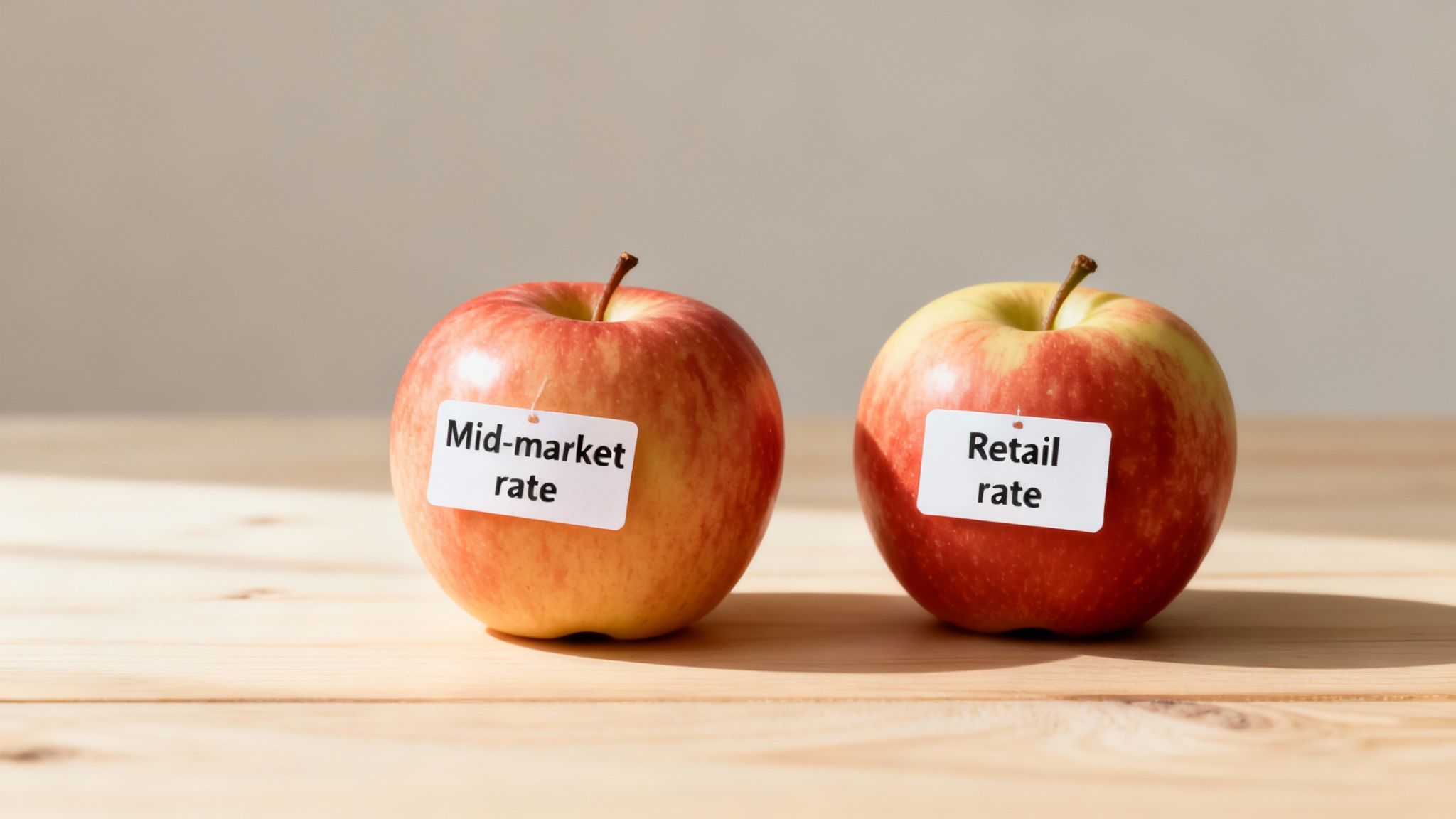
Think of it like buying apples from a farm. The farmer has a wholesale price, but the grocery store sells them to you for a bit more. That difference covers the store's costs and, of course, their profit. Foreign exchange operates on the exact same principle.
Unpacking the Exchange Rate Spread
In the world of currency, that "farmer's price" is what we call the mid-market rate. This is the genuine, raw exchange rate banks use when they trade massive amounts of currency with each other. It’s the perfect midpoint between what buyers want to pay and what sellers are asking for.
But that’s not the rate you or I get. We’re offered the "retail rate," which is the mid-market rate with the bank's markup added on top. This markup has a name: the exchange rate spread. It’s how the bank makes its money on the conversion.
The spread is essentially a hidden fee. It won't show up as a separate line item on your statement. Instead, it’s baked into the exchange rate, which means you always get a little less foreign currency for your Rands than you might expect.
How Capitec Calculates Your Rate
So, when you swipe your Capitec card overseas or send money to another country, the rate you get already includes this spread. Even if a transaction boasts no "currency conversion fee," the cost is still there, just built into the rate itself.
To get the full picture of these expenses, it helps to look at how financial fees are structured in general, like in this payment processing fees comparison. This kind of breakdown shows how different costs are often layered together.
Let’s quickly recap the total cost:
- Transaction Fee: The obvious, flat fee you’re charged for a service (like a wire transfer).
- Exchange Rate Spread: The hidden markup on the currency's true value.
This means the final Rand amount that comes off your account is always the item’s price converted at Capitec’s less favourable retail rate. For international payments, it’s the amount sent, converted at their retail rate, plus any fixed fees. You have to account for both to know what you’re really paying.
Tapping Your Capitec Card Overseas: What You Need to Know
One of the biggest anxieties for any traveller is figuring out the real cost of spending money abroad. You tap your card for a coffee, and wonder what mysterious fees are being added behind the scenes. Most banks slap on a "currency conversion fee"—a percentage of your purchase—every single time you pay. This is where Capitec has seriously shaken things up for South Africans.
Capitec has done away with this fee entirely for point-of-sale payments. That means when you're paying for a meal in a restaurant, buying a souvenir, or even shopping online in a foreign currency, there's no extra percentage-based fee. The price you see on the card machine is what gets converted to Rand at that day's exchange rate. Simple as that.
It’s a straightforward approach that takes the guesswork out of your holiday budget. You can use your card for small, everyday things without the nagging feeling that you’re paying a penalty for the convenience.
How Much Do Zero Conversion Fees Actually Save You?
This isn't just a small perk; it’s a policy that has a massive real-world impact and has changed how Capitec clients spend their money overseas. People are clearly more confident using their cards now that the fee structure is so transparent.
The numbers speak for themselves. Between March and August, Capitec customers made an incredible 1.9 million international card payments. That's a 24% jump from the previous year, with total spending hitting R1 billion in just six months.
But here’s the most important number: by scrapping that single currency-conversion fee, Capitec saved its clients a massive R25 million during that period. This really shows the financial power of understanding Capitec foreign exchange fees. You can find out more about this boom in international travel and its impact.
What Does This Mean for Your Travel Budget?
This policy makes your Capitec card one of the most useful tools you can pack for an international trip. If you lean on card payments instead of constantly withdrawing cash, you can dodge a whole layer of typical banking fees.
Let's quickly sum up the advantages:
- No penalty for small buys: You're not getting hit with extra charges on small, everyday purchases.
- Clearer budgeting: The final Rand amount is much more predictable. You only have to factor in the exchange rate spread, not an extra fee on top.
- Better security: Paying by card is almost always safer than carrying around wads of foreign currency.
At the end of the day, while the bank's exchange rate spread is still part of the equation (as it is with every bank), not having that specific conversion fee on purchases makes a real, tangible difference. It lets your travel money stretch further, putting more of it towards your actual experiences instead of bank admin.
Breaking Down Capitec International Money Transfer Costs
While tapping your Capitec card abroad is surprisingly straightforward, sending a chunk of money overseas is a different kettle of fish. It follows a more traditional banking path, which means you'll encounter a specific set of costs. Getting to grips with these is crucial if you want to understand the true price of your international transfer.
When you send money from South Africa with Capitec, the total cost isn't just one number. It's actually a combination of two things: a simple, flat fee and the much sneakier exchange rate spread we touched on earlier.
The following overview gives you a sense of just how much international payment volumes have grown for Capitec, showing that more and more South Africans are moving money across borders.

This surge in overseas transactions really drives home why it’s so important to have a clear picture of the fees involved. Without it, you could be losing money unnecessarily.
The Fixed Transfer Fee
Capitec keeps this part simple. For every single international payment you send out, they charge a flat fee of R175. Think of it as an administrative cost for getting your money from A to B.
It doesn't matter if you're sending R1,000 or R100,000—that R175 fee stays the same. This means it hits smaller, frequent transfers a lot harder. On a small amount, that fixed fee represents a much bigger slice of the pie.
Real-World Example: Sending R10,000 to the UK
Let's make this real. Imagine your business needs to send R10,000 to a supplier in the United Kingdom. How do the costs actually stack up?
First, we have to look at the exchange rate. The real rate you see on Google or XE.com (the mid-market rate) might be R22.50 to £1. But Capitec won’t give you that rate. They’ll offer their own retail rate, which has their margin baked in. Let's say their rate for the day is R23.00 to £1. That R0.50 difference is where the bank makes its money.
Here’s how the costs break down, step-by-step:
- The Hidden Spread Cost: If you could get the real rate, your R10,000 would convert to £444.44 (R10,000 / 22.50). But with Capitec's rate, you only get £434.78 (R10,000 / 23.00). The difference of £9.66—worth about R222—is the cost of the spread. It’s a fee, just not one they advertise.
- The Upfront Fee: Next, you add the non-negotiable R175 fixed transfer fee.
- The Total Cost: Add the two together. Your total cost is the R222 from the spread plus the R175 fee, which comes to R397.
So, to send R10,000, you’re actually paying nearly R400 in total costs. Your recipient gets £434.78, and almost 4% of the money you sent vanishes into fees and currency conversion margins.
This little example shows why just looking at the advertised Capitec foreign exchange fees of R175 is only half the story. More often than not, it’s the exchange rate spread that quietly does the most damage to your bottom line.
How Capitec Stacks Up Against Fintech Alternatives
While using your familiar high-street bank like Capitec feels safe and convenient, the world of international payments has been completely turned on its head by new, specialised providers. For a South African business, knowing the difference isn't just interesting—it's essential for protecting your bottom line.
Think of it this way: fintech companies like Zaro were built for one reason and one reason only: to make sending money across borders cheaper, faster, and way more transparent. They don't have the massive overheads of traditional banks, so they can pass those savings on.
Banks, including Capitec, have a long-established model. They charge a fixed fee for the service, but they also build a profit margin, or spread, into the exchange rate they offer you. As we've already seen, this two-part structure means the final cost is often much higher than the simple transfer fee you see advertised.
Fintechs came along and asked a simple question: what if we just got rid of the hidden spread? They give you the real exchange rate—the one you see on Google or Reuters—and charge a small, upfront fee for their service. It’s a completely different approach, one that prioritises transparency over hidden costs.
A Head-to-Head Cost Breakdown
Let's put some real numbers to this. We'll go back to our example of sending R10,000 to a supplier in the UK and see how the costs might look side-by-side.
The key takeaway here is that the total cost is always a combination of the transfer fee and the money you lose in the exchange rate spread. It’s that second part where the big savings are usually hiding.
The table below breaks it down, showing you not just the fees but, more importantly, how much foreign currency actually lands in your supplier's account. That final number is the only one that truly matters.
Cost Comparison Sending R10,000 to the UK
| Feature | Capitec | Low-Cost Alternative (e.g., Zaro) |
|---|---|---|
| Exchange Rate Offered | Retail rate with spread (e.g., R23.00/£1) | Real mid-market rate (e.g., R22.50/£1) |
| Upfront Transfer Fee | R175 (Fixed) | Varies (often a small percentage) |
| Hidden Spread Cost | Approx. R222 | R0 (No spread) |
| Total Cost | ~R397 (R175 fee + R222 spread) | Varies, but significantly lower |
| Recipient Receives | ~£434.78 | ~£444.44 (minus a small, clear fee) |
The numbers speak for themselves. The fintech route gets more money to your supplier, plain and simple.
By eliminating the exchange rate spread, you’re putting hundreds of Rands back into your business with every single payment. If you’re paying international invoices regularly, those savings multiply quickly over a year, potentially adding up to a very significant amount. It really comes down to a choice between what's familiar versus what's most cost-effective for your business.
Practical Ways to Cut Down Your Forex Costs
Knowing the fees is one thing, but actually putting that knowledge to work is what will save you money. With a few smart moves, you can actively shrink the bite that Capitec foreign exchange fees and other costs take out of your international transactions. It all comes down to being strategic about how and when you move your money.
Simple tweaks to your habits can lead to big savings over time. Whether you're constantly on the road or a business paying overseas invoices, these practical tips will help your Rands go much further.
Avoid the Dynamic Currency Conversion Trap
Ever been abroad and the card machine asks if you want to "Pay in ZAR?" Your answer should always be a firm "no." This is a sneaky feature called Dynamic Currency Conversion (DCC). While it seems helpful to see the cost in a currency you know, it comes with a terrible exchange rate set by the merchant's bank, not yours.
By choosing to pay in the local currency (like Euros, Dollars, or Pounds), you let your own bank handle the conversion. Their rate is almost always better, and this single choice can save you up to 5-7% on every single purchase.
Plan Your Transfers Strategically
Capitec charges a flat R175 for every international transfer. This makes sending small, frequent amounts really inefficient, as that fixed fee gobbles up a bigger chunk of a smaller payment.
- Bundle Your Payments: Instead of sending R2,000 every week, think about sending R8,000 once a month. You'll pay that R175 fee just once, not four times.
- Shop Around: For large or regular payments, it's always worth comparing the total cost (the fee plus the exchange rate spread) from Capitec against a fintech alternative. The savings from a better rate can easily make up for any perceived inconvenience.
Of course, these tips work best when you have a solid grasp of your finances. Properly and effectively tracking all your business expenses gives you the clear picture you need to spot and cut hidden costs like forex markups. It’s about understanding your complete financial situation, which allows you to make smarter, more cost-effective decisions for your business on the global stage.
Got Questions? We've Got Answers
Stepping into the world of foreign exchange can feel a bit like learning a new language. Let's clear up some of the most common questions you might have about using your Capitec account for international payments and transfers.
Does Capitec Charge for International Card Swipes?
Good news on this front. Capitec has scrapped the currency conversion fee for point-of-sale transactions, which means when you pay at a shop or checkout online.
This is a pretty big deal. You'll only pay the amount converted at that day's exchange rate. While that rate still includes the bank's built-in spread, you aren't hit with an additional percentage-based fee on top of your purchase.
What’s the Difference Between Capitec’s Rate and the “Real” Rate?
You’ve probably seen a great exchange rate on Google and wondered why it never matches what the bank gives you. That rate you see online is the mid-market rate – think of it as the wholesale price of a currency, right at the midpoint between what buyers and sellers are offering on the global market.
Banks, Capitec included, don't offer this rate to us. Instead, they add a small margin or "spread" to it. This means the rate you get is always a little less favourable, and that difference is how the bank makes its profit on the conversion.
Essentially, the rate you see on Google isn't the rate you get from the bank. Always factor in this hidden spread when calculating the true cost of your Capitec foreign exchange fees.
Is It Cheaper to Withdraw Cash or Pay with My Card Abroad?
It's almost always cheaper to pay directly with your Capitec card. Why? Because those card payments don't have any extra conversion fees tacked on.
On the other hand, pulling cash from an international ATM comes with a double hit. You’ll be charged a fixed withdrawal fee from Capitec, and often, the local ATM operator will add their own fee on top of that. If you want to keep your costs down, your best bet is to minimise ATM withdrawals and use your card for payments wherever you can.
Ready to eliminate hidden spreads and unpredictable fees from your international business payments? Zaro offers South African businesses access to real exchange rates with zero markup. See how much you can save on your next international transfer by visiting https://www.usezaro.com.