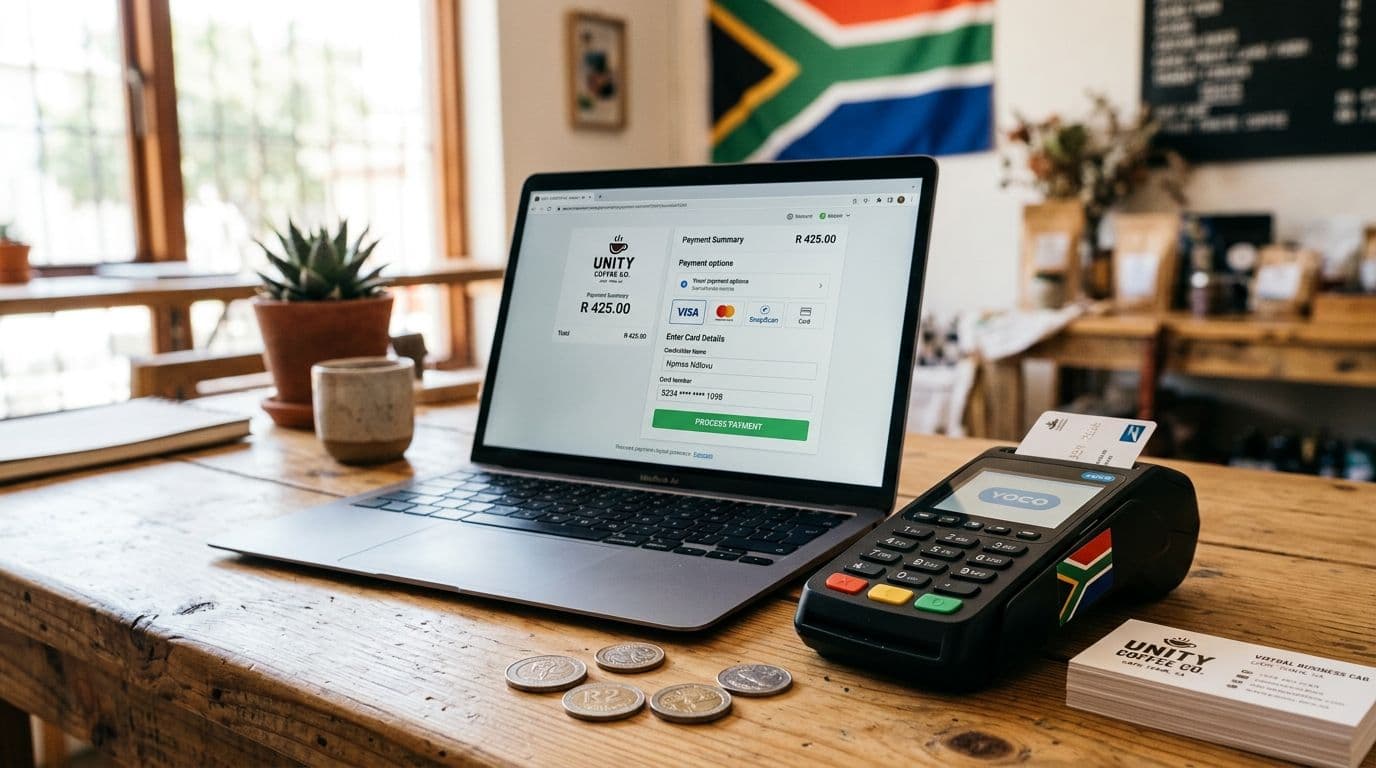
You send an invoice to a client in London or New York. They pay by card. The sale looks clean on paper, and the customer experience is smooth. Then the money lands short.
Not because the customer paid less. Because your provider, your bank, the card scheme, and the conversion path each took a slice somewhere between authorisation and settlement. For many South African SMEs, that's a significant problem with card acceptance. The advertised transaction rate is only one part of the bill.
Generic guides usually stop at “accept cards online and in store”. That advice is fine for a local café. It's weak advice for an exporter, a BPO, a digital agency, or a software business billing foreign clients. If you sell across borders, your payment setup affects margin, cash flow, reconciliation, and how quickly you can reuse cash in the business. That's why card payment solutions for small business need to be assessed as a finance decision, not just a checkout decision.
Why Your Card Payment Strategy Matters More Than Ever
A lot of owners only notice payments when something breaks. A payout arrives late. A refund is harder than expected. A foreign card transaction settles at a worse rate than finance had budgeted for. Suddenly, the payment provider isn't just back-office plumbing. It's shaping profitability.
That problem is easier to ignore when most sales are local. It becomes expensive when your business starts serving foreign customers, charging retainers, collecting deposits remotely, or running recurring billing. Card acceptance then moves from convenience feature to commercial infrastructure.
South Africa's card environment is already substantial. The country's payment card market was measured at about US$105.41 billion in 2024 and was projected to reach US$146.75 billion by 2029 at a 6.86% CAGR, according to GoCardless' payment solution overview. The practical takeaway isn't just market size. It's that cards are now a mainstream channel, and small shifts in fee structure can have a real effect on margins.

What changes when you sell beyond South Africa
A local retailer can often compare providers on terminal cost, domestic transaction fees, and settlement timing. An export-focused SME has a longer checklist.
You need to know:
- Where FX happens: Is conversion happening at checkout, at settlement, or later through your bank?
- Who controls pricing: Does the processor show the conversion logic clearly, or bury it inside a blended cost?
- How fast funds move: Delayed settlement changes working capital planning.
- What happens on refunds and disputes: Cross-border reversals are rarely as simple as the original sale.
Practical rule: If your provider can explain the headline transaction fee but can't clearly explain foreign settlement, you don't yet know your real cost of acceptance.
Why this matters to small businesses in practice
The businesses that get this right usually do two things well. They offer customers an easy way to pay, and they keep finance in control of what those payments cost. The businesses that get it wrong often optimise for setup speed and only discover the hidden charges after they've scaled.
That's why the best card payment solutions for small business aren't always the ones with the lowest advertised rate. They're the ones that fit how you sell, where your buyers are, and how your cash returns to South Africa.
The Four Key Types of Card Payment Solutions
Most SMEs don't need “a payment system”. They need the right mix of tools for different sales moments. A walk-in customer, an online buyer, and a foreign client paying after a proposal is approved don't all need the same flow.
A useful way to think about it is this: one tool captures the payment in person, another handles checkout online, another lets you charge remotely without building a full ecommerce stack, and another helps you spend for the business itself. Cards sit on both sides of the ledger. You accept them from customers, and you also use them to run operations.
A 2023 FedPayments study found that 63% of small businesses used cards for business payments, which shows how central cards have become for paying suppliers, buying services, and managing cash flow, as noted in PlainsCapital's summary of payment processing benefits.

POS terminals
A POS terminal is the counter-side tool most owners recognise first. It's the card machine in a shop, office, pop-up stand, or front desk. If your sales happen face to face, this is your first acceptance layer.
Think of it as the cashier's control point. It reads the card, triggers authorisation, and connects the sale to your receipt and till workflow. For South African SMEs, this matters in retail, hospitality, healthcare practices, and field sales.
What works well:
- Fast in-person checkout: Good for customer flow and lower friction.
- Operational simplicity: Staff can learn it quickly if the interface is clean.
- Better fit for physical trading: Useful where customers expect tap-and-go payment.
What doesn't:
- Weak remote flexibility: It doesn't solve invoiced or international remote collections on its own.
- Hidden complexity later: If the terminal isn't linked cleanly to accounting and stock systems, reconciliation becomes manual.
Online payment gateways
A payment gateway is the secure bridge between your website or invoicing page and the banking network. If someone buys through your site, this is the part handling secure card data transmission and authorisation.
For an export business, the gateway is often where small technical decisions become commercial ones. Currency display, fraud screening, recurring billing support, and checkout flow all influence conversion and operational effort.
Virtual terminals
A virtual terminal lets your team enter card details manually through a secure web-based interface. It's useful for phone orders, deposits, service retainers, and businesses that invoice first and collect later.
This is common in professional services, travel, clinics, and B2B support environments where the sale doesn't always happen inside a shopping cart. It's convenient, but it needs careful permissions, process discipline, and fraud controls because manual entry changes the risk profile.
A virtual terminal solves a workflow problem, not a strategy problem. If too much revenue depends on manual card entry, you may need a better billing process rather than a bigger payment tool.
Issued business cards
The fourth category gets overlooked in payment discussions. Issued business cards are cards your business uses to pay for subscriptions, travel, digital advertising, software, and overseas suppliers. They aren't customer acceptance tools, but they're part of your broader card strategy.
If you're evaluating B2B card payment solutions, it helps to view acceptance and spending together. A finance team that collects internationally by card and also pays foreign vendors by card needs visibility across both directions of cash movement.
Understanding the True Cost of Accepting Card Payments
The most expensive payment setups are often the ones that look simple at the start. A provider advertises an easy flat fee. You sign up quickly. The dashboard looks polished. Then finance starts asking why two similar transactions settle at noticeably different net values.
That happens because card pricing is layered. There's the network cost, the processor markup, the acceptance channel, and for cross-border activity, the extra cost of currency conversion and timing. If you only compare headline rates, you're comparing the wrong thing.
The three pricing models you'll see most often
Think of card pricing like freight quotes.
A flat-rate model is the all-in quote. It's easy to understand, but you don't see what sits underneath. A tiered model groups transactions into buckets decided by the provider. It can look competitive, but the logic is often opaque. Interchange-plus is closer to an itemised bill. You see the underlying network cost plus the provider's markup.
Expert small-business guidance points to interchange-plus as the stronger option for transparency because it exposes the true network cost plus a fixed markup instead of hiding fees in a blended rate, as explained in Wise's guide to cheaper payment processing.
| Pricing Model | How It Works | Best For | Transparency |
|---|---|---|---|
| Flat-rate | One published fee across many transactions | Very small businesses that value simplicity over detailed cost control | Low |
| Tiered | Transactions are sorted into pricing bands by the provider | Businesses that accept a narrow, predictable card mix and have strong contract clarity | Low to medium |
| Interchange-plus | Network cost is shown separately, with a fixed provider markup added | SMEs that want real cost visibility, especially with mixed domestic and cross-border card activity | High |
What providers often leave out
The problem isn't only the pricing model. It's what gets excluded from the sales conversation.
Watch for these cost layers:
- FX conversion spread: The difference between a clean market rate and the rate applied when foreign funds are converted.
- Scheme and cross-border charges: These may sit outside the neat marketing rate.
- Settlement timing costs: Slow payout isn't just an inconvenience. It can force the business to fund payroll, stock, or suppliers from elsewhere.
- Refund and dispute handling: These costs are operational as much as financial.
For SMEs that deal with card-not-present transactions and foreign clients, disputes can subtly erode margin. Teams reviewing processor options should also understand strategies to protect revenue from disputes, because the cheapest acceptance setup can become expensive if chargeback handling is poor.
What transparent pricing looks like in the real world
A transparent provider should be able to answer simple questions in plain language:
- Which fees are fixed and which vary by card type?
- What changes when the card is foreign-issued?
- When exactly does FX conversion happen?
- How will this appear in reporting and reconciliation?
If the answers are vague, the pricing isn't really transparent.
The right way to assess card payment solutions for small business is to calculate the total landed cost of a foreign card payment in your bank account, not just the cost of authorising it at checkout.
How to Choose the Right Payment Solution for Your Export Business
For an exporter, consultant, agency, SaaS company, or BPO, “best payment provider” is the wrong starting question. The better question is: which setup gives me the cleanest path from foreign customer payment to usable cash in my business account?
That shift matters because international card payments create extra friction points. The customer sees one payment experience. Your finance team sees another. They deal with FX conversion, delayed settlements, mismatched references, manual reconciliation, and reporting gaps.

The most useful benchmark here is not domestic merchant pricing. It's end-to-end cost control. For South African exporters, the key issue many generic guides miss is the full cost stack, including FX conversion, scheme fees, and settlement delays, all of which can materially change profitability in a managed payments environment, as discussed in IXOPAY's analysis of credit card processors for small businesses.
Start with the settlement path
Before comparing features, map what happens after a customer pays.
Ask the provider:
- Can you settle in the transaction currency, or only after conversion?
- If conversion happens, who sets the rate and where is it disclosed?
- Do settlement reports clearly separate processing fees from FX-related costs?
- How are refunds handled if the original payment was in a foreign currency?
If a provider can't answer those in a detailed way, it's not a strong export solution.
Prioritise finance visibility over checkout cosmetics
Many platforms look strong in demo mode. They offer sleek checkouts, branded payment pages, and easy plugin integrations. Those things matter. They just shouldn't outrank finance controls.
Your shortlist should favour providers that support:
- Multi-currency acceptance: Useful when buyers expect to pay in familiar currencies.
- Clear reconciliation data: Your finance team shouldn't need spreadsheet detective work to match settlements to invoices.
- Integration with existing tools: Xero, Sage, ERP systems, CRM billing workflows, and your ecommerce stack all matter.
- Role-based access: Operations, finance, and management often need different permissions.
The best provider for an export SME is often the one that makes month-end boring. Clean reporting beats flashy onboarding every time.
Check fraud tooling, but keep it proportional
Cross-border card payments carry a different risk profile from local in-person transactions. You need fraud tools, but you also need judgement. Heavy-handed controls can reduce successful sales just as surely as weak controls can increase losses.
Look for a balance:
- Address and device checks where relevant
- Rules for higher-risk transactions
- Manual review workflows for unusual payments
- Clear alerting for suspicious activity
Later in the evaluation, this walkthrough may help broaden your comparison of Wand Websites on payment solutions, especially if you're assessing how ecommerce setup decisions interact with the processor you choose.
A short explainer can help if your team needs a visual overview before supplier calls:
Choose by use case, not by category
Different export models need different tools.
A design agency billing overseas retainers may do best with remote invoicing and stored-card workflows. A product company shipping internationally may need a stronger checkout gateway with currency display and fraud screening. A BPO might need recurring billing, payment links, and very clean reconciliation to customer accounts.
That's why card payment solutions for small business should be selected around revenue pattern, client geography, finance process, and cash reuse, not just around “online payments” as a generic requirement.
A Step-by-Step Checklist for Adopting a New Payment System
Switching providers feels risky because payments touch everything. Sales, operations, support, finance, and compliance all get involved. The safest rollout isn't the fastest one. It's the one with the fewest unknowns on go-live day.
The implementation side is also where many SMEs underestimate the work. Card acceptance needs more than a login and a checkout button. The setup requires a merchant account, a payment gateway, and PCI-DSS compliance to protect cardholder information through the transaction flow, as outlined in HoneyBook's payment processing guide.

Step 1 to Step 3 before you sign
Start with business reality, not provider marketing.
Assess how customers typically pay Separate in-person, online, invoice-based, and foreign-client flows. If one provider can't handle your key revenue path well, it's the wrong fit even if pricing looks attractive.
Prepare for onboarding and KYB checks
Have company registration documents, director information, bank details, and trading information ready. Cross-border processing often brings closer scrutiny, so delays here are normal.Map the reporting you need
Decide what finance must see daily and monthly. Gross transaction value, fees, refunds, settlement references, and customer identifiers should be easy to export and audit.
Step 4 and Step 5 during setup
Once approved, implementation becomes a process discipline exercise.
- Connect the acquiring stack carefully: Your gateway, checkout or POS layer, and merchant account need to be aligned. Don't assume default settings match your business model.
- Test end-to-end scenarios: Run successful payments, failed payments, refunds, duplicate attempts, and staff permission checks.
- Confirm customer messaging: Payment pages, invoice templates, and support replies should explain accepted methods and expected settlement or refund behaviour clearly.
- Train the team by role: Sales needs to know how to send payment links. Finance needs reports. Support needs scripts for failed authorisations and refunds.
A payment rollout usually fails in the gaps between teams, not in the software itself.
Step 6 after go-live
The first month matters more than the launch day.
Monitor:
- Settlement accuracy: Check whether actual payout values match what was expected.
- Failed transaction patterns: A spike may indicate configuration or fraud-rule problems.
- Refund turnaround: Slow reversals damage trust quickly.
- Reconciliation effort: If finance still needs too much manual work, the setup isn't finished.
Keep a short issue log. Most payment implementations reveal process problems that were already there. The new system just makes them visible.
Beyond Payments Optimising Your International Cash Flow
The strongest payment setup doesn't only accept money well. It helps you decide which money should arrive by card in the first place.
For many South African SMEs, the core question isn't limited to which processor to use. It's when cards make sense versus local bank transfer, EFT, or cross-border collection methods. That trade-off matters because cards can improve conversion and customer convenience, but they can also add fees and chargeback exposure in B2B and export receivables, a point raised in The Small Business Expo's guide to credit card processing.
Think in payment mix, not payment silo
A practical finance model usually looks like this:
- Use cards where speed and customer convenience matter most
- Use bank-based rails where invoice value is larger and cost sensitivity is higher
- Use clear internal rules for refunds, disputes, and FX handling
- Review the total path from sale to usable cash, not just checkout conversion
That's the shift many SMEs need. Payments aren't just a sales tool. They're part of working-capital management.
If you treat card acceptance as a standalone feature, you'll optimise for convenience and miss the cost stack. If you treat it as part of your international cash flow, you can make better decisions about pricing, settlement, customer experience, and margin protection.
South African businesses that sell or buy across borders need more than a processor. They need visibility into FX, settlement, controls, and the true cost of moving money internationally. Zaro gives teams a way to manage cross-border payments with real exchange rates, no SWIFT fees, efficient KYB onboarding, and both ZAR and USD operating capability, so finance can plan cash flow with fewer surprises.