At its core, a currency exchange service is simply a facility that lets you swap one country's money for another's. If you're running a South African business with any international footprint, these services are the lifeblood of your operations. They are the bridge connecting your ZAR-based finances to the global economy, making everything from paying overseas suppliers to getting paid by foreign clients possible.
Why Smart Currency Exchange Matters for Your Business

Picture the global foreign exchange (forex) market as a gigantic, non-stop marketplace. It’s where currencies like the Rand, Dollar, and Euro are constantly being traded, and their values shift every single second. A currency exchange service acts as your expert guide in this market, helping you secure the currency you need at the best possible price.
But here’s the catch: not all guides are the same. Some are slow, some are expensive, and many build hidden costs into their service that quietly chip away at your profits. For a South African business, these aren't just small details; they directly hit your bottom line and your ability to operate efficiently.
The Real-World Challenges for SA Businesses
Every single time you make or receive an international payment, you're facing a series of financial hurdles. Partnering with the wrong provider means you're almost certainly losing money you don't have to. The most common pain points we see are:
- Unpredictable Exchange Rates: The Rand can be notoriously volatile. A great rate you see in the morning could vanish by the afternoon, shrinking the profit margin on that export deal you just worked so hard to close.
- Hidden Bank Fees: This is the big one. Traditional banks often show you one rate, but then they add their own markup (the "spread"). On top of that, they pile on SWIFT fees and other administrative charges that make the final cost much higher than you expected.
- Slow Processing Times: International payments can take days to clear through old banking systems. This creates frustrating cash flow problems, delays payments to your suppliers, and can even strain important business relationships.
For a growing South African business, managing foreign exchange isn't just a back-office task—it's a strategic function. The difference between a poor exchange rate and a competitive one can easily amount to thousands of Rands on a single large transaction.
A Strategic Tool for Financial Health
Thinking of currency exchange services as just another operational cost is a huge missed opportunity. When you choose the right partner, these services become a powerful tool for managing your company's financial health. A modern, transparent provider helps you move beyond just making payments and empowers you to protect your business from market volatility and unnecessary costs.
It’s about being able to lock in favourable rates when you see them, get rid of surprise fees, and know that your money will arrive quickly and securely. By understanding the common traps and opting for a service that prioritises clarity and efficiency, you can turn a potential cost centre into a real competitive advantage. This is how you pave the way for smoother, more profitable international growth.
Comparing Banks vs. Modern Forex Specialists
When it comes to currency exchange, businesses are often caught between two very different worlds. Do you stick with the familiar comfort of your traditional bank, or do you step into the more efficient world of a modern forex specialist? For decades, banks were the only game in town, which is why they're still the default for many. They feel safe, and there’s an undeniable convenience in having everything under one roof.
But that familiarity can come with a hefty price tag.
Think of it this way: you could book a holiday through a general travel agent who does a bit of everything, or you could use a specialised flight comparison site. The agent is reliable, sure. But the specialist site is purpose-built to find you the best deal and the quickest route because that’s all it does.
The same logic applies to foreign exchange. Your bank juggles loans, savings, and investments—international payments are just one small piece of their massive puzzle. This often means the experience for your business is less competitive and a lot clunkier than it needs to be.
The Traditional Banking Route
For most South African businesses, the first foray into international payments happens through their primary bank. It feels secure because it's an institution you already trust with your daily finances. You simply log into your online banking, click through a few familiar screens, and the payment is sent.
Behind this veneer of convenience, however, are some serious drawbacks that can quietly eat away at your profits.
- Uncompetitive Exchange Rates: Banks almost always add a significant markup, or “spread”, to the real mid-market exchange rate. This hidden fee is often 2-5% of your transaction’s value. On large payments, that can mean losing thousands of Rands for no good reason.
- High Transfer Fees: On top of the poor exchange rate, most banks charge substantial SWIFT fees and other "admin" costs just for sending money abroad. These fixed fees can make smaller, more frequent payments incredibly expensive.
- Slow Processing Times: The old-school banking networks are notoriously slow. An international payment can take anywhere from three to five business days to actually land, creating cash flow headaches and potentially delaying vital payments to suppliers.
These problems are symptoms of an outdated infrastructure that was never built for the speed and cost-efficiency today's global businesses demand. While the process is secure, the model often puts the bank’s profit margins ahead of your savings.
The Modern Forex Specialist Advantage
In sharp contrast, modern forex specialists and fintech platforms were created specifically to solve these problems. Their entire business is built around providing faster, cheaper, and more transparent currency exchange. Think of them as a currency wholesaler, giving you direct access to better rates and a process that just works better.
These specialists use technology to bypass the slow, expensive layers of the traditional banking system. This sharp focus allows them to offer some powerful advantages that can give your business a real competitive edge.
By concentrating only on foreign exchange, specialist providers can offer pricing and speed that generalist banks simply can’t match. Their goal is to make international payments a smooth, low-cost part of your operations—not a profit centre built on fees you can’t see.
So, what does that look like in the real world? Here’s where you’ll feel the difference:
1. Radically Better Rates and Fees
Specialists get you much closer to the mid-market rate, sometimes with zero spread. They also tend to eliminate or slash SWIFT and other transfer fees, giving you a predictable cost structure. This transparency means you know exactly what a transaction will cost before you hit "send."
2. Superior Speed and Efficiency
By using modern payment networks, these providers can often get your money delivered within 24 hours—sometimes even instantly. This incredible speed improves your cash flow, builds trust with your suppliers, and gets rid of the frustrating waiting game common with banks.
3. Purpose-Built Technology and Support
Forex specialists design their platforms with businesses in mind. This means you get features like multi-user access controls, detailed reporting, and support from actual experts who live and breathe international payments, not just general banking. That focused expertise is a lifesaver when you’re dealing with a complex transaction or navigating a volatile market.
Ultimately, the choice comes down to what your business needs most. If staying within your existing banking ecosystem is your only priority, then your bank might be enough. But for any South African business serious about cutting costs, improving cash flow, and competing more effectively on the global stage, a modern forex specialist offers a clear and compelling advantage.
Uncovering the True Cost of a Currency Exchange

The exchange rate you see on Google is almost never the rate your business actually gets. It's a frustrating reality of international business—the world of currency exchange is packed with complex pricing models and hidden costs that quietly eat into your profits with every single transaction.
Getting a handle on these costs is the first, most crucial step to protecting your bottom line.
The biggest culprit is the exchange rate spread. Think of it as the provider’s silent profit margin. There’s a "real" exchange rate out there, known as the mid-market rate, which is the perfect midpoint between what buyers will pay and sellers will accept for a currency.
Most providers, especially the big banks, won't give you that rate. Instead, they offer you a slightly worse one and pocket the difference. It might seem like a tiny percentage, but on large payments, that "small" spread can easily add up to thousands of Rands lost.
Beyond the Spread: Other Common Fees
The spread isn't the only cost you need to watch for. Many currency exchange services layer on additional charges that can make a transaction far more expensive than it first appears. These are often buried in the fine print, waiting to surprise you.
Uncovering these true costs is vital for your financial health and is a key part of the broader strategies to effectively cut business costs across your entire operation. You need to be vigilant about these common fees:
- Transfer Fees: Most banks charge a hefty fixed fee for sending money internationally, often called a SWIFT fee. These can run from a few hundred to over a thousand Rand per payment, making small but frequent transfers incredibly expensive.
- Receiving Fees: It’s not just about sending money. Some banks also charge a fee just to receive an international payment. This can be an unwelcome surprise when you're expecting a specific amount from an overseas client.
- Administrative Costs: Vague "processing" or "handling" fees can also appear on your statement. These are often poorly explained but add directly to the total cost of your exchange.
A provider's lack of transparency is a major red flag. If you can't get a clear, all-in cost for a transaction before you commit, you are likely paying more than you should through hidden markups and fees.
Your Checklist for Uncovering Hidden Costs
To protect your business, you have to ask direct, specific questions. Don’t let a provider get away with vague answers. Use this checklist to drill down and get the full picture of what you'll really be paying.
Key Questions to Ask Your Provider:
- What is the spread? Ask them to show you the current mid-market rate and compare it directly to the rate they are offering you.
- Are there any transfer fees? Ask specifically about SWIFT fees or any other charges for the outbound payment.
- Will there be receiving bank fees? Find out if their network of correspondent banks will slice off more fees before the money even arrives.
- Are there any account maintenance or subscription fees? Some platforms lock you into monthly fees, whether you transact or not.
- Can you provide a final, all-inclusive quote? Insist on seeing the exact amount of foreign currency that will land in the recipient's account for a specific Rand amount, with all costs baked in.
By asking these pointed questions, you shift the power back to your business. It forces providers to be transparent and lets you make a truly informed decision based on the real cost, not just an attractive but misleading headline rate.
Staying Compliant with South African Forex Regulations
If you’re doing business internationally from South Africa, getting a good exchange rate is only half the battle. You also have to navigate a maze of local regulations designed to keep the country’s financial system stable. For any company making or receiving cross-border payments, understanding these rules isn’t just good practice—it’s essential for staying out of trouble.
Two main bodies run the show here: the South African Reserve Bank (SARB) and the South African Revenue Service (SARS). Think of SARB as the gatekeeper for money moving in and out of the country, while SARS is focused on making sure every Rand is accounted for and taxed correctly.
A good currency exchange service does more than just convert your money. They should act as a guide, helping you meet these complex requirements and ensuring every transaction is properly documented. This isn't just about moving funds; it's about protecting your business.
Understanding Your Core Compliance Duties
For any business, the first step is usually a Know Your Business (KYB) check. It's a bit like FICA for companies. Before a provider can handle your money, they need to verify your business registration, who the directors are, and that your company is a legitimate operation.
This might feel like a lot of paperwork, but it’s a non-negotiable step to prevent financial crime. A provider with a clunky, slow KYB process can hold up your international payments for weeks. Finding one with a smooth, efficient system is key to getting up and running quickly.
After you’re onboarded, the paperwork doesn’t stop. Every single transaction needs a clear paper trail. This includes:
- Invoices: Proof that you’re paying an overseas supplier for a real product or service.
- Contracts: Essential for payments to international freelancers or consultants.
- Customs Declarations: Required documentation for any goods you import or export.
Keep a meticulous record of everything. That paper trail is your best line of defence if SARB or SARS ever comes knocking. It proves that every cent sent abroad had a legitimate business purpose, which is the cornerstone of South Africa's exchange control rules.
The Critical Role of SARS and Tax Reporting
While SARB cares about how money moves, SARS cares about how it’s taxed. When you earn income in foreign currency, you have to declare it in Rand on your tax returns. The same goes for expenses you pay in Dollars or Euros. The exchange rate you use to do this conversion isn't just a number you pick—it has to be accurate and defensible.
This is where things can get tricky. The South African Revenue Service (SARS) actually publishes official average exchange rates to help businesses with this. These tables are the standard for converting foreign income and expenses into Rand for tax purposes, ensuring everyone is on the same page. To stay current, it's a good idea to discover the latest exchange rate tables as they are updated.
This is exactly why partnering with a provider who gets the local landscape is so important. They can give you the detailed transaction reports you need to square your books with SARS, making tax time far less of a headache. Choosing a service that’s clueless about South African regulations isn’t just a bad deal; it’s a massive compliance risk that could land your business in hot water.
How to Choose the Right Exchange Service for Your Needs
Picking the right currency exchange partner is one of the most critical financial decisions a South African business can make. This isn’t just about swapping Rands for Dollars; it's about finding a partner that protects your profits, improves cash flow, and simplifies your global operations. The right provider moves beyond being a simple service to become a genuine strategic asset.
Making a smart choice requires a clear, methodical approach. Instead of getting distracted by flashy marketing, you need to dig into the details that truly matter for your business. A thoughtful evaluation ensures you find a service that lines up perfectly with your financial goals and operational rhythm.
Start with an Internal Audit of Your Needs
Before you even start looking at providers, you need to look inward. A quick internal audit will give you a crystal-clear picture of what you actually need from a currency exchange service. This first step is crucial—it stops you from picking a platform that just doesn’t fit your business model.
Get your financial team together and ask these key questions:
- Transaction Frequency: How often are you making international payments? Are you sending dozens of small payments daily or just a few large ones each month?
- Average Volume: What's the typical size of your transactions? A business moving millions of Rands has very different needs from one paying small invoices.
- Common Currency Pairs: Which currencies do you trade most often? Some providers offer better rates for less common currency routes.
- Operational Needs: Does your finance team need multi-user access? Do you require detailed reporting for easy reconciliation?
With these answers in hand, you'll have a detailed profile of your ideal partner. This clarity transforms your search from a guessing game into a targeted mission to find the perfect fit.
Key Criteria for Comparing Providers
Once you know what you need, you can start weighing up your options. It's time to look past the marketing slogans and focus on the core elements that directly impact your bottom line and efficiency. This is where you separate the excellent providers from the merely adequate.
Transparency on rates is everything. In a volatile market, hidden markups can be devastating. For example, the South African Rand has seen major fluctuations against the US Dollar, with the average exchange rate for 2025 showing a year-on-year increase in the Rand's value by 9.76%. This constant movement is exactly why a provider offering real-time, competitive rates is so important for protecting your business. You can learn more about ZAR/USD exchange rate trends to see these dynamics for yourself.
Your goal should be to find a provider who offers complete transparency. If they can't give you a clear, all-in cost before you transact, they are likely hiding fees in the exchange rate spread.
Beyond the rates, think about the platform itself. Is it intuitive and easy to use? A clunky, confusing interface can lead to costly errors and wasted time. Finally, never underestimate the value of good customer support. When a large payment is on the line, you need access to responsive, knowledgeable experts who really understand the South African regulatory landscape.
This infographic shows the typical compliance flow for international business payments in South Africa.
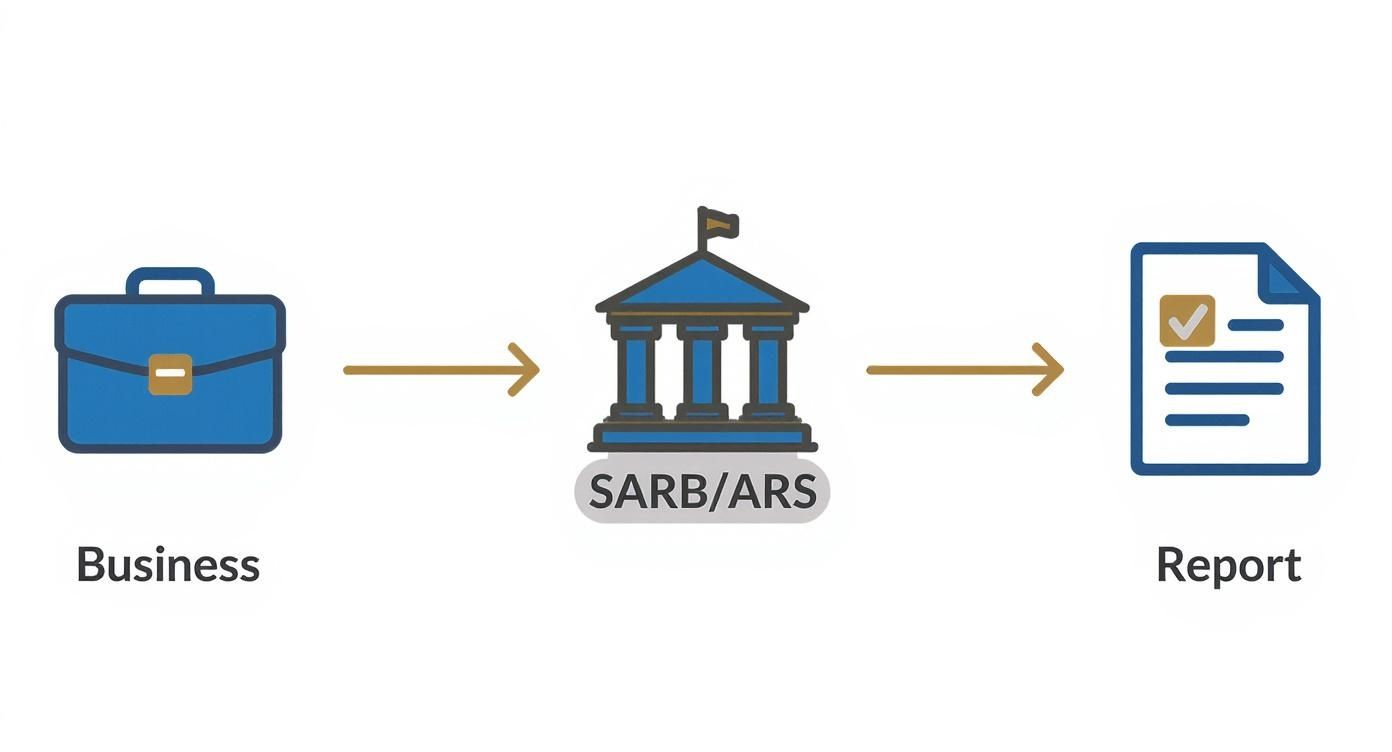
The visual drives home the point that every international transaction must align with the reporting standards set by regulatory bodies like SARB and SARS.
To help you stay organised, here's a simple checklist to use when comparing different currency exchange services.
Provider Evaluation Checklist
| Evaluation Criteria | Questions to Ask | Ideal Provider Attributes |
|---|---|---|
| Pricing & Transparency | What is your exchange rate spread? Are there any transfer fees (like SWIFT)? Are all costs shown upfront? | Offers zero or very low spreads. No hidden fees. Provides a clear, all-inclusive quote before you commit to a transaction. |
| Platform & Technology | Is the platform easy to navigate? Does it offer features like multi-user access, payment approvals, and reporting? | An intuitive user interface with robust features that streamline your workflow and enhance security controls. |
| Regulatory Compliance | Is the provider a SARB-approved Authorised Dealer? How do they handle reporting and compliance? | Fully licensed and compliant with South African regulations. Automates SARB reporting to simplify your obligations. |
| Customer Support | Is support available when I need it? Are the support staff knowledgeable about forex and local regulations? | Offers accessible, expert support from a team that understands the specific challenges South African businesses face. |
| Speed & Reliability | How long do transfers typically take? What is the provider's track record for successful payments? | Provides fast and reliable transfers, with clear communication on payment status and expected delivery times. |
Using a structured checklist like this ensures you make a decision based on hard facts, not just marketing claims.
Your Onboarding Checklist for a Smooth Transition
Once you've chosen your new provider, a smooth transition is key to getting the benefits of your choice without disrupting your operations. A well-planned onboarding process makes sure everything is set up correctly from day one.
Follow this simple checklist to guarantee a successful start:
- Prepare Your KYB Documents: Get your company registration documents, director IDs, and proof of address ready ahead of time. This will speed up the verification process significantly.
- Set Up User Accounts: Create logins for everyone on your team who needs access and configure their permissions according to their roles.
- Link Your Bank Accounts: Securely connect your business's ZAR bank account to fund your transactions easily.
- Run a Small Test Transaction: Before sending a large amount, make a small payment to get familiar with the process and confirm everything works as expected.
- Inform Your International Partners: Let your suppliers and clients know about your new payment details to avoid any confusion or delays.
By following this roadmap, you can confidently choose and onboard a currency exchange service that will save you money, reduce risk, and support your business’s global ambitions.
Gaining a Competitive Edge with a Modern Solution
After wading through the murky waters of hidden fees and regulatory red tape, it becomes painfully clear: the old way of handling international payments is costing South African businesses a fortune. It’s not just about the money, either. It’s about lost time, missed opportunities, and the constant headache of a system that feels stacked against you.
But what if you could turn this frustrating operational chore into a real competitive advantage? A new breed of currency exchange services is doing just that. They’ve thrown out the old, opaque rulebook and built a model based on transparency, speed, and tools that actually make sense for a modern global business. It’s a shift from complexity to clarity.
This new approach puts you back in the driver's seat. Instead of just accepting whatever rate and fees your bank decides to charge, you get to control your international finances with precision. By sidestepping the built-in inefficiencies of legacy systems, you can unlock serious savings and make your operations run smoother than ever.
The Financial Impact of Zero Spread and No SWIFT Fees
The most obvious win comes from a pricing model you can actually understand. Imagine a service that gets rid of the spread entirely. With a zero-spread model, you get the real, mid-market exchange rate—the one you see on Google or Reuters—with no hidden markups.
For a business paying large international supplier invoices or bringing export revenue back home, this one change can mean saving thousands of Rands on a single transaction. Over the course of a year, those savings add up, delivering a significant boost straight to your bottom line.
On top of that, modern platforms don't use the slow and expensive SWIFT network that traditional banks are stuck with. This means they can eliminate the hefty SWIFT fees that penalise you every time you send money abroad. What you're left with is a simple, predictable cost, so you know exactly what you’ll pay before you hit "send."
The real power here is predictability. When you strip away hidden markups and surprise fees, you can forecast your international costs with total accuracy. For budgeting and financial planning, that’s a game-changer.
The foreign exchange market never sleeps. Currency exchange services in South Africa are constantly reacting to market shifts, and a quick look at real-time data reveals just how much rates can bounce around in a single day. This volatility is precisely why locking in a transparent, real-time rate is so critical. It protects your business from being ambushed by sudden cost hikes. You can explore the history of daily rate movements to get a feel for just how much things can change.
Streamlined Onboarding and Practical Tools
Beyond the cost savings, a modern solution tackles the administrative headaches that slow you down. A clunky, paper-heavy Know Your Business (KYB) process can put critical payments on hold for weeks. A digital-first approach, however, can get your business verified and ready to transact in a fraction of that time.
That speed means you can onboard a new international supplier or client and get moving right away, seizing opportunities instead of being held back by paperwork. The day-to-day benefits are just as powerful, with practical tools designed for real-world use:
- Multi-Currency Cards: Arm your team with debit cards for international travel or online software subscriptions. They can spend directly in foreign currencies at the real exchange rate, dodging the awful rates and fees typically tacked on by corporate credit cards.
- Integrated Financial Controls: Set spending limits, manage user permissions, and get a clear view of all international payments from one central dashboard. This gives your finance team the visibility and control they need to manage cross-border spending effectively.
By combining these direct financial savings with smart operational tools, this new approach gives you a clear and lasting advantage over outdated, traditional services.
Frequently Asked Questions About Currency Exchange
When you're dealing with international payments, a lot of questions can come up. Let's tackle some of the most common ones we hear from South African businesses to help you get a clearer picture and feel more confident about your forex strategy.
The 'Spread' vs. The Real Exchange Rate: What's the Difference?
Think of the real exchange rate (you might see it called the mid-market rate) as the genuine, wholesale price of a currency. It's the midpoint between what buyers are willing to pay and what sellers are asking for on the global market.
The spread, on the other hand, is the margin a provider adds on top of that real rate before offering it to you. It’s essentially a hidden fee, and it's how most banks and many forex providers make their money from your transaction.
Why Do My International Bank Transfers Take Forever?
The culprit is usually the outdated SWIFT network, which most traditional banks still use. Instead of sending your money directly from A to B, SWIFT routes it through a chain of intermediary (or correspondent) banks.
Each stop adds another layer of processing, another potential fee, and another day of waiting. That’s why a simple transfer can easily take three to five business days to land.
This delay isn't just a minor hassle. It can tie up your cash flow, leaving you waiting for funds you need to pay suppliers or run your day-to-day operations.
Is It Really Possible to Avoid SWIFT Fees?
Yes, absolutely. Newer currency exchange services have built their own global payment networks to get around the old SWIFT system.
By creating more direct payment corridors, they can bypass all those intermediary banks. No middlemen means no extra handling fees, so they don't need to pass those SWIFT charges on to you. It's a much more direct and cost-effective way to move money.
Should I Exchange a Bunch of Cash Before I Travel Internationally?
Exchanging physical cash at an airport or a currency kiosk is almost always a bad deal. You'll get hit with poor exchange rates and high service fees.
A much smarter approach is to use a multi-currency card connected to a modern forex platform. This lets you spend directly in the local currency, often at the real exchange rate, sidestepping the hefty markups that your regular bank card would charge.
Ready to eliminate hidden fees and simplify your international payments? Zaro offers zero-spread exchange rates and no SWIFT fees, giving your business the transparency and control it deserves. Get started with Zaro today.