Yes, Capitec does offer foreign exchange services, but you won't find them in the way you might expect, like a traditional walk-in bureau de change. Instead, Capitec has built its foreign exchange tools right into the digital banking products you use every day, letting you manage international money directly from your account.
How Capitec's Foreign Exchange Services Actually Work
So, if you can't just stroll into a branch and buy a pocketful of Euros, how does it all work? It helps to think of Capitec’s approach not as a currency shop, but as a set of smart financial tools designed for a world where money constantly crosses borders.
Their whole system is built around the practical needs of everyday South Africans and growing businesses. Forget handling wads of foreign cash. Capitec’s setup is made for modern life—whether that’s tapping your card for a coffee in London or getting paid by a client based in New York.
What This Means for You
If you're a personal banking client, this approach makes international spending and receiving money feel surprisingly normal. For business owners, it unlocks more powerful ways to send and receive payments around the globe.
In this guide, we'll get into the nitty-gritty of how these services work, what they cost, and who they’re really built for. We’ll look at:
- Using your Capitec card for travel and online shopping.
- Getting money from overseas paid directly into your account.
- The more advanced forex tools available for Capitec Business clients.
At its heart, the idea is simple: Capitec has woven foreign exchange directly into your existing bank account, trying to make international finance less of a headache and more of a background process.
Before we dive into the details of each service, here's a quick summary to give you a clear picture of what's on offer.
Capitec Foreign Exchange Services at a Glance
| Service | Primary Use | Best For | Key Benefit |
|---|---|---|---|
| Global One Card | International travel and online shopping | Individuals travelling or buying from international websites | Automatic currency conversion at the point of sale without needing foreign cash. |
| Inward International Payments | Receiving funds from overseas | Freelancers, families, and individuals getting paid from abroad | A straightforward process to receive foreign currency directly into your ZAR account. |
| Business Forex | Sending and receiving global payments | Small to medium businesses trading internationally | Cost-effective solutions for managing cross-border supplier payments and customer invoices. |
Now, let's break down exactly how you can use each of these services.
Using Your Capitec Card Abroad
Think of your Capitec card as your financial passport. When you’re overseas or buying something from an international website, it automatically handles the currency conversion for you. Your Rands are swapped for Euros, Dollars, or whatever the local currency is, right at the moment you pay.
It’s a remarkably straightforward system. There’s no need to load foreign currency onto your card or even phone the bank to let them know you’re travelling. Your standard Global One card is ready for international use from the get-go, saving you the stress of carrying wads of foreign cash.
The whole process is managed by the Mastercard network, which sets the exchange rate at the exact time you tap, swipe, or click ‘buy’. It's a key part of how Capitec makes foreign exchange simple for its customers. And it's proving popular—between March and August, Capitec clients made a staggering 1.9 million international card payments, a 24% jump from the previous year. You can read more about how South Africans travel with Capitec on capitecbank.co.za.
Understanding the Fees and Rates
While the convenience is undeniable, it’s not entirely free. It’s crucial to know what you’re actually paying for. Every international transaction has two cost components: the exchange rate and the bank’s fees.
The exchange rate you get isn’t the one you see on Google. That’s the ‘mid-market rate’, and it’s a benchmark. The rate you’re charged includes a small markup added by the card network and the bank. On top of that, Capitec applies a currency conversion fee to each international transaction, which is a set percentage of your purchase amount. You can always find the latest fee structure in their official pricing guide.
Key Takeaway: Your Capitec card is a fantastic tool for spending abroad, converting your ZAR instantly. Just remember that this convenience comes at a cost, which includes conversion fees and a marked-up exchange rate.
Daily Limits and Practical Tips
Your international spending is tied to the same daily limits as your local purchases. The good news is you can adjust these yourself right in the Capitec app. It's a smart move to check and tweak these limits before you jet off, just to make sure you don’t run into any frustrating payment declines.
Here are a few quick tips for a hassle-free trip:
- Check your limits: Before you leave, pop open the app and set your card limits to a level that will cover your planned spending.
- Update your details: Make sure your mobile number is correct in the app. This ensures you get security notifications for all your transactions.
- Have a backup plan: Technology can be fickle. It’s always a good idea to travel with a second payment option, like another card or some emergency cash, just in case.
Getting a handle on these simple details means you can use your Capitec card with confidence, making it a powerful and easy-to-use foreign exchange tool for your next global adventure.
Receiving International Payments into Your Capitec Account
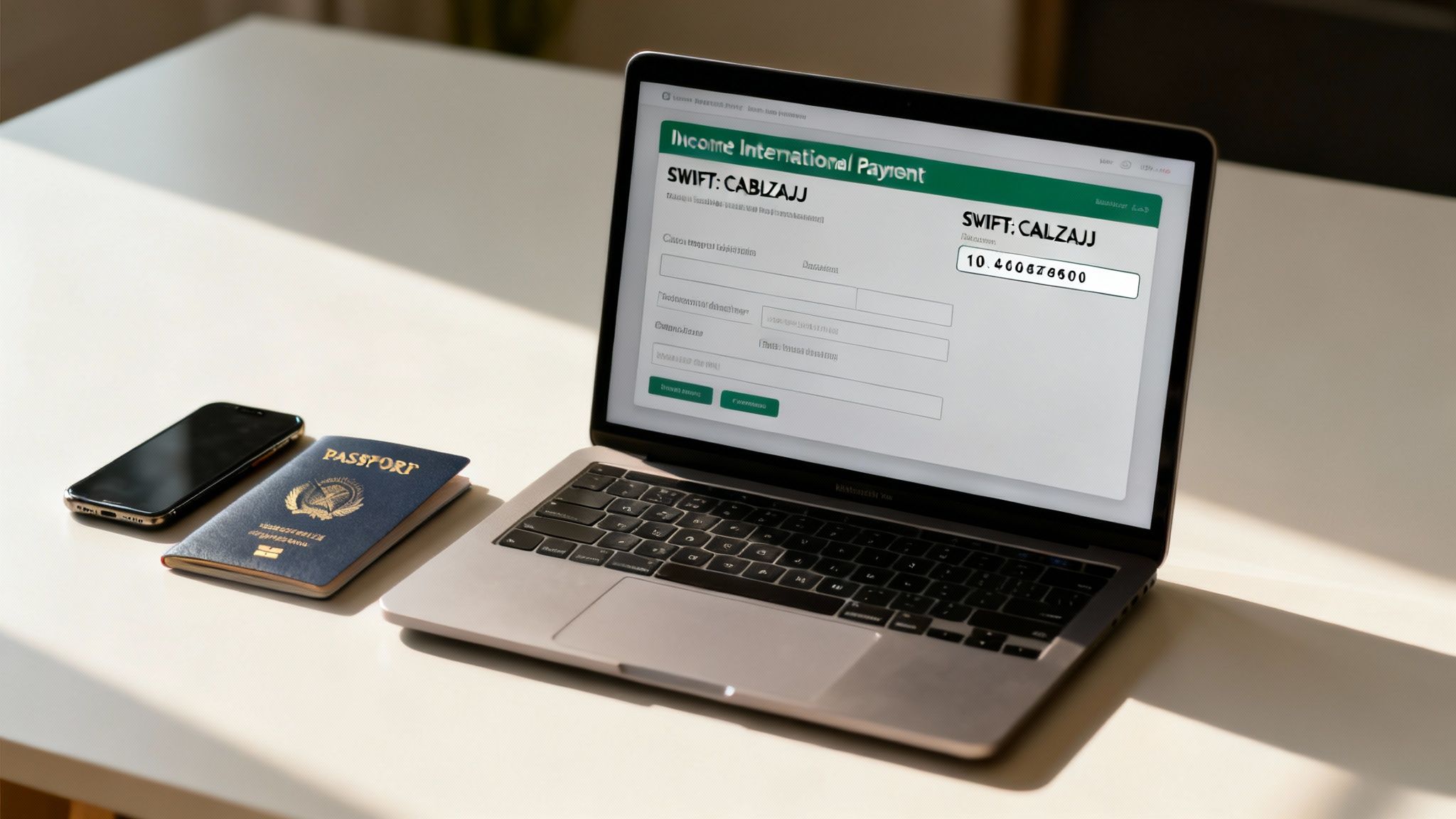
Getting paid by an overseas client or receiving money from family abroad often feels more complicated than it should be. The good news is, Capitec has a well-defined process to get that money into your account. Once you know what details the sender needs and what you have to do on your end, it’s actually quite simple.
One of the first hurdles people run into is being asked for an IBAN (International Bank Account Number). Let’s clear this up right away: South African banks don't use the IBAN system. We use a different set of details to get money into the country, so giving the sender the right info from the start is the key to avoiding delays.
The Essential Information for the Sender
For the money to land in your account without a hitch, you need to provide the sender with a specific recipe of information. Think of it as the complete delivery address for your funds.
Here's the exact info you need to give them:
- Your Full Name: Make sure this is exactly as it appears on your bank account and ID. No nicknames!
- Your 10-Digit Capitec Account Number: It pays to double-check this one. A single incorrect digit can send the payment off-course.
- Capitec's SWIFT Code: The universal code that identifies Capitec in the global banking network is CABLZAJJ. This code is non-negotiable; it tells every bank in the chain where to direct the funds.
Give the sender these three details, and they’ll have everything they need to start the transfer from their end. They will also need to state a reason for the payment, which is standard practice for things like "family support" or "payment for invoice 123."
The Final Step: The Balance of Payment Declaration
Once the funds hit South Africa’s shores, there’s one last, critical step you must take before the money shows up in your account. This is the Balance of Payment (BOP) declaration.
Think of this declaration as a customs form for your money. It’s a legal requirement from the South African Reserve Bank (SARB) for all incoming international payments, helping them track foreign currency moving into the country.
Thankfully, Capitec has made this a painless, digital process. You won’t be heading into a branch or dealing with any paperwork. When the payment arrives, you’ll get a notification, usually through the app or an SMS.
From there, you complete the declaration right inside your Capitec banking app. Just follow these quick steps:
- Sign into the Capitec app and tap Transact.
- Select International payments.
- Tap Receive a payment and follow the prompts to declare where the money came from and why you’re receiving it.
As soon as you’ve done that, Capitec handles the rest. They'll convert the foreign currency into Rands at their exchange rate for the day and credit your account. This final declaration is mandatory to release the funds and is a core part of how Capitec does foreign exchange for inward payments, keeping everything compliant with South African regulations.
Forex Services for South African Businesses
While Capitec’s personal banking tools are great for receiving money and spending abroad, it’s the Business division where their foreign exchange services really come into their own. For any entrepreneur, the ability to both send and receive international payments is a non-negotiable, and this is where Capitec Business provides a clear, affirmative answer.
Let's face it, for most small and medium-sized businesses (SMEs) in South Africa, dealing with global suppliers or customers has traditionally meant navigating a minefield of confusing bank fees and lacklustre exchange rates. Capitec Business is trying to change that with a digital-first approach that’s all about transparency and simplicity. Whether you’re settling an invoice with a supplier in Germany or getting paid by a client in the States, their platform is built for it.
This isn’t just a side hustle for them; it’s a core part of their growth strategy. The numbers speak for themselves: business forex transactions shot up by a staggering 92% in the last fiscal year. That kind of jump tells you there's a huge appetite among South African businesses for better, more affordable ways to handle international payments. You can dig deeper into this in their annual results on capitecbank.co.za.
Getting Started with Capitec Business Forex
Naturally, the first step is to open a Capitec Business account. Once you’re set up, you gain access to a dedicated online platform to manage everything. It’s a much more direct and powerful experience compared to personal banking, giving your finance team the hands-on control they need over cross-border transactions.
Here’s a quick look at what you can expect:
- Outward International Payments: You can pay your overseas suppliers, contractors, or service providers directly from your business account.
- Inward International Payments: Receiving money from international customers is just as straightforward, with a fee structure that’s easy to understand.
- Competitive Exchange Rates: The rates you get are generally much better than what you’d find on a personal card transaction.
As your business grows its international footprint, you’ll also need to get familiar with banking rules in different markets. For instance, if you're building relationships in the Middle East, it pays to understand the specifics of how to open a bank account in the UAE.
Capitec Business positions itself as more than just a bank; it’s a financial partner for SMEs that want to compete globally. The entire goal is to dismantle the old barriers of high costs and complexity that have long held businesses back from international trade.
By putting all these forex tools in one place, Capitec offers a strong alternative for entrepreneurs who have felt ignored by the big, traditional banks. This focus on clear, cost-effective solutions is giving South African businesses the confidence to manage their international finances without any nasty surprises.
Understanding Capitec Forex Fees and Rates
Let’s be honest, foreign exchange costs can be a real headache. Between confusing terms and charges that seem to pop up out of nowhere, it’s tough to know what you’re really paying. So, when you ask, "does Capitec do foreign exchange?", the next logical question is, "what will it actually cost me?" Let's break it down.
First up, you need to get your head around the mid-market rate. This is the rate you see when you Google "USD to ZAR"—it’s the pure, wholesale exchange rate without any markups. Think of it as the 'at-cost' price of a currency. The catch? It's not the rate you or I get from the bank.
The Exchange Rate Spread Explained
Banks, Capitec included, make their money by adding a small margin, or spread, to that mid-market rate. This is their fee for handling the currency conversion. It's a completely standard practice, but it means the rate you're offered will always be a bit less favourable than the one you see on the news.
On top of the spread, you'll often find fixed transaction fees. For instance, if you're receiving money from overseas into your Capitec account, they charge a set fee for that inward payment. This is a separate admin charge, completely distinct from the currency conversion itself.
Key Takeaway: The total cost of any forex transaction is two-fold: the hidden margin in the exchange rate (the spread) plus any upfront administrative fees. To know the true price, you have to look at both.
You can see just how important these services are becoming for the bank. Their business division, in particular, saw a massive 92% jump in forex transactions last fiscal year, right alongside a big increase in business lending. If you're curious, you can dig into the details over on Capitec's official site.
This chart really puts that growth into perspective, especially for their business clients.
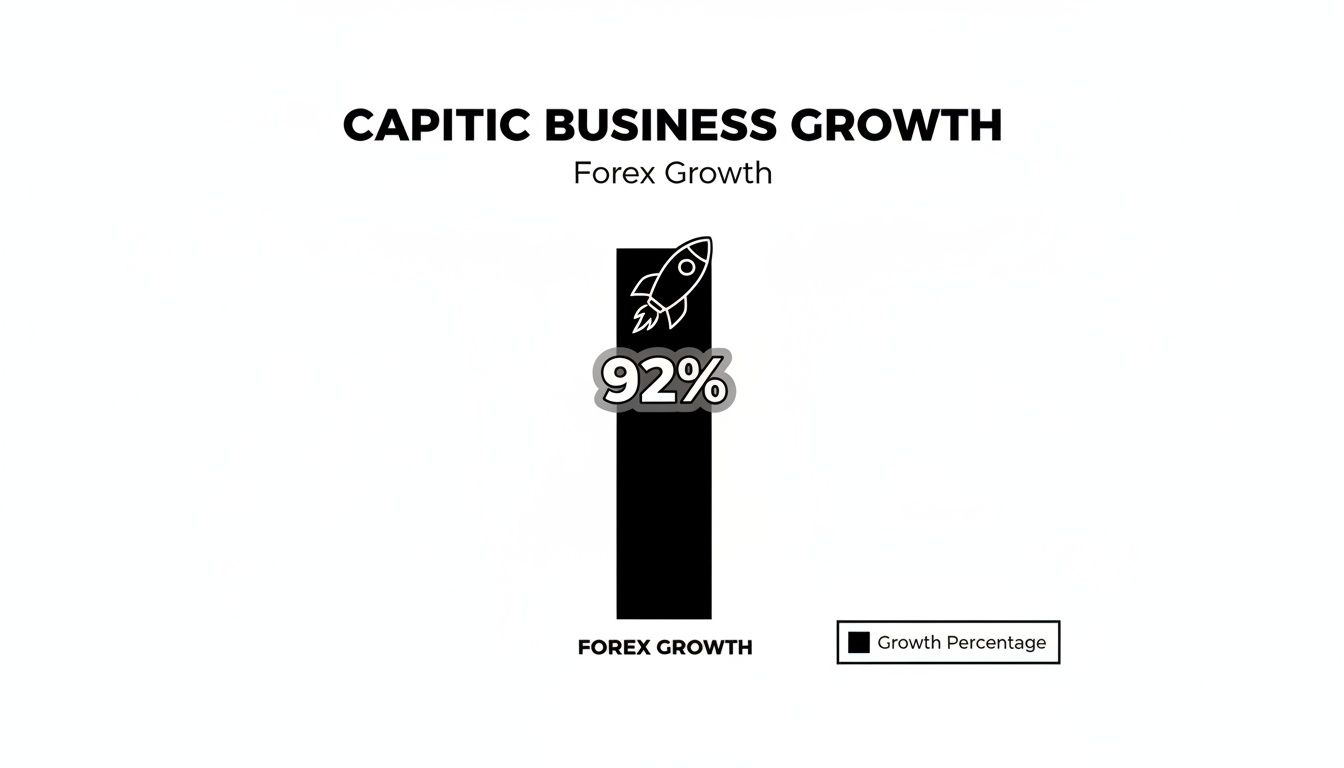
What this tells us is that South African SMEs are clearly looking for better, more straightforward ways to handle international payments.
To bring this to life, let’s see how a simple transfer might stack up with different types of providers. The table below gives you a rough idea of how those fees and spreads can eat into the final amount that lands in your account.
Cost Comparison for a $1000 International Transfer
| Service Provider | Typical Transfer Fee | Exchange Rate Margin | Estimated ZAR Received |
|---|---|---|---|
| Traditional Bank | R250 - R500 | 2% - 4% | R17,800 - R18,200 |
| Capitec | R50 (Inward) | 1% - 3% | R18,100 - R18,400 |
| Specialist Provider | R0 - R150 | 0.5% - 1.5% | R18,300 - R18,600 |
Just a heads-up: These figures are purely for illustration and are based on industry averages. The actual amounts you see will change with market rates.
Once you get a feel for these different cost components, you're in a much better position to compare services and figure out the true cost of moving your money across borders.
When You Might Need an Alternative for Sending Money
While Capitec is fantastic for receiving money from overseas and for spending abroad with your card, there’s one major catch for personal clients: you can't send money abroad directly from your account.
This is a really important point to grasp. If your goal is to pay for university fees in another country, send money to family living overseas, or even make an international investment, you'll have to look for a different service.
This is where specialist foreign exchange providers come into the picture. They are built from the ground up to handle these kinds of payments.
Why a Specialist Provider Could Be a Smarter Choice
When your main need is sending money out of South Africa, these dedicated services usually have the upper hand over traditional banks. Because their entire business is cross-border payments, they've fine-tuned their systems and pricing to be incredibly efficient.
Here’s what that means for you:
- Better Exchange Rates: Specialists often offer exchange rates with a much tighter margin (the "spread") than the big banks. Simply put, this means less of your money gets lost in the conversion, and more arrives on the other side.
- Lower Transfer Fees: Many charge smaller fixed fees, and some have no fees at all. This makes a huge difference, especially if you're sending smaller amounts regularly.
- Total Transparency: With a good specialist, you'll see the exact amount the recipient will get before you hit send. This takes the guesswork out of the equation and avoids nasty surprises from hidden intermediary bank fees.
Here's the bottom line: Capitec is a brilliant, cost-effective tool for specific forex needs, but it doesn't do everything. Knowing when to use it versus when to turn to a specialist is the key to managing your international finances smartly.
For South African businesses that need a transparent, low-cost way to make global payments, a platform like Zaro is an excellent alternative. They offer the real exchange rate without adding hidden markups. At the end of the day, picking the right tool for the job is what saves you from paying unnecessary fees.
Got Questions About Capitec Forex? We've Got Answers
Let's be honest, foreign exchange can feel a bit complicated. When you're trying to figure out the basics like "does Capitec do foreign exchange?", a lot of other questions pop up. To make things simple, we’ve tackled the most common ones right here.
Think of this as your quick-reference guide, boiling down the key details from everything we've covered.
Can I Send Money Overseas from My Personal Capitec Account?
The short answer is no. If you have a personal Capitec account, you can't send money directly to an international bank account. That feature is reserved for Capitec Business clients right now.
So, if you need to send funds abroad for personal reasons, you'll have to look at a dedicated money transfer service.
What Is Capitec's SWIFT Code?
Capitec's SWIFT code is CABLZAJJ. This is a non-negotiable piece of information if someone is trying to send you money from another country.
The person sending the funds will need this code, your full name, and your 10-digit account number. Make sure they have all three to avoid any hiccups or delays.
Think of it like a postal address for your bank account. Your name, account number, and the SWIFT code are the complete "address" for an international payment. Getting it right upfront is key.
Do I Need to Tell Capitec Before I Use My Card Overseas?
Nope! You don't have to give Capitec a heads-up before you travel. Your Global One card is good to go for international use from the get-go, so there are no extra steps to take before your trip.
That said, it’s always a good idea to double-check that your contact details in the Capitec app are current, especially your mobile number. This ensures you get transaction alerts and security notifications while you're away, which is great for peace of mind.
How Long Does an International Transfer to Capitec Take?
You can generally expect funds from an overseas sender to arrive within two to five business days.
Once the payment lands with Capitec, they'll ping you with a notification. You'll then need to quickly complete an online Balance of Payment (BOP) declaration. As soon as you submit that form, the money gets converted into Rand and deposited into your account.
For South African businesses tired of hidden fees and murky exchange rates on global payments, Zaro is a breath of fresh air. We give you the real exchange rate without the markups, putting you back in control of your international finances. Learn more and get started with Zaro today.