
If you've ever tried to send money overseas or pay an international supplier from South Africa, you've likely bumped into something called exchange control regulations. But what are they, really?
In simple terms, these are the rules that govern how money, especially foreign currency like Dollars or Euros, flows in and out of the country. Think of them as the financial gatekeepers for South Africa's economy, managed by the South African Reserve Bank (SARB). These regulations affect everything from a major corporation's international dealings to an individual sending cash to family abroad.
Decoding South Africa's Financial Borders

Let's use an analogy. Picture South Africa's economy as a large dam. The water in the dam represents the country's supply of money, particularly its reserves of foreign currency. The exchange control regulations are like a series of carefully monitored sluice gates controlling the water level.
The goal isn't to block the flow completely but to manage it intelligently. By regulating how much currency leaves (outward payments) and how much comes in (inward receipts), the SARB works to keep the economy stable. This prevents a sudden, massive outflow of capital that could drain the dam, weaken the Rand, and throw our economy off balance.
Who Needs to Understand These Rules?
It's a common misconception that these rules only apply to big banks or multinational corporations. The truth is, they touch a huge range of everyday activities. You're dealing with exchange control regulations if you:
- Own a business that imports materials or pays for international software subscriptions.
- Run an export company and receive payments from clients in another currency.
- Are an individual looking to invest in overseas shares or property.
- Need to send money to a child studying or a relative living in another country.
Basically, if you're moving money across South Africa's borders for any reason, you're operating within this framework—even if you don't realise it.
A solid grasp of the 'why' behind exchange control regulations is the first and most critical step toward ensuring compliance. Understanding the core purpose—economic stability—transforms these rules from arbitrary obstacles into a logical system designed to protect the national economy.
The Foundation of Financial Compliance
Getting this wrong can be costly. For businesses, ignoring the rules can lead to frustrating payment delays, frozen funds, or even serious fines. For individuals, it can complicate everything from investing for your future to supporting family members abroad.
This guide will demystify these regulations for you. We’ll break down the allowances, show how they impact international business, and point out the common mistakes to avoid. By starting with this core idea of managing financial flows, you’ll be in a much better position to handle the practical details. The goal is to help you move from feeling uncertain to feeling confident with every international transaction you make.
A Look Back: Where Did SA's Exchange Controls Come From?
To get a real grip on today's exchange control regulations, you have to wind the clock back. These rules weren't just dreamt up overnight; they were forged over decades of economic upheaval, political isolation, and, eventually, a slow march towards reform. The story really kicks off more than 80 years ago, right in the middle of a world at war.
South Africa first rolled out exchange controls back in 1939. It was meant to be a temporary, emergency measure during World War II. At the time, the country was part of the Sterling Area, a bloc of nations whose currencies were tied to the British pound. The main idea was simple: stop money from flooding out of the country and protect the balance of payments.
What started as a temporary fix, however, soon became a permanent part of South Africa’s economic machinery. It was formalised, expanded, and cemented into the financial system. For a deep dive into the legal nitty-gritty of those early days, the Rand Commission of Inquiry reports offer a fascinating look.
The Financial Rand Era
Things got a lot tighter in the second half of the 20th century. The real crunch came in the 1980s, a decade where international pressure against the apartheid government hit a boiling point. The country was slammed with sanctions, trade boycotts, and disinvestment campaigns, putting the economy on the ropes.
The government's answer was to introduce an incredibly complex two-tiered currency system: the Financial Rand (Finrand). This split the currency in two:
- The Commercial Rand: This was your everyday currency for trade—paying for imports and cashing in on exports.
- The Financial Rand: This applied specifically to investment capital from non-residents. It effectively trapped foreign money inside the country by forcing it through a separate, less favourable exchange rate.
This created what was essentially a "blocked funds" system. If a foreign investor decided to sell their South African assets, they couldn't just cash out and leave. They were forced to use the Finrand, which almost always traded at a steep discount to the commercial rand. It was a costly and deliberate barrier to disinvestment.
The Financial Rand system was a desperate measure to stop capital from bleeding out of the country during a time of intense political and economic isolation. It turned South Africa into a financial fortress, but it came at a huge cost—scaring off new investment and making global trade a nightmare.
Opening the Doors: The Move to Liberalisation
The dawn of democracy in 1994 changed everything, not just politically but economically, too. The new government knew that the old, iron-fisted exchange controls were holding the country back. If South Africa was going to rejoin the global economy and attract the foreign investment it desperately needed for growth, these walls had to come down.
And so began a gradual process of liberalisation. One of the first, and most powerful, moves was scrapping the Financial Rand system entirely in March 1995. It was a bold statement that unified the exchange rate and told the world, "South Africa is open for business."
Since then, the South African Reserve Bank (SARB) has continued to ease the rules, although the fundamental framework of exchange control regulations is still in place. The mindset has shifted from a blanket "no" on capital leaving the country to a more managed system. This evolution is clear in the specific allowances for individuals and companies we'll dive into next.
Understanding this journey—from wartime necessity to apartheid-era fortress and finally to today's managed system—is key to making sense of the rules we all have to navigate now.
Getting to Grips with Today's SARB Allowances
To understand South Africa's modern exchange control landscape, you need to know the specific allowances for moving money across our borders. The old, restrictive Financial Rand system is long gone. In its place, the South African Reserve Bank (SARB) has built a more managed, yet flexible, framework.
So, who are the players? You’ve got two main bodies you'll interact with, and they have very different jobs.
First up are the Authorised Dealers. Think of them as the frontline. These are your typical commercial banks, given the power by the SARB to approve a whole host of everyday transactions up to set limits without needing to phone Pretoria.
Then there’s the SARB’s own Financial Surveillance Department, or FinSurv as it’s known. For any large or unusual transactions that go beyond the standard allowances, FinSurv is the final word. They're the ones who review and sign off on applications that exceed the limits given to the banks, making sure major capital flows don't rock the national economic boat.
Allowances for Individuals
When it comes to personal finances, the SARB has laid out clear annual allowances for taking money out of the country. These are in place to give you the freedom to invest, travel, send gifts, or support family living abroad.
You really only need to know about two main allowances:
- Single Discretionary Allowance (SDA): This is your go-to for most personal transfers. You get up to R1 million per calendar year to use for almost any legal reason—think holidays, gifts, donations, or even a small overseas investment. The best part? You don't need a tax clearance certificate for it.
- Foreign Investment Allowance (FIA): If you’re looking to make more substantial investments offshore, the FIA is what you’ll use. It gives you an additional R10 million per calendar year. But there's one crucial catch: you absolutely must have a valid Tax Compliance Status (TCS) Pin from SARS.
Put them together, and an individual can move up to R11 million out of South Africa every year, as long as their tax affairs are in order.
This is a world away from the tightly controlled system of the past.
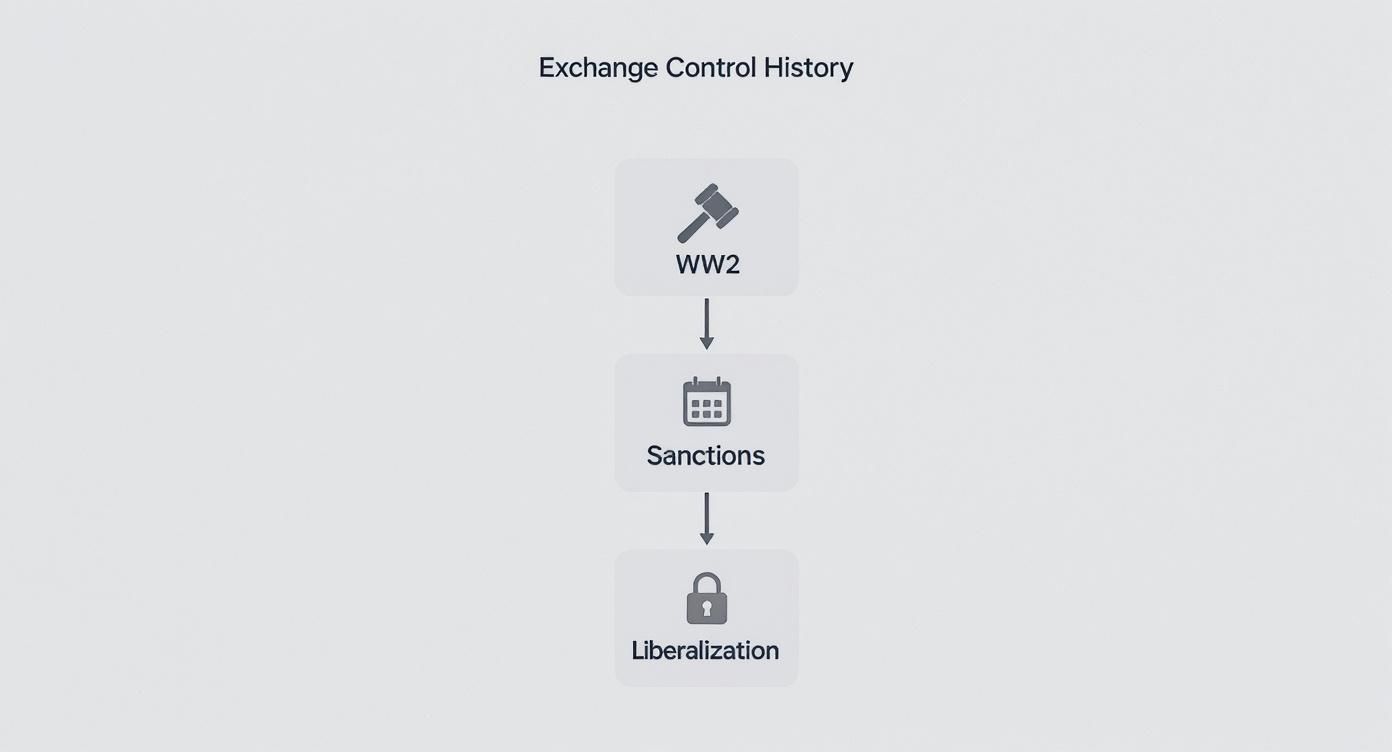
As you can see, the journey has been one of gradual liberalisation, moving from the strict capital controls during the sanctions era to the more open, but still regulated, system we have today.
Allowances for Companies
For businesses, the rules are naturally geared towards making international trade and investment easier. Since 1994, South Africa has been chipping away at the old controls, particularly on capital account transactions. A huge moment was the scrapping of the Financial Rand in March 1995, which unified our exchange rate and signalled to the world that we were open for business.
By 1996, controls on current account transactions were lifted, bringing us in line with the IMF's Article VIII requirements. But some controls on capital still remain. For example, South African companies can invest up to R1 billion per year in foreign direct investments (FDIs) with just the approval of their Authorised Dealer. Anything over that massive threshold needs a direct application to FinSurv. You can get more expert insights on how these regulations have evolved for businesses over at bakermckenzie.com.
It's vital for businesses to understand the difference between a current account payment (like paying a supplier for imported goods) and a capital account transfer (like buying a stake in a foreign company). While trade payments are generally unlimited—provided you have the paperwork—capital investments fall under specific annual limits.
The table below gives you a quick snapshot of these key allowances, serving as a handy reference for both individuals and companies.
Key Annual Exchange Control Allowances for South African Residents
Here’s a summary of the main foreign exchange allowances. It outlines the limits and tells you who you need to speak to for approval.
| Allowance Type | Applicable To | Annual Limit | Approval Body |
|---|---|---|---|
| Single Discretionary Allowance (SDA) | Individuals | R1 Million | Authorised Dealer |
| Foreign Investment Allowance (FIA) | Individuals | R10 Million | Authorised Dealer (with SARS TCS Pin) |
| Foreign Direct Investment (FDI) | Companies | R1 Billion | Authorised Dealer |
| FDI (Exceeding Limit) | Companies | Above R1 Billion | FinSurv (SARB) |
Knowing these limits and who holds the authority to approve them is the first practical step in making sure every cross-border payment you make is compliant, quick, and hassle-free.
How Regulations Impact International Business

For any South African business with global ambitions, exchange control regulations aren't just a bit of legal red tape. They're a core part of your daily operations. While the rules for individuals are fairly straightforward, the corporate framework is a different beast altogether.
Finance teams must get to grips with these rules, because they directly shape how you pay overseas suppliers, get paid by international clients, and handle profits from foreign investments. Think of it this way: for every Rand that leaves or enters South Africa, there’s a specific process and a paper trail that must follow it.
Getting this wrong can mean delayed payments, unhappy suppliers, or even having your funds frozen. The trick is to stop seeing compliance as a barrier and start treating it as the proper, legal roadmap for doing business across borders.
Managing Cross-Border Payments and Receipts
When you strip it all back, the regulations really focus on two main activities: sending money out (payments) and bringing it in (receipts). Each side of the coin has its own set of rules.
Say you need to pay a supplier in Germany. You can’t just do a simple bank transfer. Your bank, which acts as an Authorised Dealer, will ask for proof—like a valid invoice—to show that the payment is for a real trade transaction. It's their job to ensure that money leaving the country is tied to genuine economic activity.
The same logic applies when you get paid by a client in the US. The rules for bringing foreign income home are strict and time-sensitive, all designed to ensure that foreign currency earned by local companies makes its way back into the South African economy.
The Critical Rule of Repatriation
If your business exports anything, whether it’s goods or services, the concept of repatriation is absolutely non-negotiable. This isn’t a friendly suggestion; it's a legal requirement.
In short, when your business earns foreign currency—be it Dollars, Euros, or Pounds—you are legally required to bring it back to South Africa. The funds have to be converted into Rand within a set timeframe, which is currently 180 days from when the money was due to you.
This 180-day rule is a cornerstone of business compliance. It ensures a steady flow of foreign currency into the country, which helps stabilise the Rand and build our national reserves. Missing this deadline without explicit SARB approval is a serious compliance breach.
This rule has massive implications for how you manage your company’s money. Your treasury function needs solid systems to:
- Track all foreign invoices to make sure that 180-day deadline never gets missed.
- Keep an eye on exchange rates to choose the best time to convert your foreign cash into Rands within that six-month window.
- Organise your documents to create a clear audit trail for every single incoming payment.
Navigating Foreign Direct Investment and Profits
The regulations don't just stop at simple trade deals. They also cover more complex situations, like managing profits from a foreign subsidiary or making a new investment overseas. If your SA-based company owns a business abroad, the profits from that foreign entity fall under our exchange control rules.
There are allowances to keep some profits offshore for legitimate business needs, like reinvesting in that foreign operation. However, the default expectation from the SARB is that dividends and other returns will be brought back to South Africa. If you want to keep funds offshore, you’ll need a strong business case and, often, approval from your Authorised Dealer or FinSurv.
The same applies when you’re investing outwards, for example, buying a company in another country. You have to work within the corporate allowances. For any business managing these kinds of transactions, a deep understanding of Payment Integration in Fintech is incredibly valuable, as modern platforms are built to navigate this complexity.
This is where a fintech partner like Zaro can make a real difference. By automating the collection of compliance documents and showing you clear, real-time exchange rates, these platforms take the friction out of international finance. It frees up your team to focus on growing the business, knowing your cross-border transactions are fully compliant with South African regulations.
Common Compliance Mistakes and Penalties
Knowing the rules of South Africa’s exchange control is one thing. Actually avoiding the common traps businesses fall into? That’s a whole different ball game.
Even an honest mistake can create serious headaches, especially with authorities ramping up their scrutiny since the country's grey-listing by the Financial Action Task Force (FATF). A simple slip-up can quickly snowball into delayed payments, frozen funds, and strained relationships with your international partners. Getting ahead of these common errors is about building a strong compliance defence, not just reacting when something goes wrong.
Misclassifying Transactions
One of the most frequent stumbles we see is getting the classification of a payment wrong. A business might, for instance, try to dress up a capital investment as a regular trade payment to dodge stricter limits or paperwork. This is a massive red flag for the banks and, by extension, the SARB.
Think of it like this: labelling the purchase of shares in an overseas company as a "consulting fee" is a serious misrepresentation. The regulations have very specific categories for a reason, and each one comes with its own set of rules and required documents.
The name of the game is transparency. Every single cross-border transaction needs to be described for what it is, backed up by the right paperwork. Trying to squeeze a payment into a more convenient box is a fast track to getting flagged for non-compliance.
This is where putting in the work upfront pays dividends. Make sure your finance team truly understands the difference between a current account transaction (like paying for imported goods) and a capital account one (like an offshore investment). It’s fundamental.
Failing to Repatriate Funds on Time
Another classic pitfall is missing the deadline to bring export earnings back home. As we've mentioned, South African businesses are legally required to repatriate foreign currency and convert it to Rand within 180 days of the payment becoming due.
This isn't a friendly suggestion; it's a hard and fast rule. Many companies, particularly those new to exporting, are surprised by how quickly that six-month window can slam shut. Forgetting an invoice or just having a sloppy system for tracking foreign receivables is all it takes to breach the rules.
Common repatriation slip-ups include:
- Poor Invoice Tracking: Not having a clear view of when foreign payments are due, making it impossible to manage the 180-day countdown.
- Holding Funds Offshore: Leaving export proceeds sitting in a foreign bank account past the deadline without getting specific SARB approval.
- Incorrect Documentation: Lacking the proof of export needed to justify the incoming funds when they finally do arrive.
The High Cost of Getting It Wrong
Let's be clear: the consequences for breaking exchange control regulations are severe. This isn't just a slap on the wrist. The SARB has the power to levy penalties that can genuinely hurt a company's bottom line and its reputation.
The potential penalties are no joke:
- Hefty Fines: Fines can be huge, often based on the value of the transaction. In certain cases, they can climb as high as R250,000 or an amount equal to the transaction value, whichever is greater.
- Asset Freezing: The SARB can block or freeze the funds tied to a non-compliant payment, completely paralysing a company's cash flow.
- Criminal Charges: For serious or repeated violations, company directors could face criminal prosecution, which can even lead to imprisonment.
It’s not enough to just know the regulations; you have to appreciate how they're enforced. For more context on navigating breaches, exploring resources on understanding enforcement policies and penalties can offer valuable insights. These risks highlight why diligent compliance isn't just good business—it's essential for survival.
Your Top Exchange Control Questions, Answered
Let's be honest, even when you understand the basics of exchange controls, real-life situations always bring up tricky questions. It’s one thing to know the rules, but another to apply them when you’re about to make a payment or receive funds from overseas.
This section is designed to be your go-to reference for those practical "what if" scenarios. We've gathered the most common queries we hear from South African individuals and businesses and answered them in plain, straightforward language.
Can I Use My R1 Million Discretionary Allowance for Business?
This is a big one, and the answer is a hard no. Your R1 million Single Discretionary Allowance (SDA) is strictly for personal use. Think of it as your personal allowance for things like overseas holidays, sending a cash gift to a relative abroad, or making a small personal investment offshore. The beauty of the SDA is that you don't need a tax clearance certificate to use it.
But you absolutely cannot dip into your personal SDA to cover business expenses. Paying an international supplier for your company's stock using your R1 million allowance is a serious no-go. Business payments have their own set of rules and must be processed through corporate channels, backed by proper documents like invoices. Mixing the two is a major red flag for the banks and SARB.
What Happens If My Customer Pays Late and I Miss the 180-Day Rule?
The 180-day rule for bringing export earnings back to South Africa is a cornerstone of the regulations. But we all know that clients don't always pay on time. So, what happens when a late payment pushes you past that six-month deadline?
The key is to be proactive. If you know a payment is going to be late, or if the deadline has already passed for reasons outside your control, you need to talk to your bank immediately. You'll have to show them why there's a delay—things like email correspondence with your client chasing the overdue payment will be crucial.
The SARB can be reasonable when there are legitimate, documented reasons for a delay. But they only show this leniency if you are upfront and transparent with your bank. Ignoring the deadline and hoping it goes unnoticed is a risky move that can end in penalties. Document everything, communicate early.
Do I Need Approval to Receive Foreign Investment into My SA Company?
Good news here. For the most part, when a non-resident wants to buy shares in your South African company, it's considered foreign direct investment (FDI). These kinds of inbound capital flows are generally encouraged and don't require you to get prior approval from the SARB.
However, the paperwork has to be in order. When the investment funds land in your account, your bank will need to see documentation that proves what the money is for. Be ready to provide:
- A clear description of what the payment is for (e.g., "Purchase of equity in [Your Company Name]").
- Details of the non-resident investor.
- A copy of the share subscription or sale agreement.
Getting this right is vital. It ensures the transaction is properly recorded, which makes life much easier when your foreign investor wants to take dividends out or eventually sell their shares.
Can I Hold Foreign Currency in a South African Bank Account?
Yes, you can. Both businesses and individuals in South Africa can open what are known as Customer Foreign Currency (CFC) accounts. These are incredibly handy, especially for businesses that earn foreign currency and also have to pay expenses in it.
Imagine your company exports goods and gets paid in US dollars. You can have that revenue deposited directly into your USD-denominated CFC account. When it's time to pay an international supplier, you can pay them directly from that account, without having to first convert the dollars to Rands and then back again. This is a great way to shield your business from exchange rate swings and cut down on conversion costs.
Just remember, the 180-day rule still applies here. You can’t just let export earnings sit in a CFC account forever. The funds must be converted to ZAR within that timeframe unless you have specific permission from the SARB to hold them for longer.
What Is the Difference Between an Authorised Dealer and FinSurv?
Knowing who does what is key to navigating exchange control regulations without any headaches.
Authorised Dealers are your day-to-day contacts. These are the major commercial banks (think FNB, Standard Bank, Absa) that the SARB has empowered to handle the vast majority of foreign exchange transactions. For about 95% of what you need to do—like using your discretionary allowance or paying a standard supplier invoice—your bank is the only party you’ll deal with.
The Financial Surveillance Department (FinSurv) is a department within the SARB itself. They are the top-level authority. You generally only have to engage with FinSurv directly for very large or complex transactions that fall outside the standard limits given to the banks. A classic example would be a company looking to make an overseas investment of more than R1 billion; that application has to go straight to FinSurv.
A simple way to think about it: Authorised Dealers are like the local branches, while FinSurv is the head office.
Dealing with South Africa's exchange control regulations doesn't have to feel like a chore. With the right knowledge and a smart approach, managing your global finances can be simple and cost-effective. Zaro gives you a platform to bypass hidden FX fees and handle compliance smoothly, all while getting the real exchange rate. Find out how much you could save by visiting https://www.usezaro.com.