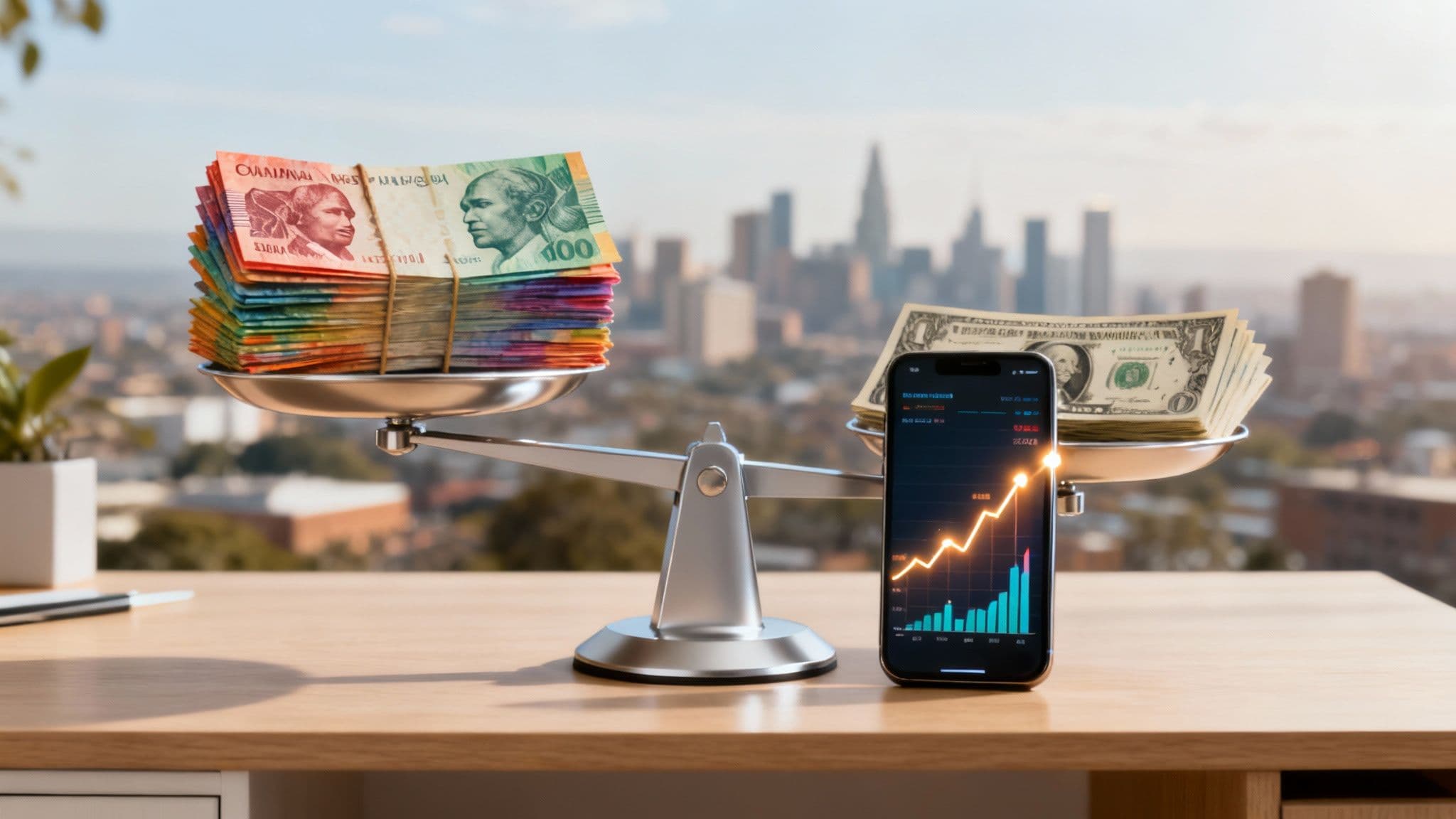
The exchange rate to South Africa is simply the price you pay to swap your home currency for South African Rand (ZAR). Whether you're using US Dollars, British Pounds, or Euros, the exchange rate tells you exactly how many Rands you'll get for each unit of your currency.
Getting to Grips with the South African Rand Exchange Rate
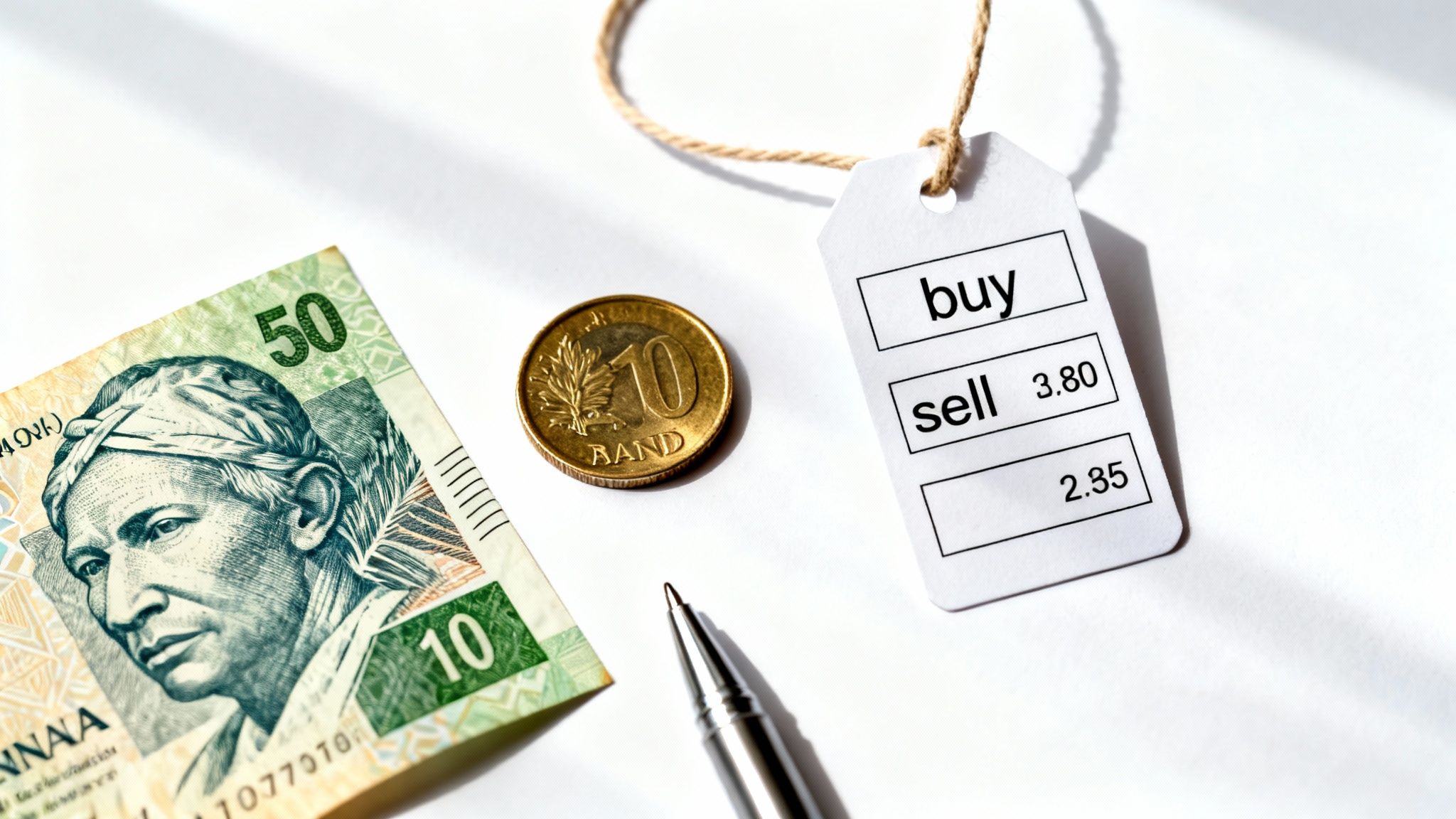
Think of an exchange rate as the price tag on a currency. But here's the catch: unlike a fixed price in a shop, the Rand's value is always on the move. It shifts constantly based on global supply and demand, meaning its value is always measured against another currency.
This is why you'll see rates like USD/ZAR or GBP/ZAR. These are called currency pairs, and they are the building blocks of foreign exchange. The USD/ZAR rate, for instance, tells you how many Rands you can buy with one US Dollar.
The Difference Between Buying and Selling Rates
Ever noticed two different prices when exchanging money? That's the "buy" and "sell" rate in action. A bank or currency exchange will buy foreign currency from you at one price and sell it to you at a slightly higher one.
The gap between these two numbers is known as the spread—and that’s how they make their money. Being aware of this spread is your first step to making sure you're not paying more than you have to.
The real effective exchange rate of the Rand, adjusted for inflation, reveals its true international purchasing power. This metric is vital as it directly influences South Africa's trade competitiveness and domestic inflation.
Looking back, the Rand has always been a currency of cycles, its value often swaying with global commodity prices and the pulse of the local economy. To get a better sense of these forces, it's worth exploring some general information about South Africa and its unique economic backdrop. History shows these long-term waves of currency strength and weakness are a defining feature of the Rand's story.
What Really Drives the Rand's Value?
The value of the South African Rand isn't set in stone. It's constantly shifting, pushed and pulled by a mix of powerful economic forces, both at home and on the global stage. Getting a handle on these drivers is crucial for anyone needing to understand the exchange rate to South Africa and protect their business from unexpected currency swings.
Imagine the Rand’s value as a small boat on a vast ocean. Some factors are like deep, powerful currents that create long-term trends. Others are more like the choppy surface winds, causing a bit of volatility day-to-day. The three most important forces to watch are commodity prices, interest rates, and the all-important investor confidence.
Commodity Prices and the Rand
South Africa's economy is rich in natural resources. We're a major global exporter of valuable commodities like gold, platinum, and coal. When the global prices for these resources climb, international buyers need to get their hands on Rands to pay for them. This spike in demand naturally pushes the Rand's value up.
The reverse is also true. When commodity prices take a tumble, the Rand often weakens alongside them. This direct link means that if you're watching the ZAR, you absolutely have to keep an eye on what's happening in the global commodity markets.
The Role of Interest Rates
The South African Reserve Bank (SARB) holds a lot of sway here, mainly through its decisions on interest rates. Think of higher interest rates as a magnet for foreign investment. When investors overseas see they can get a better return on their money in South Africa, they move their capital here.
This flood of foreign cash has to be converted into Rands, which boosts demand and strengthens our currency. On the flip side, lower interest rates can make the ZAR less appealing, potentially causing its value to drop as capital looks for better returns elsewhere.
Investor Confidence and Political Climate
Perhaps the trickiest factor to predict is investor confidence. This is really just a fancy term for how optimistic global investors feel about South Africa’s economic and political future. Good news—like strong economic data, stable governance, or clear, predictable policies—encourages investment and supports the Rand.
Unfortunately, political instability or a whiff of bad economic news can spook investors, causing them to pull their money out in a hurry. This "capital flight" can send the Rand tumbling in a very short space of time.
To wrap it up, these forces don't operate in a vacuum. The table below summarises how they interact to create the dynamic and often volatile behaviour of the Rand.
Main Drivers of the ZAR Exchange Rate
| Factor | Impact on the Rand (ZAR) | Example |
|---|---|---|
| Commodity Prices | Strengthens when prices for SA exports (gold, platinum) rise. Weakens when they fall. | A global surge in gold prices increases demand for ZAR, boosting its value. |
| Interest Rates | Strengthens when the SA Reserve Bank raises rates. Weakens when rates are cut. | The SARB hiking rates to 8.25% attracts foreign investors seeking higher returns. |
| Investor Confidence | Strengthens with political stability and positive economic news. Weakens with uncertainty. | News of a stable election outcome or a credit rating upgrade can cause a rally in the Rand. |
Understanding this interplay between commodities, interest rates, and confidence is the first step to navigating the currency market with a bit more certainty.
How the Rand Stacks Up Against the Dollar
It’s one thing to talk about exchange rates in theory, but seeing how the rand to dollar exchange rate actually plays out in the real world is where it gets interesting. The US Dollar is the globe's go-to reserve currency, which makes the USD/ZAR pairing a crucial barometer for the Rand's health and stability.
Think of it this way: when the Rand strengthens, it means your ZAR can buy more US cents. If you’re a South African business importing equipment from the States, that’s fantastic news – your costs just dropped. On the flip side, if you're exporting proudly South African wine, a stronger Rand makes your bottles more expensive for American customers, which could dent your sales.
A Look at Recent Performance
The currency market is always on the move, but a recent twelve-month period saw the Rand make some serious gains. The ZAR appreciated against the USD by roughly 8.33%, a major turnaround that bucked previous downward trends.
During that time, the rate bounced between a peak of 0.05831 USD and a low of 0.05065 USD for every one Rand. You can always explore more historical data about the ZAR/USD exchange rate to see these patterns for yourself.
This constant push and pull is influenced by several key factors.
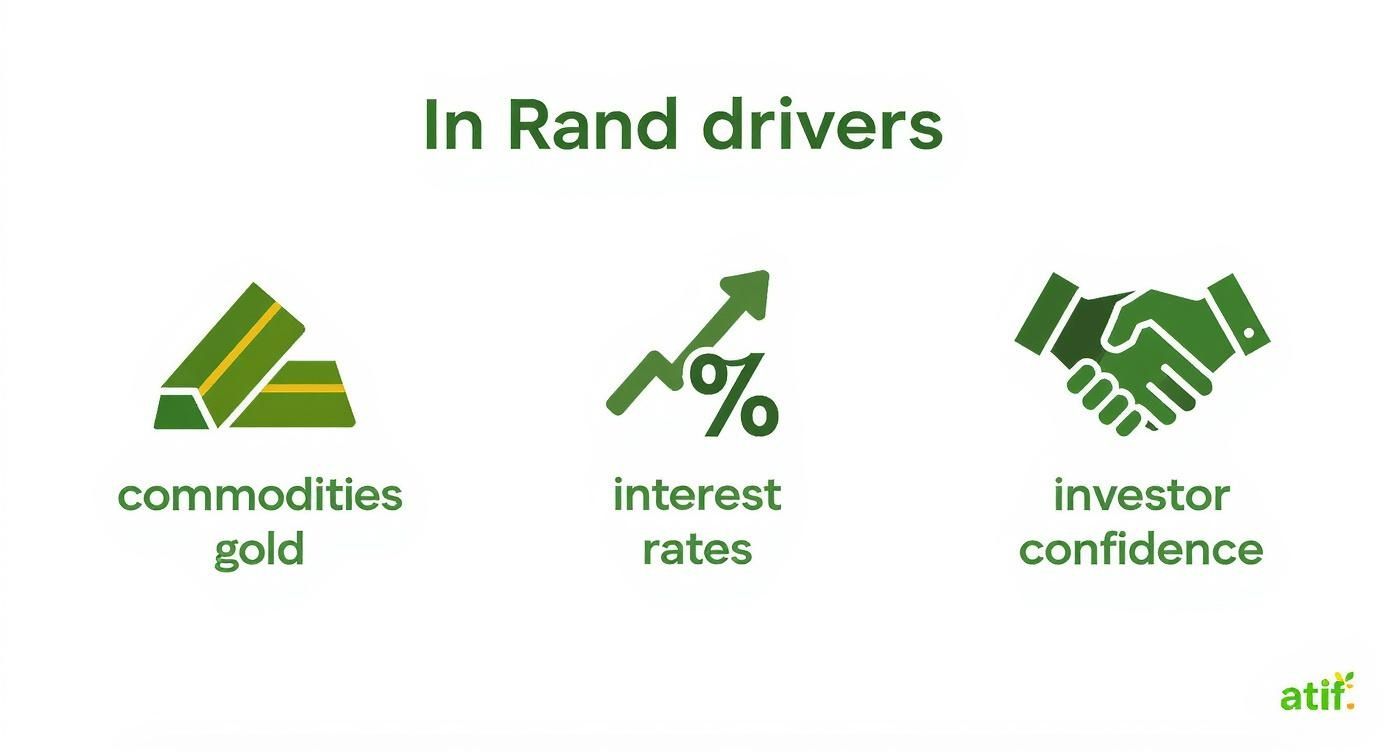
As the infographic shows, it’s a delicate dance between commodity prices, interest rate decisions, and the general mood of global investors that causes the Rand's value to shift.
A strengthening Rand isn't automatically "good" or "bad." Its impact depends entirely on which side of the transaction you're on—whether you're sending money out or bringing it in. This is exactly why businesses need a solid plan to handle currency risk.
Keeping an eye on these trends isn’t just for economists; it's essential for any business with international dealings. Even tiny movements in the exchange rate can have a massive impact on your profit margins, turning a great quarter into a stressful one in the blink of an eye. Getting a handle on this dynamic is the first step to protecting your business from nasty currency surprises.
Why Global Currency Trends Matter for the Rand
The exchange rate to South Africa isn't determined in a vacuum. While local events certainly play their part, the performance of major global currencies, especially the US Dollar, often pulls the strings. For any business dealing with international payments or trade, getting a handle on this relationship is non-negotiable.
Picture a seesaw with the US Dollar on one end and the Rand on the other. When the US economy falters or its central bank signals a cut in interest rates, the dollar tends to weaken. As the dollar's side of the seesaw goes down, the Rand's side naturally rises, meaning it strengthens against the dollar.
This is precisely why keeping an eye on US economic policy is a surprisingly vital task for South African businesses. A weaker dollar can make our exports more appealing on the world stage and attract foreign investment. But on the flip side, it also affects the value of any assets or revenue held in US dollars.
The Dollar's Direct Impact on the ZAR
This push-and-pull between the two currencies can create some serious market waves. For instance, over a recent one-year period, the US Dollar fell by about 7.69% against the Rand. That same year, the USD/ZAR exchange rate was all over the place, hitting a high of 19.742 ZAR and a low of 17.150 ZAR for a single dollar. You can explore detailed historical data on the USD/ZAR pairing to see just how volatile this relationship can be.
A range that wide really drives home how sensitive the Rand is to global economic news, shifts in commodity prices, and our own domestic policies. It shows how forces well beyond our borders can create both massive opportunities and significant risks.
A weaker US Dollar often translates into a stronger Rand. This can be fantastic news for South African importers, who suddenly have more buying power. For exporters, however, it's a challenge, as their goods become more expensive for international customers.
This isn’t just some abstract economic theory; it has real, tangible effects on the bottom line. For businesses bringing money back from the US or paying for American imports, these fluctuations can make or break profit margins. Staying ahead of foreign exchange movements isn’t just a good idea—it’s essential for staying financially stable in today’s connected economy.
How to Find the Best Exchange Rates
Finding the best exchange rate to South Africa isn't just about a quick online search. It's about knowing the difference between the rate you see on the screen and the actual amount that hits the bank account. For a business, that difference can make or break your profit margins on every single international deal.
You've probably seen the rate on Google or financial news sites. That's called the mid-market rate. Think of it as the 'true' or wholesale price of a currency at any given moment—the perfect midpoint between what buyers are willing to pay and what sellers are asking for on the global markets.
Here's the catch: that's almost never the rate you're offered. Most banks and exchange services build their profit margin into the rate by adding a 'spread' or 'markup'. This is a hidden fee that quietly chips away at your funds, and the worst culprits are often the convenient airport currency counters, which charge a massive premium for their location.
Comparing Your Options
When you need to exchange currency, it pays to shop around, because not all providers are built the same. Each has its pros and cons, especially when it comes to being upfront about the real cost.
- Traditional Banks: They're a familiar and secure option, but banks are known for offering less competitive exchange rates. On top of that, they often add hefty SWIFT fees for international transfers, making them an expensive choice.
- Airport Currency Kiosks: While they seem handy for last-minute travel cash, these are almost always the most expensive route. Their rates are poor and their spreads are wide.
- Digital Payment Platforms: Modern, online-first platforms can typically offer much better rates and lower fees. They operate more efficiently than traditional banks and pass those savings on to you with greater transparency.
To really get a feel for how these options stack up, checking a good guide on foreign currency exchange comparison can give you the insights needed to make an informed choice.
The real secret to getting the most for your money is finding a provider that gives you a rate as close to the mid-market rate as possible, with any fees stated clearly upfront. The hidden markups are where the real costs are buried.
For South African businesses juggling international payments, these unpredictable costs can create a lot of financial headaches. This is exactly where a solution like Zaro comes in. We give you the real exchange rate—no spread, no hidden fees, no surprises. With Zaro, what you see is what you get, ensuring your business keeps more of its hard-earned money and protecting your bottom line.
Got Questions About the ZAR Exchange Rate? We've Got Answers.
When you're dealing with the exchange rate to South Africa, a few questions always seem to pop up. Let's tackle some of the most common ones that businesses face when managing payments in Rand.
What Is the Best Time to Exchange Currency for ZAR?
If only there were a magic answer! The truth is, the foreign exchange market is in constant motion, so there's no single "best time" to make a trade. The smartest strategy is to keep an eye on economic news and get a feel for the trends shaping the Rand's value.
For larger business transactions, a much safer bet is to use a service that allows you to lock in a good rate when you see one. One thing is for certain, though: avoid exchanging money at airports or tourist traps. Their markups are notoriously high, and you'll always get a poor deal.
How Does Inflation Affect the Exchange Rate?
Think of high inflation as an anchor dragging the Rand down. When prices rise quickly in South Africa, each Rand buys less than it used to. This erodes its purchasing power, making it less attractive to foreign investors, which usually causes its value on the global market to fall.
Conversely, when inflation is low and stable, the ZAR becomes a more appealing currency. The South African Reserve Bank often steps in to curb high inflation by raising interest rates. This can actually strengthen the Rand, as higher interest rates attract foreign investment from those seeking better returns on their capital.
A currency’s value is fundamentally tied to its purchasing power. When high inflation erodes that power, the exchange rate often adjusts downwards to reflect the new reality.
Why Is the ZAR Considered a Volatile Currency?
The Rand has a well-earned reputation for being a bit of a rollercoaster. This volatility boils down to three main drivers:
- Commodity Prices: South Africa's economy is deeply connected to the global prices of commodities like gold, platinum, and coal. When these prices swing, the Rand often swings right along with them.
- Investor Sentiment: As an emerging market currency, the ZAR is highly sensitive to the mood of global investors. Any whiff of worldwide economic trouble can cause them to pull money out of what they see as riskier markets, weakening the Rand in the process.
- Domestic Factors: Political stability and local economic health are massive factors. Any uncertainty at home can make investors nervous, leading to rapid changes in the currency's value.
Stop losing money to hidden fees and unpredictable rates. With Zaro, you get the real exchange rate with zero spread, giving your business complete transparency and control over its international payments. See how much you can save at https://www.usezaro.com.