
Thinking about taking your South African business global? It can feel like a huge leap, but the rewards are well worth it. Imagine taking the success of your local shop and replicating it on an international stage. That's the essence of exporting and importing, and this guide is here to walk you through it.
Your First Steps in Global Trade
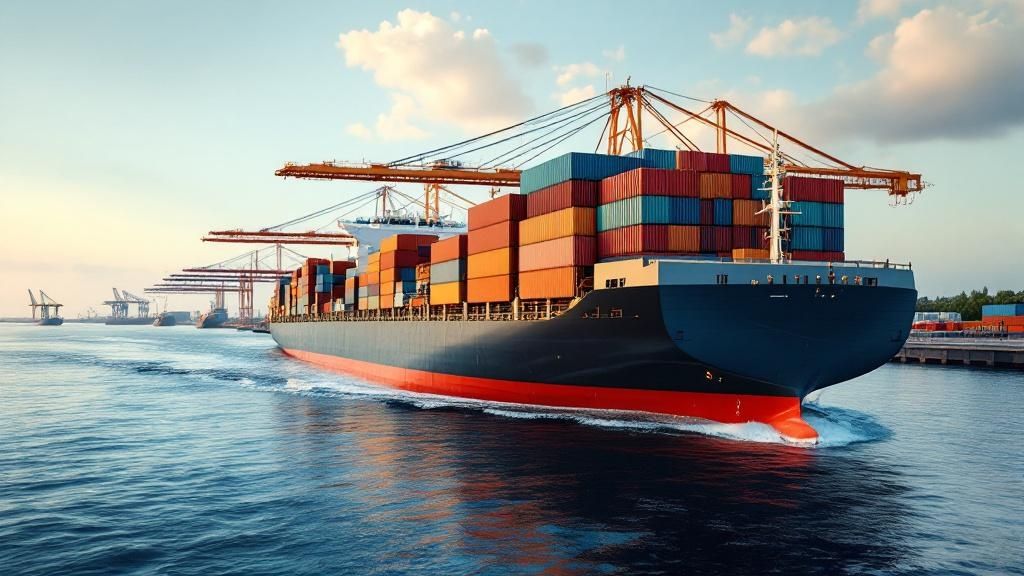
Stepping onto the world stage means moving your business beyond our local borders and unlocking a whole new world of opportunity. At its heart, the idea is straightforward. Export and import is simply the business of selling your products to customers in other countries (exporting) and buying goods or materials from suppliers abroad (importing).
But this is so much more than just finding a new place to sell things. It’s a powerful strategic move that can make your business far more resilient and pave the way for serious growth. When you diversify your customer base, you’re no longer entirely dependent on the South African economy. You suddenly have access to massive new markets and customer pools.
The Real-World Benefits of Going Global
Getting involved in export and import gives you tangible advantages that can set you apart from the competition. And it's not just a game for the big corporations; small and medium-sized businesses (SMEs) have just as much, if not more, to gain.
Here are a few of the key benefits you can expect:
- New Revenue Streams: Tapping into international markets is a direct path to more sales and a healthier turnover.
- Smarter Diversification: By spreading your business across different economies, you protect yourself from slumps or downturns in any single market.
- A Sharper Competitive Edge: Sourcing materials from around the world can mean lower costs or better quality, giving your final product a real advantage.
- Achieving Economies of Scale: Ramping up production to meet global demand often drives down the cost per unit, which directly improves your profit margins.
The real power of export and import is how it connects economies and creates shared prosperity. You only have to look at the strong trade relationship between South Africa and our neighbours to see the incredible potential for regional growth.
A Practical Look at Trade in Action
This isn't just theory; the numbers tell a compelling story. Take our trade with Zambia, for instance. In 2023, Zambia's import market grew substantially, with total imports hitting a value of around $9.3 billion – a 13% jump from the year before. And who is their biggest import partner? South Africa. We supply a huge range of goods, proving just how much opportunity is waiting right on our doorstep. You can dig deeper into Zambia's import dynamics on tradeimex.in.
This guide will give you a clear, practical roadmap to make sure your first international deal is a resounding success.
How an International Trade Deal Unfolds
So, what does a real-world export and import deal actually look like from start to finish? Let's ground this in a practical example. Imagine a small business in Cape Town that makes beautiful, handcrafted leather bags. Through some savvy online research, they’ve connected with a boutique in Berlin, Germany, that loves their style and wants to place an order.
Getting those bags from a workshop in Cape Town to a retail shelf in Berlin is a journey with many steps. It doesn't start with a shipping container, but with careful research and building a solid relationship. The first real move is finding that potential buyer, which can happen through market analysis, virtual trade shows, or simply tapping into your professional network.
Once you've found an interested party, the real work of negotiation begins. This is where you have to master communicating effectively across different time zones and cultural norms.
The Negotiation and Agreement Stage
The initial thrill of finding a buyer quickly gives way to the nitty-gritty details of putting together a contract. This goes far beyond just settling on a price per bag. To protect both the South African seller and the German buyer, the contract needs to be watertight, covering every possible detail of the arrangement.
Here are the critical points you'll need to nail down:
- Payment Terms: When will you get paid? Will it be upfront, once the goods are shipped, or only when they arrive in Berlin? This is often one of the most intensely negotiated clauses.
- Incoterms: These are a set of globally recognised rules that clearly define who is responsible for what. They spell out who pays for and manages the shipping, insurance, paperwork, and customs clearance. Getting this right is crucial.
- Quality Standards: The agreement must be crystal clear about the specifications of the leather bags—materials, colours, stitching, everything. This prevents any arguments about quality down the line.
I’ve seen it happen time and time again: new exporters get excited and rush through the contract. This is a huge mistake. A well-drafted contract is your roadmap and your safety net. It prevents expensive misunderstandings about who is meant to do what, and when.
This infographic shows how each successful step in the trade process builds on the last, leading to bigger financial wins.
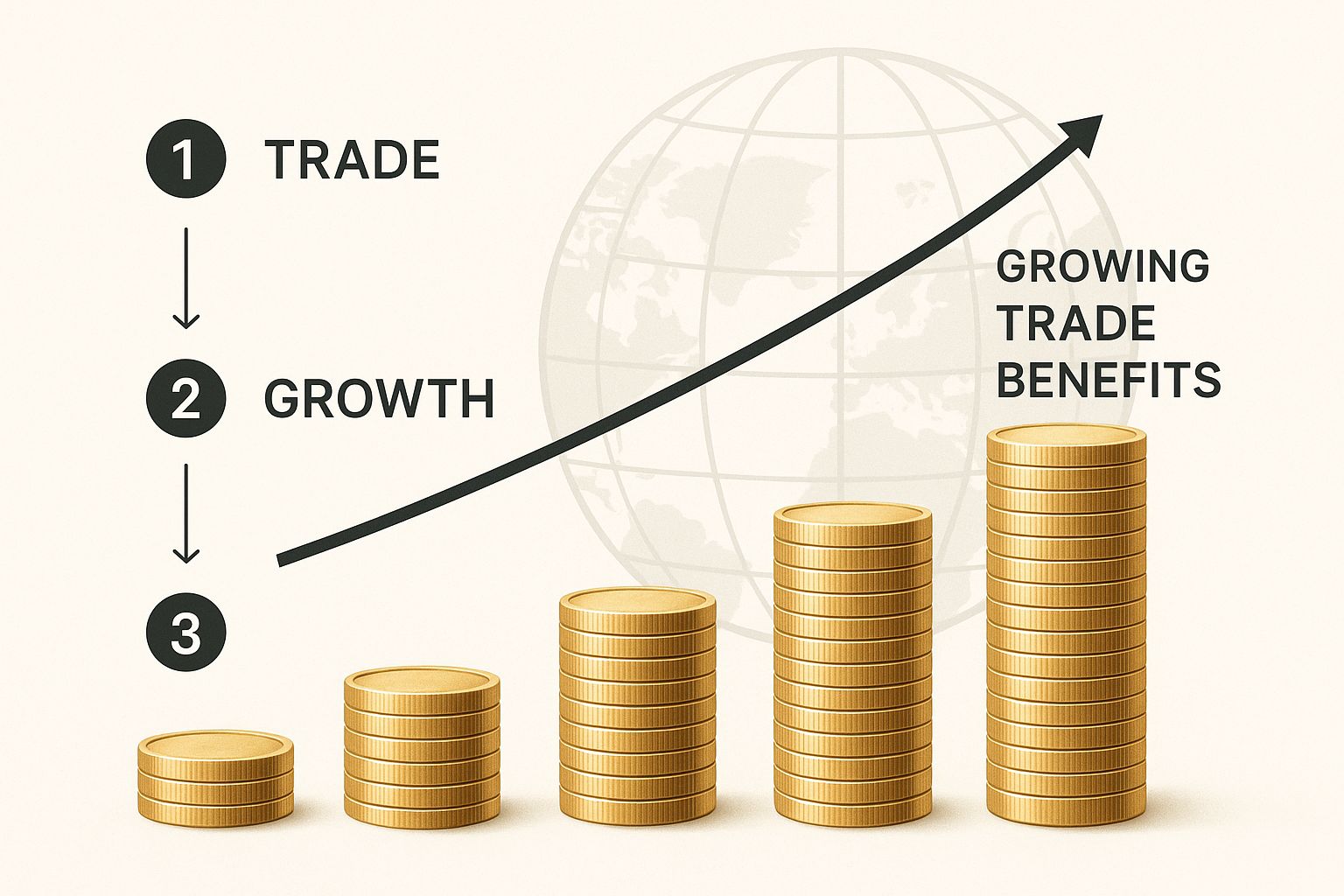
As you can see, consistent and well-managed trade doesn’t just add up; it compounds over time, seriously boosting your profitability.
From Production to Port
With a signed contract in hand, our Cape Town artisan can finally start crafting the order. As soon as the bags are finished, the logistics machine roars to life. This is where the export and import process gets physical.
The business now faces a few key decisions:
- Choose a Freight Forwarder: This is your most important partner in the process. A reliable freight forwarder is worth their weight in gold, handling all the headaches of booking transport, whether by sea or air.
- Select the Shipping Method: Air freight is quick but pricey, perfect for high-value or urgent orders. Sea freight is much cheaper for bigger, bulkier shipments, but you’ll need to factor in the much longer transit time.
- Arrange Insurance: Cargo insurance is simply not optional. It’s what protects your investment if the goods are lost or damaged during their long journey.
- Prepare for Customs: All the export documents must be prepared with painstaking accuracy. One small mistake here can cause massive delays and headaches at the port.
Finally, the goods are securely packaged, loaded onto a truck, and sent off to the Port of Cape Town. Once they clear South African customs and are loaded onto the ship, their international journey officially starts—a huge milestone in the export and import cycle.
Mastering Customs and Essential Paperwork
Getting your paperwork right isn't just a good idea in international trade—it's everything. Think of it as your shipment's passport. Without the correct documents, stamped and in order, your goods are simply not crossing any borders. This part of the process is where precision becomes your best friend.
Every country has its own rulebook, and authorities like the South African Revenue Service (SARS) need to be sure your goods are legal, safe, and valued correctly. A tiny mistake on a form can spiral into frustrating delays, unexpected fines, or even having your entire shipment seized. Getting this right from the very beginning saves a world of headaches down the line.
Your Shipment’s Core Documents
While the specific paperwork can change depending on what you’re shipping and where it’s going, a handful of documents are the foundation of almost every international transaction. They work in tandem to tell the complete story of your shipment to everyone involved, from your freight forwarder to customs officials on both sides of the border.
Here’s a look at the essential documents you’ll need to get familiar with:
- Commercial Invoice: This is far more than just a bill. It’s a detailed record of the transaction—what the goods are, their value, and the terms of sale. Customs officials use this to calculate the duties and taxes owed. It has to be perfect.
- Bill of Lading (B/L) or Air Waybill (AWB): This is your contract with the carrier transporting your goods. It also acts as a receipt, proving the carrier has taken possession of your cargo. In many cases, it’s a document of title, meaning whoever holds the original B/L legally owns the goods.
- Packing List: This document gives a detailed breakdown of what’s inside each box or pallet, including weights, dimensions, and item counts. If customs decides to physically inspect your shipment, they’ll use this list to verify the contents.
- Certificate of Origin (COO): This document formally declares the country where your goods were produced. It's crucial for customs because it helps them determine if your products qualify for lower tariffs under specific trade agreements.
Think of these documents as a team telling a story. The commercial invoice explains what the deal is. The bill of lading clarifies who controls the goods. And the packing list shows how they’re packed. Together, they create a clear, verifiable record for your export and import activities.
To give you a clearer picture, here’s a breakdown of these key documents and their roles for everyone involved.
Key Documents for International Shipments
| Document Name | Purpose for Exporter | Purpose for Importer | Issuing Body |
|---|---|---|---|
| Commercial Invoice | Provides proof of sale and a basis for payment. | Required for customs clearance and to calculate duties. | The Exporter (Seller) |
| Bill of Lading (B/L) or Air Waybill (AWB) | Serves as a receipt for goods and a contract of carriage. | Acts as proof of ownership to claim the goods upon arrival. | The Carrier (Shipping Line or Airline) |
| Packing List | Helps freight forwarders and carriers handle the cargo correctly. | Used to check the received goods against the order. | The Exporter (Seller) |
| Certificate of Origin (COO) | Proves where the goods were made, meeting buyer or L/C terms. | Needed to claim preferential duty rates under trade agreements. | Chamber of Commerce or other authorised body |
Mastering this set of documents is a fundamental skill for anyone in the import-export game.
Understanding Tariffs and HS Codes
Once your paperwork is in order, the next puzzle is figuring out the customs duties and taxes. This is where the Harmonized System (HS) code comes in. It’s a global language for classifying products—a standardised numerical code that tells customs officials exactly what you are shipping.
From avocados to automotive parts, every single product has a specific HS code.
Assigning the correct HS code is absolutely critical. Why? Because that code directly determines the rate of duty customs will apply to your goods. A simple mistake here can lead to you either overpaying and losing profit or underpaying and facing penalties. For any South African business involved in export and import, getting the HS code right isn't just important; it's a core compliance responsibility.
Ultimately, accurate paperwork and correct tariff classification are the bedrock of a smooth customs process. It's an area where a little extra attention to detail upfront saves you an enormous amount of time, money, and stress, ensuring your goods keep moving across borders without a hitch.
Calculating the True Cost of Your Shipment

A profitable export and import deal really comes down to one thing: knowing every single cost involved. It’s a common pitfall for new traders to get caught off guard by expenses that go far beyond the initial price tag on the goods. To make any money, you have to calculate your total landed cost—the complete price of getting a product from the factory floor all the way to your customer's door.
This isn’t just about adding up the product and shipping costs. It’s a much more detailed calculation that must include freight, insurance, customs duties, VAT, and clearing agent fees. Miss just one of these, and a promising deal can quickly flip into a loss. Think of a precise budget as your best defence against nasty financial surprises down the line.
Beyond the Obvious Expenses
Most people remember to budget for shipping and duties. It’s the hidden costs, however, that usually do the most damage to your profit margins. These are the sneaky, often overlooked expenses that can pile up fast if you’re not watching closely. Just knowing they exist is the first step to protecting your bottom line.
Here are some of the most common costs that catch people out:
- Currency Conversion Margins: When you pay an international supplier, banks almost never give you the real, mid-market exchange rate. They add their own markup, which is a direct, often hidden, cost to your business.
- Bank and SWIFT Fees: Making international payments the old-fashioned way comes with a string of administrative and transaction fees that can quickly add up.
- Demurrage and Detention Charges: If your container isn't collected from the port on time, or the empty one isn't returned promptly, shipping lines will hit you with hefty daily penalties.
- Inland Transport: Don't forget the cost of moving your goods from the port to your warehouse, or from your factory to the port. This can be a significant expense that needs to be factored in from the start.
The goal is to build a financial buffer. Assume there will be unexpected costs—because there almost always are—and build a contingency of 5-10% into your budget. This simple step provides a safety net and helps maintain your profitability, even when things don’t go exactly as planned.
Building Your Realistic Budget
Putting together a complete cost checklist is the only way to set a profitable price for your goods. For commodity-driven economies, this kind of precise cost management is essential to stay competitive on the world stage.
Take Zambia's trade relationship with the United States, for example. In 2024, the U.S. imported goods worth $171.47 million from Zambia. Of that, precious metals and stones made up $128.38 million, while copper, another key export, accounted for $25.46 million. For those Zambian exporters, every single cost—from mining and refining to shipping and insurance—is critical to the success of each transaction. You can discover more insights about these trade figures on tradingeconomics.com.
When it comes to your own export and import activities, start by listing every single potential charge. This means product cost, freight, insurance, customs duties, VAT, clearing fees, and currency conversion costs. By creating a detailed cost sheet for every shipment, you get a true, unfiltered picture of your financial position. That’s how you price your products to win in the global marketplace.
Solving International Payments the Smart Way
You’ve wrestled with logistics, cleared customs, and finally, you're at the last hurdle: paying your international supplier. This should be the easy part, right? Unfortunately, for many South African businesses, this is where profits quietly bleed away. The old-school way of sending money overseas through traditional banks is often slow, confusing, and riddled with costs you don't see coming.
For decades, making an international payment meant you had little choice but to accept your bank's exchange rate. These rates almost always have a hidden markup baked in, a buffer over the real "mid-market" rate—the true midpoint between what buyers and sellers are offering for a currency. On top of that, you’re hit with hefty SWIFT fees just to get the money from A to B. This system adds a layer of financial guesswork that any business involved in export and import simply can't afford.
A Modern Approach to Global Payments
Thankfully, financial technology has delivered a much better way forward. New payment platforms were built from the ground up to fix these exact problems, putting transparency and control back into the hands of the business owner. Instead of patching into outdated banking infrastructure, they give you direct access to fair exchange rates and do away with pointless fees.
A platform like Zaro is a perfect example, designed specifically with the needs of South African businesses in mind. It gives you an immediate advantage in two crucial ways:
- Real, Mid-Market Exchange Rates: You get the actual exchange rate, with no hidden spread or markup. What you see is precisely what you get, meaning you don't lose a chunk of your money in the conversion process.
- Fee-Free International Payments: By cutting out the intermediary bank charges and SWIFT fees, the cost of sending your payment plummets to zero. This makes every single transaction more profitable.
The old way forces you to budget for a moving target of unknown costs. A modern fintech solution removes the guesswork entirely. By giving you total transparency on rates and fees, it turns a volatile expense into a predictable, manageable part of your operations.
A Practical Example of the Savings
Let’s put some real numbers to this. Imagine you need to pay a supplier invoice for R500,000. Here’s a quick breakdown of how the costs might look when you compare a typical bank transfer with a platform like Zaro.
Comparing a R500,000 International Payment
| Cost Factor | Traditional Bank | Zaro |
|---|---|---|
| Exchange Rate Markup | Banks often add a 1-3% markup. On R500,000, this could be R5,000 - R15,000 in hidden costs. | R0. You get the real mid-market rate with no markup. |
| SWIFT/Transfer Fees | A standard fee of R250 - R750 per transaction is common. | R0. There are no fees to send your payment. |
| Total Avoidable Costs | R5,250 - R15,750 | R0 |
| Total Savings with Zaro | Up to R15,750 on a single transaction |
The comparison speaks for itself. That extra R15,750 is pure profit that drops straight to your bottom line, instead of getting absorbed by bank fees and poor rates. For companies that regularly engage in export and import, these savings can become substantial over the course of a year.
By making the switch to a smarter payment solution, you’re doing more than just saving money. You’re making your entire global trade operation more efficient, predictable, and ultimately, far more profitable.
Your Export and Import Questions Answered
Diving into the world of export and import can feel a bit overwhelming at first. It’s one thing to understand the theory, but when you’re actually on the ground, a host of practical questions always pop up. This section is designed to tackle some of the most common queries we hear from South African businesses.
Think of it as a quick-reference guide to help you navigate those initial hurdles with a bit more confidence. We’ll cover everything from finding people you can trust to understanding the specific paperwork you’ll need right here in South Africa.
How Do I Find Reliable International Partners?
This is probably the biggest question for anyone starting out. Finding suppliers or buyers you can genuinely rely on is crucial. A great place to start your search is on well-known B2B platforms like Alibaba or Global Sources, but a word of caution: always do your own homework. Never just take a profile at face value.
If you prefer a more hands-on approach, nothing beats attending industry trade shows. It's a fantastic way to meet potential partners in person and get a feel for their business. Don't forget to tap into local resources either; your local Chamber of Commerce can be a goldmine for vetted contacts.
To protect yourself, especially early on:
- Start small: Begin with trial orders to test quality and build a relationship.
- Verify everything: Use a third-party inspection service to check the goods before you commit to a big payment.
What Is the Biggest Mistake New Importers Make?
Without a doubt, the most common and costly mistake is getting the landed cost wrong. It’s so easy to focus on the price of the product and the shipping quote, but that's only part of the story. New importers often completely overlook customs duties, VAT, clearing agent fees, and the cost of transport from the port to their warehouse.
This single oversight can flip a profitable venture into a painful loss overnight. Before you even think about placing an order, you absolutely must create a detailed cost sheet that maps out every single potential expense. Always add a small buffer for those unexpected charges that seem to pop up out of nowhere.
This level of financial planning is non-negotiable, particularly when you're dealing with economies where trade values can swing. Take Zambia, for instance. Historical data shows its export and import figures can be quite volatile. At one point, exports were around 28,010 million ZMW while imports hit about 27,454 million ZMW, showing a tight trade balance. You can dig into these variable trade dynamics on tradingeconomics.com. Watching these trends really drives home why every cent in your cost calculation matters.
Do I Need a Special Licence in South Africa?
Yes, you do. Before any South African business can trade internationally, it must register with SARS for an importer/exporter code. This is your very first step, and it’s mandatory for everyone. There are no shortcuts here.
On top of that, some goods are restricted and need special permits to be imported or exported. This often applies to products like certain agricultural goods, chemicals, or scrap metal. You’ll need to check with the right government body, like the International Trade Administration Commission (ITAC), to see if your products fall into a controlled category. Make sure you have any required permits in hand before you ship anything.
Ready to stop overpaying on international payments and take control of your global transactions? Zaro offers fee-free payments at the real exchange rate, saving you thousands on hidden markups and bank charges. Simplify your export and import finances and see how much you could save by visiting https://www.usezaro.com.