
In an increasingly interconnected global market, South African businesses engaging in international trade face a significant and often unpredictable challenge: foreign exchange (FX) risk. Fluctuations in currency values, particularly the rand (ZAR), can dramatically impact your company's profitability, turning a seemingly lucrative deal into a loss overnight. An unexpected dip in the dollar or euro can erode profit margins on exports, while a surge can inflate the cost of imported goods and services, disrupting cash flow and making financial forecasting a complex puzzle.
For Small and Medium-sized Enterprises (SMEs) and even larger corporations, managing this volatility is not just a financial exercise; it is a critical component of strategic planning and business sustainability. Failing to address currency risk can leave your bottom line exposed to market forces far beyond your control. This is where implementing robust foreign exchange risk management strategies becomes essential.
This guide moves beyond theoretical concepts to provide a practical, actionable overview of seven effective strategies your business can use to protect itself from adverse currency movements. We will explore a range of techniques, from straightforward internal methods to more structured financial instruments. Each strategy is explained with a focus on its practical application for South African businesses, helping you understand which tools are best suited to safeguard your international revenue streams. You will learn how to implement techniques like Natural Hedging, Forward Contracts, and Currency Options to gain control over your FX exposure and achieve greater financial certainty.
1. Natural Hedging
Natural hedging is one of the most organic foreign exchange risk management strategies an SME can adopt. Instead of relying on complex financial instruments, this approach involves structuring your company's operations to create an internal, natural offset to your currency exposure. At its core, it's about matching your foreign currency revenues with costs in that same currency, thereby neutralising the impact of exchange rate fluctuations on your profit margins.
For a South African SME, this could mean sourcing raw materials from the same European country where you sell your finished goods. If you earn in Euros, you also spend in Euros. When the Rand weakens against the Euro, your Euro-denominated revenue becomes more valuable in Rands, but your Euro-denominated costs also increase, creating a balancing effect. This strategy integrates risk management directly into your business model, making it a sustainable, long-term solution rather than a short-term financial fix.
Key Insight: Natural hedging transforms foreign exchange risk from a financial problem to be solved into an operational characteristic to be managed, aligning your risk strategy with your core business activities.
How Natural Hedging Works in Practice
Multinational corporations have long perfected this strategy. Toyota, for example, mitigates its USD/JPY risk by building manufacturing plants in the United States. This means a significant portion of the costs to produce cars for the American market (labour, local parts, and overheads) are in US Dollars, directly matching their US Dollar sales revenue.
For a growing South African business, this might seem out of reach, but the principle is scalable. Consider a Cape Town-based software company that provides services to clients in the UK. Instead of paying all its developers and operational staff in Rands, it could establish a small satellite office or hire remote contractors in the UK, paying them in British Pounds. This creates a natural hedge by matching GBP revenue with GBP expenses.
This summary box highlights the core operational shifts involved in creating a natural hedge.
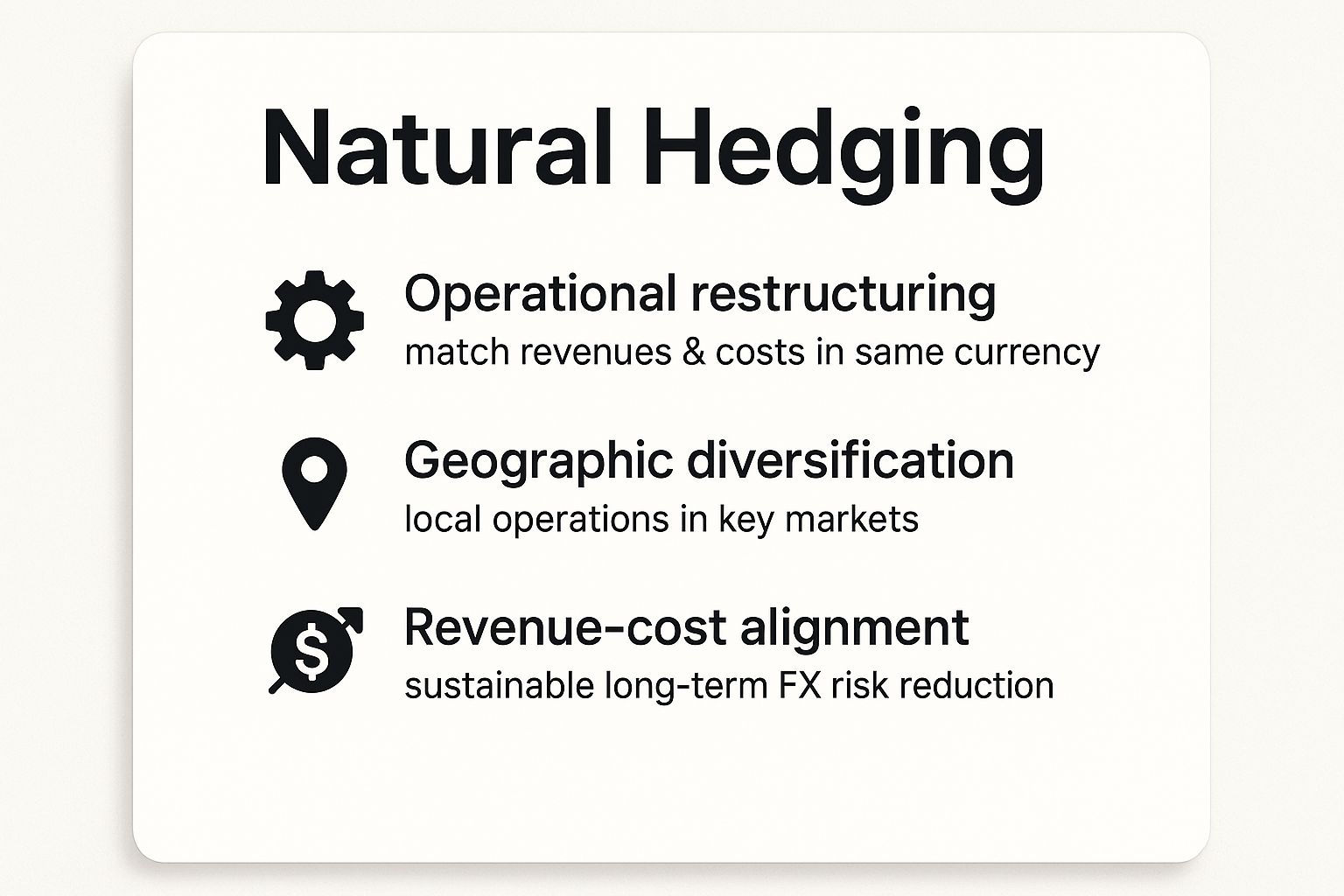
As the graphic illustrates, the strategy is fundamentally about aligning your operational footprint with your revenue streams to achieve a more stable financial outcome.
Actionable Tips for Implementation
Implementing a natural hedge requires careful planning and isn't a quick fix. It's a strategic business decision with long-term implications.
- Conduct a Thorough Analysis: Before restructuring operations, perform a detailed cost-benefit analysis. Evaluate the costs of setting up foreign operations or changing suppliers against the potential savings from reduced currency volatility.
- Start with Your Largest Exposures: Identify the foreign currency that represents your biggest risk. Focus your initial natural hedging efforts on that market to achieve the most significant impact.
- Combine with Other Strategies: A complete natural hedge is often impractical for an SME. Consider a partial hedge combined with other tools, like the forward contracts offered by Zaro, to cover any remaining exposure.
- Monitor Effectiveness: Continuously track how well your natural hedge is working. Market dynamics change, and an operational structure that works today might be less effective tomorrow.
2. Forward Contracts
Forward contracts are one of the most direct and widely used foreign exchange risk management strategies available to SMEs. It is a customised agreement between your business and a financial provider, like a bank or a specialised service like Zaro, to buy or sell a specific amount of foreign currency at a predetermined exchange rate on a future date. This approach removes uncertainty by locking in a future rate, guaranteeing the value of your international transactions regardless of market volatility.

For a South African importer purchasing goods from China, a forward contract locks in a specific ZAR/USD exchange rate for a payment due in 90 days. This means you know exactly how many Rands you'll need to settle your invoice, protecting your profit margins from a sudden weakening of the Rand. This certainty transforms currency risk from a volatile unknown into a fixed, budgetable cost, allowing for more accurate financial planning and pricing.
Key Insight: Forward contracts provide absolute certainty for future foreign currency cash flows, shifting the focus from speculating on market movements to securing predictable business outcomes.
How Forward Contracts Work in Practice
Major multinational corporations rely heavily on this tool. Apple, for instance, uses forward contracts to hedge against currency fluctuations when purchasing components from its Asian suppliers. By locking in rates for future payments in currencies like the Japanese Yen or Taiwanese Dollar, it protects its production costs and stabilises its product pricing.
This strategy is highly accessible for South African SMEs. Imagine an export business in Durban that has just secured a large order from a US client, with payment of $100,000 due in 60 days. Instead of waiting and hoping the ZAR/USD rate is favourable then, the business can enter into a forward contract to sell $100,000 in 60 days at today’s forward rate. This secures their Rand-based revenue, eliminating the risk that a stronger Rand could erode their profits.
Actionable Tips for Implementation
Using forward contracts effectively requires a clear understanding of your business's cash flows and risk appetite.
- Hedge Highly Probable Cash Flows: Only use forwards to cover transactions you are certain will occur, such as confirmed sales orders or committed purchase agreements. Hedging speculative flows can lead to losses if the transaction doesn't materialise.
- Consider Partial Hedging: You don't have to hedge 100% of your exposure. A partial hedge (e.g., 50-80%) allows you to lock in a portion of your cash flow while leaving some exposure to potentially benefit from favourable market movements.
- Match Contract Maturity: Align the settlement date of the forward contract as closely as possible with the actual date of your cash flow. Mismatched timing can create new risks or cash flow gaps.
- Work with a Reputable Partner: Choose a reliable counterparty for your forward contracts. A transparent provider like Zaro ensures competitive rates and dependable execution, minimising counterparty risk.
3. Currency Options
Currency options offer a flexible yet powerful approach to foreign exchange risk management strategies, giving a business the right, but not the obligation, to exchange a specific amount of foreign currency at a predetermined rate (the strike price) on or before a future date. This flexibility is the key differentiator from forward contracts. While a forward locks you into a rate, an option provides protection against downside risk while allowing you to benefit from favourable exchange rate movements.
For a South African SME, this means you can secure a worst-case exchange rate for a future transaction without forfeiting the potential to gain if the Rand strengthens or weakens in your favour. You pay a premium for this right, which acts like an insurance policy against adverse currency swings. This makes options particularly suitable for hedging uncertain cash flows, such as those from a potential but unconfirmed sales contract.

Key Insight: Currency options transform FX risk management from a rigid commitment into a strategic choice, providing a safety net against losses while keeping the door open to potential currency gains.
How Currency Options Work in Practice
Large corporations have long used options to manage complex exposures. A classic example is a tech giant like Microsoft hedging against potential fluctuations in its overseas revenues. If they anticipate earning €100 million but the deal isn't finalised, they can buy a put option to sell Euros at a set USD rate. If the Euro weakens, they exercise the option to protect their dollar-based earnings. If the Euro strengthens, they can let the option expire and convert their Euros at the more favourable market rate.
For a South African business, this principle is highly relevant. Imagine a local BPO company that has tendered for a large US contract. The revenue is in US Dollars but is not yet guaranteed. By purchasing a USD put/ZAR call option, the company can lock in a minimum Rand value for its potential dollar revenue. If they win the contract and the Rand strengthens (making their USD revenue worth less), their option protects their profit margin. If they lose the contract, their only loss is the premium paid for the option, a manageable cost of doing business.
Actionable Tips for Implementation
Using currency options effectively requires a clear understanding of your risk appetite and the specific nature of your exposure.
- Use for Contingent Exposures: Options are ideal when you face an uncertain future transaction, like a competitive bid or a sales contract with a performance clause. The cost of the premium is often a small price to pay for certainty.
- Evaluate the Premium Cost: The premium is influenced by the strike price, time to expiry, and market volatility. Analyse whether the cost of this "insurance" is justified by the level of risk you are mitigating.
- Consider Collar Strategies: To reduce or eliminate the upfront premium cost, you can use a "collar." This involves simultaneously buying a put option (to set a floor) and selling a call option (to set a ceiling), creating a risk-free or low-cost trading range.
- Understand Time Decay: The value of an option (its premium) decreases as it approaches its expiry date, a phenomenon known as "time decay." Be mindful of this when timing your purchase and setting the expiration date.
4. Currency Swaps
Currency swaps are sophisticated financial agreements that represent one of the more powerful foreign exchange risk management strategies for businesses with long-term international operations. This instrument involves an agreement between two parties to exchange a principal amount in one currency for an equivalent amount in another. Over the life of the swap, they also exchange interest payments, before re-exchanging the principal amounts at a pre-agreed rate upon maturity.
For a South African company, this strategy is invaluable when securing long-term foreign financing or managing cash flows from an overseas asset. Imagine an SME has acquired a factory in Germany and financed it with a Euro-denominated loan, but its primary revenue is in Rands. A currency swap allows the company to effectively convert its Euro debt into Rand debt. It can swap its Rands for Euros to service the loan, thereby locking in the exchange rate for both principal and interest payments and eliminating long-term currency risk.
Key Insight: Currency swaps transform the nature of long-term debt or assets from a foreign currency obligation into a domestic one, providing certainty over multi-year periods where exchange rate forecasting is impossible.
How Currency Swaps Work in Practice
Major multinational corporations and financial institutions like the World Bank frequently use swaps to optimise their financing. The World Bank, for instance, might issue bonds in a market where it can get favourable rates, say in Japanese Yen, and then use a currency swap to convert the proceeds and debt obligations back into US Dollars to fund its projects. This allows it to access cheaper capital without taking on unwanted JPY/USD currency risk.
While this might sound complex for a South African SME, the principle is accessible. A local manufacturing firm expanding into the US might need to borrow in Dollars to fund its new operations. If it can secure better loan terms in Rands from a South African bank, it could take the Rand loan and enter into a ZAR/USD currency swap. This would provide the necessary Dollars for its US investment while its repayment obligations are effectively in Rands, aligning its debt with its domestic financial base.
Actionable Tips for Implementation
Currency swaps are powerful but require careful consideration due to their complexity and long-term nature. They are typically reserved for significant, multi-year exposures.
- Target Long-Term Exposures: Swaps are most effective for hedging risks that extend beyond two years, such as long-term loans, international asset ownership, or multi-year revenue contracts. They are not suitable for short-term transaction hedging.
- Assess Counterparty Risk: A swap is a contract with another party. It's crucial to ensure your counterparty (usually a bank or financial institution) is financially stable and has a strong credit rating, as their failure to uphold their end could expose you to significant risk.
- Match the Terms Precisely: Ensure the swap's terms, including the principal amount, interest payment dates, and maturity date, perfectly align with the underlying loan or asset you are hedging. Any mismatch can create new, unhedged risks.
- Understand the Costs: Swaps involve costs, often built into the exchange rates or interest rates of the agreement. Work with a trusted financial partner like Zaro to fully understand the pricing and ensure the cost of the hedge is justified by the risk reduction.
5. Money Market Hedging
A money market hedge is a sophisticated method among foreign exchange risk management strategies that uses money market transactions (borrowing and lending) to lock in the value of a future foreign currency cash flow. This strategy effectively creates a synthetic forward contract, using interest rate differentials between two currencies to secure a future exchange rate today. It is particularly useful when traditional forward markets are illiquid or unavailable.
For a South African SME, this technique can be invaluable. Imagine you are due to receive €100,000 in three months. Instead of waiting and being exposed to ZAR/EUR volatility, you could borrow Euros today, convert them immediately into Rands at the current spot rate, and deposit the Rands into a South African bank account. The future €100,000 receivable is then used to repay the Euro loan. The interest earned on the Rand deposit and the interest paid on the Euro loan effectively determine your final, locked-in exchange rate.
Key Insight: Money market hedging turns the international money markets into a tool for currency risk management, allowing a business to create its own forward rate when direct hedging instruments are not ideal.
How Money Market Hedging Works in Practice
This strategy is often employed by corporate treasurers in emerging markets where forward contracts may be expensive or short-dated. It circumvents the need for a derivatives market by using fundamental banking products: loans and deposits.
Consider a South African IT firm that has just invoiced a US client for $50,000, payable in 90 days. To hedge this receivable, the firm would:
- Borrow in USD: Take out a 90-day loan for a principal amount that, with interest, will equal $50,000 in 90 days. For example, borrow approximately $49,380 today, assuming a 5% annual USD interest rate.
- Convert to ZAR: Immediately convert the borrowed $49,380 into Rands at the current spot rate.
- Deposit ZAR: Place the resulting Rands into a 90-day interest-bearing account in South Africa.
- Repay the Loan: When the client pays the $50,000 invoice in 90 days, use the funds to settle the principal and interest on the USD loan.
The company is left with the matured Rand deposit, having completely eliminated any risk from USD/ZAR fluctuations over the 90-day period. This process ensures the Rand value of the receivable is known from day one.
As this video explains, the effectiveness of the hedge hinges on the interest rates available in both currencies, which together create the "synthetic" forward exchange rate.
Actionable Tips for Implementation
Executing a money market hedge requires access to credit facilities and careful calculation to be effective.
- Compare the Costs: Before proceeding, calculate the effective exchange rate from the money market hedge and compare it to the rate offered on a traditional forward contract. Choose the more favourable option.
- Secure Competitive Rates: The success of this strategy depends heavily on securing competitive interest rates for both borrowing the foreign currency and depositing your local currency.
- Analyse Balance Sheet Impact: Taking on new loans and deposits will affect your company's balance sheet. Ensure this is accounted for and does not breach any existing loan covenants or credit facility limits.
- Clear Documentation: For accounting and auditing purposes, clearly document the transactions and the strategic purpose of the hedge. This is crucial for hedge accounting treatment.
6. Currency Diversification
Currency diversification is a sophisticated approach to foreign exchange risk management strategies that applies the principles of a balanced investment portfolio to a company's currency exposures. Instead of concentrating risk in a single foreign currency, this strategy involves deliberately spreading your business activities, and thus your revenue and costs, across multiple currencies. The core idea is that different currencies rarely move in perfect unison, so a loss in one can be offset by a gain or stability in another, smoothing out overall volatility.
For a South African business, this means not relying solely on the US Dollar or the British Pound for international sales. By expanding into different markets, for example, the Eurozone, Australia, and Japan, the SME reduces its dependence on the fate of any single currency pair, like the ZAR/USD. When the Rand strengthens against the Dollar, impacting US-based revenue, it might simultaneously be weakening against the Euro, boosting the value of European sales and creating a stabilising effect on total earnings.
Key Insight: Currency diversification treats your foreign revenue streams like a portfolio of assets. By spreading exposure across uncorrelated or weakly correlated currencies, you reduce the overall risk profile without necessarily sacrificing growth opportunities.
How Currency Diversification Works in Practice
Global giants are masters of this strategy. A company like Unilever, with operations in over 190 countries, generates revenue in a vast array of currencies. This immense diversification means that even a significant adverse movement in one currency has a diluted impact on the company's consolidated global financial results. Similarly, a South African mining company might have operations in Zambia (Kwacha), Australia (AUD), and Canada (CAD), naturally diversifying its revenue and cost base.
For a growing South African SME, the principle is the same, just on a smaller scale. A BPO business in Johannesburg, for instance, could actively seek clients not just in the UK (GBP) but also in Australia (AUD) and continental Europe (EUR). This diversifies its income streams. If a political event in the UK causes the Pound to weaken, the relative stability or strength of the Euro and Australian Dollar can help cushion the blow to the company's overall ZAR-denominated profits.
Actionable Tips for Implementation
Actively diversifying your currency exposure requires a strategic approach to market expansion and financial management.
- Analyse Currency Correlations: Before entering new markets, research the historical correlations between the currencies you are targeting. Look for pairs that do not always move in the same direction relative to the Rand.
- Focus on Economically Diverse Regions: Target markets with different economic drivers. For instance, balance exposure to a commodity-driven economy like Australia with a service-based economy like the UK.
- Balance Diversification with Efficiency: Spreading yourself too thin can create operational complexity and increase administrative costs. Start by adding one or two new currency markets that align with your business strategy.
- Regularly Rebalance Your Exposure: As your business grows in different markets, your currency mix will change. Periodically review and rebalance your exposures to ensure they align with your risk tolerance and business goals. This can be managed alongside other tools, such as the currency accounts offered by Zaro, which simplify holding and managing multiple currencies.
7. Netting and Matching
Netting and matching are sophisticated foreign exchange risk management strategies that allow businesses to reduce their overall currency exposure by consolidating and offsetting internal transactions. Netting involves aggregating a company's foreign currency payables and receivables in the same currency to arrive at a single 'net' amount. Matching takes this a step further by coordinating the timing of these cash flows to ensure they offset each other directly, minimising the need for external hedging.
For a South African SME with multiple international dealings, this means looking inwards before looking outwards for a solution. Instead of executing numerous small, separate foreign exchange transactions for every invoice you pay and receive in US Dollars, you consolidate them. By offsetting what you owe with what you are owed, you only need to manage the final net exposure, significantly reducing transaction costs and the volume of currency that is subject to market volatility.
Key Insight: Netting and matching transform multiple, scattered currency exposures into a single, manageable position, allowing for more efficient and cost-effective risk management by focusing only on the net amount at risk.
How Netting and Matching Works in Practice
This strategy is a cornerstone of treasury management for large multinational corporations. General Electric, for instance, uses a centralised treasury to net its vast number of Euro receivables from European sales against its Euro payables to European suppliers. By doing so, it only needs to hedge the much smaller net amount, saving millions in transaction fees and reducing exposure. Similarly, Siemens uses multilateral netting across its global subsidiaries to cancel out intercompany payables and receivables, streamlining cash flows and minimising FX risk.
A growing South African business can apply this same logic. Imagine an engineering firm in Johannesburg that imports components from Germany (paying in Euros) and also provides consulting services to a client in France (receiving Euros). Instead of converting Rands to Euros for the import payment and then converting the Euro revenue back to Rands, the company can use the incoming Euros from its French client to directly pay its German supplier. This internal matching process bypasses two conversion steps and eliminates the FX risk on that portion of its business.
This summary box highlights the core processes involved in netting and matching.
Actionable Tips for Implementation
Effectively implementing a netting and matching system requires strong internal coordination and clear financial oversight.
- Implement a Robust Treasury System: Use accounting software or a simple treasury management system to get a clear, consolidated view of all foreign currency payables and receivables across the company.
- Establish Clear Policies: Define a central policy for managing intercompany and third-party transactions. This includes setting rules for settlement timing and identifying which entity is responsible for managing the net exposure.
- Optimise Payment Timing: Where possible, align the timing of your currency inflows and outflows. If you know a large Euro payment is due from a customer, try to schedule your Euro supplier payments for around the same date.
- Focus on High-Volume Currencies: Begin by applying netting and matching to the currencies in which you have the most frequent two-way transactions, such as the US Dollar or Euro, to achieve the biggest initial benefit.
Foreign Exchange Risk Management Strategies Comparison
| Strategy | Implementation Complexity 🔄 | Resource Requirements ⚡ | Expected Outcomes 📊 | Ideal Use Cases 💡 | Key Advantages ⭐ |
|---|---|---|---|---|---|
| Natural Hedging | High 🔄🔄🔄 | Significant capital & operational integration ⚡⚡ | Sustainable long-term FX risk reduction 📊📊 | Long-term strategic multinational operations 💡 | No direct costs, operational synergies, competitive positioning ⭐⭐ |
| Forward Contracts | Low to Medium 🔄🔄 | Minimal upfront costs, OTC contracts ⚡ | Certainty on known future cash flows 📊 | Short to medium-term predictable cash flows 💡 | Customizable, no premium, simple implementation ⭐⭐ |
| Currency Options | Medium to High 🔄🔄🔄 | Upfront premium payments, monitoring required ⚡⚡ | Flexibility with upside potential 📊📊 | Uncertain or contingent exposures 💡 | Asymmetric risk profiles, limited downside risk ⭐⭐ |
| Currency Swaps | High 🔄🔄🔄 | Complex documentation, credit risk, long term ⚡⚡ | Long-term hedge plus interest rate management 📊📊 | Long-term financing or investment needs 💡 | Access to competitive funding, principal & interest hedging ⭐⭐ |
| Money Market Hedging | Medium 🔄🔄 | Multiple transactions, requires money market access ⚡ | Synthetic forward payoff, cost-effective sometimes 📊 | Short to medium-term hedging in limited forward markets 💡 | Uses liquid instruments, flexible structuring ⭐ |
| Currency Diversification | Medium 🔄🔄 | Management of multiple currencies ⚡ | Reduced overall FX volatility 📊 | Long-term portfolio risk management 💡 | No direct costs, strategic market exposure ⭐ |
| Netting and Matching | Medium 🔄🔄 | Sophisticated treasury systems, coordination ⚡ | Reduced net exposure and hedging costs 📊 | Ongoing operational FX netting 💡 | Lowers transaction & hedging costs, central control ⭐⭐ |
Final Thoughts
Navigating the volatile currents of the global marketplace is a defining challenge for South African SMEs. As we have explored, the fluctuations of the rand against major currencies are not merely abstract economic data points; they are tangible forces that can dramatically impact your profitability, cash flow, and overall business stability. Leaving your enterprise exposed to this foreign exchange risk is akin to setting sail in a storm without a rudder. However, by proactively implementing robust foreign exchange risk management strategies, you can transform this potential liability into a manageable and predictable business parameter.
Throughout this guide, we have dissected a suite of powerful tools, from the operational elegance of Natural Hedging and Currency Diversification to the contractual certainty offered by Forward Contracts and the flexibility of Currency Options. We’ve also delved into more complex yet effective methods like Currency Swaps, Money Market Hedging, and the internal efficiencies of Netting and Matching. The central theme connecting all these approaches is one of control. It’s about moving from a reactive stance, where you are at the mercy of market whims, to a proactive position of strategic foresight.
Key Takeaways for Your Business
To crystallise the insights from this article, let’s recap the most critical takeaways for your South African business:
- No 'One-Size-Fits-All' Solution: The ideal strategy is not universal. A business that imports raw materials and exports finished goods may find Natural Hedging highly effective, while a company with a single large, future-dated international invoice might lean heavily on a Forward Contract. Your unique operational structure, risk appetite, and cash flow patterns will dictate the optimal mix of strategies.
- Proactivity is Paramount: The most effective foreign exchange risk management strategies are implemented before a currency crisis hits. Waiting until the rand is in a freefall to devise a plan is too late. Building these practices into your standard financial operations is the hallmark of a resilient, forward-thinking enterprise.
- Cost vs. Certainty: Every hedging strategy involves a trade-off. Forward Contracts offer certainty but may lock you out of favourable market movements. Currency Options provide flexibility but come with an upfront premium. Understanding this balance is crucial for making informed decisions that align with your financial goals.
- Start with Simplicity: If you are new to forex risk management, don't feel pressured to implement complex derivative strategies overnight. Begin with the fundamentals. Can you implement Natural Hedging by invoicing in ZAR? Can you use a simple Forward Contract to lock in a rate for a significant upcoming payment? Mastering the basics builds a strong foundation.
Your Actionable Next Steps
The journey to mastering forex risk doesn’t end here. It begins with a clear, deliberate plan. Your immediate next steps should involve a thorough internal review. Analyse your exposure: identify all transactions, assets, and liabilities denominated in foreign currencies. Quantify the potential impact of adverse currency movements on your bottom line.
Once you have a clear picture of your risk profile, you can begin to map the strategies we’ve discussed to your specific needs. Engage with your financial team, consult with forex specialists, and explore modern platforms that simplify the execution of these strategies. The goal is to create a formalised hedging policy that provides clear guidelines for when and how to act.
Ultimately, effective foreign exchange risk management strategies empower your business to focus on its core mission: innovation, growth, and delivering value to your customers. By neutralising the unpredictable nature of currency markets, you secure your margins, protect your cash flow, and build a more durable and competitive enterprise, ready to thrive on the international stage.
Ready to take control of your forex risk with transparent, cost-effective solutions? Zaro provides South African businesses with the tools to seamlessly execute hedging strategies, offering competitive rates and a platform designed for clarity and efficiency. Explore how you can protect your profits and simplify your international payments at Zaro today.