At the heart of the global marketplace are the foreign exchange traders, the people who buy and sell currencies, setting in motion the price movements that shape international trade and investment. They are the engine of the world's largest financial market, and their decisions create ripples that are felt across entire economies.
Demystifying the Role of a Foreign Exchange Trader
Forget the high-stakes drama you've seen in movies. In reality, foreign exchange traders are crucial operators in the global economy. Think of them as the architects of the world's financial circulatory system, directing the flow of currencies from where they are plentiful to where they are needed most.
Their work makes everything possible, from a giant multinational corporation paying its international suppliers to a small South African business importing specialised equipment.
At its core, a trader's job is to dive deep into economic data, keep a close watch on geopolitical events, and gauge market sentiment to predict how currency values will shift. Armed with this analysis, they buy or sell currency pairs, either to generate a profit from the movement or to shield a business from risk.
Two Sides of the FX Market: Institutional vs Retail Traders
The foreign exchange market isn't just one big, monolithic entity. It’s better understood as two distinct arenas, each populated by different types of traders with very different motivations. This is a crucial distinction for any business to grasp.
The table below breaks down the fundamental differences between the market's major players: the big institutions and the individual retail traders.
Two Sides of the FX Market: Institutional vs Retail Traders
| Characteristic | Institutional Traders | Retail Traders |
|---|---|---|
| Who They Are | Professionals at banks, hedge funds, central banks, and large corporations. | Individuals trading their own capital through online brokerage platforms. |
| Primary Goal | Hedging against currency risk, proprietary trading (for the firm's profit), or executing client orders. | Speculation to generate personal profit from currency price fluctuations. |
| Trade Volume | Extremely large (millions or billions of dollars per trade). | Relatively small (from micro-lots to a few standard lots). |
| Market Impact | Significant. Their collective actions drive market liquidity and long-term price trends. | Negligible individually, but their combined activity can create short-term volatility. |
| Access to Info | Access to sophisticated research, direct interbank market feeds, and advanced analytical tools. | Primarily rely on public data, news, and retail-focused trading platforms. |
Ultimately, institutional traders are the elephants in the room—their moves create the major market currents. Retail traders, while numerous, are more like a school of fish, reacting to those currents and sometimes creating smaller, choppier waves of their own.
A key distinction lies in purpose and scale. An institutional trader might execute a massive ZAR/USD trade to help a South African mining company pay for US machinery, whereas a retail trader might make a similar, much smaller trade purely to speculate on the outcome of an upcoming economic announcement.
Understanding this division is vital for your business. The exchange rates you get for your international payments are a direct result of the supply and demand created by both institutional and retail foreign exchange traders. Their combined behaviour shapes the market you have to navigate every single day.
The importance of this market is growing at a serious pace right here in South Africa. The nation's foreign exchange market hit USD 3,861.60 million recently, and it's projected to expand to USD 6,852.50 million by 2033. That represents a compound annual growth rate of 6.58%, cementing the country's position as a key financial hub in Africa. You can explore the data in this comprehensive South Africa foreign exchange market report.
A Day in the Life of a Professional FX Trader
If you want to get a real sense of what foreign exchange traders do, it helps to walk a mile in their shoes. So, let’s imagine a typical day for a professional trader working at one of South Africa’s major banks. Forget the Hollywood image of frantic shouting and chaos; the reality is a disciplined mix of deep analysis, quick decisions, and iron-clad risk management.
The day kicks off early, usually around 6:00 AM, well before the Johannesburg Stock Exchange even stirs. This first hour is all about absorbing a flood of global information. The trader isn't just scanning headlines; they're connecting the dots.
For instance, a sudden political flare-up in the Middle East could drive up oil prices, which in turn might weaken the Rand. A surprise inflation report from the Eurozone could signal a policy shift from the European Central Bank, directly impacting the EUR/ZAR pair. This initial deep dive is about forming a market bias—a core hypothesis about which way currencies might move for the day.
Assembling the Toolkit
Once they have a general feel for the market, the focus shifts to their tools. This isn't about gut feelings or guesswork; it's a data-driven process backed by powerful technology.
- Economic Calendar: This is the day's roadmap. It lists every major data release, from local unemployment figures to an interest rate decision from the US Federal Reserve. Each one is a potential landmine for market volatility.
- Charting Software: Sophisticated platforms provide a real-time view of price movements. Here, the trader looks for patterns, identifies key support and resistance levels, and gets signals from various technical indicators.
- Real-Time News Feeds: Services like Reuters or Bloomberg are non-negotiable. They deliver market-moving news instantly, ensuring the trader is never a step behind.
These tools don’t work in isolation. The real skill lies in synthesising the fundamental news with the technical patterns on the charts to pinpoint trading opportunities where the potential reward outweighs the risk.
A professional trader's desk looks less like a casino and more like a pilot's cockpit. Every screen, chart, and news alert is there for one reason: to build a complete picture of the market and manage risk with surgical precision.
Executing Under Pressure
Let's play out a scenario. It’s mid-afternoon, and the ZAR/USD has been stuck in a narrow range all day. The trader has been patiently watching, waiting for a scheduled speech from the Governor of the South African Reserve Bank (SARB).
Suddenly, a headline flashes across the news feed: the SARB Governor has hinted at a more aggressive "hawkish" stance on inflation than anyone expected. This is the trigger. The trader’s analysis immediately tells them this news should strengthen the Rand against the US Dollar.
The next few moments are a flurry of swift, methodical actions:
- Opportunity Spotted: The hawkish comment from the SARB aligns perfectly with the trader's fundamental analysis. A quick glance at the ZAR/USD chart shows the price has just broken through a key resistance level, giving them the technical confirmation they needed.
- Trade Execution: The trader immediately places a "sell" order on USD/ZAR, betting that the US Dollar will fall against the stronger Rand. The size of the position is meticulously calculated according to the bank’s strict risk guidelines.
- Risk Management: At the exact same time, two other critical orders are set. A stop-loss order is placed at a price point that will automatically close the trade for a small, pre-calculated loss if the market unexpectedly turns against them. Think of it as a safety net. A take-profit order is also set at a specific target, designed to automatically lock in the profits if the trade goes their way.
This entire sequence—from seeing the news alert to having a fully managed trade in the market—can happen in less than a minute. It’s a powerful demonstration of the mental agility and discipline that defines professional foreign exchange traders.
Later that day, minutes from the US Federal Reserve meeting are released and sound less aggressive than the market was anticipating. This pushes the US Dollar down even further. The trader’s USD/ZAR position moves deeper into profit until it hits the take-profit target, closing out automatically for a successful trade.
The day doesn’t end with a celebration. It ends with a quiet, objective review of all the day's trades—analysing what went right, what went wrong, and getting ready to do it all again when the market opens tomorrow. This constant cycle of analysis, execution, and review is the true lifeblood of a successful trading career.
Understanding the Core Strategies That Move Markets
Foreign exchange traders don't just gamble. Their moves are calculated, based on well-defined strategies designed to read the market's mood and predict where prices might go next. Much like a detective uses different tools to crack a case, a trader relies on specific analytical frameworks to build a solid reason for buying or selling a currency.
At a high level, these strategies boil down to three main schools of thought. Each offers a unique perspective on the market, and for any South African business owner, understanding them is key to figuring out what's really driving the day-to-day shifts in the Rand.
H3: Fundamental Analysis: The Economic Detective
Fundamental analysis is all about the big picture. Imagine you’re researching a company before buying its shares—you’d look at its profits, debts, and leadership. In the currency world, the "company" is an entire country.
A fundamental trader digs into a nation’s economic health to judge the long-term value of its currency. They're obsessed with data points that signal strength or weakness.
- Interest Rate Decisions: When the South African Reserve Bank (SARB) hikes interest rates, it can make the Rand a more tempting investment for foreigners seeking better returns, which often boosts the ZAR's value.
- Inflation Reports: Runaway inflation eats away at a currency's buying power, making it less valuable over time.
- GDP Growth: A booming economy is a good sign. Strong GDP growth usually points to a stronger currency.
- Political Stability: Nothing spooks investors like political uncertainty. Geopolitical events and policy shake-ups can have a huge effect on confidence and, by extension, a currency's worth.
For instance, if South Africa's latest GDP numbers smash expectations while the US economy seems to be cooling off, a fundamental trader might see a clear reason to buy the ZAR against the USD. Their decision is rooted purely in the underlying economic "fundamentals."
H3: Technical Analysis: The Market Meteorologist
While fundamental traders pore over economic reports, technical traders are more like meteorologists. They study past price movements to forecast future conditions, believing that all the economic news is already baked into a currency's current price.
Instead of reading reports, they read charts. They hunt for recognisable patterns, trends, and formations that have historically led to certain outcomes.
The central idea for a technical trader is that history repeats itself. If they spot a chart pattern that has resulted in a price jump 70% of the time in the past, they can place a trade with a statistical edge.
Their toolbox is filled with things like moving averages, support and resistance levels, and candlestick patterns. A technical trader watching the ZAR/USD chart might see the price repeatedly try and fail to push past a certain level. They’d call this a "resistance" point and might decide to sell, betting that the price will drop back down just like it did before.
H3: Sentiment Analysis: Taking the Market's Pulse
Finally, there’s sentiment analysis, which is all about gauging the market's overall mood. Is the collective feeling among traders optimistic (bullish) or pessimistic (bearish)? This approach recognises that markets are driven by human emotion.
A sentiment trader might be watching:
- News Headlines: Are financial news outlets painting a rosy or a grim picture of the South African economy?
- Trader Positioning Reports: These reports show how many big institutional players are buying versus selling a currency, offering a peek into what the "big money" is thinking.
If a flood of negative international news hits about South Africa's power supply, a sentiment trader might sell the ZAR. Their decision isn't based on a specific economic number or a chart pattern, but on the belief that the market's overall mood has turned sour.
To execute these strategies with precision and speed, professional traders often lean on sophisticated tools, including various algorithmic trading strategies.
This table offers a quick summary of how these core strategies differ in their approach.
H3: Key Trading Strategies at a Glance
| Strategy | Primary Focus | Common Tools | Goal |
|---|---|---|---|
| Fundamental Analysis | Economic health and long-term value | Economic reports (GDP, inflation, interest rates) | Predict long-term currency direction based on a country's economic strength |
| Technical Analysis | Price charts and historical patterns | Charts, indicators (moving averages, RSI) | Identify recurring patterns to forecast short-to-medium term price movements |
| Sentiment Analysis | Market mood and trader positioning | News headlines, positioning reports, social media | Gauge collective emotion to anticipate moves driven by fear or greed |
While each strategy can stand on its own, the most effective traders rarely stick to just one.
The infographic below gives a simplified look at how a typical trade unfolds, from the initial analysis all the way through to execution and management.
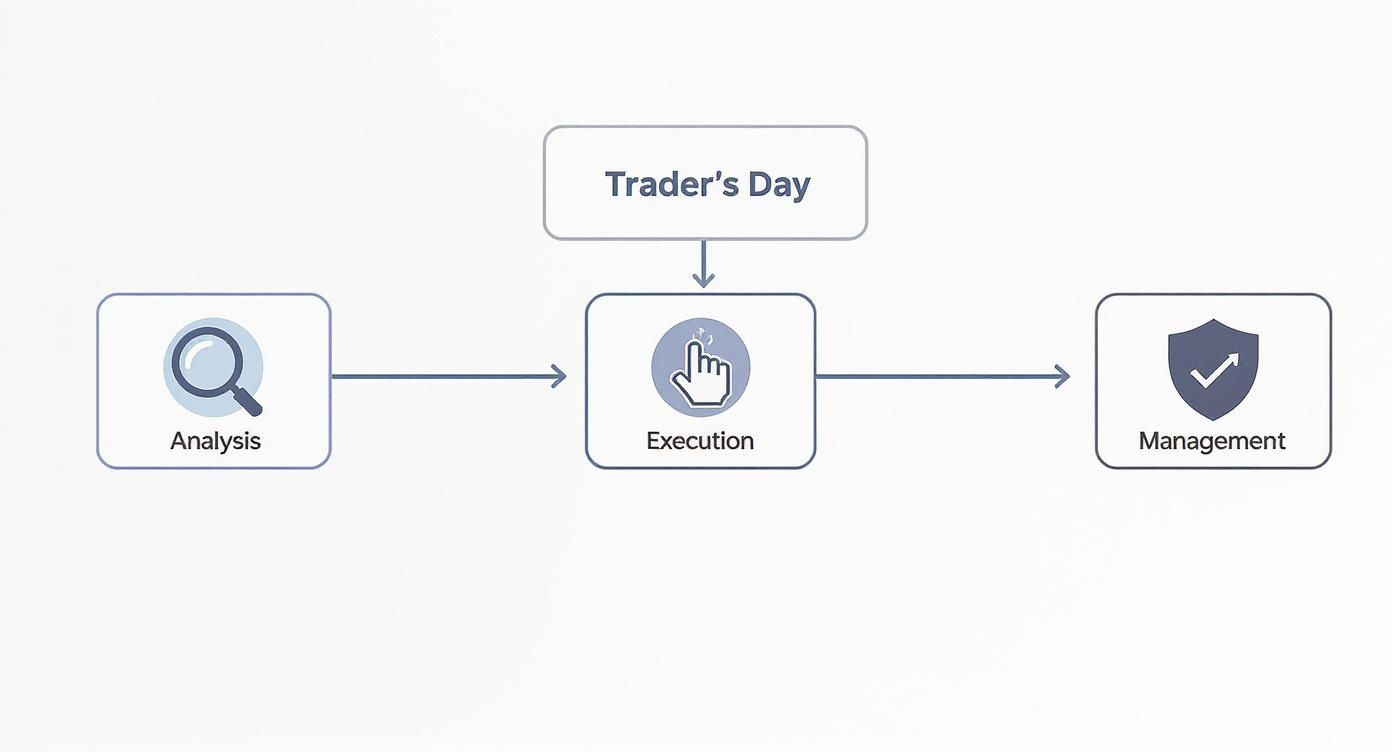
As you can see, trading is a cycle. Solid analysis always comes first, followed by the trade itself, and then careful risk management to protect the position.
In reality, most pros blend all three approaches. A trader might use fundamental analysis to decide what to trade (e.g., buy the ZAR), technical analysis to figure out when to enter the trade (e.g., when the price breaks above a key level), and sentiment analysis to make sure the rest of the market seems to agree with them.
How Trader Behaviour Impacts Your Business Payments
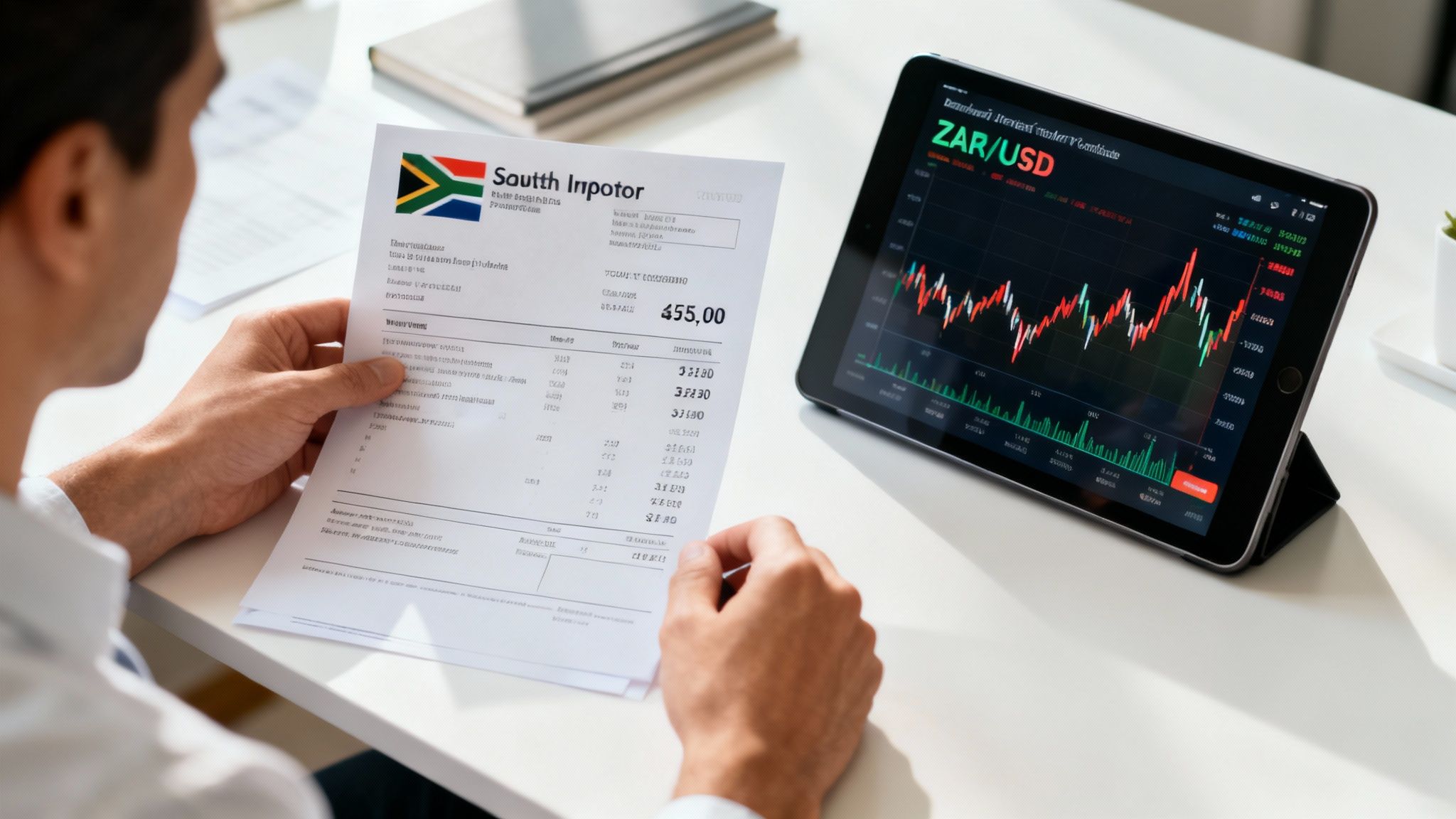
This is where the theory of forex trading crashes into the reality of your business's bottom line. The daily decisions of thousands of foreign exchange traders—from institutional giants to individual speculators—all blend together to create the one thing that directly affects your international invoices: currency volatility.
Every time the ZAR/USD exchange rate moves, even slightly, it’s a direct reflection of their collective actions. For any South African business involved in global trade, understanding this isn't just an interesting economic concept. It's a critical piece of financial planning and risk management.
The Real Cost of Currency Volatility
Let's make this tangible. Imagine you run a manufacturing business in Cape Town and you need to import specialised machinery from a supplier in the United States. The invoice is for $50,000, and the supplier gives you 30 days to settle the bill. This is exactly where the behaviour of traders starts to hit your pocket.
On the day you agree to the purchase, let's say the exchange rate is R18.50 to the US Dollar. A quick calculation tells you the machinery will cost R925,000. You budget for this amount and get on with business.
But over those 30 days, the forex market never sleeps. Traders are constantly reacting to a flood of new information, from economic reports to political headlines.
For a business, an exchange rate is a single price point needed for a transaction. For a trader, that same rate is a dynamic opportunity, a moving target influenced by global economics, politics, and market sentiment. Their activity is what causes the rate to change between the day you agree on a price and the day you pay.
Let's say two weeks later, unexpected inflation data comes out of the US. This news leads thousands of traders to bet that the US Federal Reserve will keep interest rates higher for longer, making the dollar a more attractive investment.
In a flash, they start buying US Dollars and selling other currencies, including the South African Rand. This sudden surge in demand for the dollar pushes its value up.
A Practical Example of Market Impact
Now, let's follow the money. That trader-driven event has a direct, tangible effect on your final payment for the machinery.
- Day 1 (Order Placed): The exchange rate is R18.50 per USD. Your budgeted cost is R925,000.
- Day 30 (Payment Due): After weeks of market activity driven by trader reactions to news, the rate has shifted to R19.10 per USD.
When you go to make the payment, that same $50,000 invoice no longer costs R925,000. It now costs R955,000.
That’s an extra R30,000 that has just vanished from your profit margin. It’s not because your supplier changed their price or you miscalculated. It’s because the market moved against you, driven entirely by the collective decisions of foreign exchange traders.
Geopolitical Ripples and Your Payments
The triggers for these movements aren't always purely economic, either. Geopolitical events can send massive waves through South Africa's foreign exchange market.
For instance, if the United States imposes a new global minimum import tariff, it injects a huge amount of uncertainty into the market. Traders are forced to rapidly reassess their positions to account for shifting economic conditions and trade relationships. You can find more insights into how trade policy affects markets on spglobal.com.
This shows that trader behaviour isn’t random; it's a constant reaction to global events. For any South African business, understanding what drives these reactions is the first step toward protecting your finances in an interconnected world. It makes it crystal clear why managing currency risk isn't just for big corporations—it's an essential practice for preserving your hard-earned profits.
Navigating FX Markets Without Becoming a Trader
Getting a handle on the fast-paced world of foreign exchange traders is one thing. Shielding your business from the financial tremors they cause is something else entirely. The good news? You don’t need to become a market speculator yourself to protect your profit margins from wild currency swings.
The goal isn't to try and outsmart the traders. It's about building a solid, defensive financial strategy. For a South African business, this means moving away from speculation and towards proactive risk management, using proven financial tools to add a layer of certainty to your international payments. You're essentially taking currency volatility out of the picture for the transactions that matter most.
Locking in Certainty with Forward Contracts
One of the most effective and straightforward tools in your arsenal is the forward contract. The easiest way to think about it is like pre-ordering your currency at a price you lock in today. It’s a simple agreement with a financial institution to buy or sell a set amount of foreign currency on a future date, but at an exchange rate that's fixed right now.
This single move eliminates all the guesswork. Let’s go back to our South African business importing $50,000 worth of machinery.
- The Problem: The business owner has a 30-day window of market risk, with no idea what the final Rand cost will be when the invoice is due.
- The Solution: The day the order is placed, the owner gets a forward contract to buy $50,000 in 30 days at today’s agreed-upon rate—let’s say it’s R18.50.
Now, whatever the foreign exchange traders do over the next month is irrelevant to this transaction. Even if the live spot rate skyrockets to R19.10 or even R20.00, the business is guaranteed to pay exactly R925,000. Their budget is safe, and their profit margin is secured.
A forward contract is like putting a price lock on your future currency needs. You trade the potential to gain from a lucky market move for absolute certainty and protection against a damaging one.
Gaining Flexibility with Currency Options
Forward contracts are fantastic for certainty, but sometimes a business needs more wiggle room. This is where currency options enter the picture. A currency option gives you the right, but not the obligation, to exchange currency at a pre-agreed rate on or before a certain date.
Think of it like putting a deposit down on a house. You pay a small premium to lock in the purchase price. If you find a better deal later, you can walk away—you'll just lose your initial deposit.
The Right to Buy (Call Option): An importer worried about a weakening Rand could buy a call option. If the ZAR tumbles (say, to R19.10), they can exercise their option and buy USD at the much better, pre-agreed rate (e.g., R18.50). But if the Rand unexpectedly strengthens, they can just let the option expire and buy their dollars on the open market at the new, even better rate.
The Right to Sell (Put Option): An exporter who will be paid in USD can use a put option as a safety net. This protects them if the Rand strengthens, which would otherwise devalue their dollar-denominated income when they convert it back home.
Options give you a floor to protect against losses while leaving the ceiling open to capture potential gains. This flexibility does come with the cost of an upfront premium, but for many businesses, it’s a small price for such valuable strategic control. By using these tools, you can confidently navigate the market and leave the high-stakes speculation to the traders.
Frequently Asked Questions About FX Traders
When you're dealing with global business payments, it's easy to get lost in the jargon. For South African business owners and financial managers, one of the biggest question marks is the role of foreign exchange traders. Let's break down who they are and why they matter to your bottom line.
What Is the Main Difference Between a Trader and a Broker?
It's a common mix-up, but the roles of a trader and a broker are worlds apart. They both live in the same financial neighbourhood, but they have very different jobs.
Think of it like this: a trader is the one behind the steering wheel, making the decisions. They analyse the market, look at the road ahead, and decide when to buy a currency (accelerate) or sell it (brake). They are the ones taking on the financial risk, hoping to make a profit for themselves or protect their company from losses.
A broker, on the other hand, provides the car and the highway. They are the go-betweens, giving traders the platform they need to access the market and execute their trades. For this service, brokers charge a small fee, often as a commission or a "spread" – that tiny difference between a currency's buy and sell price.
In short, a foreign exchange trader is an active participant who takes a position in the market. A broker is a service provider that enables those trades to happen.
How Do Foreign Exchange Traders Affect My Exchange Rate?
The rate you get for your international payment isn't set by a bank in a boardroom; it’s the direct result of the combined actions of millions of foreign exchange traders all over the world. Their activity creates the constant tug-of-war between supply and demand that decides a currency's price second by second.
When economic news breaks and traders decide to buy US Dollars more than they sell them, the dollar’s value climbs. If sentiment sours, and everyone starts selling, its value will drop. The exchange rate you see on your screen is simply the most up-to-the-minute price from this massive, ongoing global auction.
This means the cost of sending Rands to pay a dollar invoice can change in the blink of an eye, all because of how traders are reacting to the world around them. Their decisions create the very volatility that can eat into your profit margins.
Can My Business Trade Forex Like a Professional Trader?
Technically, anyone can open a trading account. But it’s crucial to understand the massive difference between corporate hedging and speculative trading. For your business, the goal should always be to manage risk, not to gamble.
- Corporate Hedging: This is a defensive move. Your business uses the forex market to shield itself from the risks tied to its day-to-day operations, like paying an overseas supplier or getting paid by a foreign customer. The aim is to lock in a rate and protect your profits from nasty currency swings.
- Speculative Trading: This is an offensive play. It's about taking on risk with the sole aim of profiting from currency movements. This introduces a whole new level of financial risk that is usually far outside the expertise of most non-financial businesses.
For professional foreign exchange traders wanting to set up shop in a global hub like Dubai, sorting out regulatory details like getting a DED Trader License is a fundamental step. For your business, the smart money is on using financial tools to reduce your risk, not becoming a full-time trading operation.
What Key Economic Indicators Do FX Traders Watch in South Africa?
Foreign exchange traders who trade the South African Rand (ZAR) have a dashboard of local economic data they watch like a hawk. These numbers are the vital signs of the economy, helping them decide whether to buy or sell the Rand.
As a South African business, knowing what they're looking at can give you a much better understanding of why the Rand is on the move.
Here are the big ones:
- Interest Rate Decisions: What the South African Reserve Bank (SARB) says and does is huge. Higher interest rates tend to attract foreign money, which can strengthen the Rand.
- Inflation Data (CPI): The Consumer Price Index is a major focus because runaway inflation often forces the SARB to raise interest rates.
- Gross Domestic Product (GDP): This is the economy's report card. Better-than-expected growth is almost always good news for the ZAR.
- Trade Balance: Traders look closely at the difference between what South Africa exports and imports. A surplus is a healthy sign for the currency.
- Employment Numbers: How many jobs are being created or lost gives a real-time snapshot of the economy's strength.
Beyond the hard data, traders also keep a close eye on political stability and our sovereign credit ratings from agencies like S&P and Moody’s. These factors have a massive influence on international investor confidence in the ZAR.
Navigating the currency volatility driven by traders is a major challenge for South African businesses. At Zaro, we provide the tools to take back control. Our platform offers real exchange rates with zero spread and no hidden fees, empowering you to make international payments with clarity and confidence. Stop letting unpredictable bank markups erode your profits.
Discover a smarter way to manage your cross-border payments with Zaro.