At its heart, the forex currency rate today is the price you pay to swap your money for another country's currency. Picture a price tag on a US Dollar, but the price is shown in South African Rands. This price is never static; it’s constantly on the move, affecting everything from big business deals to your personal travel budget.
Your Guide to Todays Forex Currency Rate
Getting your head around the daily forex rate is a game-changer for anyone touching the global economy. For South African businesses and individuals, the strength of the Rand (ZAR) against giants like the US Dollar (USD), Euro (EUR), and British Pound (GBP) directly shapes financial results. Every single international transaction—whether you're paying a supplier in China or getting paid by a client in London—balances on this fluctuating number.
This rate isn't decided by some committee in a boardroom. It’s the result of a massive, non-stop dance between global supply and demand. Billions of dollars are zipping around the world every minute, causing the Rand's value to wobble up and down all day long.
The Rand in the Global Market
The ZAR is what experts call a commodity-linked currency. In simple terms, its value often moves in step with the prices of South Africa’s key exports, like gold and platinum. But that's just part of the story. A whole host of other factors are constantly stirring the pot, making for a pretty lively and unpredictable market.
The constant movement in the forex market means that timing and transparency are everything. A tiny shift in the rate can mean big savings or extra costs, especially when you're dealing with large business transactions.
Let's look at a real-world example of this volatility. As of late 2025, the South African Rand (ZAR) was trading at around 17.27 per US Dollar (USD). This figure wasn't pulled out of thin air; it was the direct result of ongoing events both at home and abroad. You can dig into more detailed South African currency data to see these trends for yourself.
Ultimately, understanding the basics of the forex currency rate today gives you the power to make smarter financial moves. It turns what seems like complicated financial jargon into useful, practical knowledge that can protect your bottom line whenever money crosses a border.
What Really Moves the Rand Exchange Rate
The forex currency rate today isn't just a number pulled from thin air. It’s a real-time reflection of South Africa's economic standing on the world stage. Think of the Rand on a giant seesaw with all the other global currencies. Every major economic report, political announcement, or even a subtle shift in investor mood can add or remove weight, tipping the rate one way or the other.
Getting a handle on these forces is the first step to making sense of why the rate moves. These aren't just abstract ideas discussed by economists; they have a direct impact on the value of the ZAR in your bank account.
Interest Rates and Inflation
The South African Reserve Bank (SARB) is a key player in this ongoing drama. When it adjusts the repo rate—the country's main interest rate—it sends a huge signal to investors around the globe.
Higher Interest Rates: If the SARB pushes rates up, holding Rands suddenly becomes more appealing. International investors see a chance to earn a better return, so they buy up ZAR, and this demand boosts its value.
Lower Interest Rates: The opposite happens when rates are cut. The incentive to keep money in Rands shrinks. Investors often start looking for better returns elsewhere, selling their ZAR and causing its value to drop.
Inflation is the other half of this puzzle. If inflation runs too high, it eats away at the Rand's buying power, making it a less attractive currency to hold. This is why the SARB often raises interest rates to get inflation under control, showing just how closely these two forces are linked.
Investor Sentiment and Global Risk
South Africa is what's known as an emerging market, and that makes the Rand very sensitive to the overall mood of global investors. You'll often hear this sentiment described in simple, almost binary terms.
In a "risk-on" environment, investors feel optimistic. They're happy to put their money into assets in countries like South Africa, which strengthens the Rand. But in a "risk-off" period, fear and uncertainty take over. Investors pull their money out and flock to "safe-haven" currencies like the US Dollar, which can cause the Rand to weaken significantly.
Things like global political turmoil or worries about a financial crisis can flip the switch from risk-on to risk-off in an instant, leading to sharp drops in the ZAR's value. This constant flow of foreign money in and out of the country is one of the biggest drivers of the daily exchange rate.
Commodity Prices and Economic Data
As a country rich in natural resources, South Africa's fortunes are closely tied to the global prices of what we sell—think gold, platinum, and coal. When the prices for these commodities climb, it means more foreign currency (usually US Dollars) is coming into the country to buy them.
This creates a higher demand for Rands to convert those export earnings, which naturally pushes our currency's value up.
Finally, regular economic reports are like a report card for the country's health. Data on Gross Domestic Product (GDP), unemployment numbers, and the trade balance give everyone a clear picture of how the economy is performing. A strong GDP report can boost confidence and lift the Rand, while a poor trade figure can do the exact opposite, directly impacting the forex currency rate today.
How to Read Live Forex Quotes Like a Pro
Staring at a live forex quote can feel like you're trying to crack a secret code. All those numbers and acronyms can be intimidating at first, but it's actually much simpler than it looks. Once you know the lingo, you can instantly see how the forex currency rate today will impact your money.
At its core, every forex quote is just a simple comparison between two currencies.
Let's use a familiar example for anyone in South Africa: the USD/ZAR pair. This little snippet of text tells you exactly how many South African Rands (ZAR) you'd need to buy one single US Dollar (USD). The first currency in the pair (USD) is always the base currency, and it's always equal to one. The second one (ZAR) is the quote currency, showing you how much of it is needed to get one unit of the base.
So, if you see USD/ZAR trading at 18.50, it means you need R18.50 to buy $1. That's it.
Getting to Grips with Bid and Ask Prices
Now, here’s where things get a little more detailed. When you look up a live rate, you won't just see one number – you'll see two. This is where most people get tripped up, but it's essential to understand. These two prices are the bid and the ask.
- The Bid Price: This is what a bank or broker is willing to buy the base currency (USD, in our example) from you for. It's always the slightly lower of the two numbers.
- The Ask Price: This is what they will sell the base currency to you for. Naturally, it's the higher of the two numbers.
Think of it this way: if you're cashing in your US dollars to get Rands, the bank uses the bid price. If you need to buy US dollars with your Rands, you'll be dealing with the ask price. The bank buys from you at a lower price and sells to you at a higher one.
What on Earth is "the Spread"?
That tiny gap between the bid price and the ask price has a name: the spread. This isn't just a random difference; it’s precisely how banks and exchange services make their profit on every single transaction. It’s the built-in, and often hidden, cost you pay.
The spread is essentially the fee you pay for the service of exchanging currency. A wider spread means you're paying a higher cost, while a tighter spread means you're getting a much better deal that's closer to the real market rate.
Let's tie this all together with a real-world quote:
USD/ZAR
- Bid: 18.4950
- Ask: 18.5050
The spread here is R0.01 (which you get by subtracting 18.4950 from 18.5050). It might look like a ridiculously small amount, but when you're moving thousands of rands or dollars, that tiny gap quickly widens into a significant cost.
Understanding the bid, the ask, and the spread is the secret to reading any forex quote with confidence and truly knowing what your international money transfer is costing you.
Uncovering the Hidden Costs in Currency Exchange
Have you ever checked the forex currency rate today on a financial news site, then gone to your bank to make a transfer and been quoted something completely different? It’s a common frustration, and that difference isn’t an accident. It’s where the hidden costs of currency exchange live, and it’s a major way traditional financial institutions profit from your transactions.
The rate you see on Google or Bloomberg is what's known as the mid-market rate. You can think of this as the "true" or wholesale price of a currency. It’s the live rate banks and large financial players use to trade massive volumes with each other, representing the purest point of supply and demand without any fees baked in.
The Retail Rate and the Markup
What you, the customer, are offered is something else entirely: the retail rate. This rate always has a markup added on top of the mid-market rate. This markup, often called the spread, is essentially the built-in service fee for handling your currency conversion.
The gap between the mid-market rate and the retail rate you receive is pure profit for the financial institution. The bigger the gap, the more you are secretly paying for your international transfer.
This infographic gives a simple visual breakdown of how a forex quote is put together, showing the different parts like the bid, ask, and spread.
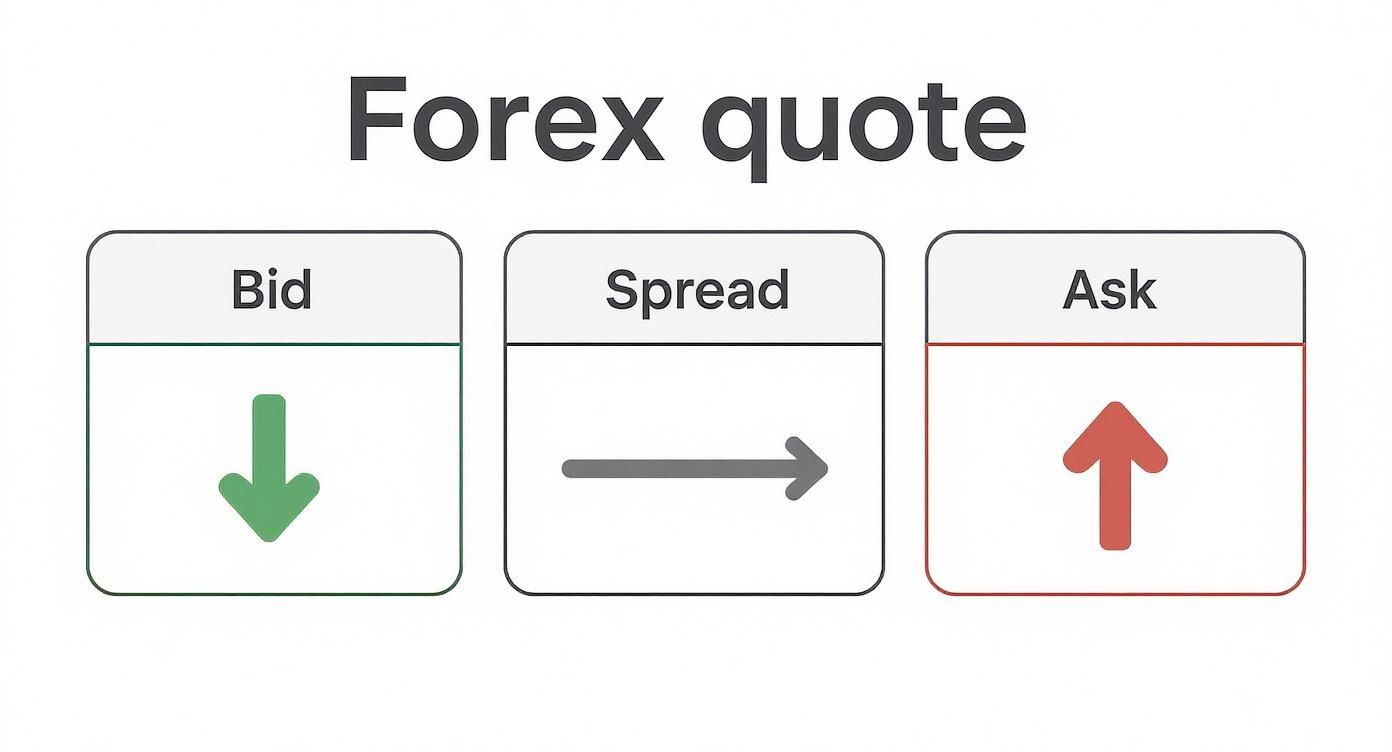
The crucial thing to realise is that this spread is the immediate cost of the transaction, and that’s before any other "transfer fees" are even mentioned.
How a Small Percentage Adds Up
A markup of just a few percentage points might not sound like a big deal, but it can eat away a surprising amount of your money, especially when you're moving larger sums for your business.
Let's walk through a real-world example. Say your business needs to pay a supplier in the United States R20,000.
The Real Rate (Mid-Market): The mid-market rate is sitting at 18.50 ZAR to 1 USD. Based on this, your R20,000 should convert to $1,081.08. Simple enough.
The Bank's Rate (with a 3% markup): Your bank, however, offers you a retail rate of 19.05 ZAR to 1 USD. At this inflated rate, your R20,000 now only buys you $1,049.86.
In this situation, that "small" markup has cost you over $31. That’s almost R600 that just disappeared from your transfer without ever showing up on a fee statement.
For businesses making regular or high-value international payments, these hidden costs can easily spiral into thousands of rands lost every year, directly hurting your bottom line. This is precisely why finding a provider that offers transfers at the real mid-market rate is so vital for any financially savvy business.
Why Retail Forex Trading Is Booming in South Africa
While many South Africans keep a close eye on the forex currency rate today for business or travel, there's another, much faster-paced world of forex that's exploding in popularity: retail forex trading. This isn't about sending money abroad; it's about speculating on the currency market itself, and it's captured the attention of thousands across the country.
This surge isn't just a random trend. It's tied directly to our unique economic situation here in South Africa. As internet access has become more widespread and slick, easy-to-use trading apps have popped up, the once-imposing walls of the financial world have come crumbling down. Now, anyone with a smartphone can trade on the same markets that were once the exclusive playground of big banks.
The promise of a new way to earn an income is a powerful draw, especially in an economy with ongoing unemployment struggles. This has fuelled a significant expansion of the retail forex market, as more people explore new avenues for financial growth. You can read more about the boom in South Africa's retail forex market on newzimbabwe.com.
The Appeal and the Inherent Risks
So, what’s the big attraction? It’s the chance to profit from the constant ebb and flow of global currency values. Traders try to predict whether the Rand will rise or fall against the US Dollar, for example, and place bets accordingly. When they get it right, they can turn a small market movement into a tangible gain.
But let's be clear: this is not a get-rich-quick scheme. The reality of retail forex trading is that it's a high-stakes environment. The market is incredibly volatile and notoriously difficult to predict, punishing anyone who dives in without a solid plan. It demands a serious commitment to learning about global economics, technical chart analysis, and, most importantly, managing risk.
While the potential for profit is what draws people in, it's the risk of loss that truly defines the experience. The high leverage offered by brokers can magnify your gains, but it can also wipe out your account just as quickly.
The numbers tell a cautionary tale. Despite the hype, the vast majority of aspiring traders don't make it. In fact, research from South African universities shows that around 72% of new forex trading accounts get liquidated within six months.
This statistic hammers home a critical truth. The forex market is full of opportunity, but it's also fraught with risk. Success isn't about having a trading app; it's about education, discipline, and a healthy respect for how quickly you can lose money speculating on the forex currency rate today.
Got Questions About Forex Rates? We've Got Answers
Even when you understand the basics, the world of forex can still feel a bit murky. It's completely normal to have questions pop up when you're dealing with the forex currency rate today, especially when your money is on the line. Getting clear answers is the key to managing your international finances with confidence.
Let's dive into some of the most common questions we hear. We'll give you straight, simple answers to help you make smarter decisions next time you send or receive money across borders.
When Is the Best Time to Exchange Currency?
Everyone wants to know if there's a "magic window" for getting the best possible exchange rate. The short answer? Not really. While currency markets are most buzzing when major financial centres like London and New York are open at the same time (usually 2 PM to 6 PM SAST), trying to "time the market" is a bit like trying to catch lightning in a bottle.
During these peak hours, the gap between buying and selling prices (the spread) can sometimes shrink a little, which is technically better for you. But for most of us, these tiny daily wobbles aren't worth the stress. A much more effective strategy is to find a provider that offers a consistently low and transparent fee structure. That will save you far more money in the long run.
How Can I Find the Real Exchange Rate?
This is the big one. The "real" exchange rate is what's known as the mid-market rate. Think of it as the wholesale price of a currency, before any markups are added. It’s the rate you'll see on financial news platforms like Google Finance, Reuters, or Bloomberg.
Always check the mid-market rate before you make a transfer. This is your baseline. By comparing this real rate to the one your bank or transfer service is offering, you can instantly see the hidden markup they’re charging you. It’s the only way to know the true cost.
Why Is the Rate I Get So Different from Online Rates?
It's a common point of frustration. You see one rate online, but get offered a completely different, less favourable one from your bank. That difference is the bank's profit margin.
Financial institutions take the wholesale mid-market rate and add a "spread" or "markup" to it. This is how they make money on the transaction, often on top of any flat fees they charge. So, the rate you’re quoted as a retail customer will always be worse than the mid-market rate you see on the news. The real question is, how much worse? That markup is the hidden fee you’re paying.
Tired of trying to decode hidden fees and unpredictable rates? With Zaro, what you see is what you get. We give your business access to the real mid-market exchange rate with zero spread and no hidden markups. See exactly how much you can save on your next international payment at https://www.usezaro.com.