Picture this: you're swapping your Rands for Dollars before a trip overseas. Now, imagine doing that, but on a gigantic, global scale, right from your phone or laptop. That's the essence of forex exchange online. It’s a worldwide marketplace where currencies are traded, and it’s the biggest financial market on the planet.
For South Africans, this once-exclusive world is now wide open.
What Is Online Forex Exchange and How Does It Work
At its core, online forex exchange is simply the act of buying one currency while selling another at the same time. Think of it like a massive, non-stop tug-of-war between currencies like our South African Rand (ZAR), the US Dollar (USD), the Euro (EUR), and the British Pound (GBP).
Traders are basically making educated guesses on which currency will get stronger and which will get weaker. For instance, if you think the Rand is about to gain strength against the US Dollar, you would buy the ZAR/USD pair. If you're right and the Rand's value climbs, you close the trade and pocket the profit. It all happens electronically through dedicated trading platforms.
The Sheer Scale of the Forex Market
To get a sense of just how massive this market is, consider this: over $7.5 trillion changes hands every single day. That figure completely overshadows the world's stock markets, making forex the most liquid financial market in existence.
What does "liquid" mean for you? It means you can buy or sell almost instantly, without waiting for a buyer or seller to show up. The market never really sleeps, either. It runs 24 hours a day, five days a week, following the sun from Sydney to Tokyo, then to London, and finally New York. This gives traders in South Africa the freedom to participate whenever their schedule allows.
The Key Pieces of the Puzzle
When you start trading forex online, there are a few essential components you'll need to get your head around. Getting these basics down is your first real step into the market.
- Brokers and Platforms: Your online forex broker is your connection to the market. They give you access to a trading platform—the software that shows you live currency prices and lets you place your trades.
- Currency Pairs: You never trade a currency by itself; it's always in a pair. For example, with the EUR/ZAR pair, you're speculating on the value of the Euro against the South African Rand.
- Price Movements: Currency values are constantly on the move, influenced by everything from economic news and interest rate decisions to political stability and general market mood. The goal is to profit from these tiny, constant shifts in value.
It all boils down to a simple principle: buy low and sell high. You’re essentially placing a bet on the economic strength of one country versus another, and you can do it all from behind a screen. This incredible accessibility has thrown the doors open for everyday people to get involved in global finance.
Getting to Grips with Forex Lingo
Before you can confidently navigate the world of online forex exchange, you need to speak the language. Think of it as learning the rules before playing a new game—once you know the terms, you can start making sense of the action. Every trade, price shift, and strategy you encounter is built on a few core ideas.
Right off the bat, you'll see currencies listed in pairs, like ZAR/USD or EUR/GBP. This is the heart of forex; you're always swapping one currency for another. In any pair, the first currency is the base currency, and the second is the quote currency. The price you see simply tells you how much of the quote currency it takes to buy one unit of the base.
For instance, if the ZAR/USD exchange rate is 0.055, it means one South African Rand will get you 5.5 US cents. Grasping this simple relationship is your first step towards reading the market.
This back-and-forth exchange of value is what drives the entire forex market. The infographic below shows this simple cycle from a trader's point of view.
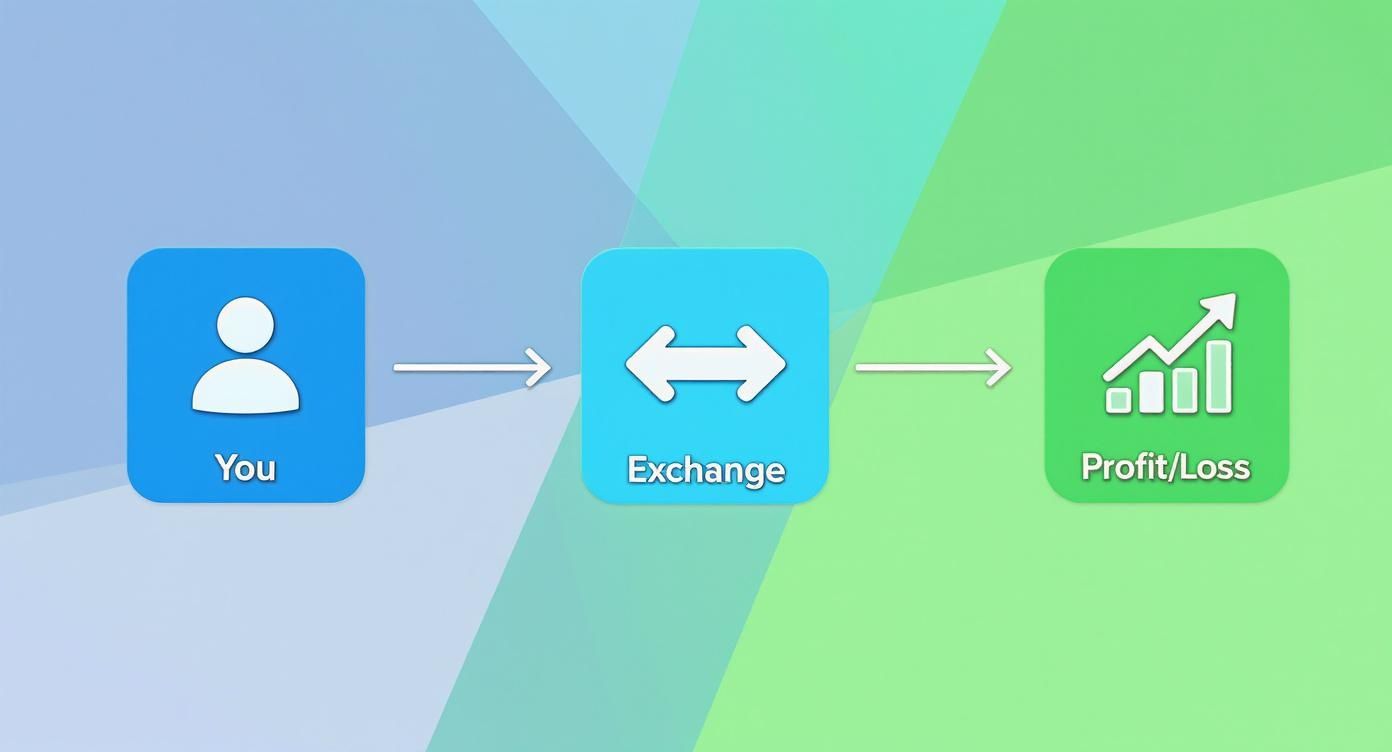
As you can see, it all comes down to you, the trader, making a call on how a currency will move. Get it right, you profit; get it wrong, you take a loss. To help you make sense of it all, let's break down the essential terms that pop up constantly.
Learning forex terminology can feel overwhelming at first. To help you get started, here is a simple breakdown of the most important concepts you'll need to know.
Key Forex Trading Concepts Explained
| Term | Simple Explanation | Why It Matters |
|---|---|---|
| Currency Pair | Two currencies quoted against each other (e.g., ZAR/USD). You buy one and sell the other simultaneously. | This is the instrument you trade. Your goal is to profit from the change in its exchange rate. |
| Pip | The smallest unit of price movement in a currency pair, usually the fourth decimal place (0.0001). | Pips are how you measure your profits and losses. A small pip movement can mean big money depending on your trade size. |
| Lot Size | The size of your trade, measured in units of the base currency. Common sizes are standard, mini, and micro. | Your lot size directly controls your risk. Bigger lots mean bigger potential profits but also bigger potential losses. |
| Leverage | A tool that lets you control a large amount of currency with a small amount of your own money. | Leverage magnifies both your gains and your losses. It's powerful but must be used with extreme caution. |
| Spread | The small difference between the buying price (ask) and the selling price (bid) of a currency pair. | This is the broker's fee for the trade. A smaller spread means lower trading costs for you. |
Understanding these five terms gives you a solid foundation. They are the building blocks for every single trade you will place.
Measuring Tiny Price Shifts with Pips
Currency prices don't jump around in huge leaps; they move in tiny, fractional increments. To measure these small changes, traders use a unit called a pip, which is short for "percentage in point." For most pairs, a pip is the fourth decimal place (0.0001).
It's a bit like measuring a long road in metres instead of millimetres. Pips give everyone a standard way to talk about price changes without getting tangled in long decimals. So, if the EUR/USD pair climbs from 1.0750 to 1.0751, traders will say it moved up by one pip. Simple.
How to Size Your Trades with Lots
In forex, a lot is just a word for the size of your trade. It’s a standard unit of whatever base currency you're buying or selling. Getting your head around lot sizes is absolutely crucial because it dictates your risk and potential reward on every trade.
- Standard Lot: This is the big one—100,000 units of the base currency. A one-pip move here is typically worth about $10.
- Mini Lot: A more manageable size at 10,000 units. A one-pip move is worth around $1.
- Micro Lot: The best starting point, a micro lot is 1,000 units. A one-pip move works out to about $0.10.
Most new traders are far better off starting with micro or mini lots. This lets you get a feel for the live market and learn the ropes without putting too much capital at risk. This accessibility is a huge reason for the market's explosive growth.
Here in South Africa, this growth is impossible to ignore. We've become the continent's top forex trading hub, processing daily volumes of around $2.21 billion. On any given day, there are about 190,000 active traders in the country. What's really driving this is the younger generation; trading volume has shot up by an incredible 450% in just two years, led by South Africans aged 18 to 25. You can get more details on Africa's leading trading nations in this comprehensive report.
Leverage: The Double-Edged Sword
One of the defining features of forex trading is leverage. In simple terms, leverage allows you to control a large position with a small amount of your own money. For example, with 100:1 leverage, you can control a $100,000 position with just $1,000 in your account.
But here's the catch: while leverage can seriously amplify your profits, it’s a double-edged sword. It magnifies your losses just as quickly. Using leverage without a solid understanding of risk management is one of the fastest ways for a new trader to wipe out their account. Treat it with respect.
Why Forex Trading Is Gaining Traction in South Africa
The sheer size of the global forex market is mind-boggling, but the really interesting story is happening right here at home. In South Africa, online forex exchange has moved out of the stuffy offices of financial experts and into the hands of everyday people. This isn't just a random trend; it's happening for some very specific reasons tied to our local economy and the tech we use every day.
For many South Africans, forex trading is more than just playing the markets—it's a real shot at creating new sources of income. In an economy that's had its fair share of struggles, people are actively searching for ways to earn extra money or build wealth beyond a 9-to-5 job. Forex provides a global platform where anyone with an internet connection can potentially capitalise on currency fluctuations, which is why it's catching on with everyone from students to young professionals and entrepreneurs.
The Power of Your Smartphone
One of the biggest drivers of this growth is probably sitting in your pocket right now. Your smartphone has completely torn down the old walls of the financial world. Things that once demanded expensive gear and a direct line to a trading floor can now be managed from anywhere with a mobile signal, all through user-friendly trading apps.
This leap in technology has removed some serious hurdles. You're no longer tied to a desk. You can check the markets and place a trade while waiting for a coffee or during your lunch break. That kind of flexibility fits perfectly into modern life, allowing people to weave trading into their existing schedules, whether that’s around a job, university classes, or family commitments.
The Barrier to Entry Has Dropped
It wasn't that long ago that you needed a small fortune just to get a foot in the door of the financial markets. That world was out of reach for the average person. Online forex brokers have completely flipped that script by offering incredibly low minimum deposits, and that has been a total game-changer.
The modern South African trader isn't some high-flying banker. They're a student checking their app between lectures, a young professional managing a trade after hours, or an entrepreneur looking to make their money work harder. The market is now open to anyone with the drive to learn.
What this really means is that you don't need to be wealthy to start. Many brokers now let you open an account and begin trading with a surprisingly small amount of cash. This low entry point makes it possible for more South Africans to get their feet wet and gain real-world experience without having to risk a huge amount of capital. It has fundamentally changed who can participate in the online forex exchange market.
A Direct Response to Our Economic Climate
South Africa’s retail forex market has exploded, even against the backdrop of a tough economy. With high unemployment figures, many people are looking for alternatives to traditional jobs, and online forex trading has emerged as a popular option. This has led to a flood of new accounts with local brokers, who in turn have made it even easier to get started. For example, the minimum deposit to start trading has dropped to as low as R200, putting it within reach for many people navigating a difficult job market. You can read more about this in this detailed report on South Africa's forex boom.
When you mix economic pressure with easy-to-use technology, you get the perfect conditions for something like forex trading to take off. For a growing number of South Africans, it offers a sense of agency and opportunity in an often uncertain financial world.
How to Choose a Safe Forex Exchange Platform
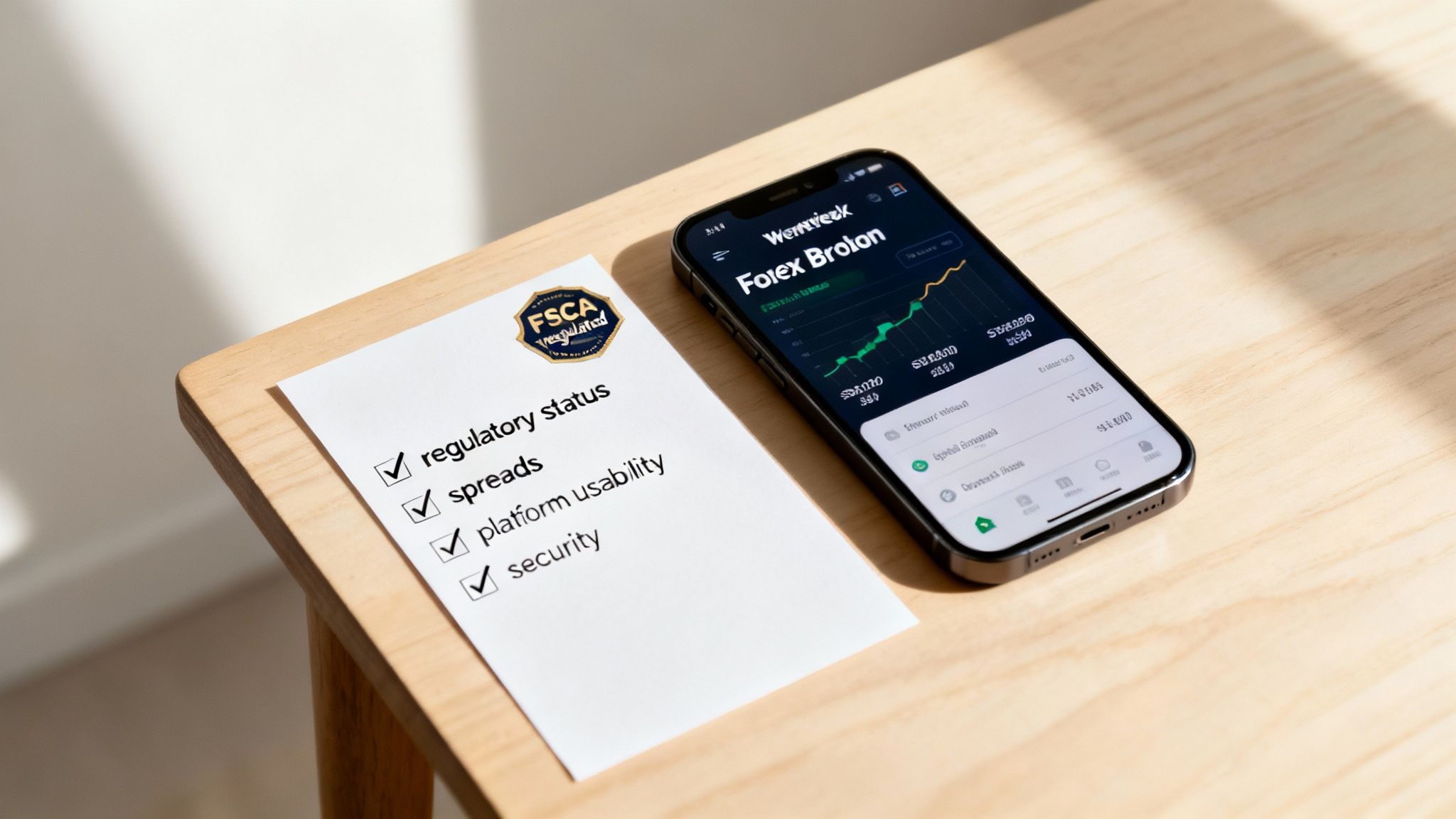
Alright, this is probably the single most important decision you'll make when you start your journey with forex exchange online. Your chosen platform isn't just a piece of software; it's your partner in the market. They hold your money, execute your transactions, and give you the tools you need to navigate the currency world.
Think of it like picking a bank. You wouldn't just give your life savings to a company with a flashy website and a nice logo. You'd check their credentials, their security, and exactly how they make their money. The same logic applies here, especially with so many options available to South Africans. You need to look past the marketing hype and dig into what really counts.
Prioritise Regulation Above All Else
Before you even think about spreads, charts, or special offers, the very first thing you need to check is regulation. This is non-negotiable. In South Africa, the main body that oversees financial service providers, including forex brokers, is the Financial Sector Conduct Authority (FSCA).
An FSCA licence isn't just a rubber stamp. It's your first line of defence. It means the broker has to follow strict rules, like keeping client money in separate, segregated accounts. This is a massive deal—it protects your capital if the company ever runs into financial trouble.
The Golden Rule: If a broker isn’t regulated by the FSCA or another top-tier international body, walk away. Don't even consider them. Unregulated brokers are the Wild West of finance, leaving you with zero protection if things go sideways.
It’s actually quite easy to check a broker's status. They usually display their FSCA licence number in the footer of their website. Your next step should be to go directly to the official FSCA website and verify that number. Make sure it's real and up to date. This simple check can save you a world of pain later on.
Scrutinise the True Cost of Trading
You'll see a lot of platforms advertising "zero commission" trading, which sounds great but doesn't mean it's free. Brokers have to make money somehow, and it’s usually through spreads and commissions. You need to get a clear picture of these costs to know how they'll impact your bottom line.
- Spreads: This is the tiny difference between the buy (ask) and sell (bid) price of a currency pair. The smaller, or 'tighter', the spread, the less it costs you to make a trade.
- Commissions: Some accounts (often called ECN accounts) charge a fixed commission for each trade but in return, offer incredibly tight spreads.
- Other Fees: Keep an eye out for the less obvious charges. These can include overnight funding fees (also called swaps), fees for not trading for a while (inactivity fees), and even fees for withdrawing your own money.
Which fee structure is best really depends on how you trade. If you're in and out of the market multiple times a day, those low spreads are crucial. If you're holding a position for weeks, the swap fees will be more important. Always read the fine print to get the full story.
Evaluate the Platform and Tools
The trading platform is your cockpit. It needs to be stable, fast, and easy to use. A clunky or unreliable platform can be disastrous, causing your trades to be executed at the wrong price—or not at all.
Many brokers use well-known third-party platforms like MetaTrader 4 (MT4) or MetaTrader 5 (MT5). These are the industry standard for a reason; they're packed with charting tools and support automated trading. Others build their own custom platforms. Either way, make sure it has:
- A User-Friendly Interface: You should be able to find what you need quickly, whether you're on a desktop or your phone.
- Advanced Charting Tools: You need a solid set of technical indicators and drawing tools to properly analyse the markets.
- Reliable Order Execution: When you click 'buy' or 'sell', the trade should go through instantly at the price you expect.
The absolute best way to put a platform through its paces is to open a demo account. This lets you trade with virtual money in a completely risk-free setting. You can get a genuine feel for how it works before you even think about depositing real funds.
For businesses, the focus shifts slightly. Platforms like Zaro are built with corporate needs in mind, prioritising institutional-grade security, transparent pricing, and robust controls for finance teams managing cross-border payments.
When you're ready to compare a few options, a simple checklist can help you stay organised and make an informed decision.
Comparing Key Features of Forex Platforms
Use this checklist to evaluate and compare different online forex exchange platforms to find the one that best suits your needs.
| Feature | What to Look For | Why It Is Important |
|---|---|---|
| Regulation | Is the broker regulated by the FSCA in South Africa or another top-tier authority (like the FCA in the UK or ASIC in Australia)? Can you verify the licence number? | This is your primary safeguard. It ensures the broker follows strict financial standards and that your funds are protected. |
| Trading Costs | What are the typical spreads on the currency pairs you trade? Are there commissions? What about swap fees, inactivity fees, or withdrawal charges? | Costs directly eat into your profits. A clear understanding of the full fee structure prevents surprises and helps you calculate your potential net returns. |
| Platform Stability | Does the platform feel fast and responsive? Does it crash or freeze? How is the order execution speed, especially during busy market times? | A reliable platform is crucial for timely trade execution. Delays or crashes can lead to significant financial losses (slippage or missed opportunities). |
| Tools & Features | Does it offer advanced charting, a wide range of technical indicators, and risk management tools like stop-loss orders? Does it support mobile trading? | The right tools empower you to perform thorough market analysis and manage your risk effectively, which is fundamental to successful trading. |
| Customer Support | Is support available when you need it (e.g., 24/5)? Can you reach them via phone, email, or live chat? Is the support team helpful and knowledgeable? | When you have an issue with your money or a trade, you need fast, effective support. Good customer service provides peace of mind and quick resolutions. |
| Account Types | Does the platform offer different account types (e.g., standard, ECN, demo)? Do the account minimums and features align with your capital and trading style? | The right account type can offer better pricing and features suited to your specific needs, whether you are a beginner or an experienced high-volume trader. |
Taking the time to run through this checklist for each platform you're considering is a small investment that pays huge dividends. It helps you move beyond the marketing and choose a reliable partner for your trading.
Navigating Risks in the South African Market
Diving into **forex exchange online** is an exciting move, but lasting success isn't just about picking the winners. It's really about learning how to handle the risks that come with playing in the world's biggest financial arena. A smart, long-term approach always begins with a clear-eyed view of the challenges ahead.The most obvious risk you'll face is market volatility. Currency prices never sit still; they're constantly reacting to economic news, political shifts, and global investor sentiment. This movement is exactly what creates profit opportunities, but it’s also what can lead to quick, substantial losses. A trade that looks great one moment can turn sour the next.
This is particularly true for a dynamic market like South Africa's. The rand's value can be influenced by everything from commodity prices and local interest rate decisions to general investor confidence. For instance, our national foreign exchange reserves—a buffer against global shocks—recently stood at around $69.74 billion. While solid, this figure fluctuates, showing how national finances can directly impact the market you're trading in.
Understanding the Double-Edged Sword of Leverage
Leverage is one of the most powerful tools in a forex trader's kit. It lets you control a large market position with a relatively small amount of your own money. While it can supercharge your profits, it's a double-edged sword that demands respect. Leverage magnifies your losses just as effectively as it magnifies your gains.
Let's say you're using 100:1 leverage. A tiny market move of just 1% in your favour could potentially double your trading capital. But here's the catch: a 1% move against you could wipe out your entire investment for that trade. This is precisely why jumping in with high leverage and no solid risk plan is one of the fastest ways for new traders to lose their capital.
The golden rule of trading is simple: only invest money you are genuinely prepared to lose. Never trade with funds earmarked for rent, groceries, or your retirement. This discipline protects your financial stability and helps you make trading decisions based on strategy, not fear.
A huge part of successful trading, especially in a market like ours, involves truly Mastering Risk Management in Investing. This means having a disciplined plan to protect your capital from the market's natural ups and downs.
Essential Risk Management Tools and Strategies
The good news is that modern trading platforms come equipped with tools designed specifically to help you manage risk. Making these a non-negotiable part of your trading routine is fundamental to building a sustainable strategy.
The most important of these is the stop-loss order. Think of it as your safety net. It's an automatic instruction you set to close a trade if the price hits a specific level you've decided on beforehand. By setting a stop-loss, you define the maximum amount you're willing to lose on any single trade, which stops a bad trade from becoming a disaster.
Here are a few core risk management habits to build from day one:
- Use Stop-Loss Orders on Every Trade: This is your first and best line of defence.
- Calculate Your Position Size Carefully: A common rule of thumb is to never risk more than 1-2% of your total trading capital on any one trade.
- Set Take-Profit Orders: Just as a stop-loss protects you from further losses, a take-profit order automatically closes a winning trade at your target price, helping you lock in gains before the market has a chance to turn.
The Protective Role of the FSCA
Here in South Africa, traders have a vital layer of protection thanks to the Financial Sector Conduct Authority (FSCA). This is the regulatory body that makes sure licensed brokers operate fairly, transparently, and in their clients' best interests. Choosing an FSCA-regulated broker is one of the most important first steps in your risk management plan, as it ensures you're trading within a framework of accountability and security.
Your Action Plan for Getting Started
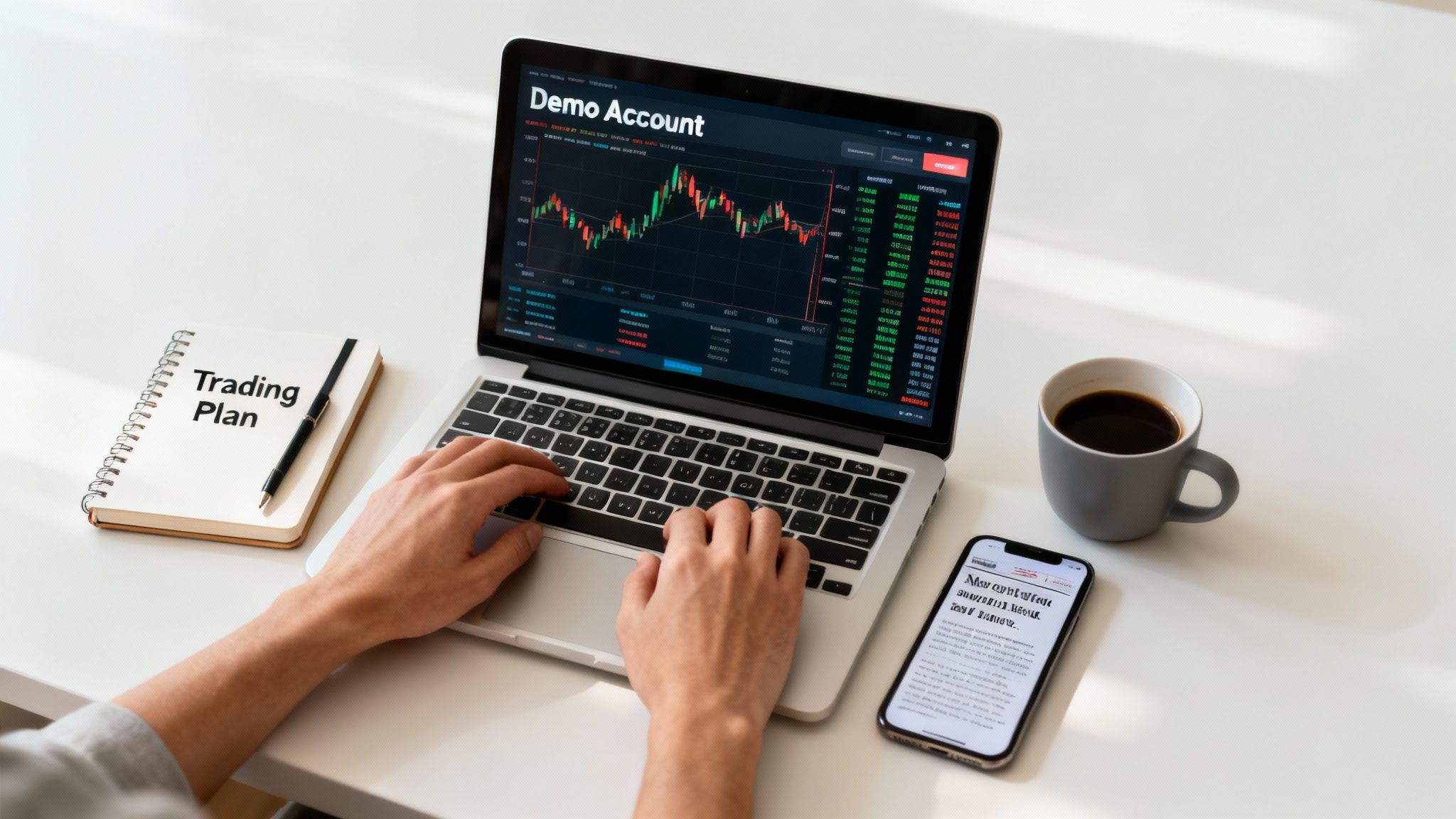
Feeling ready to jump into forex exchange online? That’s great, but the key is to turn that excitement into a plan, not a series of impulsive clicks. This simple roadmap will guide your first few moves, making sure you start off on solid ground by prioritising education and practice.
The goal isn't to dive in headfirst. It's about building real experience in a safe space first. This way, you get a genuine feel for how the market moves and can test your ideas without risking your hard-earned money from the get-go.
Your Most Important First Step
Before you even think about trading with real rands, there’s one thing you absolutely must do: open a demo account. Seriously, this is non-negotiable for anyone new to the game. A demo account is essentially a trading simulator that uses a live platform and real-time market data, but you trade with virtual money.
Think of it as a flight simulator for traders. You get to feel the turbulence of market swings, practise placing orders, and see how your strategies actually perform under real conditions—all with zero financial risk.
Success in forex is a marathon of learning and discipline, not a sprint to quick riches. The habits you build in a demo account—patience, analysis, and risk management—will become the bedrock of your real trading career.
Once you start getting the hang of things in the demo environment, the next step is to create a simple framework to guide your decisions. It doesn’t have to be complicated, just clear.
Building Your Basic Framework
A trading plan is your personal rulebook. It’s what keeps you grounded when emotions are running high. Your first plan should just cover the basics:
- Define Your Strategy: What specific market conditions will trigger you to enter or exit a trade?
- Set Your Risk Rules: Decide exactly how much you’re willing to risk on a single trade. A common rule of thumb is 1% of your total account balance.
- Stay Informed: Get into the habit of checking an economic news calendar. Major announcements can send currency prices soaring or tumbling in an instant.
As you get more comfortable, you might want to explore more advanced analytical tools. Looking into different time series forecasting techniques can offer deeper insights into market trends and help you fine-tune your strategy. This slow and steady process of learning and applying is what builds the confidence you need to navigate the forex market with a cool, disciplined head.
Your Top Forex Questions Answered
Diving into the world of online forex exchange naturally brings up a lot of questions. Getting clear, honest answers is the first step to building the confidence you need to trade smart. Let's tackle some of the most common queries we hear from newcomers in South Africa.
My aim here is to cut through the noise and give you straight answers. Once you have a handle on these basics, you'll be in a much better position to move forward.
Is Forex Trading Legal in South Africa?
Yes, absolutely. Forex trading is perfectly legal in South Africa, but there’s an important catch: it has to be done the right way. The industry is watched over by the Financial Sector Conduct Authority (FSCA), our country's main financial regulator.
This means you must trade through a broker that is officially licensed by the FSCA. Think of the FSCA as a safety net; choosing a regulated broker ensures you're playing by the rules and adds a layer of protection for your money. Any platform that isn't regulated by the FSCA is operating outside of South African law, and that’s a red flag you can't ignore.
How Much Money Do I Really Need to Start?
This is probably the number one question on everyone's mind, and the answer might surprise you. Thanks to online platforms, you don’t need a fortune to get started anymore.
Many FSCA-regulated brokers in South Africa will let you open an account with as little as R200. While it's great that you can start small, remember that trading with a tiny amount can make it difficult to manage risk properly. Having a bit more starting capital gives you the breathing room you need to make smarter decisions.
The Golden Rule: Never, ever trade with money you can't afford to lose. This isn't the place for your rent money, your emergency fund, or your retirement savings.
What’s the Best Currency Pair for a Beginner to Trade?
When you're just finding your feet, it's best to stick with the "majors." These are the major currency pairs that involve the world's biggest economies. They have the most trading activity, which usually means tighter spreads (lower costs) and more predictable movements compared to the more obscure pairs.
The big players on the field are:
- EUR/USD (Euro / US Dollar)
- GBP/USD (British Pound / US Dollar)
- USD/JPY (US Dollar / Japanese Yen)
- USD/CHF (US Dollar / Swiss Franc)
Naturally, many South Africans are drawn to the USD/ZAR (US Dollar / South African Rand) pair because they understand the local currency. Just be aware that the Rand can be a wild ride—its volatility can create big opportunities, but it also carries significant risk.
Is It Actually Possible to Make a Living from Forex?
Let's be real about this one. While a small number of people do make a living from trading, it's incredibly difficult and not the norm. It takes years of practice, iron-clad discipline, a deep understanding of market dynamics, a solid strategy, and a substantial amount of capital.
Anyone selling you the dream of getting rich quick with forex is leading you down a dangerous path. A much healthier way to look at it is as a skill you can develop over time, or perhaps as a way to generate some extra income on the side. True success isn't about one massive win; it's about consistency, discipline, and managing your risk smartly over the long haul.
For South African businesses, managing currency exchange isn't a speculative venture—it's a daily operational need. If you're tired of losing money on international payments, Zaro provides a straightforward solution. We give you access to the real exchange rate with zero spread, cutting out the hidden fees that banks typically add. Take control of your foreign exchange costs and simplify your global transactions by checking out Zaro today.