So, what exactly is the foreign exchange market?
Think of it less like a stuffy financial institution and more like a massive, bustling global marketplace. It’s where currencies are constantly being bought and sold. For your business, this market is the engine that drives every single international payment, whether you're paying a supplier in Shanghai or getting paid by a client in San Diego.
At the heart of it all is the exchange rate—simply the price of one currency in terms of another. This price is never static; it’s always moving, influenced by everything from global economic news to the simple forces of supply and demand.
Making Sense of the Global Marketplace
Every time your South African business pays an overseas invoice or receives foreign currency, you're stepping onto the forex playing field. This isn't just some abstract concept for big banks and day traders; it's a real-world factor that directly hits your profit margins. Getting to grips with how it works is the first, most crucial step to controlling your international costs.
The problem is, for most small and medium-sized businesses, the forex world feels deliberately complicated and unnecessarily expensive. Traditional banks often put up a simple storefront, but behind the scenes, the true costs are buried in the fine print and complex processes. This opacity can quietly, but surely, eat into your revenue.
The Forex Hurdles Every SA Business Faces
For a South African SME, making an international payment is rarely just a straightforward currency swap. When you go through the old-school banking system, you’ll almost certainly run into a few familiar obstacles:
- Hidden Bank Fees: Most of the costs are lumped together or not itemised at all. You might see a "transfer fee," but what you don't see are the markups and correspondent bank charges tacked on as your money moves across the globe.
- Poor Exchange Rates: The rate a bank gives you is almost never the real mid-market rate. They add their own margin, a "spread," which is basically a hidden fee that guarantees them a profit at your expense on every single transaction.
- Painfully Slow Transfers: International payments can take days, sometimes even a week, to finally land. This ties up your cash flow, creates uncertainty, and can even strain relationships with suppliers waiting to be paid.
These aren't just minor annoyances. They are real costs that shrink your margins and add unnecessary friction to your operations. A 2% spread on a R500,000 payment, for instance, is a R10,000 loss you didn't have to take.
Understanding these pain points is the key. It changes the game from passively accepting whatever rate you're given to actively managing your international finances. The goal is to become an informed business owner who demands transparency and efficiency, not one who just takes what the bank offers.
To help you get started, let's break down the essential language of forex. These aren't just buzzwords; they're the concepts that determine how much money you keep and how much you lose on every international transaction.
Forex Fundamentals Key Terms for Your Business
A simple breakdown of the essential forex terms every South African business owner needs to know before making an international transaction.
| Term | What It Really Means | Why It Matters for Your Bottom Line |
|---|---|---|
| Exchange Rate | The price of one currency compared to another. Example: How many Rands it takes to buy one US Dollar (USD/ZAR). | This number directly determines the cost of your imports or the value of your export revenue. Even a small change can have a big impact. |
| Spot Rate | The "real" exchange rate at this very moment. It's the live, mid-market price without any hidden markups. | Banks rarely give you this rate. Knowing it gives you a benchmark to see how much of a margin (spread) you're actually being charged. |
| Spread | The difference between the rate a bank buys a currency at and the rate they sell it to you. It's their hidden profit margin. | This is one of the biggest hidden costs in forex. A wider spread means you're paying more for the currency than it's actually worth. |
| SWIFT Network | The global messaging system banks use to send money internationally. Think of it as the postal service for money. | While reliable, it can be slow and expensive. Each "correspondent" bank that handles the payment along the way can charge a fee, which gets passed on to you. |
Once you understand these terms, you can start to see where the hidden costs are hiding.
Later in this guide, we’ll pull back the curtain and show you exactly how these fees are calculated. More importantly, we'll introduce you to modern solutions that get rid of them completely, putting you firmly back in control of your global payments. It’s time to bypass the old system’s roadblocks and adopt a smarter approach built for the way business works today.
The Hidden Costs in Your International Payments
Ever made an international payment and noticed the final amount that left your account was a bit more than you’d calculated? It’s a common frustration for business owners. What seems like a straightforward transaction is often loaded with hidden costs buried within traditional banking systems, silently chipping away at your profit margins.
To stop this drain on your resources, you first need to know where to look. The two biggest offenders are the exchange rate spread and SWIFT fees. They might sound like technical banking terms, but they’re really just clever ways your money is used to make someone else a profit.
This flow chart breaks down the typical hurdles businesses face when dealing with forex—from opaque fees and poor rates to infuriating payment delays.
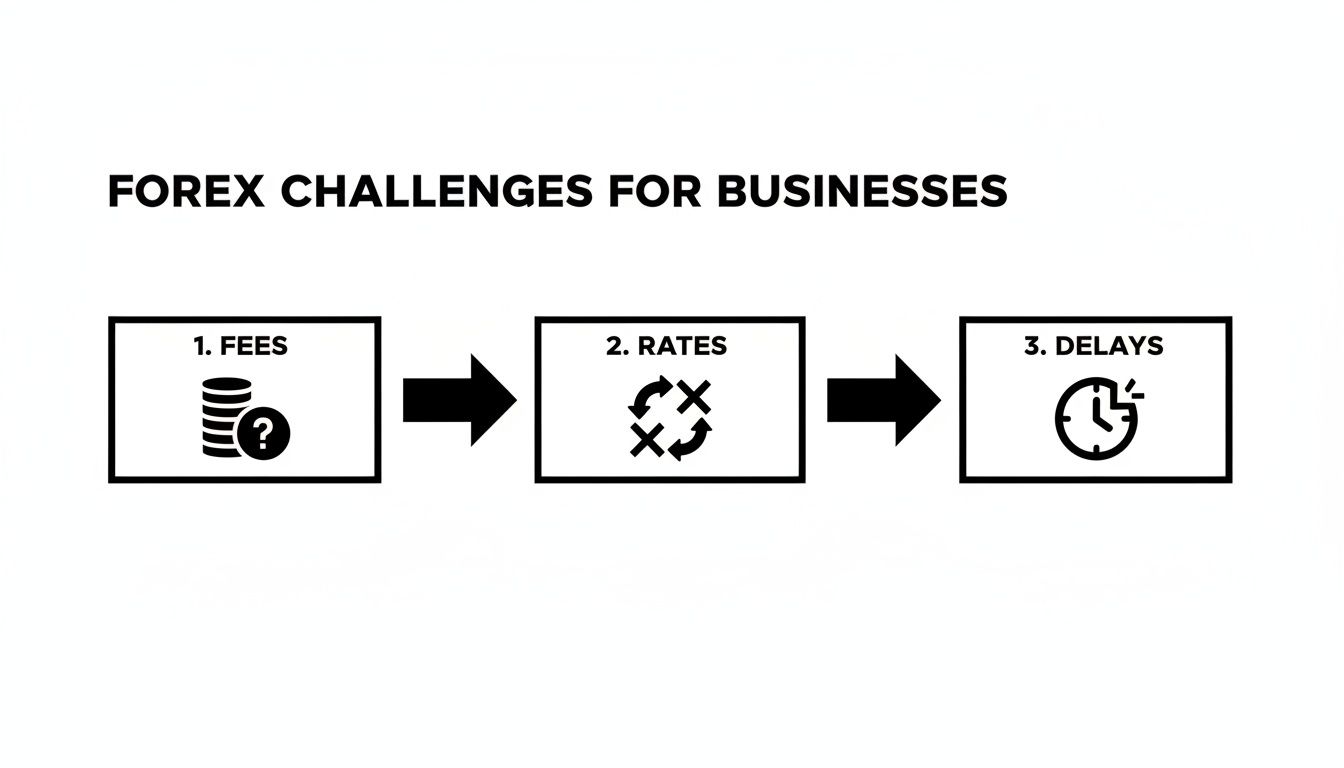
Each of these steps is a potential point where your business loses money. That’s why finding a transparent and efficient way to handle foreign payments is so critical for protecting your bottom line.
The Real Cost of the Exchange Rate Spread
By far, the biggest hidden charge is the exchange rate spread. This is simply the gap between the real mid-market exchange rate—the one you see on Google—and the less favourable rate your bank or provider actually gives you. Think of it as their built-in profit margin on the currency itself.
Let’s put it into real numbers. Say your South African business needs to pay a US supplier $5,400. You check the live mid-market rate and it’s R18.50 to the dollar.
- Real Cost: At that live rate, the payment should cost you exactly R99,900 (5,400 x 18.50).
But your bank won’t offer you that rate. Instead, they’ll quote you something like R18.95 to the dollar. That R0.45 difference is their spread.
- Bank Cost: With their marked-up rate, the payment now actually costs you R102,330 (5,400 x 18.95).
Just like that, the hidden spread has cost your business an extra R2,430 on a single payment. This isn’t a line-item fee you can query; it’s baked right into the rate. When you multiply that across dozens of payments over a year, you’re talking about tens of thousands of Rands in lost profit.
The spread isn't a fee for a service; it's a profit margin. The less transparent the rate, the more likely you are to be paying a significant, un-itemised cost for every single transaction.
Demystifying SWIFT and Correspondent Bank Fees
The second major hidden cost is tied to the SWIFT network, the decades-old system most banks rely on to send money across borders. Imagine it as an international postal service for money, where your payment gets passed between several "correspondent" banks before it reaches its final destination.
Here’s the catch: each bank in that chain can dip in and take a handling fee for passing it along. The real problem is the lack of transparency. You’re often quoted one price for the transfer, but the amount your supplier receives is short because these intermediary banks took their cut along the way.
This creates a few headaches for your business:
- Unpredictable Costs: You never quite know the final cost of the transfer until it’s all over.
- Payment Shortfalls: Your supplier receives less than the invoice amount, leading to awkward follow-up calls and reconciliation nightmares.
- Slow Transfers: This multi-step journey means payments can take anywhere from three to seven business days to finally land.
Beyond these direct financial costs, the manual work involved in processing international invoices adds another layer of administrative expense. Using tools like automated accounts payable systems can help cut down on these operational overheads significantly. By spotting both the direct transaction costs and the indirect operational ones, you put your business in a powerful position. The goal is to move away from systems that profit from complexity and choose a partner that values transparency.
What Really Drives Foreign Exchange Rates
Exchange rates don't just move on a whim. They’re pushed and pulled by the massive global forces of supply and demand, just like oil, gold, or any other commodity. Getting a handle on why these rates shift is the first step for any business owner who wants to get ahead of currency risk, not just react to it.
Think of it like a giant seesaw with the South African Rand (ZAR) on one end and the US Dollar (USD) on the other. That seesaw’s position—the exchange rate—is always tipping one way or the other based on which economy investors feel is stronger, more stable, or simply offers a better return.
When global sentiment is positive towards South Africa, money flows in, demand for the Rand goes up, and its value climbs. But if a global crisis flares up or our local economic news is grim, investors often rush to the perceived safety of the US Dollar, and the Rand takes a hit.
For any business buying or selling internationally, this dynamic is everything. The real value of your invoices, the final cost of your imported goods, and your bottom-line profitability are all tied directly to these big-picture economic forces.
Key Drivers of the ZAR Exchange Rate
So, what are the main forces pushing that seesaw up and down? For a South African business, keeping an eye on these key indicators helps make sense of why the Rand is doing what it's doing.
Interest Rates: When the South African Reserve Bank (SARB) hikes interest rates, it makes holding Rands more attractive to foreign investors looking for higher returns. This flood of capital strengthens our currency. The reverse is also true—if the US Federal Reserve raises its rates, capital might flow out of South Africa and into the US, weakening the Rand.
Inflation Reports: Simply put, high inflation eats away at a currency's buying power. If South Africa's inflation rate is consistently higher than that of our major trading partners, the Rand will likely lose value over time because it just can’t buy as much.
Economic Stability and Growth: The overall health of the economy is a huge confidence booster. Good news like strong GDP growth, low unemployment, or a stable political climate makes investors feel secure, strengthening the Rand. Bad news does the exact opposite.
Once you start tracking these drivers, your whole perspective changes. Exchange rate movements stop feeling like random, unpredictable shocks. You begin to see them as logical reactions to global economic events, which allows you to plan with much more confidence.
South Africa's Unique Position in the Forex Market
For South African businesses, you can't separate the forex conversation from the country's unique role as the largest FX hub in Africa. This gives us a deep, liquid market for the ZAR, especially when trading against major currencies like the US Dollar.
The South African foreign exchange market was valued at around USD 3.8 billion in 2024 and is on track to hit over USD 6.8 billion by 2033, according to IMARC Group. This isn't just abstract growth; it's driven by real trade and financial reforms that are making it easier for businesses like yours to tap into foreign currency markets. You can find more details in the South African forex market report from IMARC Group.
What this means in practice is that when a local exporter invoices a client in USD but pays all their staff and suppliers in ZAR, they are working within one of the most efficient currency corridors on the continent. The move from old-school, phone-based trading to transparent digital platforms has been a game-changer, especially for SMEs that used to get a raw deal from the banks.
Modern financial platforms like Zaro plug directly into this sophisticated infrastructure. We give businesses access to the real-time spot rates with no hidden spreads, tapping into the same deep liquidity pools the big corporations use, but with clear and predictable costs.
Practical Forex Tools for Managing Your Payments
Understanding what makes exchange rates tick is one thing, but actually managing them is a whole different ball game. Let's move from theory to action and look at the practical tools your business can use to handle foreign currency payments and protect your bottom line. Think of these as the core of any solid international payment strategy.
The most common tool, and the simplest to get your head around, is the spot transaction. It’s basically the "buy now" button for foreign currency. If you have an invoice from a supplier in the US that’s due today, you’d use a spot transaction to buy US Dollars at the live exchange rate for immediate payment.
This is perfect for those urgent, one-off payments. The main benefit is its simplicity—you see the rate, you agree, and the deal is done. The big drawback? It offers zero protection against future currency swings. You're completely at the mercy of whatever the rate happens to be on the day you need to pay.
Locking in Future Certainty with Forward Contracts
For any business that plans ahead, a forward contract is a much more strategic move. It lets you lock in an exchange rate today for a transaction that will happen down the line—anywhere from three days to a year or more. It's an incredibly powerful tool for managing risk and bringing some much-needed certainty to your budget.

Imagine your South African company lands a deal and is due a $100,000 payment from an American client in 90 days. The current USD/ZAR rate is a nice R18.50, but you're worried the Rand might strengthen over the next three months, eating into your profits.
- Without a Forward Contract: If the rate drops to R17.90 by the time the money lands, your revenue shrinks from R1,850,000 to R1,790,000. That’s a R60,000 loss you didn’t see coming.
- With a Forward Contract: You could lock in that R18.50 rate today. Now it doesn't matter what the market does; you are guaranteed to receive exactly R1,850,000 in 90 days.
A forward contract transforms currency risk from an unpredictable threat into a fixed, manageable cost. It gives you the peace of mind to price your goods and services confidently, knowing your profit margin is safe.
These instruments are fundamental to how the forex market operates. In fact, South Africa is the continent's forex powerhouse, with over USD 20 billion in daily turnover. The deep liquidity in pairs like USD/ZAR is built on the very same spot and forward transactions your business uses. To get a broader perspective on the African forex landscape, you can find more insights in the forex trading outlooks from Contentworks Agency.
Modernising Payments with Multi-Currency Accounts
While spot and forward contracts are essential reactive tools, a multi-currency account represents a more fundamental, proactive shift. Instead of constantly converting currencies for every single transaction, this lets you hold, send, and receive money in multiple currencies all from one place.
For a South African business, this is a complete game-changer. You can get paid in USD from American clients and just keep it in a USD balance. Later, you can use those same dollars to pay for your US-based software subscriptions or suppliers directly, without ever having to convert the funds back and forth to Rand.
This approach has some massive advantages:
- Dodges Repeated Conversion Fees: You sidestep the spread and other fees on every single transaction, which saves a surprising amount of money over time.
- Provides a Natural Hedge: By matching your foreign currency income with your foreign currency expenses, you naturally shield yourself from exchange rate volatility.
- Speeds Up Payments: Paying directly from a local currency account (e.g., USD to USD) is often much faster and simpler than routing payments through the international SWIFT network.
These practical tools—spot deals, forwards, and multi-currency accounts—give you the control you need to navigate the forex market. By picking the right tool for the job, you can stop being a passive victim of market rates and become an active manager of your international finances.
A Better Way to Handle Your Business's Forex Needs
Let's be honest, the old way of handling foreign exchange was built for a different time. For today’s South African businesses, dealing with hidden spreads and unpredictable SWIFT fees isn’t just a hassle—it's a real barrier to growth. It turns the simple act of making an international payment into a source of frustration and financial guesswork. It’s high time for an approach that actually prioritises clarity and efficiency.
Imagine seeing an exchange rate online and knowing that’s the exact rate you’ll get. No more trying to figure out how much a transfer will really cost after all the fees are skimmed off the top. This isn't some futuristic idea; it's the new standard for business forex, built on one simple principle: total transparency.
This modern model tackles the biggest problems of the old system head-on. Instead of making money from confusing you, it delivers value through simplicity and fairness. The goal is to put you, the business owner or finance manager, back in control.
Getting Rid of the Hidden Costs
The heart of this new approach is stripping away the two biggest drains on your profit: the spread and SWIFT fees. By getting rid of these hidden markups, an unpredictable expense becomes a fixed, manageable cost of doing business.
Here’s the breakdown:
- Zero Spread on Exchange Rates: You get access to the real, live mid-market exchange rate (the spot rate). The price you see is the price you pay, with no hidden percentage tacked on. This one change can save businesses thousands of Rands on every single large transaction.
- No SWIFT or Correspondent Fees: By using smarter, more efficient payment networks, modern platforms can bypass the slow and expensive SWIFT system entirely. Your payments arrive faster and in full, with no intermediary banks taking a slice along the way.
The effect of this transparency is powerful. When you know the exact cost upfront, you can budget accurately, price your products with confidence, and protect your profit margins on international deals.
The core idea is simple: You should pay for the service of moving money, not for the money itself. Accessing the real exchange rate is the difference between being a price-taker and being a financially empowered business.
Taking Control with Multi-Currency Accounts
It's not just about cutting costs. A modern forex solution gives you tools to genuinely manage your global cash flow. The most powerful of these is the multi-currency account, a game-changer for any business operating across borders.
For a South African company, this means you can hold balances in both ZAR and USD. This might sound simple, but it unlocks incredible financial and operational efficiency.
Just think about these practical benefits:
- Get Paid in USD Like a Local: When your American client pays an invoice, the funds land directly in your USD account. There’s no forced, expensive conversion back into Rand.
- Pay USD Expenses Directly: Need to pay an international supplier or for a software subscription? Just use the funds sitting in your USD balance, again skipping any conversion fees.
- Reduce Your Currency Risk: By matching your foreign currency income with your foreign currency expenses, you create a natural hedge against volatile exchange rates.
This setup completely changes how your business interacts with the global market. You’re no longer constantly swapping currencies and losing a little bit each time. Instead, you can manage your funds strategically, moving money only when it makes the most sense for you.
Practical Tools for Today’s Finance Teams
A modern forex platform is more than just a payment processor; it’s an operational hub built for how finance teams actually work. With features like multi-user access, custom permissions, and detailed reporting, you can keep a close eye on every transaction while giving your team the access they need.
On top of that, integrating tools like debit cards linked to your ZAR and USD accounts brings these benefits to everyday business spending. Your team can make international purchases online or while travelling and get the same great exchange rates, without the usual bank card markups.
This is the evolution of foreign exchange. It's a system designed not to extract hidden value, but to provide a clear, cost-effective, and straightforward service. For South African SMEs competing on a global stage, this isn’t just a nice-to-have—it’s a crucial competitive advantage.
Your Forex Questions, Answered
Even after getting to grips with the basics, it’s natural to have more questions. Business owners and finance managers often run into the same practical challenges. Here are some straightforward answers to the questions we hear most often from South African businesses.
When Is the Best Time of Day to Make a Forex Transaction?
For a business, there's really no "best time" to make a payment. Your transactions are driven by invoices and deadlines, not by trying to play the market like a day trader.
That said, the currency markets do have peak hours. The most activity happens when the London and New York trading sessions overlap, which is roughly between 2 PM and 6 PM South African time (SAST). During this window, you'll usually find the highest trading volume and the tightest spreads. The real takeaway here isn't to start watching the clock, but to work with a provider who gives you transparent, fair rates no matter what time it is.
How Can My Small Business Protect Itself from Forex Volatility?
The single most effective tool for shielding your business from unpredictable currency movements is a forward contract. It’s a simple agreement that lets you lock in an exchange rate today for a payment that needs to happen weeks or months down the line.
Suddenly, all the guesswork is gone.
- You guarantee your profit margins. You know exactly what a future import will cost or what an export sale will bring in, to the last Rand.
- You can budget with certainty. It completely removes the risk of a bad swing in the exchange rate eating into your profits overnight.
Another smart move, especially for businesses with regular international dealings, is to hold funds in a multi-currency account. This creates a natural buffer against volatility, as you won't need to convert currencies for every single transaction, reducing your exposure to those daily market jitters.
Are Fintech Forex Providers as Safe as the Big Banks?
Absolutely. A reputable fintech company is a regulated financial institution, just like a bank. They have to play by the same strict rules when it comes to safety, security, and compliance.
One of the most important safety nets is the requirement for client funds to be held in segregated accounts at large, established banks. This means your money is always kept separate from the company's own operating cash, protecting it completely.
Before you partner with any provider, just do a quick check to make sure they are properly licensed and regulated by the relevant authority, like the Financial Sector Conduct Authority (FSCA) here in South Africa.
Why Can’t I Just Use the Exchange Rate I See on Google?
That rate you see on Google is the mid-market rate (also called the spot rate). Think of it as the wholesale price of a currency—it’s the rate banks and massive institutions use to trade billions with each other. It represents the perfect midpoint between what buyers are willing to pay and what sellers are willing to accept on the global market.
The problem is, traditional banks and most payment services don't actually give this rate to their customers. Instead, they bake a hidden markup, or "spread," into the rate they offer you. That markup is their profit, and it's why the rate you get is always worse than the one you see online. Newer fintech platforms are changing this by giving you that real mid-market rate and simply charging a small, upfront fee for the service. No more hidden costs.
Ready to stop losing money to hidden fees and unpredictable rates? Zaro gives your business access to real exchange rates with zero spread and no SWIFT fees. Take control of your international payments today by visiting https://www.usezaro.com to learn more.