If your South African business deals with international clients or suppliers, you've likely encountered the term forex spot price. Simply put, it's the live exchange rate for swapping one currency for another right now. Think of it as the immediate price for converting your Rands into Dollars, Euros, or any other currency.
This real-time price is the foundation of global trade, directly influencing how much you pay for imports and how much you earn from exports.
Decoding the Forex Spot Price

Imagine the forex spot price as the 'buy-it-now' price tag on a currency. When you need to pay an overseas supplier or get paid by a foreign customer, the transaction hinges on this immediate rate. The name 'spot' comes from the idea that the trade settles "on the spot," or more accurately, within two business days.
This is worlds away from a forward rate, where you lock in a price today for a transaction that will happen sometime down the road. The spot price, in contrast, is constantly in motion, a living number that reflects the minute-by-minute shifts in global supply and demand.
Why This Price Matters for Your Business
For any South African business, the forex spot price isn't just an abstract figure on a screen—it's a critical variable that directly impacts your bottom line. Every tiny tick up or down changes the Rand amount you need to settle a foreign invoice or the value you receive from export sales.
The core function of the forex spot price is to provide a universal, real-time benchmark for international transactions. It is the foundational price from which all other foreign exchange products, like forward contracts and options, are derived.
This constant fluctuation introduces a major financial risk. If the Rand suddenly weakens overnight, that shipment of goods you're importing becomes more expensive, eating into your profit margins. On the flip side, a strengthening Rand can mean your hard-earned export revenue is worth less when you bring it back home.
Getting to grips with what drives the spot price is the first step in managing this currency risk. It’s about shifting your business from being a passive victim of market swings to a proactive financial planner. Let’s dive into how this crucial price is actually determined.
How Is the Forex Spot Price Actually Determined?
Contrary to what some believe, the forex spot price isn’t set by a central authority or government body. It’s born from a massive, non-stop global auction. Every second of every day, millions of participants are buying and selling currencies, and this collective activity is what sets the price.
Think of it like a massive fresh produce market. If a wave of buyers suddenly decides they all want to buy tomatoes (high demand) but there are only a few crates available (low supply), the price per tomato shoots up. On the flip side, if the farmers deliver a mountain of tomatoes (high supply) and there are hardly any buyers (low demand), the price will plummet.
The forex market works on this exact principle of supply and demand, just on an unimaginable, decentralised scale. The spot price you see on your screen is the equilibrium point—the exact price where the global demand to buy a currency matches the global supply for sale at that very instant.
The Role of the Interbank Market
At the heart of this global auction lies the interbank market. This is the wholesale, top-tier network where the world’s largest banks trade enormous volumes of currency directly with each other. These financial giants are the market makers, providing the deep liquidity that keeps the entire foreign exchange ecosystem running smoothly.
So, when your South African business needs to swap Rands for US Dollars to pay an invoice, your local bank or payment provider is essentially tapping into this enormous pool. The rate they quote you is a direct reflection of the prices being set in the interbank market, plus their own margin.
The interbank market is the engine room of the foreign exchange world. It’s where the foundational forex spot price is born, reflecting the collective trading activity of the world's most significant financial institutions.
This constant, 24-hour trading across different time zones is precisely why forex spot prices are always in motion. A major economic announcement from the United States or a surprise interest rate decision from the South African Reserve Bank can instantly shift supply and demand, causing the price to flicker and change in real time.
Key Participants Driving Price Discovery
While the big banks are the heavyweights, they’re not the only ones in the ring. The forex spot price is a product of the combined actions of several key groups, each trading for very different reasons.
- Corporations: This is where your business fits in. Companies need foreign currency for practical, day-to-day operations—paying international suppliers, receiving money from overseas customers, or investing in foreign markets.
- Central Banks: Institutions like the South African Reserve Bank (SARB) or the US Federal Reserve enter the market to implement monetary policy, manage national reserves, or stabilise their own currency’s value.
- Investment Managers: Hedge funds, pension funds, and asset managers are big players. They trade currencies either to speculate on future price movements or to hedge their international investment portfolios against currency risk.
- Retail Traders: Individuals also participate in the forex market, typically trading smaller amounts. While their individual impact is small, their collective volume still contributes to the overall market activity.
The combined actions of these millions of participants, all buying and selling for their own reasons, create the constant push and pull of supply and demand. This is what shapes the live forex spot price that ultimately affects the cost of your international payments every single day.
Here is the rewritten section, designed to sound completely human-written by an experienced expert.
What Makes the Rand’s Spot Price Tick?
If you’re a South African business owner, watching the USD/ZAR rate can feel a bit like watching a yo-yo. One minute it’s up, the next it’s down. But these movements aren’t random; the forex spot price is a living number, constantly reacting to a powerful mix of economic, political, and global news.
Getting a handle on these key drivers is the first step towards smarter financial planning. It helps you shift from just reacting to currency swings to actually anticipating them, giving you more control when you’re dealing with international payments. Let’s pull back the curtain on the main forces that push and pull the value of the Rand.
Interest Rates: The Global Money Magnet
Think of interest rates as a magnet for global capital. One of the biggest factors moving the Rand is the interest rate gap between South Africa and other major economies, especially the United States.
Central banks like our own South African Reserve Bank (SARB) and the US Federal Reserve are constantly tweaking interest rates to steer their economies. For a global investor looking for the best place to park their cash, these decisions are everything.
If the SARB offers higher interest rates than the US, that investor gets a better return by buying ZAR-denominated assets. This rush to buy Rands drives up its value, and you’ll see the USD/ZAR spot price drop (meaning you need fewer Rands to buy one Dollar).
But if the US Fed hikes its rates, American investments suddenly look a lot more appealing. Money flows out of South Africa and into the US, boosting demand for the Dollar and weakening the Rand. It’s why every announcement from the SARB and the Fed is scrutinised so closely by the market.
As a rule of thumb: Higher South African interest rates (compared to other countries) tend to pull in foreign investment and strengthen the Rand. Lower rates often do the opposite.
South Africa’s Economic Report Card
The health and stability of our local economy have a huge say in the Rand's value. International investors need to feel confident before they put their money here, and they’re always checking our economic report card for signs of strength or weakness.
- Gross Domestic Product (GDP) Growth: A strong GDP figure tells the world our economy is expanding. That builds confidence and gives the Rand a boost.
- Unemployment Numbers: High unemployment, on the other hand, can signal economic trouble, which often makes investors nervous and can lead to a weaker currency.
- Political Stability: Political drama is a massive red flag. Any hint of instability can trigger a knee-jerk reaction, causing investors to sell off the Rand and weaken its spot price almost instantly.
These pieces are all connected. A bit of good political news can lift investor spirits and strengthen the ZAR, even if the underlying economic numbers haven’t budged.
Commodities and The Global Mood
South Africa’s economy is deeply tied to the global prices of the commodities we export—think gold, platinum, and coal. What happens in those markets has a direct knock-on effect on the Rand's spot price.
When commodity prices are booming, South African exporters earn more foreign currency, like US Dollars. To use that money back home, they have to sell those Dollars and buy Rands. This creates a huge demand for our local currency, making it stronger. When commodity prices slump, the reverse happens.
Finally, you have to consider the world’s overall appetite for risk. The Rand is often categorised as an "emerging market" currency, which means it’s sensitive to global jitters. When things feel uncertain on the world stage, investors tend to dump what they see as riskier assets (like the ZAR) and flock to "safe-haven" currencies like the US Dollar or Swiss Franc. This "risk-off" mood can push our currency down, no matter how well our local economy is doing.
To make sense of this, let's summarise the major factors influencing the ZAR in a table.
| Major Influencers On The ZAR Forex Spot Price |
| :--- | :--- | :--- |
| Influencing Factor | Impact on ZAR Spot Price | Example for South Africa |
| Interest Rate Differentials | Higher local rates attract foreign capital, strengthening the ZAR. Lower rates can weaken it. | The SARB increases the repo rate to combat inflation, making ZAR assets more attractive to foreign investors. |
| Economic Growth (GDP) | Strong GDP growth signals a healthy economy, boosting investor confidence and the Rand. | A report showing better-than-expected GDP growth can cause the USD/ZAR rate to fall. |
| Political Climate | Stability and predictable policy build confidence. Uncertainty and instability spook investors. | News of a stable coalition government forming after an election often leads to a relief rally for the Rand. |
| Commodity Prices | As a major commodity exporter, higher prices for gold or platinum increase export earnings, strengthening the ZAR. | A surge in the global price of gold leads to an influx of USD, which must be converted to ZAR, boosting its value. |
| Global Risk Sentiment | During global uncertainty, investors flee to "safe-haven" currencies, selling off emerging market currencies like the ZAR. | A major international conflict can cause investors to sell ZAR and buy USD, weakening the Rand. |
Understanding these forces won't let you predict the future with perfect accuracy, but it does give you a much clearer picture of why the Rand is moving—and where it might be headed next.
How the Forex Spot Price Hits a South African Business
Theory is one thing, but seeing the forex spot price in action really brings its importance home. Let's walk through a simple, real-world example to see how a tiny shift in the exchange rate can have a massive financial knock-on effect for a local South African business.
Picture this: a company in Cape Town imports high-quality artisanal coffee beans. They’ve just received their latest shipment from a supplier in the United States and have an invoice for $50,000 to settle. When they choose to make that payment is going to make all the difference.
A Tale of Two Payments
Let's look at two different moments our importer could pay that invoice, separated by just one week. This comparison shows exactly how spot rate volatility can directly impact their bottom line.
Scenario 1: Paying on Monday
On Monday morning, the USD/ZAR forex spot price is sitting at 18.20. The finance manager decides to get the payment done and dusted.
- The Math: $50,000 x 18.20 = ZAR 910,000
The total cost to the business for these beans is R910,000. This is the number that goes into their books as the cost of goods sold, which directly affects the profit margin they make on this specific batch of coffee.
This infographic gives you a glimpse of the key forces—things like our economic health and interest rates—that are constantly causing these price shifts.
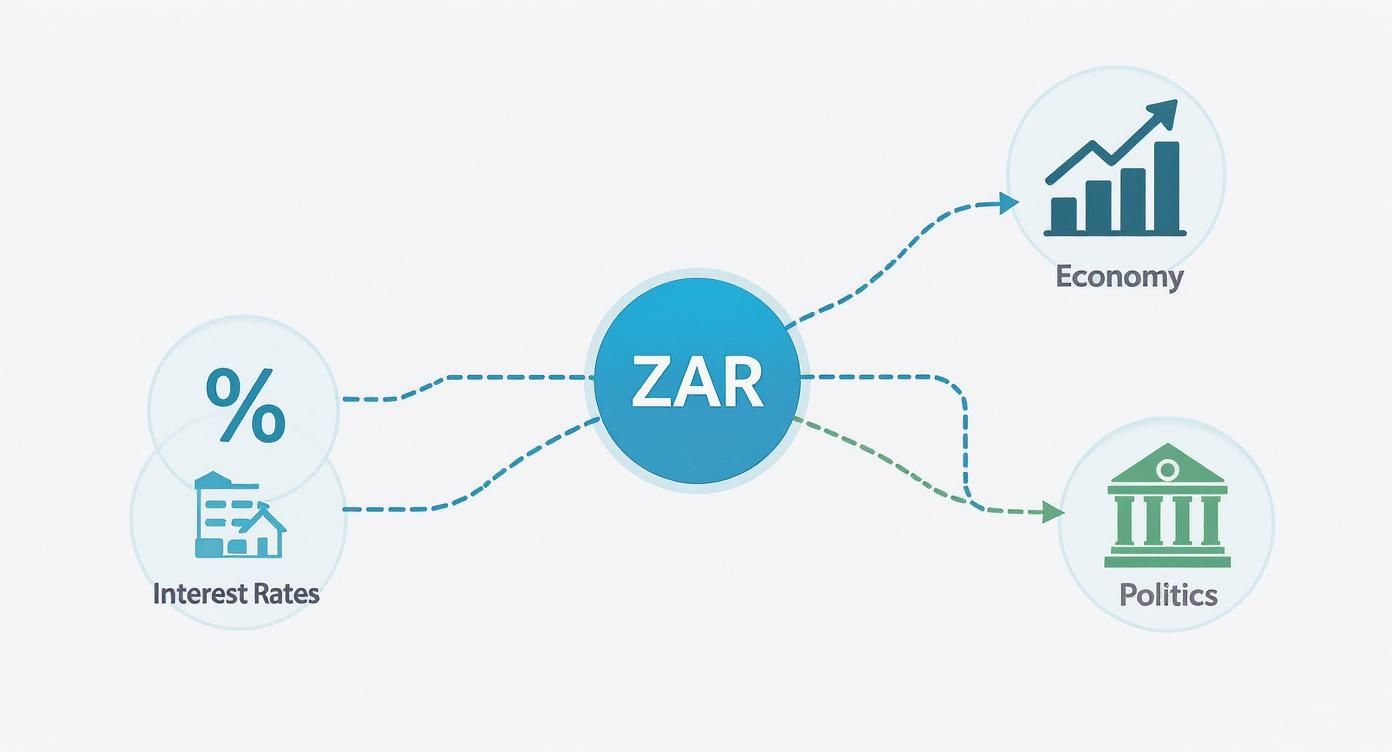
As you can see, the Rand’s value is always in a tug-of-war, pulled by what’s happening both here at home and on the global stage.
Scenario 2: Waiting a Week
Now, let's imagine the company decided to wait. Over the week, some less-than-positive economic news comes out, and the Rand weakens. The new USD/ZAR forex spot price is now 18.70.
- The Math: $50,000 x 18.70 = ZAR 935,000
In the space of seven days, the cost of paying the very same invoice has shot up by R25,000. That’s not a bank fee or a late penalty—it's a direct loss caused entirely by a negative move in the spot rate. This extra cost comes straight out of the company’s profits.
This R25,000 difference is the perfect illustration of real-world currency risk. It’s the hidden cost many businesses simply swallow because they don’t have a clear strategy for managing their foreign exchange exposure.
For any South African business trading internationally, truly understanding the impact of forex spot prices means getting to grips with the financial side of things. Properly accounting for these currency swings is a crucial part of financial planning, and resources on navigating international trade and taxation complexities can offer some really solid guidance here.
This example proves that the forex spot price isn't just a number flashing on a screen. It’s a live, moving variable that can either boost or batter your company's financial health, making proactive currency management an absolute must.
How SA Businesses Can Manage Spot Price Risk
Watching the rand jump around against major currencies can feel like a bit of a guessing game. But when it comes to your international payments, leaving things to chance is a dangerous strategy. The volatility of the forex spot price directly hits your bottom line, turning what should be a predictable expense into a constantly moving target.
The good news is, you're not powerless here. Instead of just reacting every time the market swings, you can use some smart financial tools to protect your business. The aim isn't to speculate or try to outsmart the market; it's about locking in certainty and bringing stability to your finances.
By shifting from a reactive mindset to a proactive one, you can take a volatile variable and turn it into a fixed, manageable cost. That’s how you start planning your international finances with real confidence.
Locking in Your Rate with Forward Contracts
One of the most effective tools in your arsenal is a forward exchange contract (FEC). In simple terms, a forward contract lets you lock in an exchange rate today for a payment you need to make at a set date in the future.
Think of it like booking a flight well in advance. You agree on the price now so you don't get stung by last-minute price surges. A forward contract does exactly that for your currency, guaranteeing the precise rand amount you'll pay for a foreign invoice, whether it's due in a few weeks or several months.
A forward contract takes the forex spot price out of the picture on the day your payment is due. By locking in a rate, you get complete certainty over your costs, no matter what the market does between now and then.
This is particularly important when you consider the rand's track record. The South African rand to U.S. dollar spot exchange rate has been notoriously volatile. In recent years, we've seen it move from around 14.78 to 18.33 – a depreciation of roughly 23%. This history of big swings really highlights why budget certainty is so critical, and you can learn more about the historical ZAR to USD rates and what drives them.
Gaining Flexibility with Currency Options
Another powerful tool is a currency option. This is a bit different from a forward contract. An option gives you the right, but not the obligation, to exchange currency at a pre-agreed rate on a future date.
It acts as a brilliant safety net. Here’s how it works:
- If the spot price moves against you: You simply exercise your option and use the protected rate you secured. Your business is shielded from the loss.
- If the spot price moves in your favour: You can just let the option expire and do your transaction at the better live spot rate. This way, you get to pocket the gains from the positive market move.
Yes, there's an upfront cost (a premium) to buy the option, but what you get in return is a unique mix of protection and flexibility. It's essentially an insurance policy against nasty currency swings that still leaves the door open to opportunity. Using these kinds of tools helps you turn unpredictable currency risk into just another managed business expense.
Answering Your Forex Spot Price Questions
Even when you've got a decent handle on what the forex spot price is and what makes it tick, a few practical questions always seem to pop up. Getting straight answers is the key to feeling confident enough to manage your business's international payments well.
Let's dive into some of the most common questions we hear from South African businesses about the spot price.
What Is The Difference Between A Spot Price And A Forward Price?
The easiest way to think about this comes down to one word: timing.
The forex spot price is for a deal happening right now. Technically, it settles within two business days, but for all intents and purposes, it’s the live, "on the spot" rate you get for an immediate currency exchange.
A forward price, on the other hand, is a rate you lock in today for a currency exchange that will happen at a set date in the future. Businesses use these forward contracts to hedge their bets, taking all the guesswork out of where the spot price might be in a few weeks or months.
So, think of it this way: the spot price is all about immediacy, while a forward price is about securing future certainty.
Why Is The Rate I Get Different From The One I See On The News?
This is a classic and completely understandable point of confusion. The rate you see flashing across the screen on a news broadcast is almost always the interbank rate.
Picture this as the wholesale price. It’s the rate massive banks use when they're trading enormous volumes of currency—we're talking billions—between themselves. It's the purest version of the spot price, but it's a club reserved for the market's biggest players.
When your business needs to make a payment, you go through a retail provider, whether that's your bank or a specialised payments firm. They take that live interbank rate and add a small margin, known as a spread, on top. This spread is how they cover their costs and make a profit.
The gap between the interbank rate and the rate you're actually quoted is the provider's spread. A smaller spread means more of your rands are going towards the payment itself, not to the provider.
This is exactly why it pays to compare your options. Different providers charge different spreads, which directly affects how much your international transfers actually cost you. Your goal should be to find a provider that gets you as close as possible to that real interbank spot price.
Does The Forex Spot Price Change Throughout The Day?
Absolutely. It changes constantly.
The global foreign exchange market is a 24-hour operation, running non-stop from Monday to Friday across the world's time zones. Because it’s fuelled by millions of participants buying and selling at any given moment, the forex spot price is in perpetual motion.
In fact, the price can fluctuate multiple times every single second. This is why a quote you receive for an international payment is typically only valid for a very brief window. In the time it takes to grab a coffee, the market could have moved enough to make that original rate obsolete. This constant flux is what creates both the risk and the opportunity in foreign exchange.
At Zaro, we give you direct access to the real forex spot price with zero spread. Stop losing money to hidden markups and unpredictable bank fees. Manage your international payments with complete transparency and control. Learn how Zaro can save your business money today.