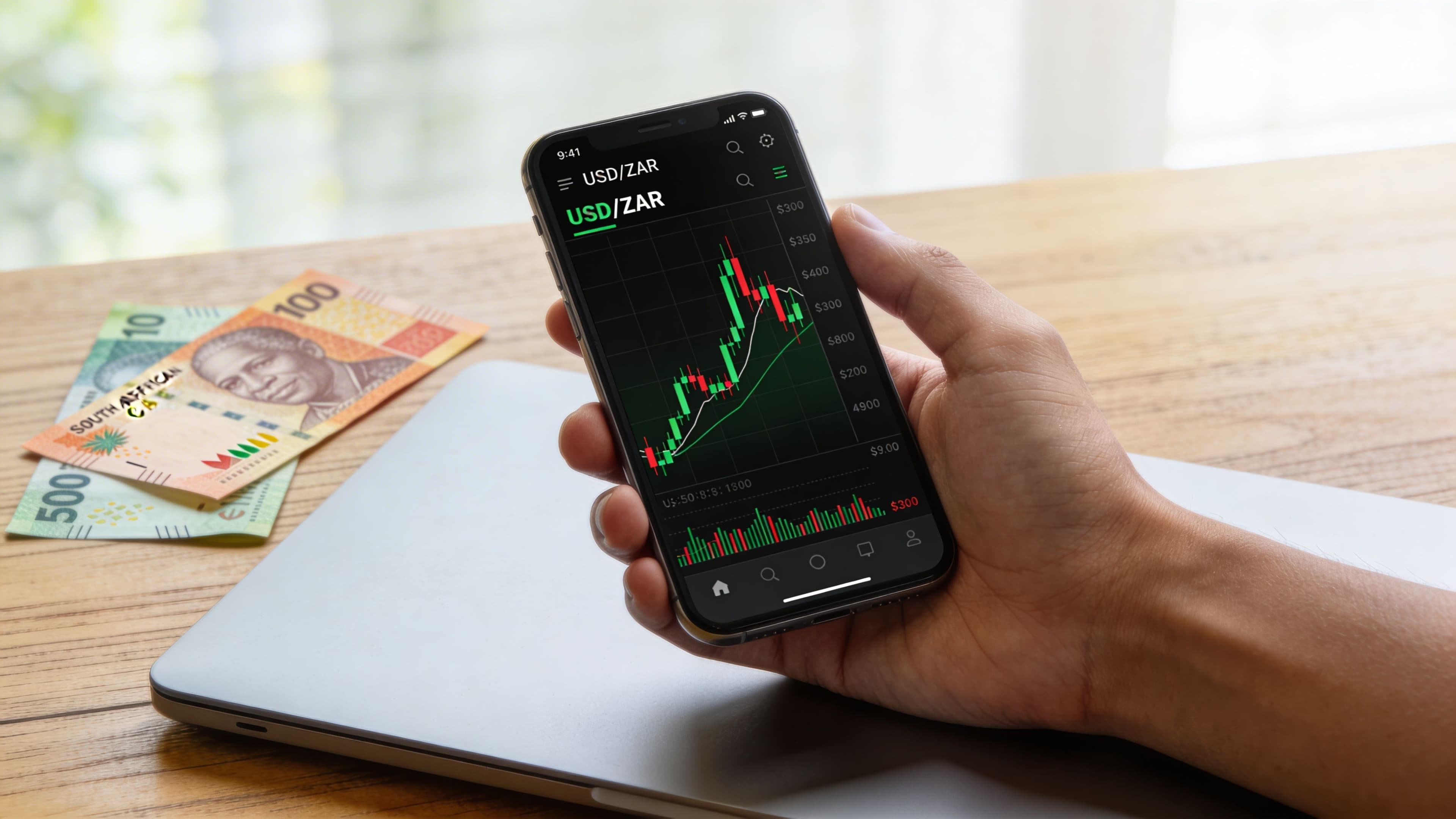
You’ve probably seen the adverts. A person on a beach. A phone screen full of green numbers. A promise that forex trading can turn spare cash into fast income.
That’s usually the moment curiosity starts. You wonder if forex is real, whether people in South Africa do this, and which app you’re supposed to trust. You may even have downloaded one already, opened a chart, and felt lost within seconds.
Forex trading apps are tools that let you buy and sell one currency against another from your phone or computer. They make the market look accessible. That part is true. What the adverts often hide is the other truth. Forex is high risk. It isn’t a salary, and it isn’t a shortcut to financial freedom.
For beginners, the safest approach is to treat forex as a skill to study before you risk real money. That matters even more in South Africa, where local regulation, ZAR funding, and the volatility of pairs like USD/ZAR shape the experience in practical ways.
Your Introduction to the World of Forex Trading Apps
A forex trading app is the digital version of a trading platform. Instead of calling a broker, you open an app, look at a currency pair such as USD/ZAR, and decide whether you think one currency will strengthen or weaken against the other.
That sounds technical, but the core idea is simple. You’re making a decision about exchange rates.
If you’ve ever exchanged Rands before travelling, you already understand the basic concept. The difference is that a traveller swaps money for a real-world need. A trader usually opens a position to profit from price movement.
What beginners usually get wrong
Many first-time users assume the app itself creates the opportunity. It doesn’t. The app is just the interface.
What matters is:
- The broker behind the app. That’s the company handling your trades and funds.
- The rules you follow. Risk management matters more than clever chart patterns.
- Your purpose. Trading for speculation is very different from managing real business payments.
Forex apps make trading easier to access. They do not make trading safe by default.
That distinction matters because many South Africans arrive at forex through social media hype. A beginner-friendly app can help you practise, learn charts, and understand order types. It can’t remove market risk, and it can’t turn guesswork into a strategy.
There’s also a second audience worth mentioning. Some readers aren’t trying to become traders at all. They’re small business owners dealing with foreign suppliers, export income, or offshore contractors. For them, “forex” often means something more practical than speculation. It means converting currency without damaging cash flow.
Understanding How Forex Trading Works
You open a forex app in Johannesburg during lunch and see USD/ZAR moving up and down every few seconds. It can look like a scoreboard without the rules. The good news is that the rules are learnable.
Forex trading is the buying of one currency while selling another at the same time. You are not betting on a currency in isolation. You are judging the relationship between two currencies and deciding whether that relationship is likely to change.

Currency pairs
Every forex quote comes as a pair.
For a South African beginner, USD/ZAR is one of the easiest examples to follow. It shows how many Rands are needed to buy one US Dollar. If USD/ZAR rises, the Dollar is getting stronger against the Rand. If it falls, the Rand is getting stronger against the Dollar.
A simple way to read it is to treat the first currency as the item you are pricing, and the second as the money used to pay for it. That framing clears up a lot of early confusion.
This matters beyond speculation too. A trader may watch USD/ZAR for price movement. A business owner may watch the same pair because a stronger Dollar can make imported stock more expensive. Same market, different purpose.
Pips and lot sizes
Two beginner terms usually cause the most friction.
A pip is a very small change in price. It is the ruler traders use to measure movement.
A lot is the size of your trade. It is the amount of currency exposure you are taking on. Bigger lot sizes mean each price move has a bigger effect on your account, for better or worse.
You do not need advanced maths on day one. You only need to understand what each term changes.
| Term | Plain-English meaning | Why it matters |
|---|---|---|
| Currency pair | Two currencies quoted together | Shows what you’re trading |
| Pip | A small price movement | Helps measure profit and loss |
| Lot size | The size of your trade | Changes how much risk you’re taking |
If that still feels abstract, picture a grocery scale. The pip is the tiny change in weight. The lot size is how much produce you put on the scale. A small movement matters much more when the amount is larger.
Financial gearing needs extra caution
Financial gearing lets you control a larger position with a smaller deposit. That is why it attracts beginners. It can make a small account feel more powerful than it really is.
It also increases risk just as fast.
Financial gearing works like a magnifying glass. A small market move can look much bigger once it hits your account balance. Gains grow faster, but losses do too, and beginners often learn the second part first.
Practical rule: If you cannot explain your worst-case loss before opening the trade, reduce the position size or do not place the trade.
A safer analogy is this. Amplified trading is like driving a very fast car before you’ve learnt how to brake smoothly. The speed is not the main problem. The problem is what happens when the road changes suddenly and your reactions are still untrained.
Some beginners also turn to tools such as using AI for trading analysis to help organise ideas and review market information. That can help with research. It should not replace a risk plan, especially when gearing is involved.
Why the South African context matters
For South Africans, forex is not just a global topic on a phone screen. It is tied to the Rand, local regulation, and how you fund and withdraw money.
USD/ZAR can move sharply, which means beginners need patience and position control. It also means South African users should pay attention to whether an app supports ZAR funding, how conversion fees are handled, and whether the broker is properly authorised by the FSCA. Those practical details affect your real experience just as much as the chart does.
There is another reason this context matters. Some readers are learning forex as a speculative skill. Others run small businesses and deal with supplier payments, foreign invoices, or overseas contractors. In both cases, you are dealing with exchange rates. The difference is the goal. One person is trying to profit from price movement. The other is trying to protect margins and cash flow. Understanding that distinction early helps you choose the right tool for the job.
How to Evaluate Forex Trading Apps
Most beginners compare forex trading apps the wrong way. They focus on what looks exciting. Fast charts. copy trading buttons. influencer recommendations. The better way is to ask a quieter question first. Would I trust this app with my money and my mistakes?

One challenge is that there isn’t much South Africa-specific market data in the material available. The provided search results didn’t surface region-specific statistical or historical data for beginner forex apps in ZA, and mostly focused on global names like IG, OANDA, and Exness, as noted by this overview of forex trading apps for beginners. That means you need to evaluate apps through first principles, not hype.
Start with regulation and security
For a South African reader, regulation isn’t a bonus feature. It’s the floor.
Look for brokers authorised by the FSCA. If an app doesn’t make its regulatory status clear, treat that as a warning sign. You’re not just choosing chart software. You’re choosing who holds your funds and processes withdrawals.
Also check for basic account protection:
- Two-factor authentication so a password alone isn’t enough
- Clear login alerts that show suspicious access
- Documented withdrawal procedures so you know what happens when you want your money back
A polished interface can hide weak protections. Regulation and security tell you more than branding ever will.
Test the user experience before funding
A beginner doesn’t need the most advanced platform on earth. You need a platform you can understand under pressure.
Open a demo account and test common actions:
- Find a currency pair without hunting through endless menus
- Place a practice order with a stop-loss
- Edit or close a trade quickly
- Read the chart on a mobile screen without feeling lost
If the app feels confusing in a calm demo environment, it will feel worse when the market is moving quickly.
For some learners, outside tools can help build confidence before a trade is placed. If you’re curious about structured research workflows, this guide on using AI for trading analysis offers useful ideas for organising your thinking. It shouldn’t replace judgement, but it can help you ask better questions.
Understand costs before you click buy
Many beginners only notice costs after they’ve started trading.
The two terms to watch are spread and commission.
| Cost type | What it means | What to check |
|---|---|---|
| Spread | The gap between buy and sell price | Whether it widens in volatile moments |
| Commission | A separate fee charged on trades | Whether it’s added on top of the spread |
Some apps look cheap at first glance because they advertise low headline costs. Then the true price appears when the market gets busy, withdrawals are slow, or extra charges show up around funding.
Features matter, but only after the basics
Once regulation, security, usability, and costs pass your test, then compare tools.
A beginner-friendly app should offer:
- A demo account so you can practise without real money
- Basic indicators such as RSI and MACD
- Price alerts for levels you’re watching
- Simple order management so stop-loss and take-profit settings aren’t buried
Good forex trading apps for beginners remove friction from basic tasks. They don’t tempt you into complexity before you can manage risk.
Customer support is the final filter. Send a question before funding the account. The quality of that reply often tells you what support will feel like when something goes wrong.
Your First Steps on a Forex Trading App
You download a trading app on a Tuesday evening in Johannesburg, fund nothing, and open a demo account instead. That is a smart start. Forex apps move fast, and your first job is not to make money. Your first job is to learn where everything is before real rand are involved.
A demo account gives you a flight simulator for trading. The prices are live, but the money is not. For a South African beginner, that matters even more when you are watching a pair linked to the rand, because ZAR pairs can move sharply and test your nerves before you understand the basics.

Open the app and learn the layout
Many beginners in South Africa start with MetaTrader 4, or MT4, because many brokers still support it and the layout is widely recognised. The name matters less than the habit you build. On day one, treat the app like a car parked in your driveway. Learn the pedals and mirrors before you drive into traffic.
Start by finding five things:
- The list of currency pairs
- A chart for one pair, such as USD/ZAR
- The buy and sell buttons
- The place to set a stop-loss and take-profit
- The tab that shows open and closed trades
Keep your first chart simple. Candlesticks, one timeframe, one pair.
The South African context matters here. If your broker supports ZAR deposits, the account usually feels easier to manage because you can think in rand from the start. If the broker is regulated by the FSCA, you also have a clearer local reference point if problems come up. That same foreign exchange awareness can later help business owners too. A solo trader may watch USD/ZAR for price moves, while an SME may watch it because supplier costs, invoices, or import payments change with the exchange rate.
Place one practice trade
Your first practice trade should feel almost boring.
Pick one pair. Use the smallest size available in the demo account. Set your stop-loss before you confirm the order. Then watch the trade without touching it for a few minutes.
Focus on these questions:
- Why did you enter this trade?
- Where is your exit if you are wrong?
- How much would you have lost if this were real money in rand?
- Did you enter because of a rule, or because the chart looked busy?
Those questions teach more than a lucky profit does.
If you want a simple framework before risking any money, this guide on 8 key factors to consider before investing is a useful reminder that every financial decision needs a reason, a risk limit, and a time horizon.
Use one tool at a time
Beginners often load a chart with indicators and then feel more confused than informed. A crowded chart is like a dashboard with every warning light flashing. You stop seeing what matters.
Start with one indicator only.
RSI can help you notice when price has pushed unusually far in one direction. MACD can help you judge whether momentum is strengthening or fading. Neither tool predicts the future. They help you organise what you are seeing.
If you cannot explain your trade in one calm sentence, pause and wait.
A short visual walkthrough can help if you prefer seeing the process before trying it yourself.
Keep your first month simple
The first month is for repetition, not excitement. You are building habits.
A sensible routine looks like this:
- Practise on demo until placing, editing, and closing orders feels familiar
- Track each trade in a notebook or spreadsheet
- Trade one setup only, instead of changing strategy every few days
- Review your notes once a week and look for patterns in your mistakes
That routine may feel slow. Slow is fine. In forex, especially for South Africans dealing with volatile ZAR pairs, patience usually protects beginners better than confidence does.
Common Mistakes Beginner Traders Make and How to Avoid Them
The biggest beginner mistake isn’t choosing the wrong app. It’s bringing the wrong mindset into the app.
Many people start trading as if they’re buying a lottery ticket with charts attached. They chase movement, react emotionally, and confuse activity with skill. That usually ends badly.
Taking too much risk too quickly
A new trader sees a small win and immediately increases position size. One losing trade then wipes out days of progress.
The fix is dull, but effective. Decide your maximum risk before the trade opens. Then keep position sizes small enough that one loss feels manageable, not catastrophic.
Revenge trading after a loss
This one is common. You lose a trade, feel irritated, and enter another one too quickly just to “get it back”.
That second trade is rarely based on analysis. It’s based on emotion.
Try this instead:
- Pause after a loss and step away from the screen
- Write down the reason the first trade failed
- Wait for a new setup rather than forcing one
Trading without a plan
A beginner opens the app, sees movement, and clicks. There’s no entry rule, no exit rule, and no stop-loss. That isn’t trading. It’s improvisation.
A basic plan should answer:
| Question | Your rule |
|---|---|
| What will I trade? | One or two currency pairs only |
| Why will I enter? | A specific setup, not a feeling |
| Where will I exit if wrong? | A stop-loss set in advance |
| When will I stop for the day? | After a set number of trades or losses |
If you want a broader mindset check before putting money into any risky activity, this article on 8 key factors to consider before investing is a useful companion read.
Confusing discipline with caution
Some beginners think discipline means being timid. It doesn’t. It means being consistent.
The traders who survive longest usually aren't the boldest. They’re the ones who can follow their own rules on ordinary days.
That’s why capital preservation matters more than excitement. If you protect your downside, you give yourself time to improve.
Navigating Forex Trading in South Africa
South African traders need to think beyond charts. The local framework around the app matters too.
Why FSCA regulation matters
The Financial Sector Conduct Authority, or FSCA, oversees financial conduct in South Africa. If you’re opening an account with a broker, checking whether that broker is FSCA-regulated is one of the first things you should do.

Regulation doesn’t eliminate trading risk. It does help you avoid a different category of risk. Poor conduct, weak oversight, and difficult disputes.
Funding in ZAR
One practical issue many global guides ignore is how South Africans move money in and out.
A usable app for a local beginner should make ZAR funding straightforward. If deposits and withdrawals feel opaque, delayed, or awkward from the start, that friction usually becomes more frustrating later. Simplicity matters because the app should help you manage trades, not create admin headaches.
Keep tax in mind from day one
If you make profits from trading, don’t treat them as invisible. SARS may view trading profits as income that needs to be declared, depending on your circumstances.
You don’t need to become a tax expert before opening a demo account. You do need to keep records once real money is involved. Save statements. Track deposits and withdrawals. Don’t leave the paperwork for year-end panic.
One local reality beginners should remember
South African traders often focus on international apps and brand names. That’s understandable. But regulation, funding practicality, and record-keeping matter just as much as chart quality.
A clean app is nice. A broker that works properly in the South African context is better.
Forex for Businesses A Smarter Approach
A beginner trader and a business owner may both deal with foreign exchange, but they’re solving different problems.
An individual using forex trading apps for beginners is usually speculating. They’re trying to profit from price movement. An SME usually isn’t trying to “win” on charts. It needs to pay overseas suppliers, collect foreign revenue, manage timing, and keep books accurate.
Why trading apps fall short for SMEs
That’s where ordinary trading apps often stop being useful.
According to this guide on forex app limitations for business use, individual trading apps lack critical features SMEs need, including native integrations with accounting systems such as Xero or Sage for reporting and tax compliance. The same source also notes that they don’t provide tools for hedging currency exposure or forecasting multi-month cash flow for businesses managing irregular export revenue or international invoices.
That gap is bigger than it sounds.
A business doesn’t just need an exchange rate. It needs:
- Clean records for finance and tax work
- Visibility across payments for staff and leadership
- Predictable cash flow planning when income and expenses land in different currencies
Speculation versus operations
Here’s the simplest distinction.
| Use case | Typical goal | Best tool type |
|---|---|---|
| Beginner trader | Learn and speculate on price moves | Trading platform |
| SME or exporter | Send, receive, and manage foreign currency | Business FX and payments platform |
If you run a South African business, treating a speculative trading app as your payments system creates unnecessary friction. Finance teams need structure, not just market access. They need controls, auditability, and a way to connect foreign exchange to the rest of the business.
That’s why many SMEs eventually outgrow consumer-style forex apps. They weren’t built for operational finance in the first place.
Frequently Asked Questions for Beginners
Is forex trading legal in South Africa
Yes, forex trading is legal in South Africa. The safer question is whether the broker behind the app is properly regulated and suitable for local users. That’s why checking FSCA status matters before you deposit funds.
How much money do I need to start
There isn’t a one-size-fits-all answer. Some platforms let you start small, but “small” doesn’t mean “safe.” If losing the amount would put pressure on your budget, it’s too much for a beginner. Start with a demo account first and only move to live trading once you understand the platform.
Should I start on MT4 or another app
Many beginners start with MetaTrader 4 because it’s widely available and commonly supported. What matters most is that the app offers a demo account, clear order entry, and risk controls you can use.
Can I make quick money with forex
You can make money in forex. You can also lose money quickly. Treat any promise of easy profit with suspicion. The more realistic goal is learning risk management, building discipline, and avoiding costly beginner mistakes.
Are forex trading apps suitable for my business
Usually not, if your main need is paying suppliers, receiving export income, or managing foreign currency within your finance process. Trading apps are designed for market positions, not for accounting integration, compliance workflows, or business cash flow planning.
If your company needs a practical way to handle cross-border payments instead of speculative trading, Zaro offers a business-focused alternative for South African firms. It’s built for sending and receiving international payments with real exchange rates, zero spread, no SWIFT fees, and stronger controls for finance teams that need visibility, compliance, and predictable cash flow.