
If your business deals with international payments, you're already in the forex game. At its simplest, forex trading is just swapping one currency for another to pay a bill or get paid. This isn't some high-flying skill reserved for speculators; it's a core competency for any South African business paying overseas suppliers or bringing in revenue from abroad. Getting a handle on the basics is all about protecting your profits from the ups and downs of currency markets.
Why Forex Basics Matter for Your Business

Many business owners hear "forex" and immediately picture complex charts and professional traders. But that's a misconception. If you pay even a single international invoice, you're a participant in the foreign exchange market. At its heart, forex is just a marketplace where currencies are bought and sold.
Think of it this way. When you buy from a local supplier, you pay in Rands. Simple. But when you buy from a supplier in China or Europe, you first have to "buy" their currency—be it US Dollars or Euros—before you can pay them. That transaction right there? That's a forex trade.
It's About Profit Protection, Not Speculation
Learning the ropes of forex isn't about trying to outsmart the market for a quick profit. For a business, it's about one thing: risk management. A sudden, unfavourable shift in an exchange rate can wipe out your profit margin on a big international sale or make a shipment of imported goods far more expensive than you budgeted for.
When you grasp these fundamentals, you gain the tools to make smarter financial decisions. You can protect your business from volatility, helping ensure the price you agree on today is the price you actually get tomorrow. For any South African SME, this isn't just theory—it's a practical skill that directly hits your bottom line.
For any business involved in cross-border trade, forex is not an optional financial instrument to be dabbled in; it is an unavoidable component of your operational costs. Managing it effectively is as vital as managing inventory or payroll.
A Key Market for South African Businesses
The importance of forex for local businesses is backed by South Africa's impressive financial infrastructure. Our forex market is the undisputed giant of Africa, with daily trading volumes topping $2.21 billion.
The South African Rand is the 18th most traded currency on the planet. This means local companies are operating within a deep, reliable system that makes it easier to manage international payments well. You can get more insights into the African forex trading landscape and see how it impacts businesses just like yours.
Translating Forex Jargon into Business Language
To manage your company’s foreign currency exposure, you need to speak the language. The world of forex is full of jargon that can sound complicated, but for a business owner or finance manager, these terms are just new labels for concepts you already live and breathe—risk, cost, and transaction size.
Instead of getting bogged down in textbook definitions, let’s translate this vocabulary into practical business terms. This will give you the confidence to discuss your needs clearly, whether you’re talking to your bank, a payment provider like Zaro, or your own finance team.
Before diving into the details, here's a quick reference table that cuts through the noise and shows you what these core forex terms really mean for your day-to-day operations.
Key Forex Terms for Your Business
| Forex Term | Technical Definition | What It Means for Your Business |
|---|---|---|
| Spot Forex | The immediate exchange of one currency for another at the current market rate, with settlement usually in two business days. | This is your standard international payment. When you pay an overseas supplier, you're doing a spot transaction. |
| Pip | The smallest standard price move a currency pair can make. Usually the fourth decimal place (e.g., 0.0001). | A direct measure of your cost. A few pips moving against you on a large invoice can wipe out your profit margin. |
| Lot | A standardised unit of currency. A standard lot is 100,000 units of the base currency. | Think of this as your transaction size. Paying a $100,000 invoice is a one-standard-lot deal. |
| Leverage | Borrowed capital from a broker to control a larger currency position than your own capital would allow. | A high-risk tool for speculative traders. For your business, it's an unnecessary gamble that has no place in prudent treasury management. |
This table gives you a bird's-eye view, but understanding how these concepts interact is where you gain real control over your international finances.
Pips and The Real Cost of Price Moves
You’ve probably heard traders talking about making or losing pips. A pip, short for "percentage in point," is simply the smallest price change a currency pair can make. For most major pairs, like the USD/ZAR, it’s the fourth decimal place (0.0001).
So, what does that mean in the real world?
Imagine you need to pay a supplier invoice for $100,000. When you get the quote, the USD/ZAR exchange rate is 18.5000. A few hours later, when you make the payment, the rate has shifted to 18.5050. That’s a tiny move of just 50 pips.
It sounds insignificant, right? But on that $100,000 invoice, those 50 pips just increased your cost in Rands by R5,000. For a business, a pip isn't some abstract number—it's the small detail that can quietly eat away at your profit margin on every single international transaction.
Lots and Understanding Transaction Size
In the forex world, currencies are bought and sold in standardised amounts called lots. Knowing the lingo helps put the scale of your business payments into context.
- Standard Lot: 100,000 units of the base currency (e.g., $100,000).
- Mini Lot: 10,000 units.
- Micro Lot: 1,000 units.
For your business, a "lot" is just a formal way of describing the size of your payment. That $100,000 supplier invoice we mentioned? That’s a one-standard-lot transaction. Framing it this way helps you and your provider understand the scale of your currency needs and highlights why even tiny pip movements have a big financial impact on larger transaction volumes.
Leverage: The Double-Edged Sword
Leverage is one of the most dangerous and misunderstood concepts in forex, especially for businesses. For a professional trader, leverage is a tool—a loan from a broker—to control a large currency position with a very small amount of their own money. For example, with 100:1 leverage, a trader can control a $100,000 position with just $1,000.
While leverage can amplify profits for a speculator, it magnifies losses just as brutally. For a business that needs stability and predictability, using high leverage to make a payment is like taking out a high-stakes loan at a casino to pay an invoice. It's an unnecessary and reckless gamble.
Your goal as a business isn't to speculate on where the Rand is heading. It’s to pay your bills, manage your costs, and protect your profits. The focus should always be on securing a good rate and ensuring cost certainty, not amplifying risk.
For any sound financial management strategy, leverage should be left to the professional traders. It’s a tool for speculation, not a strategy for prudent corporate treasury.
How Are Currency Prices Really Set?
Ever seen a currency rate on the news and then gotten a completely different, much worse, rate from your bank? That’s not a mistake. It’s one of the most important, and often misunderstood, realities of the foreign exchange market.
The price you see on Google or a financial news site is usually the “mid-market” rate—a midpoint between what buyers are paying and what sellers are asking. But that’s not the rate your business actually gets. The real price is determined by a two-way system, and getting to grips with it is the first step in protecting your bottom line.
It's All About the Bid-Ask Spread
At the heart of every single currency transaction is the bid-ask spread. You can think of it as the gap between the highest price a buyer will pay for a currency and the lowest price a seller will accept.
This isn't just an abstract concept; it’s a real, tangible cost baked into every international payment you make or receive. It’s how banks and brokers make their money on the transaction.
Here’s the breakdown:
- The Bid Price: This is the price a market maker (like your bank) is willing to buy a currency from you. If you’re converting US dollars from export sales back into Rands, you’ll be offered the bid price.
- The Ask Price: This is the price the market maker is willing to sell a currency to you. When you need to buy US dollars to pay an overseas supplier, you'll have to pay the ask price.
Crucially, the ask price is always higher than the bid price. That difference, the spread, is where your business loses money.
How the Spread Chips Away at Your Profits
Let's put this into a real-world context. Say you need to pay an American supplier an invoice for $55,555. The fair, mid-market rate you saw online is 18.00 ZAR/USD, which means the payment should cost you exactly R1,000,000.
But your bank doesn’t give you that rate. Instead, they quote you their own prices, which include their spread. For instance:
- Their Bid (to buy USD from you): 17.82 ZAR/USD
- Their Ask (to sell USD to you): 18.18 ZAR/USD
Since you need to buy dollars to make the payment, you’re stuck with their much higher ask price of 18.18. Your actual cost suddenly balloons to R1,010,000 ($55,555 multiplied by 18.18).
That seemingly tiny difference in the exchange rate just cost your business an extra R10,000. It’s a hidden fee that won’t show up on any bank statement or invoice, but it comes directly out of your profit margin.
For any finance team, questioning the spread shouldn't be optional—it's essential. This is why businesses are increasingly turning to transparent providers like Zaro. By offering the real exchange rate without a built-in spread, you can see exactly what you're paying and save a significant amount over time.
So, Why Do Currency Prices Move So Much Anyway?
The spread is only one part of the puzzle. The underlying value of currencies themselves is constantly shifting, often dramatically, thanks to a whirlwind of global economic forces.
If you understand what makes these prices tick, you can start to anticipate risks and opportunities instead of just reacting to them. The biggest movers are major economic data releases and central bank announcements. These are the signals that tell the world about the health and direction of a country's economy, which in turn drives demand for its currency.
Here are the key drivers to watch:
- Interest Rate Decisions: When a central bank like the South African Reserve Bank (SARB) hikes interest rates, it makes holding Rands more attractive to foreign investors. This new demand can strengthen the Rand.
- Inflation Reports: High inflation is bad news. It eats away at a currency's purchasing power, and a worse-than-expected inflation report can cause the Rand to drop against the Dollar.
- GDP Growth Figures: A strong Gross Domestic Product (GDP) number signals a robust, growing economy. That's usually a green light for investors and can give the currency a boost.
- Employment Data: Good news on the jobs front, like a falling unemployment rate, points to economic strength and can also lead to a stronger currency.
Keeping an eye on these economic indicators helps your finance team get ahead of the curve. You can start asking smarter questions about when to time payments and demand better, more transparent pricing from your financial partners.
Protecting Your Profits from Currency Volatility
Knowing how currency prices are set is the first step. The next, and arguably more important one, is using that knowledge to protect your business. Those daily wobbles in the forex market aren't just abstract numbers—they represent a very real threat to your bottom line. For a business, dealing with forex isn't about speculation; it's about defence and creating predictability.
This is where we need to draw a clear line in the sand between two very different approaches: speculative trading and strategic hedging.
Trading vs. Hedging: The Critical Difference for Your Business
It’s easy to lump all forex activity together as "trading," but for a South African business, that's a costly mistake. The entire mindset and goal of a professional trader is worlds apart from that of a business owner.
Speculative Trading: This is all about buying or selling currencies to profit from where you think the price is headed. A trader might buy US Dollars today, betting they’ll be worth more against the Rand next week. It’s an offensive move designed to generate new profit, and it’s packed with risk.
Currency Hedging: This is purely defensive. The sole purpose is to protect the value of your future payments or revenues from nasty surprises in the currency market. Hedging is about taking uncertainty off the table and locking in a known cost or profit margin. It’s not about making money from the market; it’s about stopping the market from taking your money.
For an SME, the goal isn't to outsmart the Rand. The real victory is making sure a sudden currency swing doesn’t wipe out the profit on a hard-won international deal.
A Practical Playbook for Hedging
Hedging might sound like something reserved for corporate giants, but the tools are often straightforward and incredibly effective. The most common and useful of these is the forward contract.
Think of a forward contract as pre-ordering your currency. It's a simple agreement to buy or sell a specific amount of foreign currency on a future date, but at a price that you lock in today.
Let’s walk through how this works in the real world.
Example: A South African Exporter Secures Their Profit
Imagine an export business in Cape Town agrees to sell R2,000,000 worth of goods to a client in the United States, with payment due in three months. At today's exchange rate of 18.50 ZAR/USD, that revenue translates to roughly $108,108.
But the finance manager is nervous. What if the Rand strengthens over the next three months to, say, 17.50 ZAR/USD? Suddenly, their client has to pay more in dollars ($114,285) for the same R2,000,000 worth of goods, which could complicate the deal. More importantly, if the business was expecting a specific dollar amount, a weaker Rand would mean less money when converted back home.
Instead of rolling the dice, they use a forward contract to lock in today's rate of 18.50. Now they have certainty. It doesn't matter if the Rand strengthens or weakens over the next 90 days. They know exactly how much foreign currency they will deal with. Their budget is safe, and their profit margin is protected.
This decision tree clearly illustrates the choice businesses face when it's time to exchange currency.
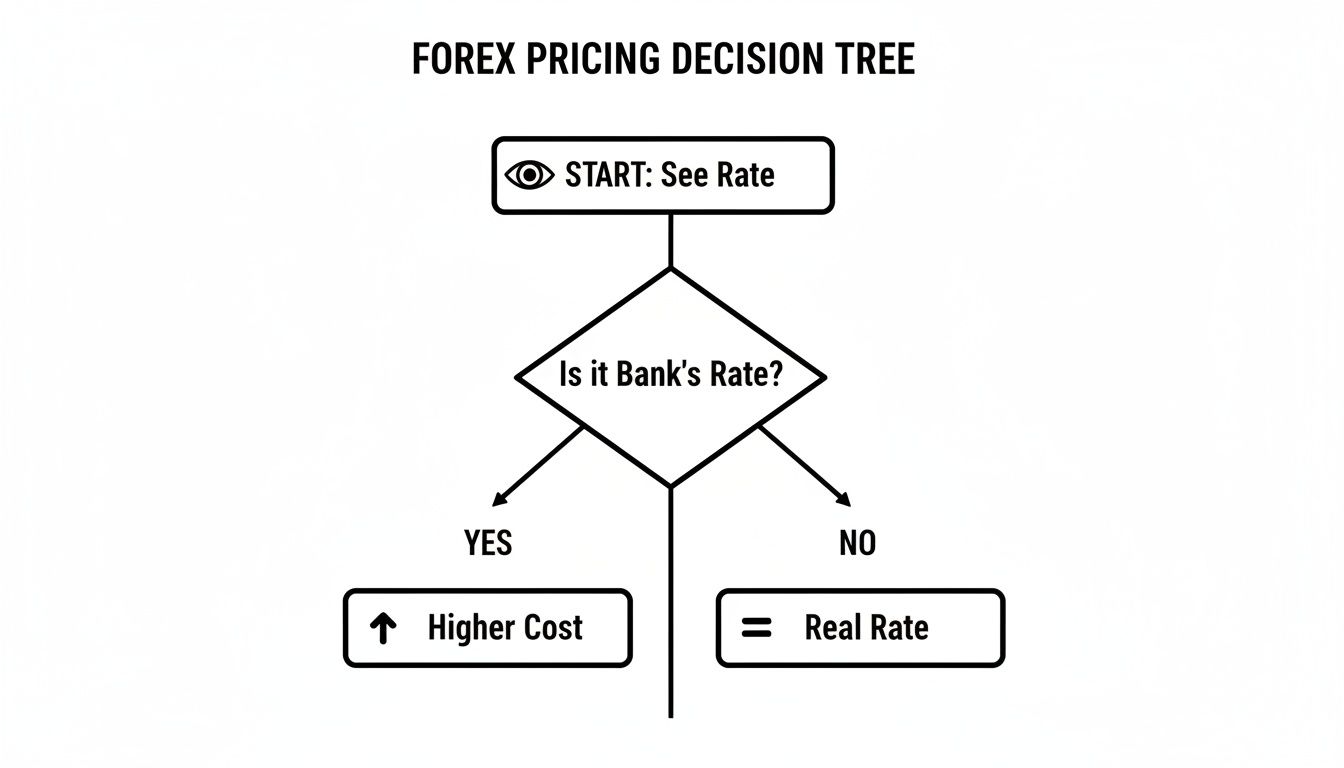
As you can see, simply accepting a bank's rate, which is loaded with hidden markups, leads directly to higher costs. Seeking out the real rate is the only way to ensure you're paying a fair price.
Winning at Forex Means Achieving Predictability
For any business involved in international trade, the real win in foreign exchange isn't about beating the market. Trying to predict short-term currency movements is a full-time, high-stakes game—one that even seasoned professionals get wrong.
The smarter play is to sidestep the volatility completely. By using simple hedging tools and working with transparent payment partners like Zaro who provide the real exchange rate, you shift your focus from speculation to strategy. You stop gambling on market direction and start guaranteeing your financial outcomes.
This approach transforms forex from a source of anxiety into a manageable part of your operations. It gives you the budget certainty you need for accurate financial planning, confident pricing, and sustainable growth. For a business, that’s the only definition of winning that matters.
Upgrading Your International Payment Strategy
Now that you have a firm grip on the basics of forex, it’s time to look beyond just accepting the old way of making international payments. For years, South African businesses have been stuck in a sluggish, costly system run by big banks with their confusing fee structures. This usually meant getting hit with wide spreads, waiting on slow wire transfers, and drowning in paperwork.
Thankfully, that’s not the only option anymore. Technology has paved the way for a new breed of financial tools built around transparency and efficiency. These platforms are designed from the ground up to fix the very problems that have always frustrated businesses operating across borders.
From Hidden Fees to Real Rates
The biggest game-changer is the shift away from spread-based pricing. Modern payment platforms, including Zaro, are built on a simple but powerful idea: giving you the real exchange rate. This is the same mid-market rate you’d see on Google or a financial news channel, a rate once only available to the largest corporations.
By cutting out the hidden markup, the true cost of every transaction is laid bare. No more guesswork. This direct approach can lead to massive savings over time, boosting the profitability of every international invoice you pay or receive.
"The shift towards electronic dealing platforms has fundamentally transformed how South African businesses conduct international transactions. This technological evolution has decreased transaction costs, enhanced price discovery, and improved execution speeds, making the market more competitive and accessible for SMEs."
Essentially, this levels the playing field, giving businesses of all sizes access to fair and transparent pricing that directly impacts their bottom line.
Streamlining Compliance and Security
It's not just about the money you save. These newer platforms also provide powerful tools for managing the day-to-day operations of global finance. Manual compliance checks and tedious reporting can be automated, which frees up your finance team to focus on strategy instead of getting bogged down in administrative tasks.
Security is also at the heart of their design. You'll typically find features like:
- Bank-level encryption to keep your sensitive financial information locked down.
- Segregated client accounts, which means your funds are always held separately and are never mixed with company funds.
- Customisable team permissions and multi-user access, giving you total control over who can set up and authorise payments.
This combination of automated compliance and tight security means your transactions are not just efficient but also completely protected. When dealing with complex global operations, clear communication is vital, and using specialized financial document translation services can ensure all financial dealings are understood and compliant across borders.
Ultimately, rethinking your international payment strategy is about more than just finding a cheaper way to move money. It's about adopting a system that gives you the clarity, control, and efficiency you need to compete on a global stage. By choosing tools that offer real rates and simplify complicated workflows, you can turn a necessary business cost into a real competitive advantage.
Got Questions About Business Forex? We've Got Answers.
Diving into the world of international payments often brings up a lot of questions. That’s perfectly normal. Getting your head around the details of forex is one of the best ways to protect your business’s bottom line. Here are some straightforward, practical answers to the questions we hear most from South African business owners and finance teams.
What’s the Real Difference Between Forex Trading and Currency Hedging?
It’s crucial to know the difference here because their goals are polar opposites.
Think of it like this: speculative forex trading is all about trying to predict which way the market will swing and placing bets to make a profit. It’s an offensive move, a high-risk game aimed at generating brand-new income from currency movements.
Currency hedging, on the other hand, is purely defensive. It’s like building a sturdy wall to protect your valuable inventory from a storm, no matter which direction the wind blows. The goal isn’t to make a profit from the storm, but to make sure you don’t suffer any losses. It’s about protecting the profits you’ve already made and bringing certainty to your budget.
For almost every business, the main objective is financial stability, not speculation. That’s why hedging is the smart, prudent strategy for managing your company’s exposure to unpredictable currency shifts.
How Much Are Hidden Forex Fees Really Costing My Business?
Those hidden fees you hear about, usually bundled into the exchange rate itself, are like a slow leak in your profit tank. They can drain your finances without you even noticing.
The rate you see on Google? That’s the ‘mid-market rate’. It’s the real, wholesale price of a currency. But banks and most traditional payment providers almost never give you that rate.
Instead, they add a markup—a bid-ask spread. On its own, it might look like a tiny percentage, but it adds up fast, especially on larger transactions.
Let's take an example. A 2% spread on a $50,000 international payment might not sound like much, but if the ZAR/USD rate is 18.00, that’s an extra R18,000 flying out of your account. That’s pure cost, hitting your profit margin directly. When you add in separate wire transfer fees and intermediary bank charges, trying to forecast your international payment costs becomes a guessing game. A transparent, spread-free platform means the price you see is the price you get, giving you full control.
I Want to Manage My Company's Forex Risk. Where Do I Start?
The single most important first step is to run a forex exposure audit. It sounds complicated, but it's really just about getting a clear picture of your currency needs.
All you're doing is mapping out all the foreign currency payments your business expects to make and receive over the next three to six months.
- List your incoming foreign cash: Write down all expected payments from overseas clients. Note the currency and when you expect to receive it.
- List your outgoing foreign payments: Do the same for all the payments you need to make to international suppliers, contractors, or for things like software subscriptions. Again, note the currency and due date.
- Find your net position: For each currency (e.g., US Dollars, Euros), figure out if you're a net buyer or a net receiver. Do you need to buy more dollars than you receive, or vice versa?
Once you have this map of your future currency needs—your ‘exposure’—you can start looking at the right tools to protect your business, whether that's simple hedging instruments or a modern payment platform that lets you lock in rates for those future payments. You can’t manage risk until you can see it clearly.
Are Modern Fintech Platforms Actually Secure for Large Business Payments?
Absolutely. For any reputable fintech platform, security isn't just a feature; it's the foundation of their entire business. They are purpose-built to handle large, sensitive corporate transactions, often with security measures that are more advanced than what you'd find in traditional systems.
Here’s what you should expect as standard:
- Bank-Level Encryption: Your data is protected with the highest levels of encryption, both when it's being sent and when it's stored.
- Segregated Client Funds: This is a big one. Your money is held in safeguarded accounts at major, regulated banks, completely separate from the platform’s own operational funds. Your cash is protected.
- Advanced Access Controls: You get granular control with features like multi-factor authentication, custom permissions for your team members, and detailed audit trails showing every action taken.
On top of all this, these platforms are strictly regulated and must follow tough Anti-Money Laundering (AML) and Know Your Business (KYB) rules. They often automate these compliance checks, making the process faster and more thorough than old-school manual methods. It’s this robust security framework that gives you the confidence to manage your global finances without worry.
Take back control of your international payments. Protect your hard-earned profits from volatile currency markets and hidden bank fees. With Zaro, you get the real exchange rate, zero spread, transparent pricing, and enterprise-grade security. Discover how you can upgrade your corporate FX strategy with Zaro today.