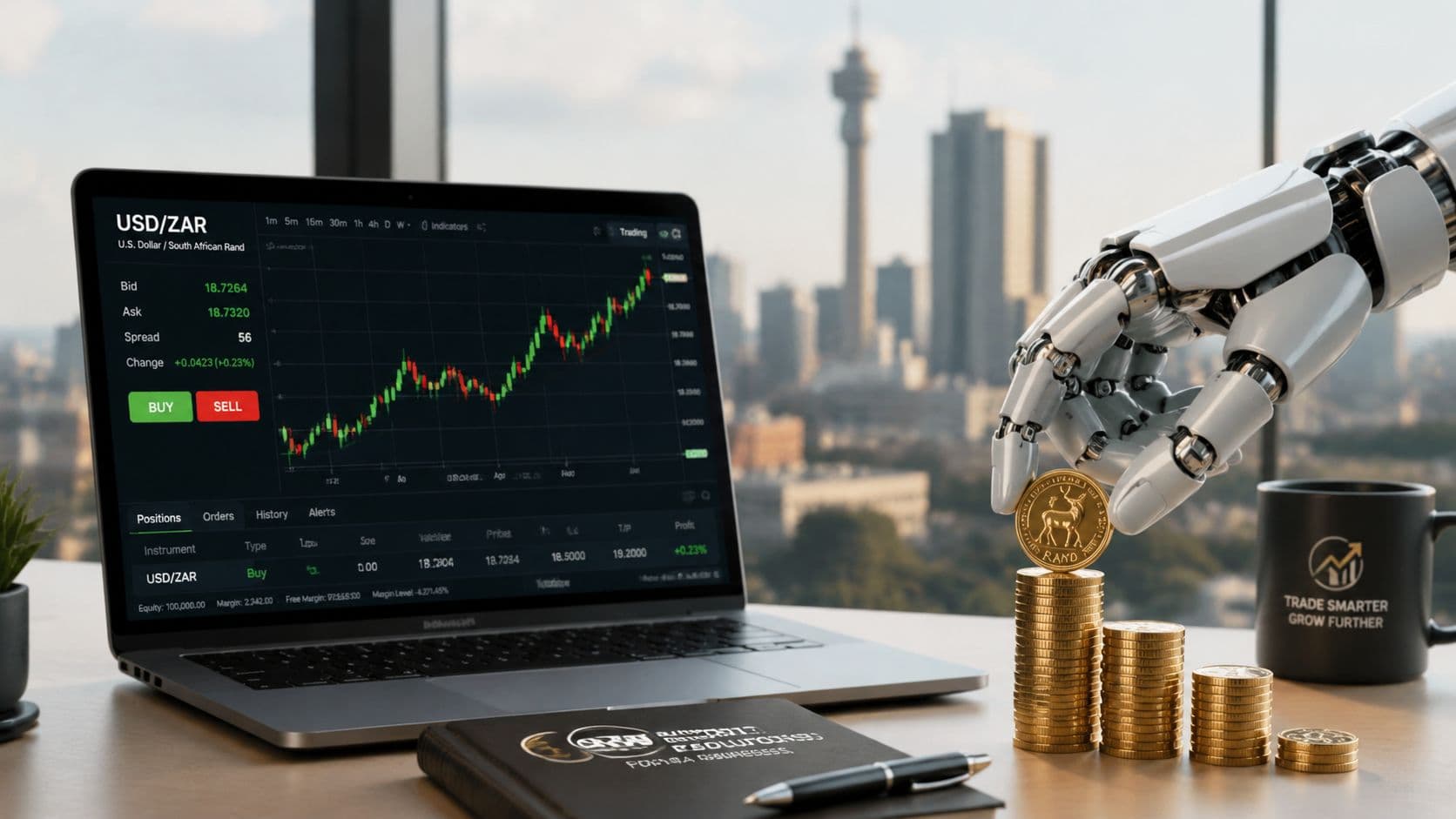
The most popular advice about a free forex trading robot is also the most misleading. It treats foreign exchange as a game of speed, signals, and passive income, when a South African business usually needs something very different: cost control, policy discipline, and predictable access to currency.
If you run an importer, exporter, BPO, or services firm with offshore payments, your FX problem isn't "How do I outsmart the market?" It's "How do I pay suppliers, collect revenue, and protect margins without hidden costs or governance failures?" Those are not the same job.
A retail trading robot may suit a speculator who accepts losses as part of the activity. It is a poor fit for a business that has payroll, tax, approvals, and counterparties depending on it. That's the lens that matters here.
The Risky Allure of a Free Forex Trading Robot
A free forex trading robot sounds efficient. The sales pitch is familiar: automate decisions, remove emotion, react faster than a human, let software work around the clock.
For an individual trader, that promise is attractive. For a business owner, it's often a category error.
Speculation and treasury are not the same function
A business treasury process exists to support operations. It helps you settle invoices, manage receivables, reduce cost leakage, and keep cash flow organised. A trading robot exists to take probabilistic bets in the market. Even when the software is free, the risk it introduces is not.
That distinction gets blurred online. Retail content talks about "winning trades". A finance team should be asking different questions:
- Can we explain every FX decision? If finance cannot justify a transaction path to management, auditors, or stakeholders, the tool is already a problem.
- Can we control who approves what? Treasury needs authority levels and clear workflow, not just execution speed.
- Can we forecast cash impact? An SME needs visibility on landed FX cost, not an uncertain trading outcome.
- Can we stay inside a regulated framework? South Africa's forex environment sits within an FSCA-shaped compliance reality, not a hobbyist forum.
A serious business doesn't need a robot that chases opportunity. It needs a process that protects obligations.
Why the appeal persists
The appeal is easy to understand. South African firms deal with currency pressure, volatile input costs, and cross-border friction. When margins are tight, any tool that claims to automate FX decisions can sound practical.
But "automated" and "appropriate" are different things. Many retail tools are built for speculative account growth, not for managing supplier payments or export receipts. They optimise for entry and exit rules. A business optimises for certainty, record-keeping, and operational control.
The wrong question to ask
The wrong question is, "Which free forex trading robot is best?"
The better question is, "Should a business be using a speculative trading tool at all when the primary need is transparent FX execution and governance?"
For most SMEs, the answer is no.
What Forex Robots Are and How They Actually Work
Most so-called forex robots are not magic, and they are not intelligent advisers in the way marketing suggests. In South Africa, a free forex trading robot is usually an Expert Advisor, or EA, running inside MetaTrader 4 or MetaTrader 5, where it can analyse price data, place trades, and manage positions automatically. "Free" usually means no licence fee. It does not mean no trading cost, because live performance still depends on spreads, slippage, and risk controls, as noted by Point Zero Trading's explanation of free EAs.

Think of an EA as a strict assistant
An EA is best understood as a tireless assistant that only follows written instructions. If the code says, "Buy when these indicators align, then place a stop-loss and take-profit," it will do exactly that. It won't ask whether the market is behaving unusually. It won't question whether a sudden move is linked to a domestic political event, a surprise data release, or poor liquidity.
That matters because many users imagine a robot is making nuanced judgements. It isn't. It is executing a rule set.
What sits inside the robot
Most EAs combine a few basic components:
| Component | What it does | What can go wrong |
|---|---|---|
| Entry logic | Decides when to buy or sell based on rules | Rules may only work in one type of market |
| Exit logic | Closes positions using stops, targets, or reversals | Tight exits can get hit by noise |
| Risk settings | Controls position size and stop-loss behaviour | Aggressive sizing can magnify losses |
| Platform execution | Sends orders through MetaTrader to the broker | Delays and slippage can distort results |
Why backtests can mislead
A robot often looks strongest in hindsight. The reason is simple. Historical testing shows how the strategy behaved on old data, not how it will cope with live conditions, changing spreads, or different market regimes.
Practical rule: If you can't describe the strategy in plain English, you shouldn't trust it with company money.
That is why disciplined users backtest, optimise carefully, and then forward-test before going live. The tool itself is only a delivery mechanism. The key question is whether the logic is sound and whether it survives actual execution conditions.
What business owners often miss
A business owner reading retail robot marketing may assume automation creates reliability. In practice, it creates consistency of execution, which is not the same thing. A bad rule executed perfectly is still a bad outcome.
For treasury work, that distinction matters. A finance team needs controls, approvals, visibility, and a clear audit trail. MetaTrader robots were built for automated trading workflows, not for business FX governance.
Uncovering the Hidden Costs and Common Scams
The "free" part of a free forex trading robot is often the least important part. The actual cost sits in everything around it: execution, hosting, account friction, and the incentives of whoever gave it to you.

Free often means funnel
In practice, many free robots are marketing devices. The developer may want you to open an account with a specific broker, join a paid signal group, upgrade to a premium version, or grant the software broad permissions inside your trading environment.
That doesn't automatically make every free bot dishonest. It does mean you should ask who benefits if you use it.
A fragmented market of open-source bots, freemium products, and broker-linked tools creates a verification problem. The deeper issue for South African firms is governance. The key risk isn't just weak performance. It's the absence of a clear way to verify legitimacy, audit decisions, or decide whether the tool is suitable for business treasury rather than speculation, as highlighted by the EA31337 Libre project discussion around open-source robot ecosystems and auditability.
The hidden costs people ignore
A robot with no licence fee can still become expensive quickly. Common cost layers include:
- Broker spreads: A strategy that looks viable in testing can deteriorate once real spreads are applied.
- Slippage: Fast-moving markets don't always fill at the expected price.
- Latency and hosting: If the strategy is timing-sensitive, your setup quality matters.
- Monitoring time: Someone still has to supervise, review, and intervene.
- Operational distraction: Finance staff can spend time managing a speculative tool instead of managing exposures properly.
For a trader, those frictions are part of the game. For a business, they're an avoidable source of noise.
How performance gets dressed up
The most common deception isn't an outright fake statement. It's selective presentation.
A seller can show a backtest from a favourable period, omit ugly live phases, tune settings so tightly that the strategy only fits old data, or highlight win rate without discussing drawdown or execution sensitivity. The robot may appear stable until live conditions shift.
A short explainer is worth watching before trusting any automated claim:
Red flags worth treating seriously
Some warning signs are immediate:
- Closed logic with bold promises: If the seller won't explain how the bot trades, you're relying on faith.
- Broker dependency: If the "free" offer only works through a specific introducing arrangement, incentives may be misaligned.
- No audit trail: If you cannot reconstruct why trades were opened and closed, governance is already weak.
- Treasury misuse: If someone suggests using a retail robot to manage company FX obligations, they are mixing speculation with operational finance.
If a tool can't survive due diligence, it has no place near business cash.
Why this matters more in a company than in a personal account
A private individual can decide to speculate. A company carries additional responsibilities. Directors, finance managers, and owners need to answer for process, approvals, and foreseeable risk.
Once a robot is placed between the business and its foreign currency exposure, you create a chain of accountability problems. Who approved the rules? Who monitored deviations? Who signed off the broker choice? Who explains losses caused by an unauditable script downloaded from an online marketplace?
Those are not technical questions. They are governance questions.
A Professional Framework for Evaluating Any Automated Tool
If someone is still determined to evaluate a free forex trading robot, the only sensible approach is professional due diligence. Not hope, not screenshots, not testimonials.
A forex robot's performance depends on its underlying logic and the market regime. It should be judged using measurable metrics such as win rate, expectancy, maximum drawdown, and latency sensitivity, because a zero-licence tool still faces market frictions and execution risk, as explained in Weltrade's overview of how forex robots should be assessed.

Start with the logic, not the promise
Before looking at results, ask what the system is doing. Is it trend-following, scalping, averaging into losses, or using a grid? A robot with vague "AI" language but no clear rule set isn't investable.
If the logic is understandable, then test it in sequence.
A professional review sequence
Backtest first
Use historical data to understand behaviour across different market conditions. This is only a first filter. It does not prove future viability.Model real trading friction
A test that ignores spreads, slippage, and execution delay is incomplete. Many weak systems only look acceptable before live costs are considered.Forward-test on demo
Let the robot run in real-time without capital at risk. Watch whether behaviour matches the historical profile.Use a very small live environment if you proceed
Only after the previous steps should any live deployment be considered, and even then the purpose is verification, not confidence.
The metrics that matter
Many buyers focus on win rate because it is easy to market. That's a mistake. A robot can win often and still fail badly.
Use a tighter evaluation lens:
| Metric | Why it matters | Why marketers misuse alternatives |
|---|---|---|
| Expectancy | Shows whether the strategy has a positive edge over time | Win rate alone hides poor pay-off structure |
| Maximum drawdown | Reveals how painful the strategy can get | Smooth equity screenshots often conceal stress |
| Latency sensitivity | Tests whether execution delays ruin the edge | Demo results may ignore live fill quality |
| Regime dependence | Shows whether the bot only works in one market state | Sellers rarely highlight when conditions changed |
Good automated tools survive boring scrutiny. Weak ones need exciting marketing.
Questions a finance team should insist on
- Who wrote the code, and can it be reviewed?
- What permissions does the software require?
- How are decisions logged and explained?
- What happens when market conditions change sharply?
- Who is responsible for stopping the system?
Those questions don't make the process less exciting. They make it professional.
Why most free robots fail this test
Most free tools break down during one of three checks. The logic is opaque, the test process is unrealistic, or the live execution cost destroys the theoretical edge.
That failure is useful. It tells you the tool may be acceptable for learning or experimentation, but not for safeguarding company funds.
Why Trading Robots Are Unfit for South African Business Operations
A South African business doesn't hold foreign currency exposure for entertainment. It does so because it imports stock, invoices clients abroad, pays international contractors, or repatriates earnings. That exposure is operational. A trading robot treats it as speculative.
Those aims conflict from the start.
Your business needs certainty, not signal-chasing
When a company buys dollars or receives offshore proceeds, the objective is usually straightforward. Reduce unnecessary cost, complete the transfer cleanly, and keep the process within policy.
A robot is built for a different objective. It seeks trade opportunities based on market rules that may or may not work at a given moment. That turns a treasury function into a betting process.
For an SME, this creates several misalignments:
- Cash flow mismatch: Supplier deadlines don't wait for a strategy to recover from a drawdown.
- Approval mismatch: Businesses need delegated authority and visibility across users.
- Documentation mismatch: Treasury decisions must be explainable after the fact.
- Risk mismatch: Company capital should serve operations first.
The ZAR makes retail robot logic even less suitable
For South African users, the rand adds a practical constraint. The ZAR is a managed-floating currency prone to sharp moves, and bots that rely on tight stop-losses or scalping logic are especially exposed when local volatility causes live results to diverge from backtests, as discussed in this analysis of ZAR-linked trading conditions and bot fragility.
That matters because many retail robots are optimised for narrow conditions. They don't cope well when spreads expand, liquidity shifts, or domestic event risk jolts the market. A strategy that looks precise in testing can become unstable during real local-market stress.
Governance is the decisive issue
Even if a robot were profitable for a period, a business would still need to answer tougher questions:
- Who approved the strategy?
- Who verifies the broker arrangement?
- Who monitors exceptions?
- Who explains why company funds were exposed to speculative logic?
- Who ensures the process aligns with internal controls?
Those are standard treasury questions. Most retail robot products have no good answer.
A business treasury process should lower uncertainty. A trading robot introduces a new source of it.
Regulation raises the bar
South Africa's financial environment is not an unstructured online playground. Firms offering financial services to South African clients operate within an FSCA-led regulatory setting. That doesn't make every robot illegal. It does mean a company should hold itself to a far higher standard than a retail punter downloading software over a weekend.
Professional finance teams need compliant processes, accountable control, and visible limits. A robot downloaded for speculative execution struggles to meet that standard.
The practical conclusion
If you're managing business FX, the problem isn't finding a bot clever enough to trade the rand. The problem is building a workflow that lets your company buy, sell, send, and receive currency without hidden leakage and without governance gaps.
That is why trading robots are the wrong tool for most South African business operations. They solve the wrong problem.
The Professional Alternative for Managing Business FX
Once you strip away the marketing, the core business requirement is simple. You need a controlled way to move money across borders, access currency transparently, and keep approvals, records, and compliance in order.
That is not a trading problem. It is an execution and governance problem.
Professional FX management looks boring for a reason
Good treasury infrastructure is meant to be uneventful. It should help a business:
- See the actual exchange rate clearly
- Understand total transfer cost upfront
- Assign roles and permissions across the team
- Keep a clean compliance trail
- Move money without relying on speculative timing
Professional platforms differ sharply from retail trading software. They are designed around payments, control, and accountability.
South Africa's Financial Sector Conduct Authority oversees financial service providers, which reinforces why businesses should prefer compliant tools with strict oversight and risk limits rather than speculative robots, as outlined in Investopedia's explanation of forex robot use and regulatory context.

What a business should choose instead
A professional-grade FX solution for a South African company should prioritise four things.
| Need | Retail robot approach | Professional business approach |
|---|---|---|
| Cost control | Unclear after spreads and slippage | Transparent pricing and visible conversion cost |
| Governance | Limited auditability | Multi-user controls and approval structure |
| Use case | Speculative trading | Supplier payments, collections, treasury operations |
| Compliance | Often an afterthought | Built into the operating model |
That shift in mindset matters more than any software feature list. A business doesn't win by "beating" the market. It wins by reducing avoidable cost, limiting process risk, and keeping cash available for operations.
The better standard for South African SMEs
If you're an exporter, importer, BPO, or services firm, judge your FX setup by practical outcomes:
- Can finance see and approve transactions clearly?
- Can you avoid hidden markups and unpredictable transfer friction?
- Can your team operate securely without relying on one person?
- Can you support audit, KYB, and internal policy requirements without improvisation?
Those are the standards that matter in a real business. A free forex trading robot doesn't meet them. A proper business FX platform is designed to.
If your company needs a safer alternative to speculative FX tools, Zaro gives South African businesses a professional way to manage cross-border payments. You get real exchange rates with zero spread, no SWIFT fees, multi-user controls, KYB-based onboarding, and clear visibility over ZAR and USD flows. For businesses paying suppliers, receiving offshore revenue, or managing international contractors, that's a far better fit than trying to run company money through a retail trading robot.