
Let's be blunt: an FX margin call is that dreaded notification from your broker demanding more money. It’s an automated signal that pops up when the market turns against your open foreign exchange positions, causing the funds in your account to dip below a crucial threshold—the maintenance margin.
What an FX Margin Call Really Means for Your Business
Forget the textbook definitions for a moment. Think of it like a security deposit on a rental property. You hand over a sum to the landlord, not as a fee, but as a guarantee to cover any potential damages. It’s the landlord’s safety net.
In the fast-paced world of foreign exchange, the margin you deposit for a trade serves the exact same purpose. It’s not the cost of doing business; it’s a good-faith deposit held by your broker. This deposit is what gives your business access to leverage—the ability to control a large currency position with a relatively small amount of your own capital. For instance, you could manage a R1,000,000 currency position with just R20,000 in your account.
So, when that FX margin call comes through, it’s simply your broker's system automatically flagging that your "security deposit" is getting dangerously low. It’s not a penalty. It’s a vital warning that the market is moving against you and your account is at risk of being wiped out or even going into a negative balance.
The Key Players and Their Roles
To get the full picture, you need to understand the three main parties involved in any leveraged forex transaction:
- Your Business (The Trader): You’re the one in the driver's seat, making international payments or hedging to protect against currency swings. You use a broker’s platform to take positions in the market.
- The Broker: This is your financial partner, the intermediary giving you access to the forex market. They provide the platform and the leverage that makes it possible to execute trades far larger than your capital would otherwise permit.
- The Market: This is the global foreign exchange arena itself. It’s a dynamic, ever-shifting environment where currency values bounce around based on everything from economic reports to political news.
A margin call is the broker's risk management system kicking into gear. It’s there to protect the broker from being on the hook for your losses, but it also protects you from racking up a debt far bigger than your initial investment.
This three-way relationship is central to everything. Your broker supplies the tools and the leverage, but it’s the market’s inherent volatility that introduces the risk. The margin call is the tripwire designed to manage that risk when things go wrong. For any South African business using a platform like Zaro for cross-border payments, getting to grips with this dynamic is ground zero for managing your currency exposure effectively.
How a Margin Call Is Triggered and Calculated
An FX margin call isn't the result of one single trade going south. Think of it more like a critical health check for your entire account. To really get what’s happening, you need to understand the numbers your broker is watching like a hawk. It all boils down to one crucial metric: your margin level percentage.
This percentage is the fuel gauge for your trading account. When it dips below a specific point—brokers often set this at 100%—a warning light flashes, and you get that dreaded margin call. If the gauge keeps falling to an even lower, critical level, say 50% (often called the stop-out level), the broker will step in and start automatically closing your trades to limit their own risk.
So, how do we get to that number? Let's break down the components.
The Core Components of Margin
Before we can get into the calculation, we need to be crystal clear on a few key terms. Each one plays a vital role in determining just how healthy your account is at any given moment.
- Required Margin: This is the "security deposit" we mentioned earlier. It’s the slice of your capital that the broker holds onto to open and maintain your leveraged position.
- Used Margin: This is simply the total of all the required margins for every single one of your open positions. It’s the full amount of your money that's currently tied up backing your trades.
- Equity: This is the live, real-time value of your account. You calculate it by taking your account balance and adding or subtracting the floating profit or loss from all your open positions. It changes with every tick of the market.
This visual helps put it all together, showing how the flow of funds and market movements connect.
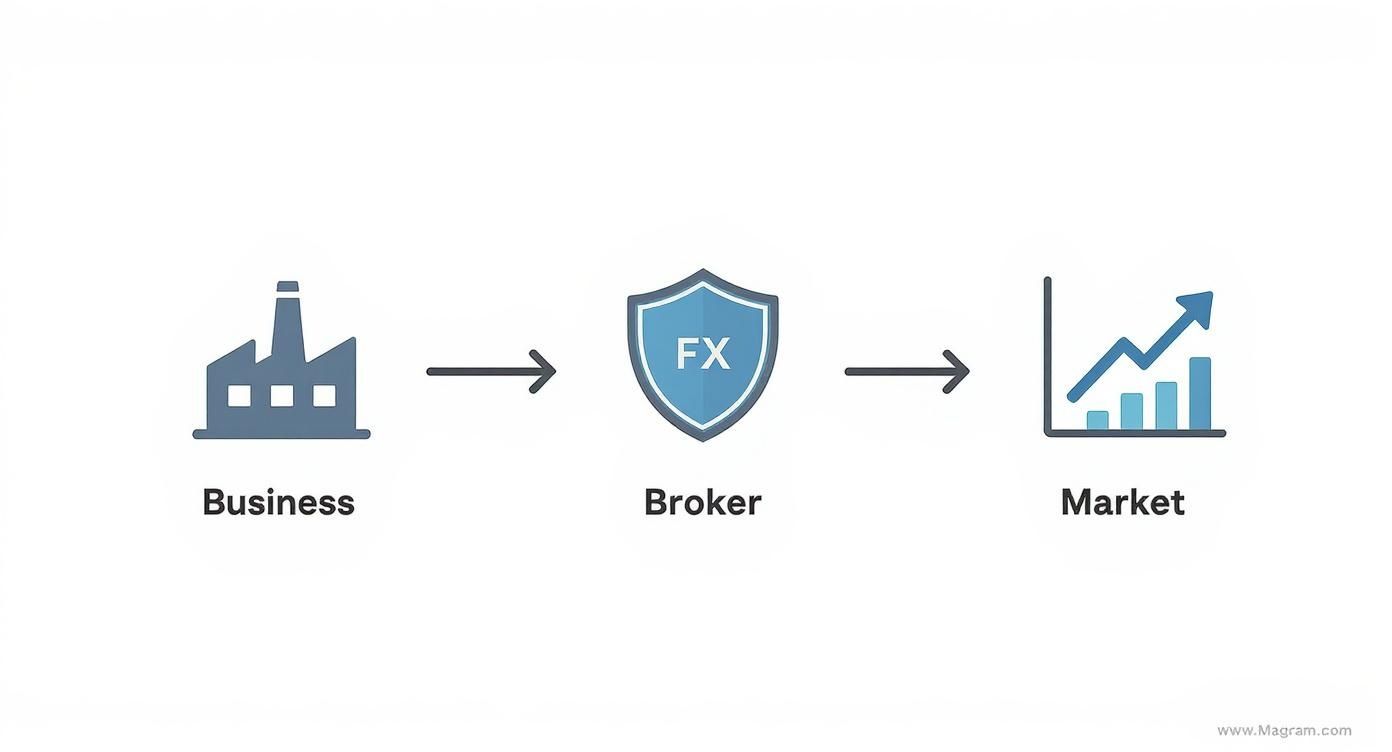
As you can see, any market shift has a direct impact on your equity, which sits at the very heart of the margin calculation.
Calculating Your Margin Level
The formula itself is actually quite simple. It’s a direct comparison of the capital you have (your Equity) against the capital that's tied up backing your trades (your Used Margin).
The Margin Level Formula:
(Equity / Used Margin) x 100% = Margin Level %
Let’s walk through a real-world example. Imagine your South African business uses a cross-border payment platform like Zaro and wants to hedge an upcoming payment of $100,000. To do this, you open a ZAR/USD position.
- Let's say your account has R180,000 in equity.
- Your broker requires a 2% margin for this trade. The required margin is $2,000 (roughly R36,000 at the time). This amount now becomes your Used Margin.
- Right after opening the trade, your margin level is looking great: (R180,000 / R36,000) x 100% = 500%. You're in a very safe position.
But then the market moves. The ZAR unexpectedly strengthens against the dollar, and your position is now showing a floating loss of R90,000. This immediately reduces your equity to R90,000 (R180,000 - R90,000).
Let's recalculate: (R90,000 / R36,000) x 100% = 250%.
Still safe, but the buffer is shrinking. If the market keeps moving against you and your equity drops all the way to R36,000, your margin level hits that critical 100% mark. That's the moment the margin call is triggered.
Understanding this calculation is the first step to actively managing your risk. Traders using high leverage are particularly vulnerable, as studies show they often get caught in rapid trading cycles. You can find more on the risks of high-frequency strategies in this detailed trading analysis.
To make these concepts even clearer, here’s a quick reference table breaking down the key terms.
Key Terms in Margin Calculation
This quick reference guide will help you understand the essential terms used when calculating your margin level.
| Term | Definition | Example (Based on a R100,000 account) |
|---|---|---|
| Equity | The real-time value of your account (Balance +/- Floating P/L). | Your account balance is R100,000, but you have an open trade with a R5,000 loss. Your Equity is R95,000. |
| Required Margin | The amount set aside by the broker to open a specific trade. | To open a R500,000 ZAR/USD position with 2% margin, the broker holds R10,000. |
| Used Margin | The sum of all Required Margin for all your open trades. | If you have two trades open, one requiring R10,000 and another R8,000, your Used Margin is R18,000. |
| Free Margin | The capital available in your account to open new trades (Equity - Used Margin). | With R95,000 Equity and R18,000 Used Margin, your Free Margin is R77,000. |
| Margin Level | The percentage showing your account's health ((Equity / Used Margin) x 100%). | Using the numbers above, your Margin Level would be (R95,000 / R18,000) x 100% = 527%. |
Getting comfortable with these terms means you can spot potential trouble long before your broker has to make that call.
The Real Consequences of a Margin Call

Getting that margin call notification is a stomach-dropping moment. It’s an urgent signal that the market has turned against you, and it forces you into a reactive position where every choice feels like a compromise.
You're immediately at a fork in the road. Path one is to scramble for funds and top up your account, pushing your margin level back into the safe zone. This keeps your positions open, but it can put a serious dent in your company's cash flow, tying up capital that was earmarked for stock, payroll, or expansion.
Path two is to do nothing, either because you can't or won't add more money. If you take this route, the decision is taken out of your hands. Your broker will step in and start closing your trades. This is called automatic liquidation, and it’s the outcome every business wants to avoid.
The Impact of Automatic Liquidation
When a liquidation is triggered, your broker begins to forcibly close your open forex positions to reduce your risk exposure and get your account back in line. They don’t ask which trades you’d prefer to close; they usually start with the biggest losers to free up margin as quickly as possible.
This isn’t just a minor setback; the financial damage can be severe and immediate.
- Crystallising Paper Losses: Those floating losses you hoped would reverse? They’re now permanent. The trades are closed, the loss is locked in, and the money is gone from your account for good. There's no waiting for a market recovery.
- Derailing Hedging Strategies: For South African businesses using FX forwards to manage import or export costs, this is a catastrophe. The very tool you were using to protect your profit margins gets dismantled, leaving your future international payments completely exposed to unpredictable currency swings.
A forced liquidation is the market equivalent of being forced to sell at the absolute bottom. Your positions are shut down precisely when they are performing their worst, guaranteeing you take the maximum hit on that trade.
Ultimately, a margin call is more than just a single financial loss. It can throw your entire financial planning into chaos, disrupt your supply chain, and eat into the capital you need to run and grow your business. It's a harsh lesson in a fundamental forex truth: preventing a margin call is always better—and cheaper—than reacting to one. For any company involved in cross-border trade, proactive risk management isn't just a good idea; it's essential.
Proactive Strategies to Avoid Margin Calls
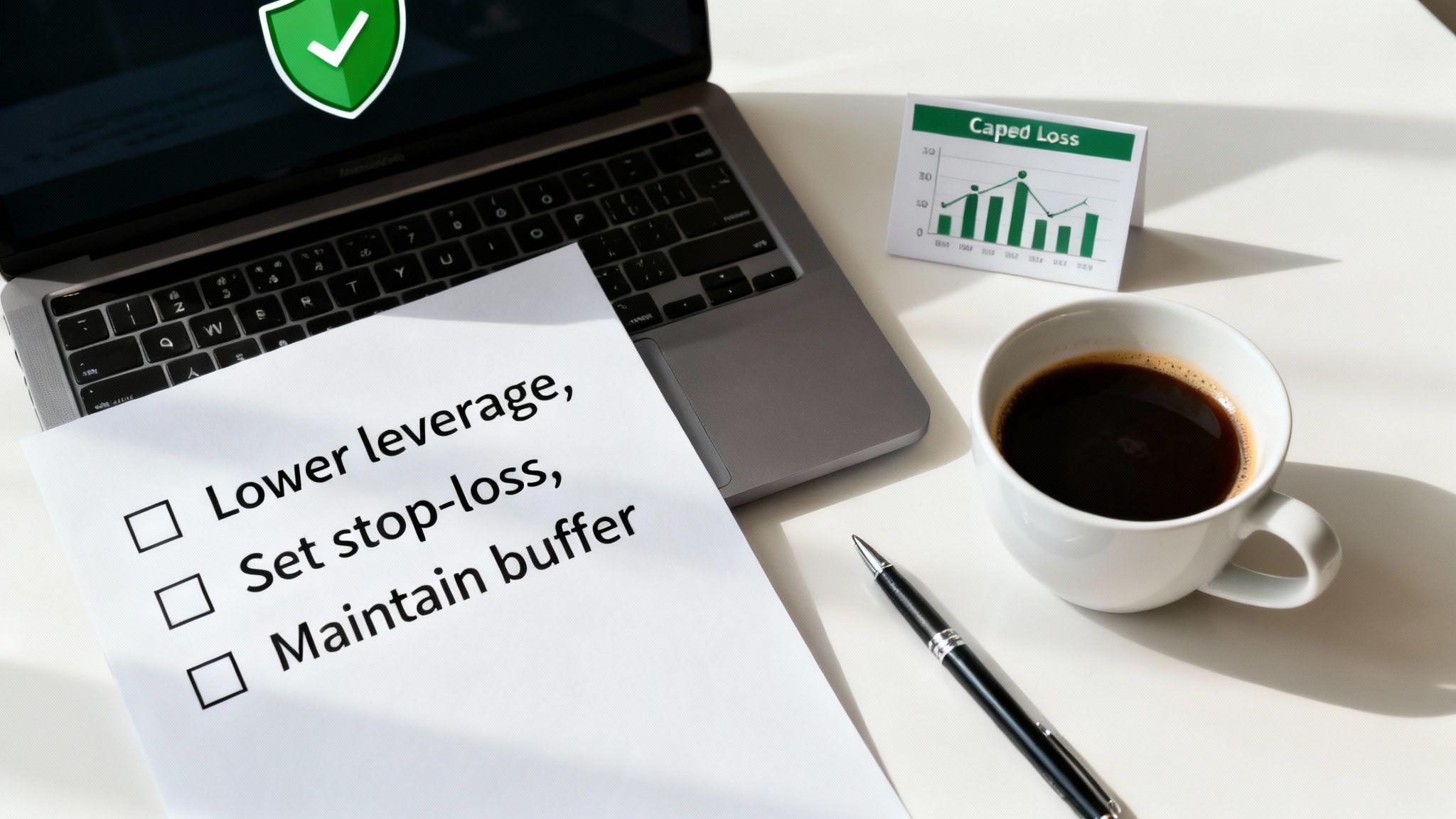
When it comes to an FX margin call, the best offence is a good defence. The goal isn't just to handle a margin call; it's to make sure one never happens in the first place.
Instead of waiting for a crisis, a proactive approach to risk management protects your capital and keeps your hedging strategies on solid ground. For South African businesses, this means adopting a disciplined mindset and using the right tools to build a strong buffer against market volatility.
Luckily, there are several powerful and practical ways to significantly reduce your risk exposure. By weaving these strategies into your forex operations, you can shift from a position of vulnerability to one of control. This turns the forex market into a tool for growth, not a source of financial stress.
Manage Your Leverage Wisely
Leverage is a powerful tool. It can amplify your gains, but it can magnify your losses just as easily. While it’s tempting to control a large position with a small amount of capital, using too much leverage is one of the quickest routes to a margin call. Even a small market movement against you can wipe out your margin with alarming speed.
A much smarter approach is to use lower leverage. This simply means committing more of your own capital to each position, which creates a larger cushion to absorb market fluctuations.
By opting for lower leverage, you are effectively giving your trades more breathing room. This reduces your account's sensitivity to minor price swings, making a margin call far less likely.
Think of it like driving in tricky weather. You wouldn't push the speed limit on a slippery road. Slowing down gives you more time to react and a greater margin for error—exactly what you need in the unpredictable forex market.
Set Intelligent Stop-Loss Orders
A stop-loss order is your ultimate safety net. It's an automated instruction you give your broker to close a trade once it hits a specific price level, capping your potential losses before they become a real problem.
Setting a stop-loss isn't just a good idea; it’s essential for sound risk management. It removes emotion from the equation and ensures your exit plan is executed with discipline, even when you aren't watching the markets.
Here’s how to put it into practice:
- Define Your Risk: Decide on the absolute maximum percentage of your account you're willing to risk on any single trade—a common rule of thumb is 1-2%.
- Calculate the Level: Based on your entry price and position size, set the stop-loss order at the price that matches your maximum acceptable loss.
- Stick to the Plan: Place the order the moment you open your trade. Critically, resist the urge to move it further away if the market turns against you.
To set realistic stop-loss levels, you need to look at historical data. For businesses in South Africa, platforms that offer historical market data are invaluable for evaluating past volatility and setting more informed trade parameters. By analysing these trends, you can spot patterns that might signal danger and adjust your strategy accordingly.
Finally, always keep a healthy buffer in your account. Avoid allocating all of your free margin to new trades, as having extra funds provides an additional cushion. In extreme cases where a margin call is unavoidable and other assets are at risk, some businesses might explore options like hard money loans to prevent foreclosure as a last resort.
Navigating Margin Rules in South Africa
https://www.youtube.com/embed/-sgpYSoOXqM
When your business starts trading foreign exchange, it's not the Wild West. Here in South Africa, the financial markets are carefully watched over by regulators to protect everyone involved and keep the system stable. Getting a handle on this local framework is essential, as it shapes how brokers deal with things like margin and risk.
The main sheriff in town is the Financial Sector Conduct Authority (FSCA). The FSCA’s job is to make sure that financial firms, including forex brokers, play fair and are upfront with their clients. For your business, this is a massive layer of protection.
Now, the FSCA doesn't hand down a single, fixed margin percentage that every broker must use. Instead, its oversight forces licensed brokers to have solid risk management policies. And a central piece of that puzzle is the FX margin call.
Why Local Regulation Is a Big Deal
For any South African business dipping its toes into forex, sticking with an FSCA-regulated broker isn't just a good idea—it should be non-negotiable. It offers a safety net you simply won't find with offshore or unregulated platforms.
Let's break down why this matters so much:
- Your Money is Kept Safe: Regulated brokers must hold client funds in separate, segregated bank accounts. This means your capital isn't mixed with theirs, so it's protected if the brokerage itself runs into trouble.
- Fair and Honest Dealings: The FSCA has strict rules about transparent pricing and clear communication. This cuts down the chances of being caught out by hidden terms or misleading advertising.
- A Way to Settle Disputes: If something goes wrong and you have a disagreement with your broker, the FSCA provides an official process for resolving it. With an unregulated broker, you're often on your own.
Choosing a locally regulated broker means you’re teaming up with a company that’s accountable right here at home.
Think of a reputable, FSCA-regulated broker as more than just a trading platform; they are a partner in your financial security. Their compliance with local rules is your first defence against bad actors and brings a much-needed dose of stability to your forex activities.
In this environment, other institutions like the Johannesburg Stock Exchange (JSE) also set the rules for trading various financial products. If your business uses more advanced tools for hedging, like futures or options, you’ll need to understand their specific margining requirements. The whole system is designed to ensure that risk management tools like margin calls are used responsibly, protecting the entire financial marketplace.
Protecting Your Business from Margin Call Risk
Think of an FX margin call less as a sudden disaster and more as a warning sign you can prevent from ever flashing. It’s not something that just happens to businesses out of the blue. Getting one is almost always a symptom of a risk management plan that’s fallen short.
The key to successful forex management isn't about chasing huge, risky wins. It’s about discipline, smart controls, and a solid grasp of how the system works. When you get this right, foreign exchange becomes a predictable part of your growth strategy, not a source of sleepless nights and expensive errors.
A Proactive Stance is Your Best Defence
By putting the strategies we've discussed into practice, your South African business can handle cross-border payments with confidence. Simple things make all the difference: keeping a healthy buffer in your account, being sensible with leverage, and using firm stop-loss orders are your best lines of defence. This is how you shift forex from a potential problem into a stable part of your financial planning.
Ultimately, good risk management is about more than just knowing what a margin call is. It’s about actively controlling risk exposures in foreign exchange so you never have to deal with one in the first place.
Here’s the main takeaway: A margin call isn’t a random market event. It’s the direct result of a breakdown in risk management. By taking charge of your exposure, keeping a close eye on your margin level, and always having a clear plan, you shield your business from market swings and can stay focused on what really matters—growing globally.
Your Top Questions About FX Margin Calls Answered
Diving into the world of foreign exchange can feel a bit like learning a new language, and terms like "FX margin call" can be particularly confusing. Let's break down some of the most common questions South African business owners have, so you can handle your currency risk with more confidence.
Can I Stop an FX Margin Call After It Happens?
In short, no. Once the alert is triggered, you can't undo it, but you absolutely can resolve it. You have two main paths: either add more funds to your account to get your margin level back up to a safe number, or start closing out some of your positions to free up the margin you're currently using. The key is to act fast, as hesitation can lead to your positions being automatically closed for you.
How Quickly Do I Need to Respond?
Immediately. I can't stress this enough. The timeframe to respond to a margin call is incredibly short. Many brokers use automated systems that will start liquidating your positions the second your account hits the stop-out level. This can happen just moments after the margin call if the market keeps moving against you.
Think of a margin call less as a friendly reminder and more as an urgent alarm demanding an instant decision. The forex market moves too quickly for a "wait-and-see" approach, which is why having a proactive risk strategy is your best defence.
Is a Margin Call Always a Bad Thing?
While it's definitely a sign that you're in a high-risk situation, a margin call is actually a safety feature. Its core purpose is to stop your account from going into a negative balance where you’d owe your broker money. It’s like a circuit breaker in your house—it trips to prevent a small problem from turning into a major disaster.
From a business perspective, though, getting a margin call is a clear signal that your risk management plan wasn't quite robust enough for the current market swings.
What's the Difference Between a Margin Call and a Stop-Out Level?
It’s easy to mix these up, but they represent two very different points in a high-risk trade.
- The Margin Call: This is the first warning flare from your broker. It’s an alert telling you that your account equity has dipped below the required maintenance level. You still have a very brief window to take control of the situation.
- The Stop-Out Level: This is the point of no return. If your margin level falls to this critical threshold (say, 50%), your broker's system will automatically start closing your trades, usually starting with the biggest loser. There's no further warning.
Getting this distinction right is crucial. The margin call is your final chance to step in before the stop-out level takes over and locks in your losses for you.
Ready to manage your international payments without the complexity and hidden fees? With Zaro, you get real exchange rates and enterprise-grade tools to control your finances. Simplify your cross-border transactions by visiting the Zaro website.