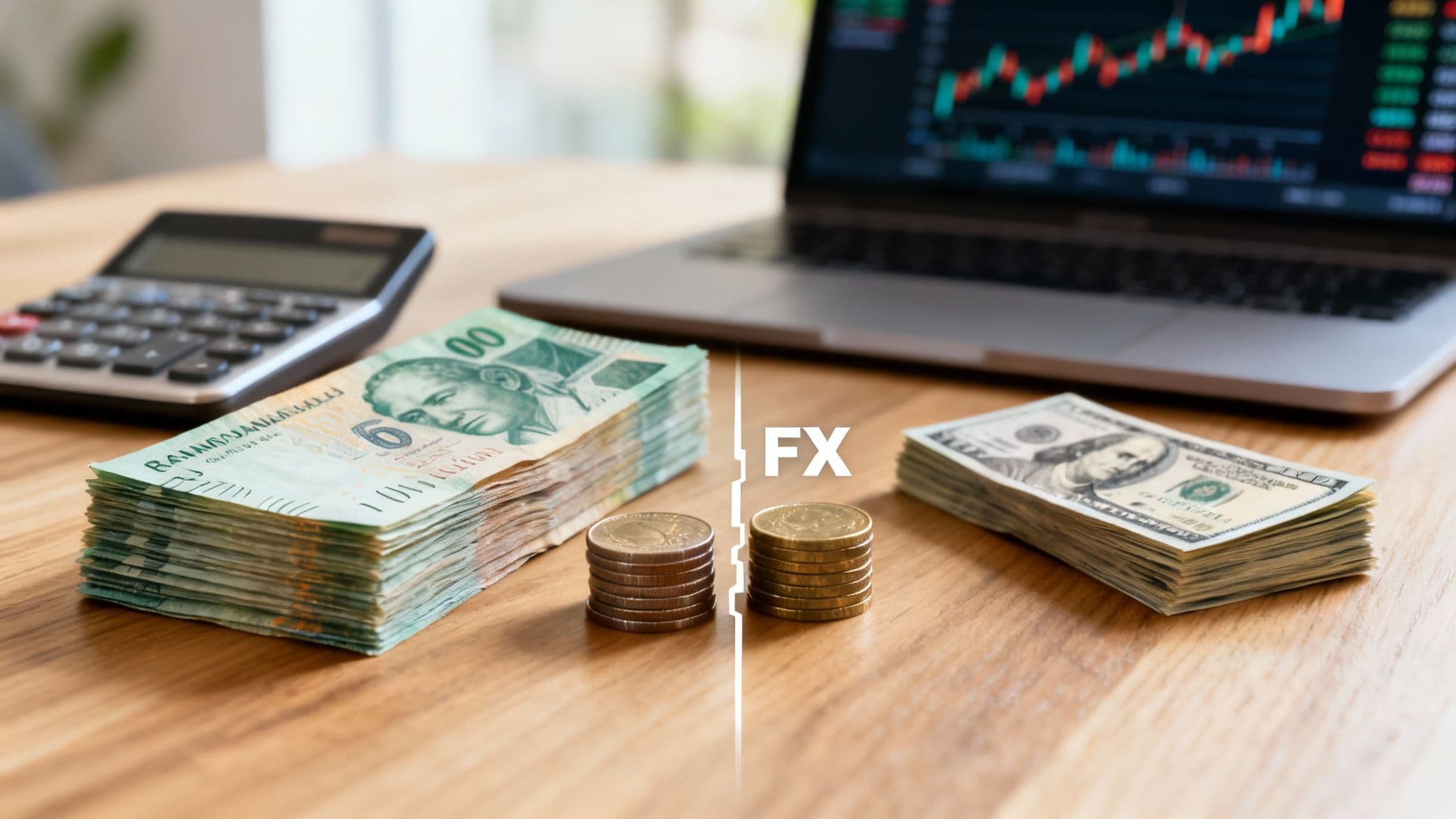
Whenever your business sends or receives money internationally, a hidden cost is quietly eating into your profits. It's called the FX trading spread, and it’s essentially a service fee banks and brokers build into the exchange rate they offer you.
Think of it this way: there's a real, mid-market exchange rate for any currency pair, but that's not the rate you get. The rate you're quoted is always slightly worse, and that small difference is where they make their money.
The Hidden Fee in Every International Payment
For any South African business paying overseas suppliers, buying imported goods, or running a global payroll, these seemingly tiny costs add up fast. The real problem is that the spread isn't listed as a separate fee on your invoice. It's just baked into the exchange rate, making it almost invisible.
This lack of transparency makes it incredibly difficult to forecast your costs accurately and can slowly erode your profit margins without you even noticing. This guide will pull back the curtain on the FX spread—what it is, how it's calculated, and most importantly, how your business can get around it. Getting a handle on this is the first step to taking back control of your international finances.
Why This Fee Matters to Your Business
The sting of the FX spread isn't just a one-off transaction cost; its effects ripple through your entire financial planning. It introduces uncertainty where you can least afford it and can put you at a serious disadvantage.
Here's why you need to pay attention:
- It drains your profits. Every fraction of a percentage lost to the spread is money straight off your bottom line. It makes your imports more expensive and reduces the value of your international sales.
- It creates budget chaos. When markets get shaky, spreads can widen without warning. Suddenly, a payment you budgeted for costs significantly more, throwing your entire cash flow forecast out of whack.
- It hurts your competitiveness. If your competitors have found a way to avoid these fees, they’re operating with lower overheads. That gives them the flexibility to offer better prices, undercutting you in the market.
The opaque nature of foreign exchange places a significant responsibility on businesses to ensure they achieve the best execution. Many firms pay more than necessary for FX, often without knowing the extra costs are being charged.
At its core, the issue is the gap between the rate banks get and the rate they give you. They profit from this information asymmetry. Thankfully, modern financial solutions are changing the game by offering direct access to the real exchange rate.
To get a fuller picture of the services and strategies available, the insights from leading payments experts can be invaluable. By closing this knowledge gap, you empower your business to stop leaking money to hidden fees and gain true control over your cross-border payments.
Decoding the Spread: Bid-Ask Prices and Pips
To get a real handle on the FX trading spread, you first have to understand how currency prices are quoted. Forget the single "exchange rate" you see on the news. In the real world of transactions, there are always two prices.
You have the bid price, which is what a buyer (like your bank) is prepared to pay for a currency. Then you have the ask price (sometimes called the offer price), which is the price a seller is willing to accept for that same currency.
The spread is simply the difference between those two numbers. It might seem small, but this gap is where the bank or broker builds in their profit for handling the trade. For your business, this is a very real, and often overlooked, cost.
The Anatomy of a Currency Quote
Let's look at a typical quote you'd see for the South African Rand against the US Dollar (ZAR/USD). It always comes in two parts.
- Bid Price: This is the rate the bank will use to buy US Dollars from you. It's always the lower of the two numbers.
- Ask Price: This is the rate the bank will use to sell US Dollars to you. It's always the higher figure, which means you pay more to acquire a currency than you get when you sell it.
The image below gives a great visual breakdown of how this spread, along with other fees, chips away at the value of your international payments when using traditional bank services.

As you can see, the FX spread isn’t just some minor detail; it’s a core cost that directly eats into the final amount of every cross-border payment you make or receive.
Measuring the Spread with Pips
So, how do we measure this price gap? In the forex world, we use pips. The term stands for "percentage in point," and it’s the smallest standardised move a currency pair's price can make.
For most major currency pairs, a pip is the fourth decimal place (0.0001). For pairs that involve the Japanese Yen, it's the second decimal place. Knowing about pips helps you quantify just how wide—and costly—a spread really is.
A wider spread means more pips between the bid and ask prices, which translates directly into higher costs for your business. It's the most common way transactional fees are hidden in plain sight.
To make this crystal clear, let's walk through a practical example. Say your business needs to buy US Dollars to pay a supplier.
Here's a hypothetical ZAR/USD quote and what it means for your bottom line.
Bid vs Ask Price: A Practical Example (ZAR/USD)
| Component | Price (ZAR) | Description for Your Business |
|---|---|---|
| Bid Price | 18.2550 | The price the bank will pay to buy $1 from you. |
| Ask Price | 18.2650 | The price you must pay to buy $1 from the bank. |
| The Spread | 0.0100 | The difference, which is the bank's profit margin. |
The calculation is straightforward: 18.2650 (Ask) - 18.2550 (Bid) = 0.0100.
This tiny difference of 0.0100 represents 10 pips. This is the cost your business pays on every single dollar it exchanges. While it looks insignificant on its own, this cost adds up incredibly fast on large transactions, silently eroding your profit margins. Once you start looking past the advertised "rate" and focus on the spread, you begin to see the true cost of your foreign exchange.
Fixed vs. Variable Spreads: Which One Are You Paying?
Just as no two exchange rates are identical, not every FX trading spread is built the same way. When your business is dealing with international payments, the spread you're charged will nearly always be one of two types: fixed or variable.
Figuring out which one applies to you is crucial. It directly affects your ability to budget accurately and can have a real impact on your bottom line. Each type has its own logic, advantages, and serious disadvantages for a business.
The Predictability of Fixed Spreads
A fixed spread is exactly what it says on the tin—it stays the same no matter what the currency markets are doing. The difference between the buy and sell price is locked in, whether the market is having a quiet day or bouncing around because of a major news event.
For a business, the main appeal here is predictability. You know exactly what the cost of the transaction will be, every single time. The catch? That kind of stability usually costs you more. To protect themselves from wild market swings, providers offering fixed spreads typically set them wider than what you’d find with a variable spread.
Here’s a quick breakdown:
- The upside: It gives you total certainty on costs, making financial planning and forecasting much simpler. You’re shielded from surprise cost hikes when the market gets choppy.
- The downside: You’ll probably pay a higher baseline cost for that peace of mind. On calm days, you're effectively overpaying compared to what you could get with a variable spread.
You’ll see fixed spreads more often on retail trading platforms than in the corporate payment solutions offered by traditional banks.
A fixed spread acts as a buffer for the currency provider. While it gives you, the client, predictability, you're paying a premium for that service through a consistently wider—and often more expensive—spread.
The Reality of Variable Spreads for Businesses
Now, let's look at variable spreads. This is the model most South African businesses encounter when making cross-border payments through their banks. A variable spread is dynamic, constantly changing in real-time. It widens and narrows based on what the market is doing at that exact moment.
And this is where the hidden costs really start to bite. The rate your bank gives you can shift from one minute to the next, pushed around by powerful market forces. The real problem is that most businesses are unknowingly paying a high and completely non-transparent variable spread, which only gets worse when economic conditions are uncertain.
It creates a nasty cycle: just when you need financial stability the most, your transaction costs become their most unpredictable and expensive.
Why Your Bank’s Spread Is So Unpredictable
So, what makes a variable spread so volatile? The two main culprits are low liquidity (fewer buyers and sellers) and high volatility (big price swings). For a currency like the South African Rand (ZAR), these factors are always at play.
When big economic news hits or global investors get nervous, banks immediately widen their spreads to protect themselves from risk.
This means your business is directly exposed to these market jitters. The R10,000 you budgeted for an international invoice could suddenly cost you R10,500 just because the market moved and the bank instantly adjusted its spread. This total lack of transparency makes it almost impossible to manage international payment costs effectively, turning every transaction into a financial gamble.
Why Does the FX Spread Change?
Have you ever looked at a foreign payment and thought, "Hang on, this is costing me more than it did last week"? Even when the official exchange rate has barely budged, the final cost in Rands can be noticeably different. What you're seeing is the FX trading spread at work, constantly expanding and contracting based on what's happening in the market.
For any South African business dealing with international payments, getting a handle on why this happens is crucial. It’s not just random chance; it's about timing your transactions to avoid paying more than you have to. Three main forces are always influencing that hidden cost: market volatility, how much of a currency is being traded, and even the time of day you hit 'send'.
Market Volatility: The Bigger the Swings, the Wider the Spread
Think of market volatility as the choppiness of the financial seas. When a currency's price is swinging wildly up and down, the market is volatile. This creates a ton of risk for the banks and brokers handling your transaction. To protect themselves from getting caught on the wrong side of a sudden price move, they simply widen the spread.
It’s a bit like an insurance premium. When the weather is stormy, insuring a ship costs more. In the same way, when currency markets are turbulent, the "insurance" the bank charges you—baked into that wider spread—goes up.
The South African Rand (ZAR) is no stranger to volatility. Political news, economic data releases, or even just a shift in global investor mood can send it on a rollercoaster. We've seen this play out time and again. According to data from the Federal Reserve, the rand-to-dollar rate has seen massive shifts, even hitting an all-time high of 19.93 in recent years. You can explore the ZAR's historical performance for yourself on the St. Louis Fed's data site.
During these choppy periods, traditional banks will almost always widen their spreads. This means your business ends up paying the highest transaction costs precisely when the exchange rates are at their most unpredictable.
Currency Liquidity: Popularity Equals Better Pricing
Liquidity is just a fancy word for how easy it is to buy or sell a currency without affecting its price. Currencies that are traded in enormous volumes every single day—like the US Dollar or the Euro—are considered highly liquid. There’s always someone ready to buy what you’re selling, and vice versa.
This high level of activity creates fierce competition, which is great for you because it results in tighter, lower-cost spreads. It's like selling a hugely popular car model; you’ll have dozens of buyers lining up, ensuring you get a fair, competitive price.
On the other hand, currencies that are traded less frequently are called "illiquid" or "exotic." While the Rand is a major currency on the African continent, its trading volumes are a drop in the ocean compared to global pairs like EUR/USD. This lower liquidity automatically leads to a wider starting spread. With fewer players in the market, there's less competition and more friction, which translates directly into higher costs for your business.
Lower liquidity means more risk for the market makers. To cover themselves for the difficulty of offloading a currency quickly, they build a bigger safety buffer into their price—and that buffer is the wider, more expensive spread you end up paying.
Timing is Everything: How the Clock Affects Your Costs
The global FX market may be open 24 hours a day, but it definitely has its rush hours and quiet periods. The time you choose to make a payment can have a surprisingly big impact on the cost.
The market is at its busiest, most liquid, and most competitive when the world's biggest financial centres overlap—particularly the window when both London and New York are open for business. Spreads are usually at their absolute tightest during these hours.
Here’s a simple breakdown:
- Peak Trading Hours (e.g., London/New York overlap): This is prime time. Liquidity is high, competition is fierce, and spreads are tight. It’s usually the best time to transact.
- Off-Peak Hours (e.g., late at night, weekends): Liquidity dries up. With fewer banks actively trading, the market thins out, and spreads can widen dramatically.
For a business in South Africa, this means sending a large payment late on a Friday afternoon could cost you significantly more than if you had processed it on a Tuesday morning. By simply being aware of these daily rhythms, you can start timing your payments more intelligently and stop leaving money on the table.
Calculating the Real Cost of Spreads on Your Payments
It’s one thing to talk about the FX trading spread in theory, but it’s another thing entirely to see how it hits your bottom line. Abstract ideas like pips and percentages suddenly get very real when you attach a Rand value to them. So, let’s get practical with a scenario that plays out daily for South African businesses.
Imagine your company owes an international supplier $50,000. You log into your business bank account to settle the invoice, but the final amount you pay in Rands is often a nasty surprise. The culprit? The spread, quietly working as a hidden fee on the transaction.

Let's walk through the numbers to show you exactly how this hidden cost is calculated. We’ll compare a typical bank’s rate against a transparent, zero-spread model. The difference will reveal just how much your business could be saving.
A Step-by-Step Cost Calculation
To see what you’re really paying, we need a starting point: the mid-market rate. Think of this as the true, unadulterated exchange rate—the halfway point between what buyers are willing to pay and what sellers are asking for on the global market. For this example, let's say the ZAR/USD mid-market rate is 18.50.
Now, here’s how a typical bank approaches this. Most traditional banks will add a variable spread, which could be anything from 1% to 3% (or even higher) on top of the mid-market rate. For a payment of this size, we’ll use a conservative 2% spread.
Work out the bank's marked-up rate: The bank adds its 2% profit margin to the real rate.
- 18.50 (Mid-Market Rate) x 0.02 (2% Spread) = 0.37
- Bank's Quoted Rate = 18.50 + 0.37 = 18.87 ZAR per USD
Calculate your total cost (using the bank’s rate): This is the final amount you’ll see debited from your account.
- $50,000 (Invoice) x 18.87 (Bank Rate) = R943,500
Calculate the true cost (with zero spread): This is what the payment should have cost you at the real exchange rate.
- $50,000 (Invoice) x 18.50 (Mid-Market Rate) = R925,000
The gap between those two numbers is the hidden cost of the spread. It’s money that left your account but never made it to your supplier.
The Hidden Cost of the Spread = R943,500 - R925,000 = R18,500
On just one $50,000 invoice, your business lost R18,500 simply because of the bank's hidden markup. This isn’t a service fee; it's a cost baked right into the exchange rate to boost the bank’s profit.
How Volatility Makes Your Costs Even Worse
This hidden cost gets even bigger and more unpredictable when the Rand is volatile. We’ve all seen the Rand go through major strengthening and weakening cycles. For instance, it once hit its strongest position in nearly two years, appreciating 11% against the US dollar in a single year. When the market moves that fast, banks often widen their spreads to protect themselves from risk.
This means South African businesses don't get the full benefit of good rate movements because those hidden spread costs eat away at the gains. For more data on currency trends, you can explore insights from sources like Trading Economics.
The table below lays out the difference in black and white, showing just how much is at stake when you sidestep these traditional markups.
Cost Comparison Paying a $50,000 Invoice
This table shows the real ZAR cost difference between using a traditional bank with a typical spread and a zero-spread platform.
| Metric | Traditional Bank (2% Spread) | Zero Spread Platform | Your Savings |
|---|---|---|---|
| Exchange Rate | 18.87 ZAR per USD | 18.50 ZAR per USD | N/A |
| Total ZAR Cost | R943,500 | R925,000 | R18,500 |
| Hidden Spread Cost | R18,500 | R0 | 100% of the spread |
By moving to a platform that gives you access to the real exchange rate, your business can put that money back where it belongs. The FX spread stops being an uncontrollable expense and becomes a strategic area for major cost savings, boosting your profitability on every single international payment.
How To Build Your Strategy To Minimise Spread Costs
Knowing what an FX trading spread is is one thing, but the real trick is turning that knowledge into a practical plan. For any South African business dealing with international payments, especially importers and exporters, a smart strategy to manage this hidden cost isn't just about saving a bit of cash—it's about protecting your profit margins and gaining a real competitive advantage.
When the market gets choppy, traditional banks often use that uncertainty as a reason to widen their spreads. This means that just when your business needs stability the most, your transaction costs suddenly become unpredictable and expensive. The only way to break this cycle is to step away from opaque, spread-based systems and embrace financial platforms built on transparency.

Adopt a Zero-Spread Mindset
The single most powerful change you can make is to actively search for solutions that give you the real exchange rate. A zero-spread approach completely changes the game because it removes the bank’s hidden markup from the equation. Instead of paying an invisible fee buried in the rate, you get to transact at the true mid-market price and only pay a small, upfront service fee.
This simple shift delivers two huge benefits:
- Cost Reduction: You immediately stop overpaying on every single transaction. Those savings add up fast and can make a massive difference to your bottom line over time.
- Predictability: Your financial forecasting becomes much more accurate. Your costs are no longer a guessing game, subject to market volatility or your bank’s internal risk strategy.
Scrutinise Your Current FX Provider
If you’re still using a traditional bank for your international payments, it’s time to ask some hard questions. Many businesses stick with the same provider for years out of habit, never truly digging into the real cost of their foreign exchange. The system is designed to be confusing, but doing your own homework is crucial.
The heart of a strong FX strategy is simple: demand transparency. If your provider can't clearly show you the mid-market rate, the spread they're charging, and any other fees, you are almost certainly paying too much.
A great exercise is to go back and compare the rates you received on past transactions with the historical mid-market rate for those days. This will instantly reveal the hidden spread you’ve been paying all along. To truly cut down on these costs, consider looking into platforms like Wise, which are built around providing transparency and efficiency for international transfers.
Time Your Transactions Strategically
While switching to a zero-spread platform is the best long-term solution, you can still save money within the current system by being clever with your timing. As we've covered, spreads are usually at their tightest when the global markets are most active—specifically during the overlap of the London and New York trading sessions.
Try to avoid making large payments late on a Friday afternoon or on public holidays when liquidity is low. A simple tweak to your payment schedule can make a noticeable difference to the variable spread you're charged.
For South African exporters, controlling these costs is non-negotiable. Research shows that things like foreign income demand have a bigger impact on export volumes than just exchange rate movements. This means companies can't just rely on a weaker Rand to stay competitive; they have to proactively fight back against the volatile spreads the banks charge. An effective, low-cost FX strategy isn’t a luxury—it's a vital tool for staying profitable and holding your ground in the market.