
When you're looking for the GBP ZAR live rate, what you're really after is the real-time price of the British Pound Sterling against the South African Rand. This isn't the tourist rate you see at the airport or the marked-up rate from your bank; this is the raw, unadulterated exchange rate as it exists on global financial markets this very second.
Your Instant GBP to ZAR Rate Overview
This live rate is often called the mid-market rate, and it’s the most important number in foreign exchange. Think of it as the wholesale price of a currency. It's the exact midpoint between what traders are buying a currency for (the bid price) and what they're selling it for (the ask price).

This is the benchmark. Every other rate you're offered, whether for paying an international supplier, receiving an inheritance from the UK, or managing your company's cash flow, is derived from this figure. Understanding it is the first, most crucial step to making smart financial decisions and avoiding hidden fees.
Understanding Recent Performance
To get a feel for the Pound-Rand relationship, you need context. Looking at its recent performance helps you see how volatile the pair has been and spot any emerging trends.
For instance, throughout 2025, the rate has been quite lively. It recently peaked at 25.236 ZAR for every 1 GBP, while its lowest point was 22.791 ZAR. That’s a swing of about 10.7% in a relatively short period, highlighting just how much the value can change. If you're curious, you can dive deeper into historical exchange rate data to see how major economic events have influenced these movements over time.
For a quick summary, here are the key numbers that give you a snapshot of the GBP/ZAR pair's recent activity.
GBP to ZAR At a Glance
| Metric | Recent Value (Example) | Significance |
|---|---|---|
| Current Live Rate | 24.550 | The real-time mid-market exchange rate, updated every second. This is your baseline. |
| 24-Hour High | 24.620 | The highest value the Pound has reached against the Rand in the last day. |
| 24-Hour Low | 24.480 | The lowest value the Pound has dropped to against the Rand in the last day. |
| 30-Day Average | 24.350 | Smooths out daily noise to give a clearer picture of the medium-term trend. |
These figures tell a story. The gap between the 24-hour high and low shows you the daily volatility, while the 30-day average helps you see past the short-term spikes and dips.
Key Takeaway: The live mid-market rate is your anchor. Always compare the rate a bank or transfer service offers you against the live rate. The difference between them is their markup—the real cost of your transaction. With these numbers in hand, we can now look at what actually makes them move.
Here is the rewritten section, crafted to sound like an experienced human expert.
What Really Moves the Pound and Rand
Ever watched the GBP ZAR live rate and wondered why it jumps around so much? It’s not random. Think of it like a constant tug-of-war between the UK and South African economies. What happens in London and Pretoria creates powerful undercurrents that directly pull the exchange rate one way or the other. Getting a handle on these forces is the first step to truly understanding the numbers you see on your screen.
At the heart of it all are the two major players: the Bank of England (BoE) and the South African Reserve Bank (SARB). These central banks are the real heavyweights, and their most powerful tool is the interest rate.
Here’s how it works: if the SARB raises its interest rates to cool down inflation, it suddenly makes holding Rands more appealing for global investors looking for a better return. They might start selling Pounds to buy Rands, which pushes the Rand’s value up. The same thing happens in reverse—if the BoE hikes its rates, the Pound gets a boost. It’s a constant dance between the two.
Economic Health and Political Tides
Beyond the central banks, the general economic health of each country acts like the wind in the currency's sails. A few key reports give us a snapshot of which economy is sailing smoothly and which might be heading for choppy waters.
Pay close attention to these figures:
- Inflation Rates: If inflation in South Africa starts running hotter than expected, it eats away at the Rand's buying power and can cause it to weaken.
- Gross Domestic Product (GDP) Growth: A strong GDP report is like a clean bill of health for an economy. It builds confidence and naturally pulls in investment, strengthening the currency.
- Employment Data: More people in jobs means a more stable, growing economy. Good job numbers are almost always good news for a currency's value.
Politics, on the other hand, is the hand on the rudder. Nothing makes financial markets more nervous than uncertainty. An upcoming election, a surprise policy announcement, or any hint of instability in either the UK or South Africa can send investors scrambling for safety. This "risk-off" sentiment often leads to wild swings in the exchange rate.
Simply put, investors hate surprises. A predictable political climate is like a calm sea, fostering stability. Political drama is a sudden squall, rocking the boat and making the currency’s direction impossible to predict.
The Commodity Connection
South Africa has an extra variable that the UK doesn't: commodities. The country is a powerhouse exporter of precious metals like gold, platinum, and palladium. This means the Rand's fate is often tied to the global price of these resources.
When commodity prices are booming, foreign buyers need more Rands to pay for South African exports. This flood of demand strengthens the Rand. But if the global car industry slows down and demand for platinum drops, less foreign currency flows in, and the Rand can take a hit against the Pound. This unique feature is why you'll often hear the Rand called a "commodity currency," adding another fascinating layer to the GBP ZAR live relationship.
A Look Back at the Pound and Rand Journey
To truly get a feel for the GBP ZAR live rate today, we need to wind back the clock. The relationship between the British Pound and the South African Rand is a long and tangled one, written over decades of sweeping economic, political, and social change. By digging into their shared history, we can spot the patterns that still ripple through their movements today.
It's been a rollercoaster, to say the least. Every major event—from the end of apartheid to the 2008 global financial crisis and the more recent tremors from Brexit—has left its mark on the exchange rate. These moments triggered intense volatility, often followed by calmer periods, teaching us a lot about the resilience and weak points of both currencies.
This image gives you a bird's-eye view of the GBP/ZAR exchange rate's general direction over the years.
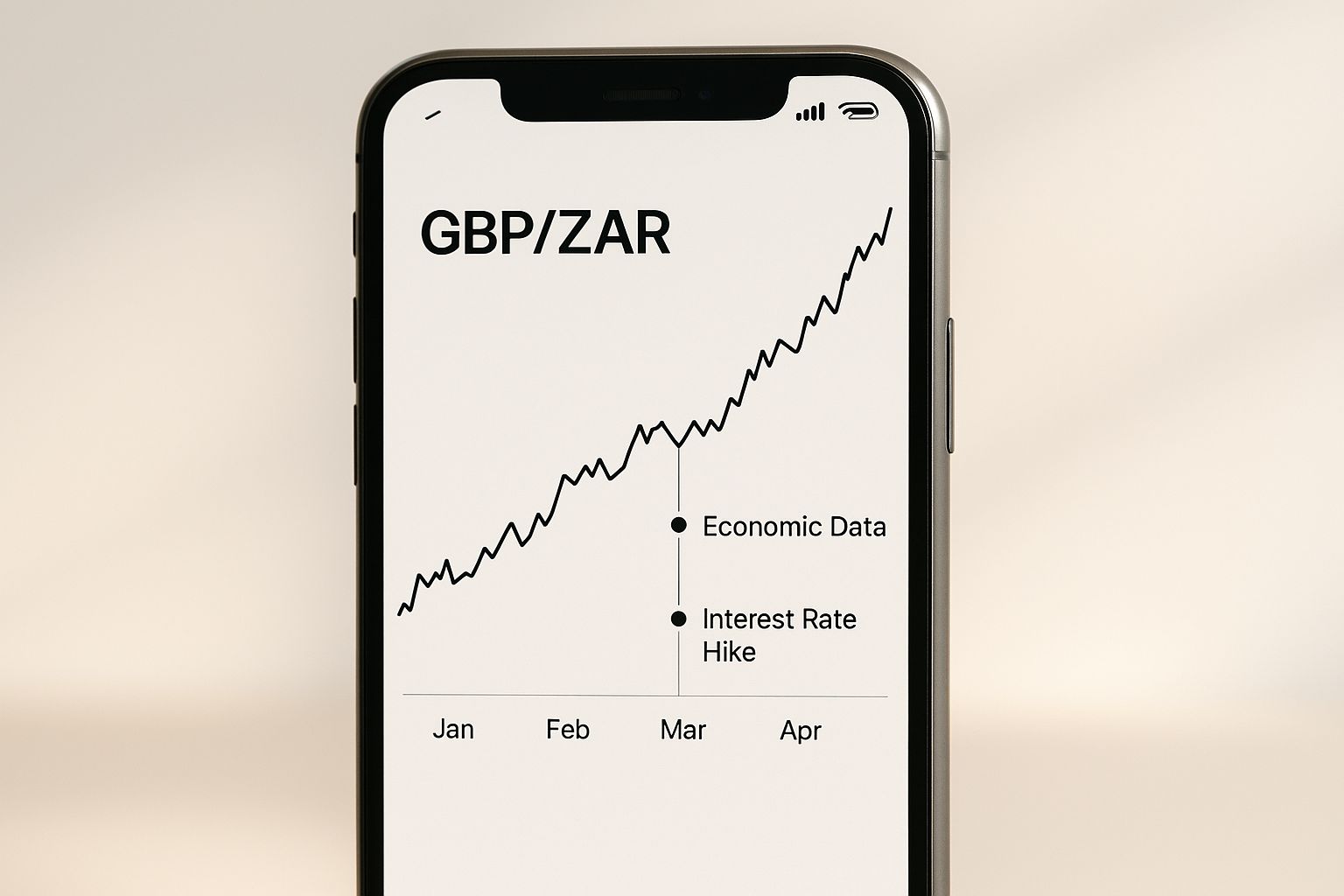
As you can see, the chart shows a clear, long-term weakening of the Rand against the Pound. This trend is a direct result of the historical turning points we're about to explore.
Key Historical Turning Points
Certain moments in time were absolute game-changers for the GBP/ZAR pair. Each tells a vivid story of how global headlines and local policies can dramatically shift a currency's value.
- The Post-Apartheid Era (Early 1990s): When South Africa re-entered the global economy, it was a seismic shift. While this move unlocked new trade and investment, it also threw the Rand into the deep end of international market forces, introducing a whole new level of volatility.
- The 2008 Financial Crisis: This global shockwave sent investors scrambling for safety. Many fled what they saw as riskier emerging market currencies, the Rand included, and flocked to perceived safe havens like the Pound. This caused a sharp spike in the GBP/ZAR rate.
- The Brexit Referendum (2016): Interestingly, this event flipped the script. The political and economic uncertainty brewing in the UK hammered the Pound, giving the Rand a period of temporary, and welcome, strength.
Understanding these historical flashpoints is key. They prove that an exchange rate isn't just a number on a screen; it's a living indicator of investor confidence, political stability, and the economic health of two nations.
Over the last fifty years, the British Pound to South African Rand exchange rate has been anything but predictable, swinging wildly with each new economic or political chapter. It's telling that the rate only started to consistently trade above 24 ZAR in the last few years—a milestone that speaks volumes about the long-term impacts of inflation and economic policy on the Rand.
For a deeper dive into these fluctuations, the historical reference rates from the Bank of England offer a fascinating timeline. Having this historical backdrop is priceless for anyone looking to manage their foreign exchange risk.
Smarter Ways To Track The GBP ZAR Live Rate

There’s a world of difference between passively glancing at the GBP ZAR live rate on a search engine and strategically tracking it for your business. To get the best value, you need to shift from being a spectator to an active participant. This means looking beyond the inflated "tourist rates" you see at exchange bureaus and homing in on the real mid-market rate.
The aim is simple: find a reliable source that gives you an honest, unfiltered view of the market. While a quick search offers a snapshot, dedicated platforms provide the depth required for making smart financial decisions. These tools show you the real-time midpoint between what buyers and sellers are offering — the very same rate platforms like Zaro use to deliver transparent FX.
Choosing Your Tracking Platform
Not all rate-tracking tools are built the same. The right one for you really depends on what you need to do, whether it's just casual monitoring or executing large international payments.
To help you decide, here’s a quick comparison of the different kinds of platforms available for tracking the live GBP/ZAR exchange rate. Think about what you're trying to achieve, and you'll find the perfect tool for the job.
Comparing Platforms for Tracking Live GBP/ZAR Rates
| Platform Type | Best For | Key Feature | Potential Cost |
|---|---|---|---|
| Financial News Sites | General market awareness and news context. | Provides live charts alongside economic news that influences rates. | Free |
| Specialised FX Apps | Active monitoring and setting alerts for specific rates. | Customisable notifications and detailed historical data analysis. | Free (with premium options) |
| Trading Platforms | Serious traders needing advanced charting tools. | In-depth technical analysis tools and immediate execution. | Varies (fees or spreads) |
| Fintech Payment Platforms | Businesses needing to transact at the live rate. | Direct access to mid-market rates for actual transfers. | Zero (with Zaro) |
Ultimately, the best platform is the one that aligns with your goals. For a general pulse on the market, news sites are fine. But for making actual transactions, a fintech platform gives you the direct access you need.
From Passive Watching To Active Timing
Just watching the rate go up and down isn't enough. The real advantage comes from putting systems in place that do the work for you, letting you know the moment the market moves in your favour. This is where rate alerts prove their worth.
By setting a target rate, you can automate your monitoring. Instead of being glued to a screen, you get a notification the second the GBP/ZAR hits a level you’re happy with. This frees you up to act decisively.
This proactive approach is key to getting the most out of your currency conversions. To stay ahead and take advantage of good rates, it's worth learning about techniques like setting up price alerts. This simple step can completely change how you manage your foreign exchange, turning market volatility from a risk into a real opportunity.
Making Sense of Currency Forecasts
Predicting where the GBP to ZAR live rate will go next isn't about gazing into a crystal ball. It’s more like methodical detective work. Currency analysts don't just guess; they build a case using established methods to give businesses a sense of what might be coming down the line. If you can grasp how they do it, you'll be able to read their forecasts with a more critical eye and make much sharper decisions.
There are two main schools of thought here.
First, you have fundamental analysis. Think of this as putting on a financial investigator's hat. Analysts dig deep into the economic health reports and political stability of both the UK and South Africa. They pour over everything from interest rate announcements and inflation data to employment numbers and GDP growth, trying to determine which country's economy—and therefore its currency—has the upper hand.
Then there's technical analysis. This is less about economics and more about psychology and patterns. Technical analysts are like chartographers, meticulously studying historical price movements. They operate on the belief that past market behaviour, from trends to specific chart patterns, can give clues about what's likely to happen next. They use various indicators to map out potential support and resistance levels—the floors and ceilings that a currency pair might struggle to break through.
Reading Between the Lines
A currency forecast is a powerful guide, but it’s crucial to remember what it is: a probability, not a promise. The market’s mood can turn on a dime, and a single unexpected global event can throw even the most solid prediction completely off course.
The smartest way to use a forecast is to see it as just one input in your decision-making process. It offers a valuable glimpse into potential market direction, but it should always be balanced with your own business strategy and a solid risk management plan.
For instance, forecasts might scream about upcoming volatility, but looking at recent history can add some much-needed context. Over the last five years, the GBP/ZAR exchange rate has been relatively stable, with manageable ups and downs. In one recent seven-day period, for example, the rate only moved by about 0.12%, which points to a fairly controlled market. You can explore a detailed five-year history of the GBP/ZAR rate on Wise.com to see these historical trends for yourself.
Ultimately, interpreting forecasts is both a science and an art. It’s about weighing the data-driven insights from analysts against the real-world needs of your own business. And beyond just currency specifics, understanding the general principles for improving forecast accuracy can give you a real edge in making sense of what the market might do next.
Of course. Here is the rewritten section with a more natural, human-written tone, following all your specified requirements.
How to Secure a Better Exchange Rate
Knowing the GBP ZAR live rate is a great start, but what really counts is actually getting that rate when you make a transfer. This is where you can stop just watching the market and start making it work for you, turning knowledge into real rands in your account. The first step? Learning to spot and sidestep the common traps.
You’d be surprised where the biggest pitfalls are hiding – often in plain sight. Take traditional banks, for instance. They almost never give you the mid-market rate you see on Google or financial news channels. Instead, they bake in a hefty margin, or spread, which is just a hidden fee that chips away at the money you’re sending. Airport kiosks and walk-in currency exchanges are even worse; they bank on your need for convenience and charge a premium for it.
Comparing Your Transfer Options
The secret to saving money isn't just about looking at the advertised transfer fee. It's about comparing the final exchange rate each provider is actually offering you. Modern financial technology companies were essentially built to take on this old, opaque banking model. By offering far more transparency and operating much closer to the mid-market rate, they can save you a significant amount, especially when you're transferring larger sums.
The Real Cost of a Transfer: The true cost is always a mix of two things: the upfront transfer fee plus the hidden cost buried in the exchange rate markup. A service might shout about "zero fees," but if their rate is poor, they could easily be more expensive than a provider who charges a small, honest fee but gives you a much better rate.
This is exactly where a service like Zaro makes a world of difference for South African businesses. It cuts through the noise by offering direct access to the real spot exchange rates with zero spread. The hidden markups are gone. Plain and simple, the rate you see is the rate you get, which brings a level of clarity and predictability that has been missing from international finance for far too long.
Your Action Plan for Better Rates
Before you pull the trigger on your next international transfer, just run through this quick checklist. Think of it as your pre-flight check to make sure you don't leave money on the table.
- Check the Real Rate First: Before anything else, look up the current mid-market GBP ZAR live rate on a reliable, independent source. This number is your benchmark—your source of truth.
- Compare the Total Cost: Don't just accept the first quote you get. Ask your bank and a few fintech platforms for a quote. The crucial question is: "For my pounds, exactly how many rands will land in the recipient's account?" Compare those final figures.
- Factor in Transfer Times: How fast do you need the money to get there? Some of the instant services might cost a bit more. You need to find the right balance between speed and cost that fits your specific situation.
By making this your routine, you move from being a passive customer who just accepts whatever rate they're given to an informed player in control of their finances. This proactive approach is the key to consistently getting a better deal, protecting your profits and improving your cash flow.
Your GBP to ZAR Questions Answered
Diving into foreign exchange can feel a bit like navigating a maze, especially with a pairing as lively as the British Pound and the South African Rand. Let's clear up some of the most common questions with practical, straightforward answers to help you handle your money with more confidence.
What Is the Best Time to Transfer Money?
This is the million-rand question, isn't it? If only there were a magic answer. The truth is, the "best" time is a moving target, completely tied to the daily rhythm of economic news and political shifts.
Instead of trying to perfectly time the market—a game even the pros struggle with—it's far smarter to decide on a rate you'd be happy with. Set up a rate alert on a trusted platform, and you'll get a notification the moment the GBP ZAR live rate hits your target. This simple step turns a stressful guessing game into a planned, strategic action.
Why Is the Rate I See Online Different From My Bank's Rate?
That rate you find on Google or financial news sites? That's the mid-market rate. Think of it as the true, wholesale cost of a currency at any given second—the midpoint between what global traders are buying and selling it for. It’s the purest rate there is.
But here’s the catch: banks and most traditional transfer services almost never give you that rate. They build in their profit by adding a markup, often called a "spread." This spread is essentially a hidden fee that reduces how much money actually arrives on the other side.
How Can I Avoid Paying High Fees?
To get the most out of your transfer, your goal should be to find a service that gets you as close as possible to that real mid-market rate.
Here’s what to look for:
- Look Beyond the Advertised Fee: A "zero fee" promise often hides a terrible exchange rate where the real cost is buried.
- Compare the Final Payout: Always ask: "If I send X pounds, exactly how many rands will land in the account?" This is the only number that matters.
- Consider Modern Platforms: Newer financial technology services were often built specifically to cut out the hidden markups that traditional banks rely on, leading to more transparent and better rates.
Grasping these key ideas helps you see past the marketing jargon and make sure you're getting genuine value every time you send money abroad.
For South African businesses tired of unpredictable costs and hidden fees, Zaro offers a clear alternative. We provide direct access to real spot exchange rates with zero spread, ensuring the rate you see is the rate you get. Discover transparent, cost-effective international payments by visiting the official Zaro website.