Revenue is up. Overseas orders are flowing. Your sales reports look healthy. Yet when the money lands, the profit feels thinner than it should.
That gap frustrates a lot of South African exporters because the usual profitability view is too clean. It captures selling price and production cost, but it often misses what happens between invoice and settlement. If you sell across borders, your bank can take a slice through foreign exchange spreads, transfer charges, and settlement friction. Those costs may sit in different lines in your accounts, but they still reduce what the sale earned.
That’s why the gross profit percentage formula matters. Used properly, it tells you whether your core operation is efficient. Used lazily, it can flatter performance and hide margin leaks.
Why Your Profits Might Be Leaking on International Sales
A common pattern looks like this. An exporter ships product to a client abroad, invoices in foreign currency, and records what appears to be a solid gross profit. Then finance reconciles the bank account and notices that realised cash is lower than expected. The sale didn’t fail. The margin did.

The blind spot in standard margin thinking
Most finance guides teach gross profit percentage as a neat classroom formula. That’s fine for domestic trading. It’s incomplete for exporters.
For South African SMEs selling internationally, many standard explanations don’t factor in hidden FX markups, often 1% to 3% above spot rates, or SWIFT fees of $15 to $50 per transaction, and those costs can reduce effective gross margins by 2% to 5% annually according to this guide on how cross-border costs affect gross profit percentage.
Those costs matter because they attach directly to international sales activity. If you can’t get paid by a foreign customer, or you lose value while converting that payment, your profitability on that sale wasn’t what your internal report said it was.
Gross profit is supposed to show what the business keeps after direct delivery costs. If cross-border payment friction is unavoidable for the sale, finance should at least analyse it as part of the true cost of serving that market.
What paper profit misses
I’ve seen businesses treat bank charges and FX losses as generic overhead because that’s where the accounting software defaulted them. That’s tidy for bookkeeping. It’s poor for decision-making.
When you classify these costs too far down the income statement, three problems follow:
- Pricing gets distorted because you think a foreign customer or market is more profitable than it is.
- Sales teams get the wrong signal because they chase volume that may carry weak real margin.
- Cash flow planning slips because the spread between invoiced value and settled value keeps repeating.
For exporters, the question isn’t only “What did we sell for?” It’s also “What did we retain after the mechanics of getting paid internationally?”
That’s where the gross profit percentage formula becomes more than a textbook exercise. It becomes a filter for commercial truth.
The Gross Profit Percentage Formula Explained
A simple way to think about gross profit percentage is this. It tells you how much of each rand of revenue remains after you’ve paid the direct cost of delivering what you sold.
If you run a rooibos tea business and export boxed product, your revenue is what the customer pays. Your direct costs include the tea, packaging, and production inputs tied to those sales. What remains after those direct costs is your gross profit. Express that as a percentage of revenue, and you have your gross profit percentage.

The formula in plain English
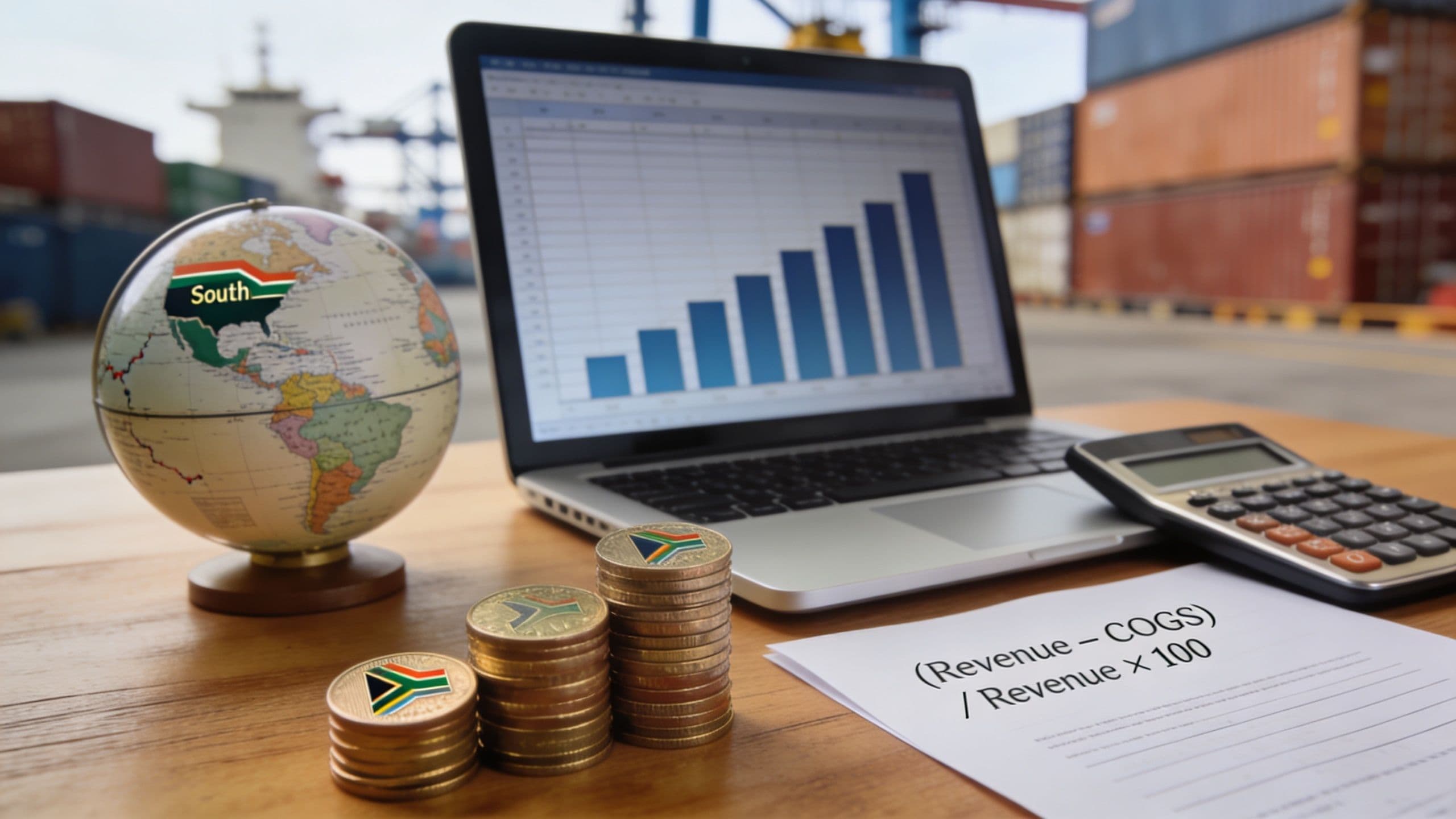
Gross Profit Percentage = ((Revenue - COGS) / Revenue) × 100
That formula is the core efficiency test for a trading, manufacturing, or service business. Revenue sits at the top. COGS, or cost of goods sold, represents the direct costs required to fulfil the sale. The result shows the share of revenue left to cover everything else, including salaries not tied to delivery, rent, software, tax, and profit.
What this percentage tells you
A higher gross profit percentage usually means one of three things. Your pricing is strong. Your direct costs are under control. Or both.
A weaker percentage usually points to the reverse. You may be underpricing, absorbing too much production cost, or carrying process inefficiencies in delivery.
For owner-managers, that’s why this figure is so useful. It answers a practical question quickly: are we making enough on the actual work before overhead gets involved?
If you want another practical view of how margin thinking applies in direct-to-consumer settings, this explainer on gross margin for DTC brands is a useful comparison point. Different model, same discipline. Know what each sale leaves behind.
The trap to avoid
Don’t confuse gross profit percentage with a markup. Markup starts from cost and adds on. Gross profit percentage starts from revenue and works backward.
That distinction matters because managers often set prices with markup logic but evaluate performance with margin logic. If those two are mixed up, product decisions go wrong fast.
A margin number should help you decide whether a product, contract, or export channel deserves more capital. If the calculation is wrong, the decision will be wrong too.
How to Calculate Your Gross Profit Percentage
A Durban exporter closes a dollar contract, delivers the work, invoices on time, and sees healthy revenue on paper. Then the bank clips the receipt with a spread on conversion, charges for the transfer path, and the margin in management accounts looks better than the cash outcome felt in the business. That gap usually starts with a weak gross profit calculation.
Start with the standard formula, but classify costs properly.
A worked BPO example
Take a South African BPO firm billing overseas clients. Revenue for the year is USD300,000. Direct delivery costs are USD180,000. Gross profit is therefore USD120,000.
Now convert that into a percentage:
Start with revenue.
Revenue = USD300,000Identify direct costs tied to delivery.
COGS = USD180,000Calculate gross profit.
Gross profit = Revenue minus COGS
Gross profit = USD300,000 - USD180,000 = USD120,000Divide gross profit by revenue.
USD120,000 / USD300,000 = 0.40Multiply by 100.
Gross profit percentage = 40%
In a spreadsheet, if revenue is in B2 and COGS is in C2, use:
=(B2-C2)/B2
Format the result as a percentage.
If you want a plain-language comparison of margin formulas, this guide to net and gross profit calculation is a useful reference. The primary management issue is not the maths. It is cost classification.
What belongs in COGS for service exporters
Service exporters often get this wrong because there is no physical inventory to point to. The test is straightforward. If the cost exists because you must deliver the client contract, assess whether it belongs in direct cost.
For BPO, outsourcing, and other service export models, direct costs often include:
- Direct labour: staff doing the client work
- Client-specific software or platform costs: systems required to fulfil the service
- Telecoms or infrastructure tied to delivery: usage that rises with client production
- Delivery materials or third-party inputs: resources consumed to complete the work
Broad finance salaries, head-office rent, general admin, and founder remuneration usually sit below gross profit, not inside it. The IFRS community’s discussion of cost classification for service entities gives a useful accounting lens on this point in this guidance on cost of sales for service businesses.
The exporter adjustment many teams miss
Cross-border payment costs deserve a separate management view, even if statutory accounts present them below gross profit. I have seen exporters price a contract at what looked like a healthy gross margin, then give part of it back through FX spreads, lifting fees, correspondent charges, and SWIFT deductions.
Those costs do not change production efficiency. They do change what the sale leaves behind.
A practical monthly model should therefore track two margin views:
- Accounting gross profit percentage, based on your formal COGS policy
- Economic gross profit percentage on export sales, after adding a separate line for cross-border collection and conversion costs
That second view is often where the problem shows up. If every foreign payment arrives a little short, or converts at a poor rate, your export margin is weaker than the standard formula suggests.
Practical rule: For every international sales channel, calculate gross profit once from the accounts and once after FX spreads, transfer fees, and collection charges. Then price from the lower number.
That discipline helps owners see whether margin pressure comes from delivery cost, pricing, or the bank.
Gross Profit vs Net Profit What Exporters Should Track
A strong export business needs both numbers. Gross profit tells you whether the underlying sale works. Net profit tells you whether the whole business works after every other expense has been paid.
Owners often jump straight to net profit because that’s the final answer in the accounts. That’s understandable. It’s also a mistake if you’re trying to diagnose where the problem sits.
Gross Profit vs. Net Profit at a Glance
| Metric | What It Measures | Formula | Key Question It Answers |
|---|---|---|---|
| Gross Profit | Profit left after direct costs of delivering the product or service | Revenue - COGS | Are our sales commercially efficient before overhead? |
| Gross Profit Percentage | Gross profit expressed as a share of revenue | ((Revenue - COGS) / Revenue) × 100 | How much of each rand sold remains after direct costs? |
| Net Profit | Profit left after direct costs, operating expenses, financing costs, and tax | No single universal shorthand if you’re presenting management accounts. It is the residual after all expenses. | After everything is paid, what do we actually keep? |
What each metric helps you decide
Gross profit is the better tool for decisions such as:
- Whether to keep selling a product line
- Whether a market is worth expanding into
- Whether pricing still covers direct cost pressure
- Whether a client contract deserves renewal
Net profit is the better tool for decisions such as:
- Whether overhead is too heavy
- Whether the business can fund expansion
- Whether debt and tax are consuming too much cash
- Whether owner drawings are sustainable
If you want a broader primer that walks through net and gross profit calculation, that resource is useful for teams training non-finance managers who need the basics without jargon.
The exporter’s diagnostic view
The most useful reading is the combination.
If gross profit percentage is healthy but net profit is weak, your product or service likely works, but overhead, admin, financing, or tax is dragging performance down. If gross profit percentage is weak from the start, the problem sits closer to production, pricing, fulfilment, or market-specific delivery cost.
That’s why exporters shouldn’t rely on one final bottom-line number. Net profit tells you the result. Gross profit percentage tells you where to look first.
The Hidden FX Costs That Erode Your Gross Profit
A South African exporter can price well, manufacture efficiently, and still watch margin slip after the invoice is paid. The leak often sits in the bank process, not in production.

Banks and traditional payment providers rarely present cross-border cost as a clean reduction in gross profit. It shows up in several places. A weaker FX rate than the market rate. SWIFT deductions. Receiving charges. Treasury adjustments posted after settlement. By the time finance closes the month, those costs are often sitting in admin, bank charges, or exchange differences instead of being tied back to the sale that created them.
Where the leakage happens
Two items do most of the damage on export transactions.
- FX spread: Your bank converts funds at a rate below the market rate. The gap is a direct cost.
- Transfer fees: SWIFT charges, correspondent bank deductions, and receiving fees reduce what lands in your account or increase what you pay to settle suppliers.
That distinction matters. If you treat those costs as general overhead, your product margin can look healthier than it really is. For exporters, they are often transaction-linked costs attached to serving an overseas customer.
Why this should concern exporters
Take a simple example. A business generates R500,000 in quarterly revenue and carries R300,000 in direct production costs. On paper, gross profit is R200,000, or 40%.
Now add the payment layer. If part of those export receipts or supplier payments goes through a bank at a marked-up FX rate, and settlement fees are deducted along the way, the economics change immediately. A worked explanation from OFX on exchange rates and international transfer fees helps illustrate why the amount quoted by a bank and the amount that arrives are often not the same number.
For a ZAR-based exporter, that difference is not academic. It can turn a solid-looking export order into a thinner-margin sale once cash is converted and received.
I see this regularly in management accounts. The sales team reports margin based on invoice value. The bank statement reports something lower. The gap is the cost of getting paid internationally, and many businesses never assign it back to the customer, corridor, or product line that caused it.
A broader trade cost mindset
Exporters already understand that trade costs go beyond factory output. Tariffs, customs handling, port delays, and compliance all affect what a sale is worth by the time cash is collected. If you work in a sector exposed to policy changes, guidance on understanding new steel import duties shows the same principle at work. Non-production costs reshape margin.
Cross-border payment friction belongs in that same category. It is a cost of serving the market.
The practical fix is visibility. Compare the invoice currency amount to the rand amount settled. Review bank conversion rates against the market rate available at the time. Reconcile every transfer deduction by customer and by route. Once those costs sit next to each export sale, gross profit starts reflecting commercial reality rather than a bank-shaped blind spot.
Protect Your Margins with Transparent Global Payments
A sale can look profitable in the quote, on the invoice, and even in the gross profit report, then still disappoint once the money lands in your South African account. I have seen exporters spend months pushing for better factory yields while losing margin every week through poor FX rates, transfer deductions, and payment routes they never priced properly.
That is a finance problem, not an operations problem.
For an exporter, improving gross profit percentage is not only about selling at a higher price or buying cheaper stock. It is also about controlling how foreign currency becomes rand. If that step is opaque, your reported margin stays too optimistic.
The margin effect in practice
Use the same exporter example from earlier. A business with R500,000 in quarterly revenue and R300,000 in COGS shows a 40% gross profit on paper. But if part of those international receipts is shaved by bank FX spreads and transfer charges before settlement, the true gross profit on export sales is lower than the formula suggests.
That difference matters most in businesses working on disciplined margins. A few basis points lost on every international receipt can wipe out the benefit of a pricing increase that took months to win from overseas customers.
The fix is straightforward. Measure export margin on cash received after conversion and payment charges, not only on invoice value.
What actually works
Exporters protect margin better when finance teams treat cross-border payments as a controllable cost line:
- Track settlement by customer and currency. If a US customer always produces a weaker realised margin after conversion, that needs to show up in reporting.
- Compare bank rates to the market rate available at the time. The spread is a real cost, even if it never appears as a separate line item.
- Pull SWIFT and intermediary charges out of overhead. If they sit in admin expenses, product and customer margin reports stay distorted.
- Use providers that show the rate and fee structure clearly. Visibility makes pricing decisions better and variance analysis faster.
Banks rarely help you do this well. Their reporting usually tells you what moved through the account, not what profit you gave up to get the funds home.
Clean gross profit reporting depends on clean settlement data.
The right payment setup will not rescue a weak product, bad customer terms, or poor production control. It will stop an otherwise healthy export business from giving away margin after the commercial work is already done.
If you want a clearer view of what your export sales are really earning, Zaro helps South African businesses send and receive international payments using real exchange rates with zero spread and no SWIFT fees. That gives finance teams cleaner cost visibility, more predictable cash flow, and a more accurate way to protect gross profit on every cross-border transaction.