At its core, how commodities are traded is simply the process of buying and selling raw materials, whether it's maize fresh from the Highveld or gold pulled from a mine in Gauteng.
It’s a bit like the difference between buying vegetables at a local farmer's market for tonight's dinner versus agreeing with the farmer now on a set price for next season's entire harvest. One is for right now; the other is about securing a price for the future.
The Fundamentals of Commodity Trading
Before we dive into the deep end, let's get the basics right. The world of commodities might sound complicated, but it runs on principles every South African business owner understands: supply, demand, and managing the financial risks that come with buying or selling the raw materials that fuel our economy.
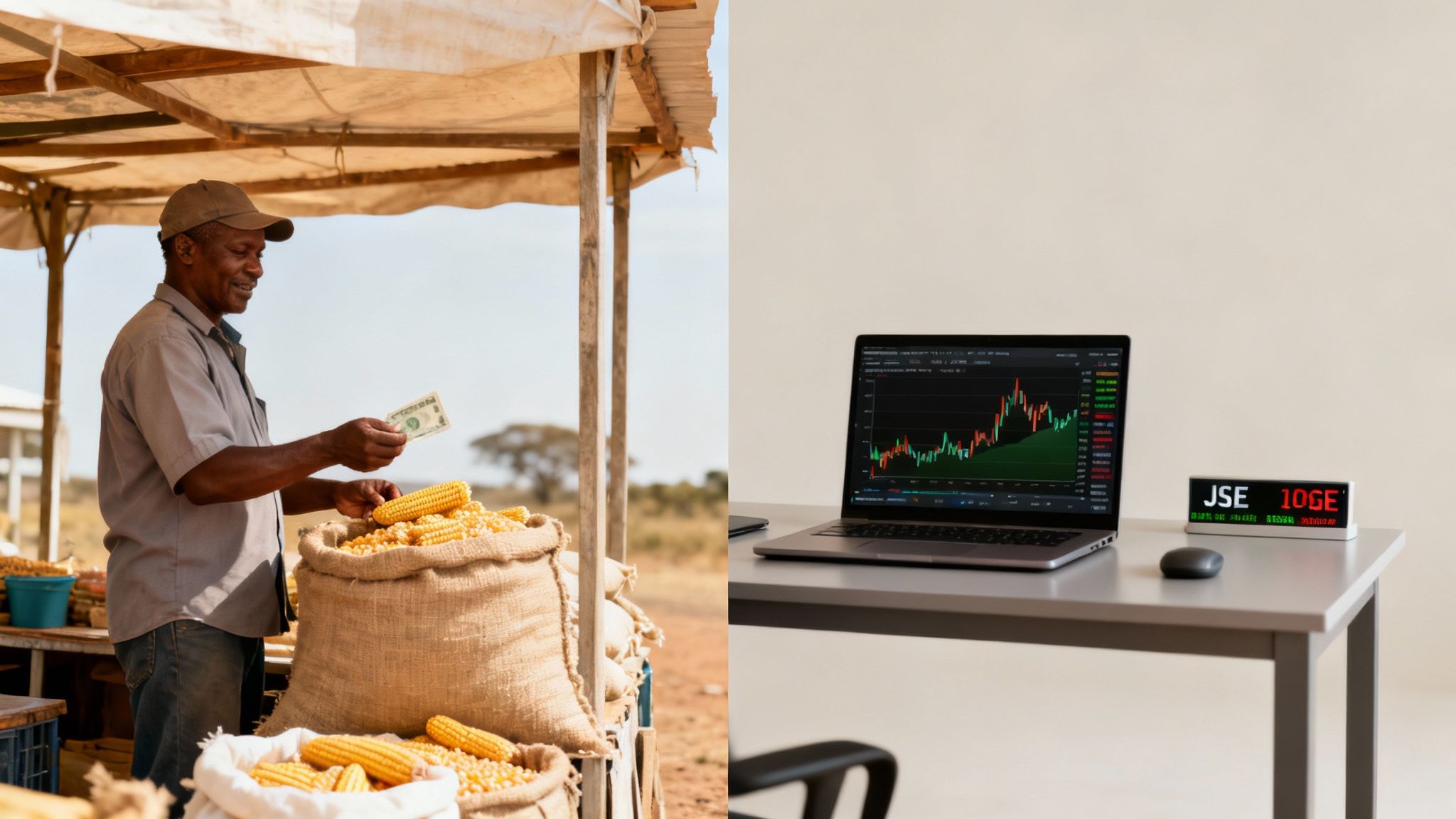
This global marketplace is the engine that sets the price of fuel for your bakkie, the cost of wheat for your bakery, and the value of the platinum mined right here on our doorstep.
Hard and Soft Commodities
First thing's first: not all commodities are created equal. They fall into two broad buckets, and the differences between them shape how they’re produced, stored, and traded.
- Hard Commodities: These are the resources we have to dig out of the ground. Think gold, platinum, iron ore, and crude oil. Their supply is limited and getting them to market often takes massive investment.
- Soft Commodities: These are the things we grow or raise. This group includes agricultural products like maize, wheat, coffee, and livestock. While they're renewable, they’re at the mercy of the weather, pests, and the changing seasons.
Knowing this distinction is crucial. It explains everything from price swings to storage challenges. A drought hitting the Western Cape's wheat farms creates a very different kind of market risk than a geopolitical crisis disrupting global oil supply.
At its heart, commodity trading is about managing the future. Whether you're a farmer locking in a price for your crops or a manufacturer securing the cost of raw materials, the goal is to create certainty in an uncertain world.
The Key Players in the Market
The commodity market isn't just for Wall Street types; it’s a bustling ecosystem where different people and businesses come together, each with their own goal. These players keep the market moving and balanced.
There are three main groups driving the action:
- Producers and Consumers (Hedgers): These are the businesses on the ground, dealing with the actual physical goods. A South African maize farmer is a producer who wants to sell their future harvest at a guaranteed price. A large food manufacturer is a consumer who wants to lock in the cost of their ingredients. They use the market to hedge—to protect themselves from prices moving against them.
- Speculators: These traders have no interest in ever seeing a real barrel of oil or bushel of wheat. Their game is to profit by correctly predicting which way prices will move. While it might sound like pure gambling, their activity adds vital liquidity to the market, making it much easier for the hedgers to find someone to take the other side of their trade.
- Brokers and Exchanges: Think of these as the facilitators. A broker is the agent who places trades for their clients. An exchange, like our own Johannesburg Stock Exchange (JSE), is the formal, regulated marketplace where all the buying and selling happens. They’re the referees, making sure everything is fair, transparent, and runs smoothly.
To tie these ideas together, let's quickly summarise them.
Key Commodity Trading Concepts at a Glance
The table below breaks down the core concepts we've just covered, giving you a quick reference for understanding the moving parts of the commodity market.
| Concept | Brief Description | Example in a South African Context |
|---|---|---|
| Commodity | A basic raw material or agricultural product that can be bought and sold. | Maize grown in the Free State, platinum mined in the North West, or Brent Crude Oil. |
| Hard Commodity | A natural resource that is mined or extracted from the earth. | Gold, iron ore, and coal. |
| Soft Commodity | An agricultural product that is grown or ranched. | Sugar cane from KwaZulu-Natal, wool from the Karoo, or citrus from Limpopo. |
| Hedger | A market participant (producer or consumer) who trades to reduce price risk. | A wheat farmer using a futures contract to lock in a selling price for their upcoming harvest. |
| Speculator | A trader who aims to profit from price movements without handling the physical good. | An investor buying gold futures, betting that the price will rise due to global uncertainty. |
| Exchange | A centralised, regulated market where commodities and their derivatives are traded. | The Johannesburg Stock Exchange (JSE), which facilitates the trading of commodity derivatives. |
This foundation gives you a clear picture of the what, who, and why of commodity trading. With these basics in place, we can now explore where and how these trades actually happen.
Where Commodity Trading Happens
To get a handle on how commodities are traded, you first need to know where it all goes down. It’s not one single place but a whole network of different trading arenas, each with its own rules and personality.
Think of it like buying a car. You could walk into a shiny, official dealership with fixed prices, haggle a private sale with a neighbour down the street, or even head to a public auction to drive one away immediately. Each route has its upsides and downsides, and the same goes for trading commodities.
A South African maize farmer looking to sell his harvest will operate in a very different world from a local wine exporter finalising a deal with a big European supermarket. Picking the right marketplace isn't just a detail—it’s a major strategic decision.
Organised Commodity Exchanges
When most people think of trading, they picture an organised exchange. These are the big, formal, and tightly regulated marketplaces where buyers and sellers come together to trade standardised contracts under a strict set of rules. For us in South Africa, the big one is the Johannesburg Stock Exchange (JSE).
The JSE has been the heart of our local commodities scene for decades. Since kicking off its commodities derivatives market back in 1994, it's grown into a major hub for agricultural and energy products across Africa. It started small with contracts for things like chilled beef and potatoes but quickly expanded to include white and yellow maize—which are still its star products today. You can read more about the JSE's 30-year impact on commodity markets to see how far it's come.
Trading on an exchange like the JSE comes with some serious perks:
- Total Transparency: Every price is public and updated in real-time for everyone to see. This makes it a level playing field where prices are set by pure supply and demand.
- Standardisation: Forget guesswork. Contracts are completely uniform. A JSE maize contract, for instance, spells out the exact quantity (100 metric tons), the quality grade, and the delivery location. No surprises.
- Minimal Counterparty Risk: The exchange itself acts as the go-between through its clearing house. It guarantees the deal. If one side defaults, the other still gets paid, which is a massive safety net.
Over The Counter Markets
Exchanges are great for structure and security, but not every deal fits into a perfect, standardised box. That’s where Over-the-Counter (OTC) markets step in. An OTC trade is simply a private deal negotiated directly between two parties, away from the watchful eye of an exchange.
Picture a specialty coffee producer in Limpopo hammering out a unique supply agreement with a boutique roaster in Germany. Their deal might involve non-standard delivery dates, very specific quality requirements, and a custom-built pricing formula. You just can't do that kind of bespoke deal on a public exchange.
OTC markets offer incredible flexibility, letting businesses shape contracts to fit their exact needs. But that freedom comes with a trade-off: higher risk. With no central clearing house, there's no one to guarantee the trade if things go wrong.
Here’s what defines OTC trading:
- Flexibility: You can customise just about anything—the commodity, quantity, quality, and delivery schedule.
- Privacy: The terms of the deal are kept between the two parties, which can be a real strategic advantage.
- Counterparty Risk: This is the big one. If the other party doesn't deliver the goods or fails to pay, you're on your own. It’s up to you to chase them down, which can lead to expensive legal battles.
Physical Spot Markets
Finally, we have the most direct and intuitive venue of all: the physical spot market. This is where commodities are bought and sold for immediate delivery and payment—literally "on the spot." It’s the real-world version of that farmer's market we talked about earlier.
When a grain mill buys a truckload of wheat directly from a farmer at a silo and pays for it right there and then, that’s a spot market transaction. Prices in the spot market reflect what’s happening on the ground with supply and demand right now.
These spot prices are incredibly important. They form the foundation for pricing in the futures markets you see on exchanges. The gap between the current spot price and a future price is a powerful signal of what the market expects to happen down the line.
Understanding Your Trading Tools
Now that we know where commodities are traded, let's look at the actual tools people use to do the trading. If exchanges and over-the-counter (OTC) markets are the arenas, then financial instruments like futures, options, and forwards are the specialised equipment. Getting a handle on how these work is the key to understanding modern commodity trading.
It’s a bit like pre-ordering a new phone. You agree on a price today to lock it in, protecting yourself in case the price shoots up on launch day. That agreement gives both you and the seller certainty about a transaction that will only happen down the line.
This is a great way to visualise the different trading venues where these tools are used.
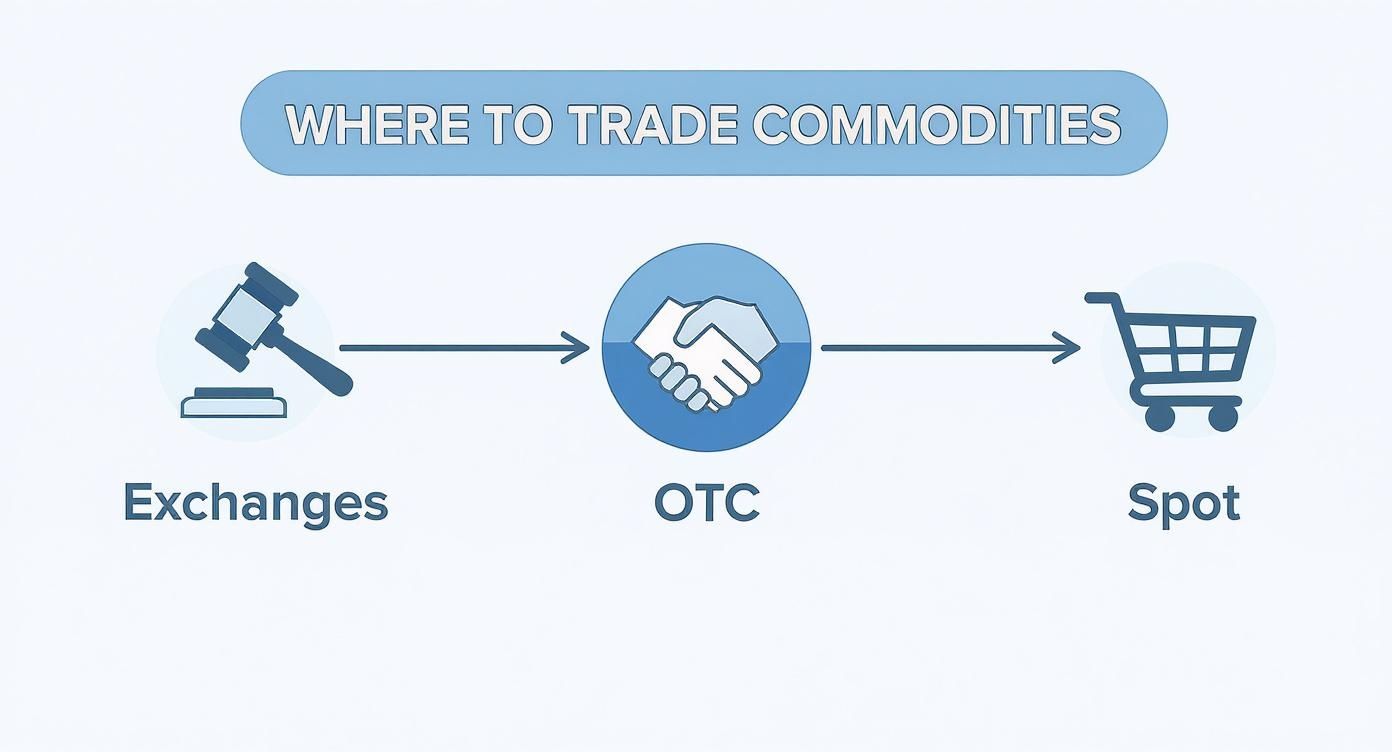
The flowchart neatly separates structured exchanges, private OTC deals, and the immediacy of spot transactions—each serving a very different purpose.
The Real Powerhouse: Futures Contracts
Futures contracts are the workhorses of the commodity world, especially on organised exchanges like the JSE. A futures contract is simply a binding legal agreement to buy or sell a specific commodity, at a price you set today, for delivery on a date in the future.
The crucial part is that these contracts are standardised. Every detail is identical for everyone trading them. For a South African business, this standardisation is everything.
Let's look at a real-world example: the JSE's Yellow Maize (YMAZ) futures contract.
- Contract Size: Every single contract represents exactly 100 metric tons of yellow maize. No more, no less.
- Quality Grade: The contract clearly specifies the grade required (e.g., YM1), so the buyer knows exactly what they’re getting.
- Delivery Months: You can trade for delivery in specific months like March, May, July, September, and December.
- Delivery Locations: The contract even lists the JSE-approved silos across the country where the maize can be delivered.
This level of detail strips out all the guesswork. It means a farmer in the Free State and a food producer in Gauteng who have never met can trade with complete confidence. Of course, to make informed trading decisions, many professionals rely on tools like technical analysis in trading to anticipate price movements.
What About Options and Forwards?
While futures are the main event, two other instruments offer different kinds of flexibility.
Options contracts give the holder the right, but not the obligation, to buy or sell a commodity at a set price before a certain date. Think of it like paying a small, non-refundable deposit to hold a car. If you find a better deal elsewhere, you can just walk away, losing only your deposit (called the "premium"). This makes options perfect for managing risk without locking yourself into a firm commitment.
Forward contracts, on the other hand, are the custom-tailored cousins of futures. These are private agreements (traded OTC) between two parties. Because they aren't on a public exchange, the terms—quantity, quality, even the delivery date—can be customised to fit a very specific need. A wine farm might use a forward contract to sell a particular vintage to an international buyer on non-standard terms.
Physical Goods or Just Cash? Delivery vs Settlement
A question that often comes up is whether trucks full of maize or barrels of oil are actually moving around when these contracts expire. The answer? It depends.
A crucial distinction in commodity trading is whether a contract is settled with the physical product or simply with money. This determines who uses the contract and for what purpose.
Physical Settlement: This is exactly what it sounds like. The seller has to deliver the actual, physical commodity, and the buyer has to take it. This is vital for the real players—the producers and consumers who genuinely need the raw materials. The JSE’s grain contracts, for instance, are physically settled at approved silos.
Cash Settlement: Here, no goods change hands. When the contract expires, the two parties just settle the difference between the agreed-upon futures price and the current market price in cash. This is the preferred method for financial speculators who have no interest in (or ability to) store tons of grain or oil.
Futures Contracts vs Spot Market Transactions
To really crystallise the difference, here's a direct comparison between trading for immediate delivery (spot) and trading for future delivery.
| Feature | Spot Market Trading | Futures Contract Trading |
|---|---|---|
| Timing | Immediate exchange of goods for cash ("on the spot"). | Agreement made today for a transaction at a future date. |
| Pricing | Based on the current, real-time market price. | Price is locked in today for the future delivery date. |
| Purpose | Fulfilling immediate supply needs. | Hedging against future price risk and speculation. |
| Customisation | Highly customised between buyer and seller. | Standardised contract terms (quantity, quality, location). |
| Primary Venue | Direct negotiation, local markets, OTC. | Organised exchanges (e.g., JSE, CME). |
| Counterparty Risk | Higher, as it depends on the two parties involved. | Lower, as the exchange's clearing house guarantees the deal. |
Essentially, the spot market is for the "now," while the futures market is for planning and managing the "what if."
Understanding these tools isn’t just academic; it’s the key to unlocking the strategic power of commodity markets. They give businesses a way to manage price risk, secure their supply chains, and bring a measure of predictability to some of the world's most volatile industries.
Managing Price Risk with Hedging
When you're dealing with commodities, price volatility isn't just a line on a chart; it's a constant threat. The core purpose of derivatives like futures and options is to manage this risk through a strategy called hedging.
Think of it as taking out an insurance policy, not against fire or theft, but against a sudden, damaging swing in the market price of your raw material. It’s about creating certainty in an uncertain world.
For any business that produces or consumes a physical commodity, an unexpected price drop can wipe out a farmer’s profit for an entire season. On the flip side, a sudden price spike can cripple a manufacturer’s bottom line. Hedging uses financial instruments to lock in a price today for a deal that will happen months down the line.
This simple act transforms a massive unknown into a fixed cost or a guaranteed revenue. It allows businesses to stop gambling on market movements and focus on what they do best: farming, mining, and running their operations efficiently.
Hedging in Action: A Maize Farmer's Story
Let's ground this in a classic South African example. Picture a maize farmer in the Free State who plants her crop in October. After doing the maths, she knows she needs to get at least R3,500 per ton when she harvests in May to cover her costs and make a decent profit.
She checks the JSE and sees the futures price for May delivery is currently R3,800 per ton. That’s a great price, but she's worried. What if a bumper crop floods the market and the price crashes by the time she's ready to sell?
To protect herself, she hedges. She calls her broker and sells enough maize futures contracts to cover her entire expected harvest, locking in that R3,800 per ton price.
By selling a futures contract, the farmer creates a financial position that is the mirror opposite of her physical one. If the price of her physical maize goes down, the value of her futures position goes up, cancelling out the loss.
Come May, her fears come true. An excellent growing season means there's a glut of maize, and the spot price plummets to R3,200 per ton. If she sold on the open market, she’d be facing a huge loss.
But because she hedged, the futures contracts she sold are now much cheaper. She buys them back, making a significant profit on her financial trade. This profit offsets the low price she gets for her physical grain, ensuring she still achieves her target price of around R3,800 per ton. She successfully managed her risk.
Protecting Profits: A Food Manufacturer's Hedge
Now, let's look at the other side of the coin. A large food manufacturer in Gauteng needs wheat to make breakfast cereal. Their biggest fear is a sudden spike in wheat prices, which would crush their profit margins.
In January, the procurement manager is planning for the next quarter. He sees the JSE wheat futures price for March delivery is R5,000 per ton. That price works perfectly with his budget, and he wants to lock it in before it goes up.
To do this, he buys wheat futures contracts, covering the amount of wheat he’ll need. This is known as a "long hedge."
If the price of wheat shoots up by March, buying the physical grain will cost him more. But, the futures contracts he bought will have also increased in value. He can sell those contracts for a profit, and that profit helps offset the higher price he has to pay for the physical wheat.
Ultimately, hedging is a foundational strategy for anyone who deals with physical commodities. It brings stability to an inherently unstable market. While these instruments are powerful, they should be part of a broader framework. To build a truly resilient business, explore the best practices for effective risk management and create a comprehensive strategy.
Navigating Cross-Border Commodity Payments
Getting a commodity trade signed and sealed—whether you're hedging a position or closing a sale—is a huge milestone. But the deal isn't really done until the money lands safely in your account. For South African businesses, this is often the most treacherous part of the journey, where well-laid plans and hard-earned profits can quickly come undone.
Think of it this way: once you’ve managed the market risk, a whole new set of financial risks kicks in. Even a perfectly executed trade can see its value chipped away by sluggish currency conversions and murky banking fees. This is the financial gauntlet that exporters and importers have to run every single day.
To truly understand global commodity trading, you have to look beyond just the price. It's about protecting that price every step of the way, right up to the final settlement.
The Hidden Costs of Getting Paid
When you’re trading with partners overseas, payments are almost always handled in a major currency like the U.S. Dollar. Right away, that puts your business at the mercy of foreign exchange (FX) risk—the constant, unpredictable dance between the USD and the South African Rand (ZAR).
A sudden dip in the exchange rate between striking the deal and the payment clearing can wipe out your profit margin. This volatility is a constant threat, capable of turning a great export deal into a mediocre one overnight.
But FX risk is only half the story. The traditional banking system piles on its own set of costs that can seriously eat into your bottom line. These usually include:
- Hefty Transaction Fees: Banks are notorious for charging steep fixed fees to send or receive money internationally through the SWIFT network.
- Sneaky Exchange Rate Markups: The rate your bank gives you is almost never the real mid-market rate. They bake in a spread, which is just a hidden fee that can add up to a significant amount on a large commodity deal.
- Frustrating Payment Delays: International transfers can take days to clear. That lag creates cash flow headaches and ties up working capital you could be using to grow your business.
For South African commodity traders, the final settlement is where the theoretical profit of a trade meets the practical reality of cross-border finance. Ignoring the costs embedded in this process is like running a race and giving up just before the finish line.
Protecting Your Margins at the Final Hurdle
Nowhere are these challenges more apparent than in South Africa's agricultural sector. The country is a net exporter, shipping huge volumes of maize, sugar, fruit, and wine across the globe. Just to give you an idea, sugar products alone accounted for 29% of agricultural exports in a recent analysis. You can dive deeper into South Africa's agricultural trade landscape from BFAP.org.za.
For the thousands of farmers and exporters behind these statistics, every single percentage point saved on currency conversion and transaction fees goes straight to the bottom line. In the world of commodities, where margins are often razor-thin, efficient payment processing isn’t just a nice-to-have—it’s a competitive edge. Nailing these financial logistics is every bit as important as negotiating a good price for your goods in the first place.
Getting Paid: The Final Hurdle in Commodity Trading
You’ve navigated the market, locked in a price, and managed the physical delivery. But the job isn’t done. The final, and arguably most critical, step is getting your money across borders. This is where so many commodity businesses watch their hard-won profits get chipped away by an old, inefficient financial system.
Think about traditional international payments. A bank might give you a quote for a USD/ZAR exchange, but the rate you actually get is rarely the real one. It includes a hidden markup, or spread, that lines their pockets and eats directly into your margin. Couple that with slow settlement times, and you’ve got a recipe for serious cash flow headaches.
A Better Way to Settle Commodity Trades
Thankfully, the days of being stuck with the old banking networks are over. Specialised financial platforms now offer a far more direct and transparent way to handle these transactions. They are built to preserve the value of your deal, from the price you agreed on paper to the money that lands in your account.
So, what does this modern approach actually look like?
- Real Exchange Rates: You get access to the mid-market rate, which is the true exchange rate without the costly spreads tacked on by traditional banks.
- Clear, Upfront Costs: You see the exact fee for your transaction before you commit. There are no surprise SWIFT charges or hidden fees from intermediary banks.
- Faster Cash Flow: Money moves quicker. This means you get paid sooner, freeing up capital to reinvest in your operations without frustrating delays.
Optimising your international payments isn’t just a nice-to-have; it's a core strategy for protecting your bottom line in the tight-margin world of commodity trading.
This kind of financial discipline is absolutely crucial, especially when you consider how quickly the market can turn. In the first quarter of 2025, for example, South Africa posted a trade surplus of R28.9 billion, driven largely by strong gold exports.
At the same time, falling demand for other key resources like platinum group metals shows just how volatile trade balances can be. When you control your payment costs, you give yourself a vital buffer against this unpredictability. You can dive deeper into these trends by reading the full economic overview report on IDC.co.za.
Got Questions? We’ve Got Answers
Diving into commodity trading can feel a bit overwhelming at first. There are a lot of moving parts and specific terms. To help clear things up, here are some straightforward answers to the questions we hear most often from South African businesses.
What's the Real Difference Between a Broker and a Trader?
Think of it this way: a commodity broker is like an estate agent. They don't own the house, but they act on your behalf to buy or sell it, earning a commission for their service. Brokers connect people—like farmers or investment funds—to the market, executing trades for their clients.
A commodity trader, on the other hand, is the one actually buying and selling the commodities for their own benefit. They are in the game to profit from price changes, whether they're a physical trader dealing with actual grain in a silo or a financial trader using instruments like futures contracts.
How Can a Small SA Business Start Hedging Commodity Risk?
Getting started with hedging isn't as complicated as it sounds. First things first, you need to pinpoint your exact price risk. Are you a maize farmer worried about prices falling before you can sell your harvest? Or a baker concerned that the price of wheat might shoot up? Your risk determines your strategy.
Once you know what you’re protecting against, the next step is to open an account with a broker registered with the JSE who knows their way around commodity derivatives. A good broker is worth their weight in gold; they’ll guide you on the best approach—like selling futures to lock in a price—and handle the trades for you. Just make sure you get a clear picture of the costs involved, like commissions and margin requirements, before you jump in.
Does Anyone Actually Take Delivery in Modern Trading?
It’s true that the vast majority of futures contracts—often well over 95%—are settled with cash before they expire. But that small chance of physical delivery is what keeps the whole system honest. It's the essential link that ties the fast-paced financial derivatives market to the real-world physical market.
Why does it matter? This connection forces the futures price to meet the spot price as the contract’s expiry date gets closer. If there wasn't a real threat of having to deliver bags of maize to a JSE-approved silo, derivative prices could drift off into their own world, completely detached from actual supply and demand. That would make them useless for hedging.
Physical settlement is the anchor that guarantees the futures market remains a true reflection of a commodity's value. It's what ensures a futures contract for maize is genuinely about, well, maize.
Can I Trade International Commodities Like Oil on the JSE?
Yes, absolutely. The Johannesburg Stock Exchange (JSE) makes it possible to trade derivatives on major global commodities, including big ones like Brent Crude oil and gold. This is a fantastic tool for local businesses looking to shield themselves from unpredictable global price swings.
These contracts are usually priced in U.S. dollars, since that's the global standard. But crucially, they are cleared and settled right here in South African Rand (ZAR). This smart setup lets South African businesses and investors hedge against or speculate on world commodity prices without having to navigate the hassle of sending foreign currency abroad to trade on international exchanges.
Managing your trades is one thing, but getting paid quickly and fairly is another. Zaro makes that final, crucial step simple. We provide transparent, low-cost cross-border payments using real exchange rates, with no hidden fees. This way, the profit you make is the profit you actually get to keep. Protect your margins with Zaro today.