
At its core, what exactly is the forex market? Think of it less like a single building and more like a massive, nonstop global bazaar. It's a decentralised digital network where currencies are traded, running 24 hours a day, five days a week. For any South African business buying or selling across borders, this isn't just a financial concept—it's the engine that directly impacts your bottom line.
A Look Inside The Forex Marketplace
The foreign exchange (FX) market isn't a physical place like the JSE. Instead, it’s a vast, interconnected system of banks, financial institutions, corporations, and traders, all linked electronically. It's the biggest financial market on the planet, with a mind-boggling $7 trillion changing hands every single day.
This incredible scale is what makes the market so liquid. It means that for major currencies like the US Dollar or the Euro, you can almost always find someone on the other side of your trade, whether you're buying or selling.
For your business, this is where the action happens. It's the arena where you swap your Rands (ZAR) for US Dollars (USD) to pay that supplier in America, or convert the Euros (EUR) a German client just paid you back into your home currency. Every one of these transactions, multiplied by millions around the world, is what keeps exchange rates moving second by second.
Who Are The Main Players?
To really get a feel for the market, you need to know who's in it. It’s not just speculators making bets; the real heavy lifting is done by entities with practical, real-world needs. Each one has a different reason for being there, which all adds up to the dynamic, constantly shifting values of currencies.
Let’s take a look at the key participants and what they do.
Key Participants in the Forex Market
Here’s a simple breakdown of the major players in the foreign exchange market and their primary roles. This helps you see who you're interacting with, either directly or through your bank.
| Participant | Role in the Market | Example Action |
|---|---|---|
| Central Banks | They manage their nation's currency, money supply, and interest rates to keep the economy stable. | The South African Reserve Bank (SARB) might buy ZAR to strengthen it or adjust interest rates, influencing its value. |
| Commercial & Investment Banks | The biggest players. They handle FX trades for clients (like your business) and also trade for their own profit. | A large bank executes a ZAR/USD trade on your behalf to pay an international invoice. |
| Corporations & Businesses | Companies involved in international trade need FX for day-to-day operations. | A South African wine exporter converts their USD sales back into ZAR to pay local staff and suppliers. |
| Investment Managers & Hedge Funds | These firms trade currencies to make a profit from future price moves or to protect their international investments from currency risk. | A fund might buy US Dollars if they believe it will strengthen against the Rand in the coming months. |
This table shows how different motivations, from national economic policy to simple international trade, all converge in the forex market.
The forex market is what’s known as an over-the-counter (OTC) market. This just means trades happen directly between two parties—usually through a network of major banks—instead of on a centralised exchange like a stock market.
This unique structure is what keeps the market humming across every time zone. If your business operates beyond South Africa's borders, you're already a participant. The trick is learning to navigate it smartly to protect your profits.
Understanding How Currencies Are Priced and Traded
To really get to grips with the forex market, we need to look past the high-level players and dig into the mechanics of an actual trade. It’s a simple but crucial starting point: currencies are never traded in isolation. They always trade in pairs. This one concept underpins every single international transaction your business will ever make.
When you see a quote like USD/ZAR 18.50, you're looking at a currency pair. It’s a straightforward price tag. It tells you exactly how many units of the second currency (the quote currency, in this case, the Rand) you need to buy one unit of the first (the base currency, the US Dollar). So, one US Dollar will set you back 18.50 South African Rands.
For any business juggling international invoices or payments, this relationship is everything. The value of your money is always relative.
The Language of Currency Pairs
Breaking down a currency pair is the first step to making sense of why the market is moving.
- Base Currency: This is the first currency in the pair (the USD in our example). Think of it as the product you're buying or selling.
- Quote Currency: This is the second currency (the ZAR). It’s the price you pay for one unit of the base currency.
A good analogy is buying apples at a market. The base currency is the item (one apple), and the quote currency is the price tag (R5.00).
Now, a huge part of how the forex market works comes down to tiny price movements. A “pip,” short for “percentage in point,” is the smallest increment a currency pair’s value can change. For a pair like USD/ZAR, a pip is usually the fourth decimal place (for instance, a move from 18.5000 to 18.5001). It sounds minuscule, and it is. But when you’re dealing with large transaction volumes, those tiny pips can add up to a massive financial impact.
The chart below shows the major players whose collective actions drive these price movements.
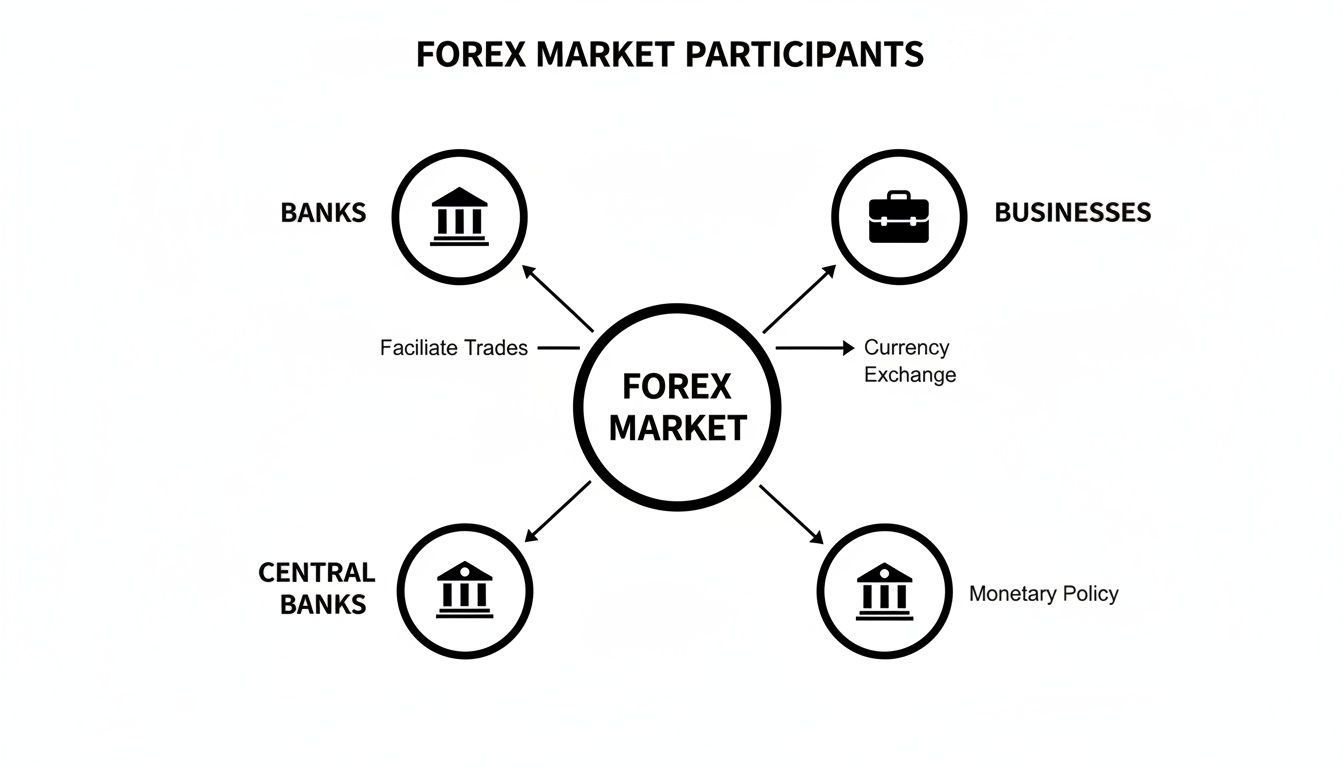
It’s a clear picture: big banks, businesses trading goods and services, and central banks are the main forces creating the supply and demand that move the market every second.
Spot Rates Versus Forward Rates
Let’s bring this into the real world. When your business needs to make an international payment, you’ll come across two different types of rates: the spot rate and the forward rate. Understanding the difference isn’t just good practice; it’s essential for smart financial planning.
The spot rate is the price for settling a deal on the spot—the "right now" price. If you needed to swap Rands for Dollars today, your transaction would happen at or very close to the current spot rate you see flashing across financial news screens.
But business rarely happens entirely "right now." And that’s where the forward rate becomes invaluable.
A forward rate lets you lock in an exchange rate today for a transaction that will settle on a specific date in the future. It’s a powerful tool for taking uncertainty off the table and protecting your profit margins from nasty currency swings.
Imagine your South African company imports components from the US. You have a $50,000 invoice that’s due in 90 days. Right now, the spot rate is 18.50 ZAR per USD, making your liability R925,000. But what if the Rand weakens to 19.50 over the next three months? Suddenly, that same invoice costs you R975,000. That’s an unexpected R50,000 loss that comes straight out of your profit.
By using a forward contract, you could agree today to buy $50,000 in 90 days at a fixed forward rate—say, 18.65. This rate is calculated from the spot rate plus or minus forward points, which simply reflect the difference in interest rates between the two currencies over that period.
By locking in that rate, you know your exact cost in Rands will be R932,500, no matter what the market does between now and then. This predictability turns forex risk from a gamble into just another manageable business expense.
Exploring the Market's Engine Room: Players and Liquidity
The forex market isn't just a screen of flashing numbers. It's a living, breathing ecosystem driven by a diverse cast of players, each with their own goals. If you want to understand how the forex market works and why currencies move the way they do, you first need to know who’s behind the curtain. These are the folks in the engine room, creating the constant supply and demand that keeps everything in motion.
At the very top, you have the central banks, like our own South African Reserve Bank (SARB). They aren't in it for profit. Their game is economic stability. When they step into the market, it’s to manage the rand, keep inflation in check, and generally steady the ship. Their actions are powerful but usually infrequent.
Then you have the big players: major commercial and investment banks. These are the titans of the market, pushing around colossal volumes of currency every single day. They handle transactions for their corporate clients, but they also trade for their own books, which makes them the primary source of liquidity in the market.
Liquidity: The Lifeblood of the Market
If there’s one concept you need to grasp in forex, it’s liquidity. In simple terms, it's about how easily you can buy or sell a currency without causing a massive swing in its price. For your business, a highly liquid market is a very good thing.
Here’s a simple way to think about it:
- A deep ocean (high liquidity): If you toss a big rock into the ocean, it barely makes a ripple. In a liquid market like USD/ZAR, a large trade can be absorbed just as easily without drastically moving the price.
- A shallow puddle (low liquidity): A small splash in a puddle sends water flying everywhere. In an illiquid market, even a small trade can cause a huge, unpredictable price jump.
This depth is what allows your business to make large payments efficiently and at prices you can actually count on. A lack of liquidity adds risk and cost, because the price can easily move against you between the moment you hit "send" and when your trade is actually filled.
High liquidity means there are always willing buyers and sellers. This results in tighter spreads—the difference between the buying and selling price—which directly translates into lower transaction costs for your business.
South Africa’s forex market is a great example of a liquid environment. It’s the powerhouse of the continent, with a daily turnover that exceeds a staggering $20 billion. This makes it the undisputed leader in sub-Saharan Africa, a region where economic growth projections are on the rise. This deep pool of liquidity comes from our role as a major financial hub, driven by strong trade flows and keen investor interest. To get a better sense of these dynamics, you can explore more about Africa's growing forex landscape and its 2025 outlook.
The Market That Never Sleeps
Another defining feature of the forex market is that it’s open for business 24 hours a day, five days a week. It can do this because trading literally follows the sun around the globe, passing from one major financial centre to the next. This creates overlapping trading sessions that ensure the market is always open somewhere.
The main trading sessions are:
- Sydney Session: Kicks off the trading week.
- Tokyo Session: The major hub for Asian trading.
- London Session: The biggest and most important session, accounting for a huge slice of daily turnover.
- New York Session: The final major session of the day.
For a South African business, this 24-hour cycle has real-world consequences. A major announcement from the US Federal Reserve late in our evening can cause the rand to strengthen or weaken dramatically while we’re all asleep. By the time your team walks into the office the next morning, the cost of paying that USD invoice could be completely different.
This constant flow is driven by the final set of players: corporations, investment managers, and hedge funds. Corporations like yours are in the market to conduct international trade. Investment funds, on the other hand, are often there to speculate on currency moves or to hedge their portfolios against currency risk.
Together, all these participants—from central banks setting policy to businesses like yours paying invoices—create the deep, liquid, and constantly moving market that underpins the entire global economy.
Why The Rand Moves: Real-World Scenarios for SA Businesses
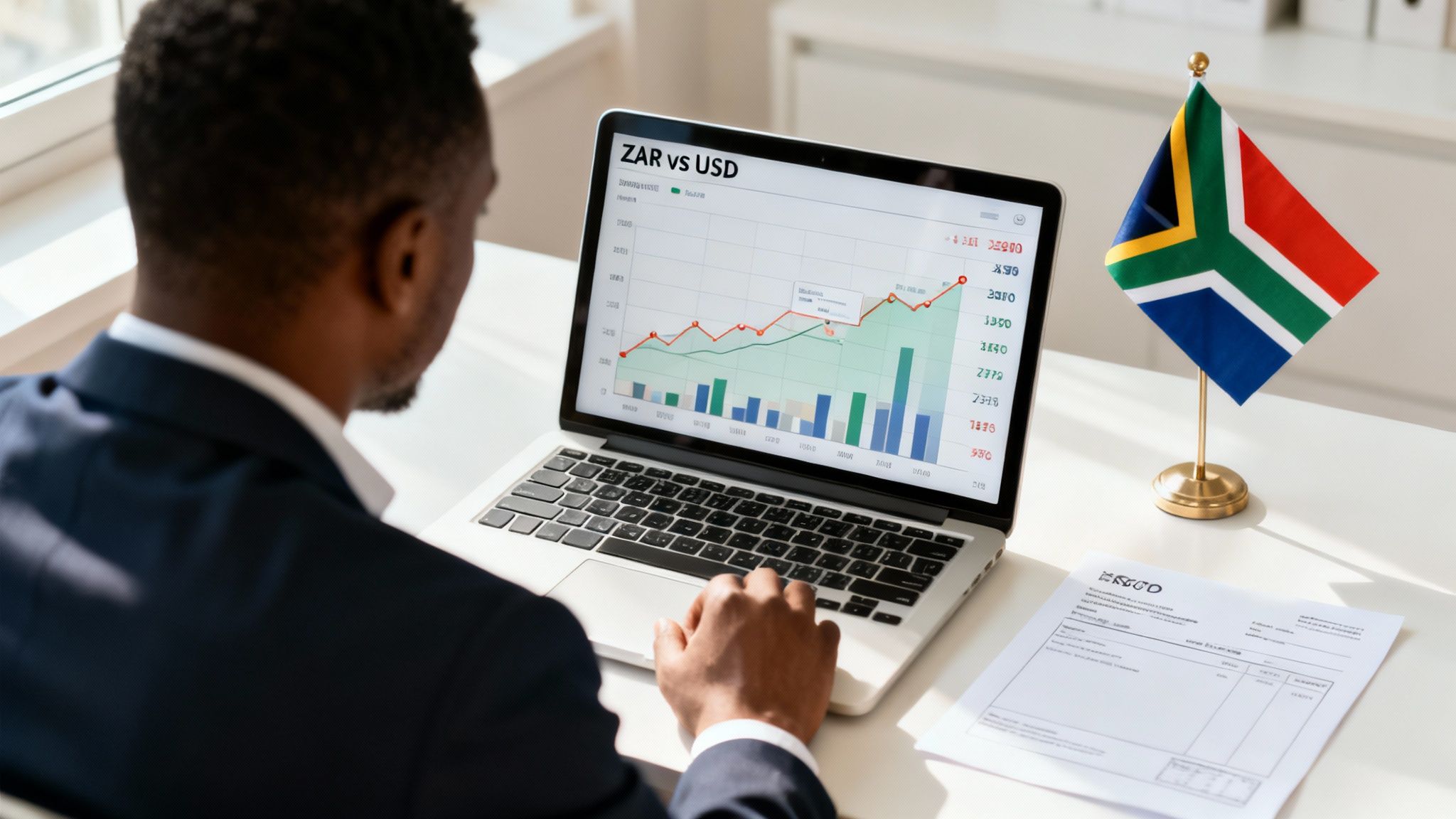
It’s one thing to understand the theory of forex, but it's another thing entirely to see how those market forces hit your company’s bank balance. The value of the Rand isn't just an abstract number; it's a direct reflection of everything from local politics and commodity prices to a single interest rate decision by the US Federal Reserve.
For any South African business trading internationally, these movements are not just lines on a chart. They represent very real risks and opportunities. A shift in the price of gold or platinum—commodities vital to our economy—can send ripples through the ZAR. So can a change in tone from the South African Reserve Bank (SARB). This is where the forex market gets personal.
Volatility is the name of the game in South Africa's currency market. The ZAR is known for its big swings, which are often turbocharged by commodity cycles. For instance, a recent surge in gold prices helped drive a 12% yearly strengthening against the US Dollar, with the Rand hitting a high of 16.6875 in late December—its best run since August 2022. You can read more on how gold prices and market confidence affect the ZAR on The Voice of Africa.
Let's step away from the theory and look at two scenarios that play out every day for businesses across the country.
Scenario One: The Exporter's Dilemma
Picture this: you run a fantastic wine estate in the Western Cape. You've just sealed a great deal, and a payment of $100,000 is on its way from a US distributor. When you shook hands on the deal, the USD/ZAR rate was 19.00.
At that rate, you were expecting R1,900,000. That’s the number you plugged into your cash flow forecast to cover production costs and, of course, your profit.
But in the couple of weeks it took for the money to land, some positive economic news broke locally, and the Rand strengthened. The rate is now 18.25. When you go to convert your $100,000, you don't get the R1.9 million you planned for. You get R1,825,000.
The Impact: A strengthening Rand just vaporised R75,000 of your revenue. Your entire profit margin on that shipment just got squeezed, and it had absolutely nothing to do with how good your wine was.
This is the classic exporter's headache. You can have a record sales month, but a currency move in the "wrong" direction can quietly chew away at your bottom line.
Scenario Two: The Importer's Cost Overrun
Now, let's flip the coin. Your business imports specialised manufacturing equipment from Germany, and you have an invoice for €50,000 that needs to be paid. When you placed the order, the EUR/ZAR exchange rate was a comfortable 20.50.
Your finance team budgeted exactly R1,025,000 to settle the bill. Simple enough.
But before the payment due date, a wave of caution about emerging markets spooks global investors, and the Rand takes a dive. The EUR/ZAR rate jumps to 21.50. That €50,000 invoice is suddenly a much bigger problem.
- Original Budgeted Cost: €50,000 x 20.50 = R1,025,000
- Actual Payment Cost: €50,000 x 21.50 = R1,075,000
Just like that, you're R50,000 over budget. You now have to find that extra cash to pay the same supplier for the exact same piece of equipment. That unexpected cost hits your cost of goods sold, putting pressure on your margins and your cash flow.
These examples aren't just hypotheticals; they show the real, tangible impact of forex volatility. For both the wine exporter and the equipment importer, the final financial outcome had nothing to do with their business skill and everything to do with market forces they couldn't control. This is exactly why a solid FX strategy isn't a "nice-to-have" for international businesses—it's absolutely essential.
Uncovering The Hidden Costs of Traditional Forex
Ever noticed that the exchange rate you see on Google never quite matches the one your bank gives you for an international payment? That's not a mistake. It’s the gap where traditional banking systems quietly build in their profits, often at your business's expense.
For a long time, South African businesses have just accepted this as the cost of doing business globally. The process is usually slow, surprisingly expensive, and frustratingly opaque. Between hidden markups on the exchange rate and a confusing stack of fees, the real cost of a simple international transaction can seriously eat into your margins.
These costs aren't just a minor inconvenience; they chip away at your profitability. What starts as a healthy international sale can end up looking a lot less impressive once it lands in your local account. The problem isn't a single fee, but a whole system of charges—some you see, and many you don't.
The Problem with Opaque Spreads
The biggest hidden cost by far is the exchange rate spread. Think of it as the bank's markup. They buy currency at the real, wholesale rate (the spot rate) but sell it to you at a less favourable retail rate. The difference is their profit.
A small percentage might not sound like much, but when you're dealing with large or frequent transactions, those fractions of a percent quickly add up to a substantial amount. This is exactly why the final ZAR amount leaving your account never seems to line up with the number you calculated using the rates you saw online.
The real cost of forex isn't just the fee on your invoice; it’s the profit you don't see because it was absorbed by an unfavourable exchange rate. This lack of transparency makes accurate financial planning and cash flow forecasting a real headache.
The Slow and Expensive SWIFT Network
On top of the spread, you have administrative fees. Most traditional international payments are sent through the SWIFT network, a global messaging system that connects thousands of banks. While it’s been the backbone of international finance for decades, it can be painfully slow and expensive.
Each bank in the chain—your bank, one or two intermediary banks, and the recipient's bank—can take a slice of your payment along the way. This means you’re often hit with:
- High Transaction Fees: A flat fee just to get the payment started.
- Intermediary Bank Charges: Unpredictable fees deducted by other banks while your payment is in transit.
- Slow Settlement Times: Payments can take several business days to arrive, creating uncertainty and holding up your supply chain.
The USD/ZAR pair dominates South Africa's forex market, and thankfully, modern electronic platforms have brought huge improvements in liquidity for everyone. This shift away from old-school voice brokers should translate to more transparency and predictable costs. The trouble is, traditional systems often haven't caught up.
Besides the obvious fees, businesses also have to contend with things like what is slippage in trading, where the price you get isn't the price you thought you locked in.
Let's break down what this looks like with a real-world example. Imagine you need to make a $10,000 payment.
Cost Comparison Traditional Bank vs Modern Platform
Here’s a simple comparison of how much that $10,000 payment would likely cost through a legacy bank versus a modern fintech platform like Zaro.
| Cost Component | Traditional Bank | Zaro Platform |
|---|---|---|
| Exchange Rate | ZAR 18.75 (includes a 1.5% markup) | ZAR 18.47 (real spot rate) |
| SWIFT/Transfer Fee | R450 | R0 |
| Total ZAR Cost | R187,950 | R184,700 |
| Hidden Cost | R3,250 | R0 |
The numbers speak for themselves. The combination of a marked-up exchange rate and fixed fees creates a significant cost that comes directly off your bottom line. It's clear that the old way of doing things is no longer the most cost-effective.
A Smarter Way To Manage Global Payments
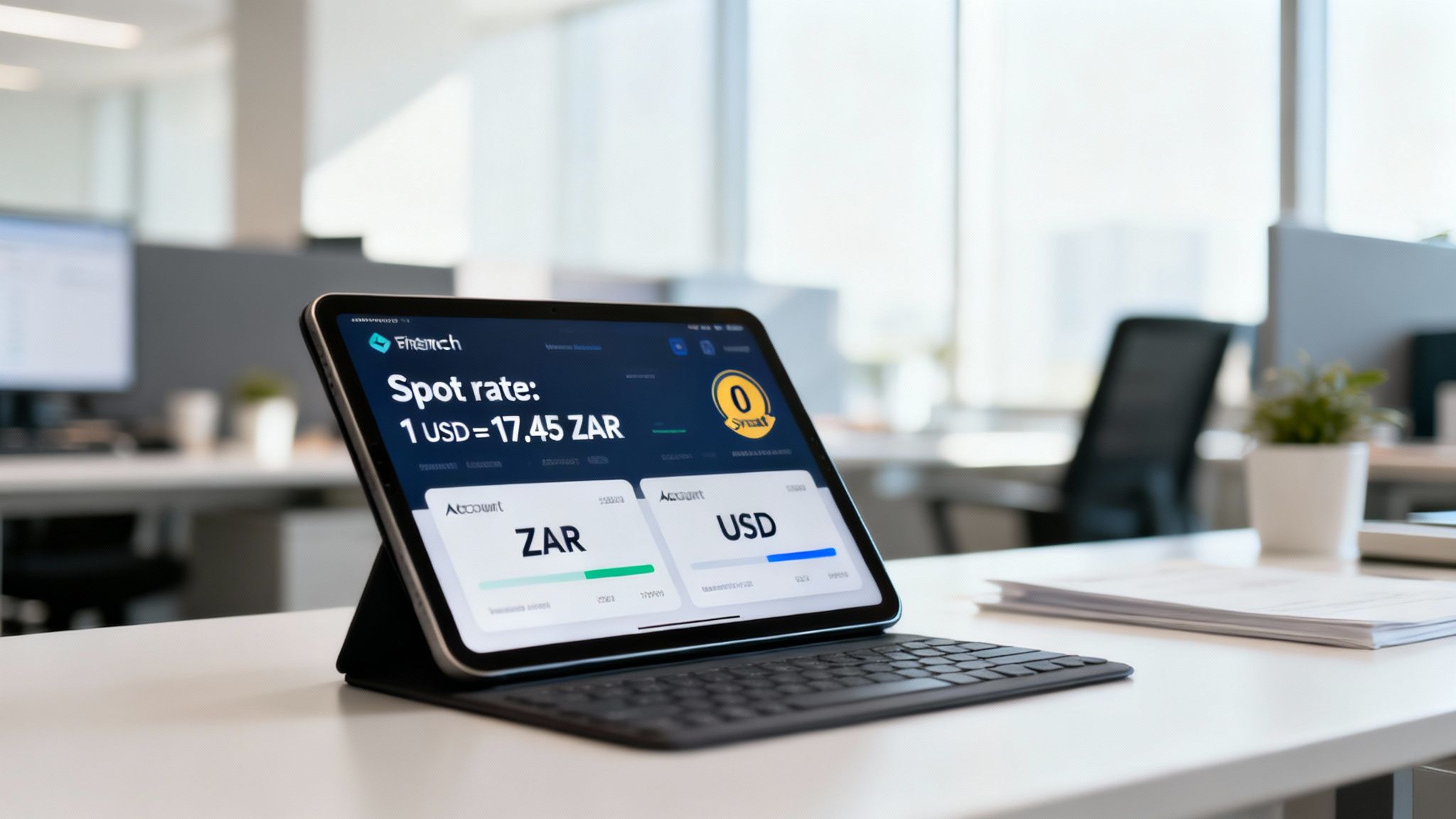
When you pull back the curtain on traditional forex, with all its hidden costs and operational headaches, it becomes pretty obvious the old way of handling international payments is broken. South African businesses have been putting up with a system that works against them for too long. The good news? A modern alternative has emerged, one that cuts through the complexity and gets rid of those painful, expensive sticking points.
This new approach tackles the challenges head-on by giving you direct access to the real currency market. Imagine making global payments at the actual spot exchange rate—the same one you see on financial news channels—with zero spread or markup. This isn't just a minor tweak; it’s a complete shift towards genuine financial transparency.
By moving away from the sluggish and costly SWIFT network, these platforms also eliminate the unpredictable intermediary bank fees that eat into your transfers. What you’re left with is a simple, fair, and remarkably efficient way to move money across borders.
The Practical Benefits for Your Business
For a South African company, this new way of doing things delivers immediate, tangible results that are about more than just saving a bit of cash. It fundamentally changes how you operate on a global scale, handing you the tools to manage cash flow with far greater precision and confidence. The whole process just becomes faster and more reliable.
Here’s what that looks like in practice:
- Rapid Onboarding: Forget waiting weeks to get started. A straightforward Know Your Business (KYB) process gets you verified and ready to trade in just a few days.
- Multi-Currency Accounts: You can easily fund and hold both ZAR and USD accounts, which means you can manage different currencies without being forced into expensive, unnecessary conversions.
- Total Financial Control: Enterprise-level features like multi-user access and customisable permissions give your finance team the secure oversight they need.
This model provides the control and visibility that CFOs and business owners have been crying out for. To really get a handle on global payments and avoid nasty surprises, it's also wise to get familiar with the tax implications of cross-border money transfers.
With a platform like Zaro, you are no longer a passive recipient of whatever rate your bank decides to offer. You gain the power to transact at the real market rate, ensuring your hard-earned revenue stays in your business.
At the end of the day, this modern solution removes the friction and guesswork from international trade. Whether you're paying overseas suppliers, bringing in export revenue, or managing a global payroll, you can finally take charge of your cross-border payments. That means less time wasted on admin, lower operational costs, and the financial clarity you need to grow your business with real confidence. It’s simply a smarter way to be part of the global economy.
Frequently Asked Questions About The Forex Market
Now that we’ve pulled back the curtain on how the forex market works, you probably have a few practical questions. It’s one thing to understand the theory, but quite another to apply it to your business. Let's dig into some of the most common queries we hear from South African business owners.
How Can My Small Business Start Managing Forex Risk?
The term "forex risk management" can sound intimidating, like something reserved for massive corporations with dedicated treasury teams. But it doesn't have to be. For most businesses, the simplest starting point is a forward contract.
Think of it as pre-ordering your currency. A forward contract lets you lock in an exchange rate today for a transaction that will happen weeks or months down the line. This simple move takes all the guesswork out of future payments or receivables. Modern platforms have made this tool incredibly accessible, so you can secure a future rate online in minutes, giving your business the stability it needs to budget properly.
What Is The Difference Between The Spot Rate and The Rate My Bank Gives Me?
This is a critical distinction, and understanding it is the key to saving money. The spot rate is the live, raw exchange rate that big banks use to trade massive volumes with each other. It's the "true" mid-market rate you might see quoted on Google or a financial news channel.
The rate your bank gives you is a retail rate. It's the spot rate plus their markup, a margin often called the spread. This spread is the bank's profit, and it's a direct cost to your business. The wider the spread, the more you're paying in hidden fees.
The name of the game in cost-effective forex is simple: get as close to the real spot rate as possible. A wide spread quietly eats away at your profits on every single transaction.
Why Does The ZAR/USD Exchange Rate Change So Often?
The Rand is in a constant state of flux, and for good reason. Its value is a real-time reflection of a complex mix of local pressures and global events. Watching the ZAR/USD rate is like watching the market's heartbeat.
Here are a few of the biggest drivers:
- Commodity Prices: South Africa is a commodities powerhouse. When prices for resources like gold, platinum, and coal move, the Rand often moves with them.
- Interest Rate Differences: Money flows where it can earn the best return. Decisions on interest rates by the South African Reserve Bank (SARB) versus, say, the US Federal Reserve can make the ZAR more or less attractive to global investors.
- Economic Data: News on inflation, GDP growth, or employment figures from either SA or the US can cause immediate shifts in sentiment and, therefore, the exchange rate.
- Global Risk Appetite: When global markets get nervous, investors tend to sell off currencies from emerging markets like ours and flock to "safe-haven" currencies like the US Dollar. This can weaken the Rand, even if nothing has changed locally.
Ready to stop losing money to hidden fees and unpredictable rates? With Zaro, you get access to the real spot exchange rate with zero spread and no SWIFT fees. Take control of your international payments and see how much your business can save. Get started with Zaro today.