At its heart, converting dollars to rands is simple. You just take the amount in US dollars and multiply it by the current USD/ZAR exchange rate. So, $10,000 multiplied by an exchange rate of 18.50 gives you R185,000.
This simple bit of maths is the starting point for any international transaction, but as anyone who's done this knows, it's rarely that straightforward in practice.
The Basic Formula for Dollar to Rand Conversion
If your business deals with international clients or suppliers, getting your head around the basic dollar-to-rand calculation is essential. It's the foundation for your invoicing, budgeting, and financial planning.
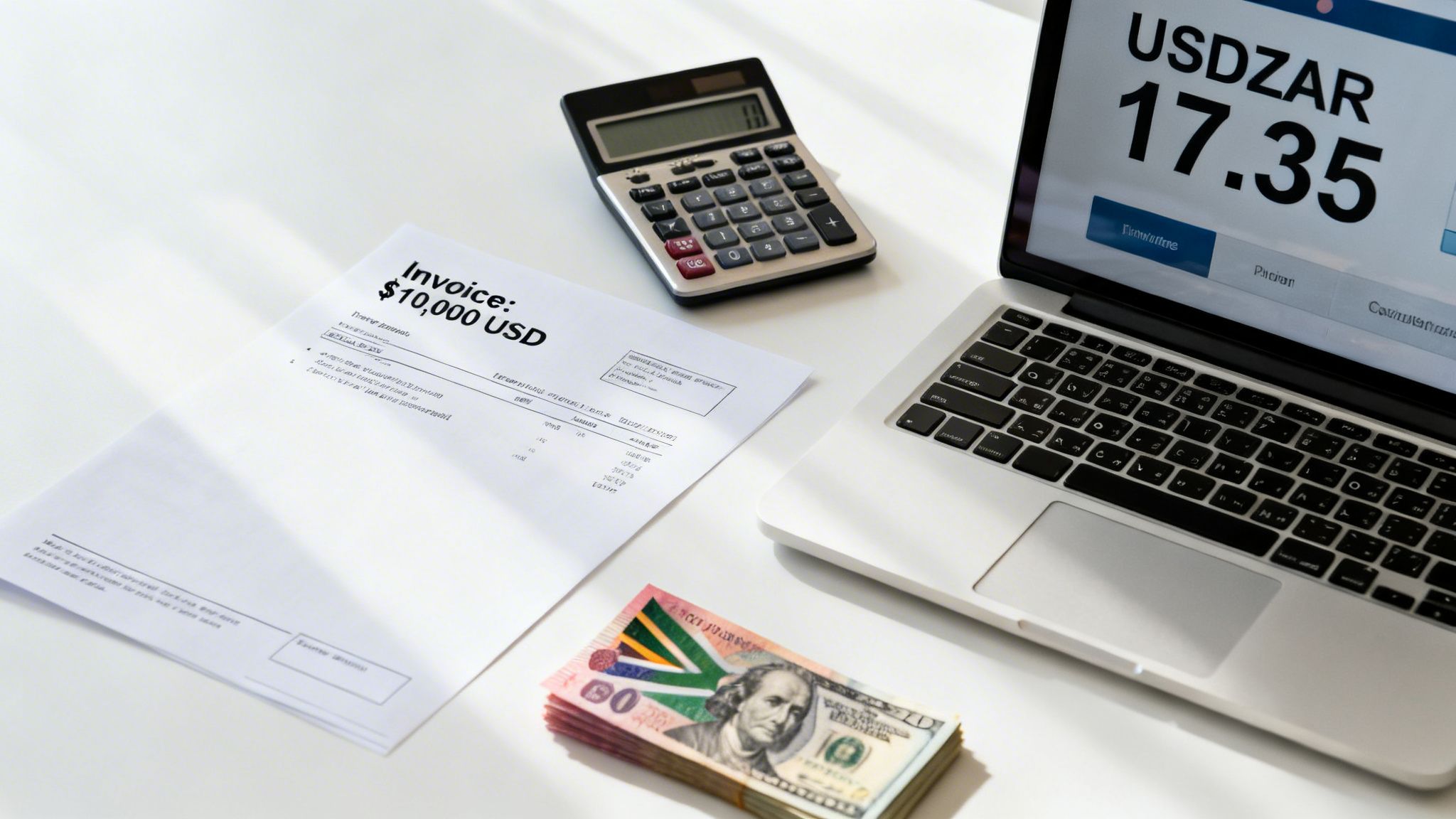
The formula you'll always come back to is:
USD Amount × USD/ZAR Exchange Rate = ZAR Amount
This is the bedrock of any foreign exchange conversion. Let’s break down what this looks like with a real-world business example.
A Real-World Calculation
Let's say you run a South African creative agency and you've just completed a project for a client in the United States. You need to send them an invoice for $10,000.
Before you send it, you check a reliable source for the exchange rate and see it’s sitting at 18.50.
Using the formula, you do a quick calculation:
- $10,000 (Your invoice amount) × 18.50 (The current rate) = R185,000
Great. You expect to see R185,000 land in your business account. But here’s the catch – the rate you see online and the rate your bank gives you are two very different things.
Why Your Calculation and Bank Deposit Never Quite Match
That exchange rate you found on Google or a financial news site? That’s called the mid-market rate. Think of it as the 'raw' exchange rate, the one banks and huge financial institutions use to trade massive volumes of currency with each other. It’s the true, midpoint price between what buyers are willing to pay and what sellers are asking for.
The problem is, your business almost never gets access to this rate.
When you go to your bank to convert the currency, they'll offer you a marked-up rate, often called the "customer rate" or "retail rate." The difference between the mid-market rate and the rate you're given is known as the "spread." This spread is essentially a hidden fee, and it eats directly into your profit margin.
Consider a small manufacturing business in Durban that needs to pay a US supplier an invoice for $50,000. The owner checks the rate online and sees 18.45, calculating the cost to be R922,500. However, the bank might only offer them a rate of 18.85. Suddenly, that same invoice costs R942,500 – an extra R20,000 that simply vanishes into the bank's pocket.
You can get a sense of historical currency trends from sources like Trading Economics, but this won't show you the spreads that providers charge. It's this discrepancy that makes understanding the true cost of currency conversion so critical for South African businesses.
Why Your Maths Doesn't Match the Bank Statement
Ever done a quick currency conversion on your calculator, only to feel a sense of disappointment when the final amount of rands hits your account? It's a common frustration, and it's not because your maths is wrong. The real issue is the gap between the exchange rate you see on Google and the one your business actually gets.
This gap is the difference between what's called the "mid-market rate" and the "customer rate".
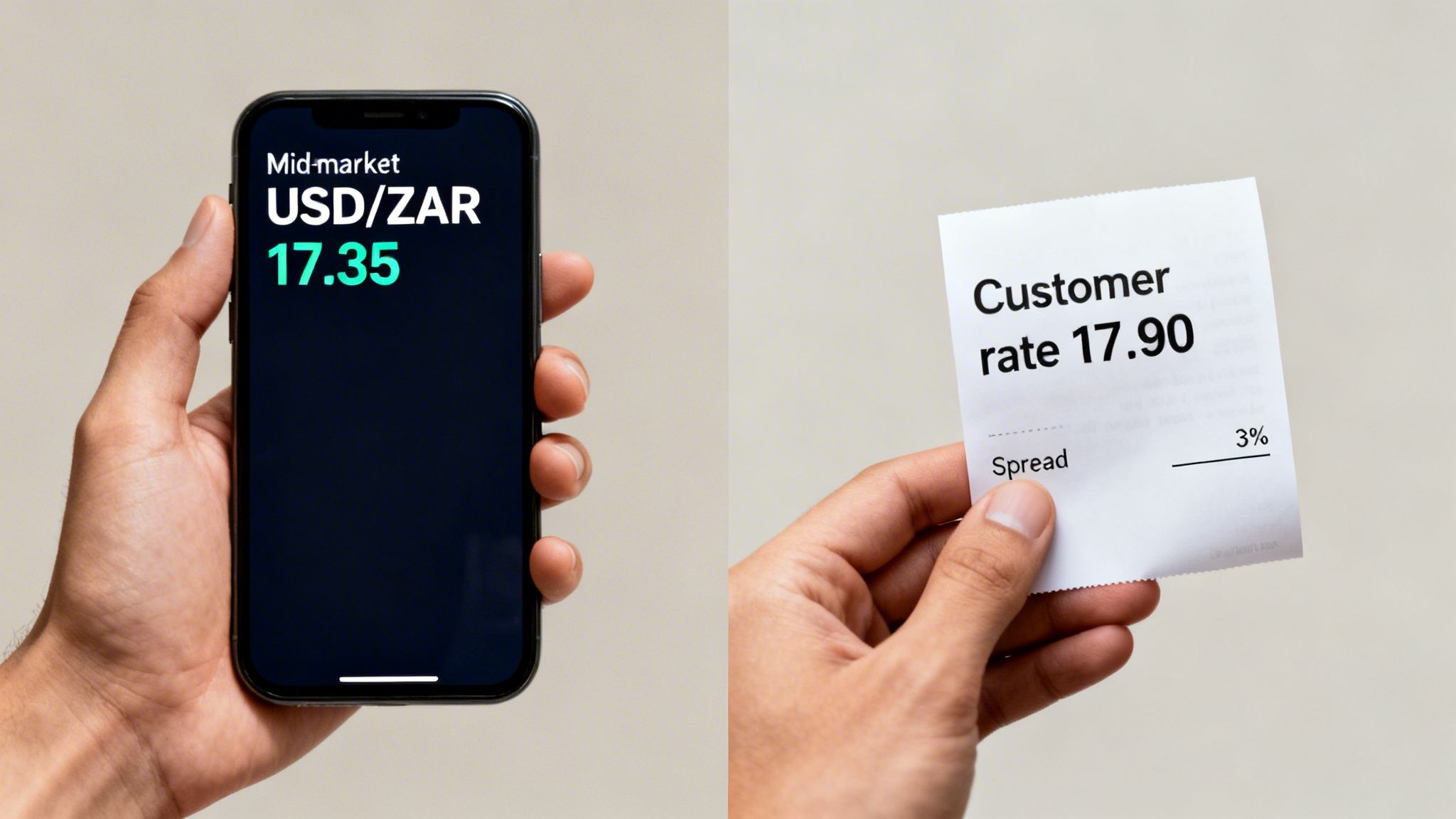
The rates you see flashed across financial news sites are the mid-market rates. Think of this as the wholesale price—the midpoint between what banks are buying and selling currencies for on the global market. It's the "purest" rate, but for your business, it’s mostly just a reference point.
The Hidden Cost: Understanding the Spread
The rate your bank or a traditional foreign exchange broker offers you is the customer rate. The difference between this customer rate and the mid-market rate is called the exchange rate spread. This is where they make a big chunk of their money.
Essentially, the spread is a hidden fee. It’s a markup they add to the real exchange rate to turn a profit. For businesses, particularly those moving larger sums, this seemingly tiny percentage can take a massive bite out of your revenue.
A typical spread from a major bank can easily range from 3% to 5%. On a large transaction, that seemingly small margin quietly chips away at your bottom line.
Let's put this into a real-world context. Imagine a Business Process Outsourcing (BPO) company in Cape Town is expecting a $100,000 payment from a client in the US.
- The mid-market rate for the day is 18.50 ZAR to the Dollar.
- The BPO's simple calculation is: $100,000 x 18.50 = R1,850,000.
- But their bank applies a 3% spread, which means the customer rate they're offered is only 17.945 ZAR per USD.
The amount that actually lands in the BPO's account is $100,000 x 17.945 = R1,794,500. That's a shortfall of R55,500. More than fifty thousand rands vanished into the bank's margin before the money even cleared. This silent cost is why calculating dollars in rands correctly means looking far beyond the simple multiplication.
It's Not Just the Spread, Either
Unfortunately, the deductions often don't stop there. The spread is usually the biggest culprit, but the final amount is frequently nibbled away by a few other charges that traditional providers love to apply.
You also need to watch out for a whole host of administrative costs, including:
- SWIFT Fees: Charges for sending money across the international SWIFT network, often a fixed fee per transaction.
- Commissions: As if the spread wasn't enough, some providers add an explicit commission on top.
- Receiving Fees: Your own bank might even charge you a fee just to receive an incoming international payment.
When you add all these up, the difference between what you expected and what you got can be significant. This is precisely the problem that modern solutions like Zaro are built to solve—by offering the real mid-market exchange rate without the spread, they eliminate these unpredictable and costly hidden fees for South African businesses.
Getting Hold of a Live Exchange Rate
To figure out what your dollars are really worth in rands, you need the right tool: a live, real-time exchange rate. Forget the "daily rate" you see on a bank’s website. That number is often stale the moment it’s posted and, more importantly, it usually has their profit margin baked right in. For the real picture, you have to look elsewhere.
Making a smart currency exchange starts with having solid, up-to-the-minute data. Fortunately, getting your hands on the mid-market rate—the genuine rate without the hidden fluff—is easier than ever.
Where to Find Rates You Can Trust
For the most accurate data, your best bet is to turn to trusted financial news platforms and the more transparent fintech companies. These sources tap directly into global financial markets, giving you the same information the big banks use behind the scenes.
Here are a couple of go-to options:
- Top-Tier Financial News: Outlets like Reuters and Bloomberg are the gold standard. They provide live charts and real-time tickers that show you exactly how the USD/ZAR pairing is moving at any given moment.
- Transparent Payment Platforms: Forward-thinking companies like Zaro and Wise build their businesses on fairness. They openly display the live mid-market rate on their websites and apps because transparency is their entire model. This makes them a fantastic source for the current, true rate.
When you use these sources, you're seeing the raw data financial institutions use for their own trades. This gives you a powerful benchmark to judge any quote you receive from a bank or broker.
Why Timing Your Transaction is Everything
Finding the live rate is one thing, but using it effectively is another. The foreign exchange market moves fast, and the USD/ZAR rate can swing quite a bit over the course of a single day. Timing is critical.
Let’s look at a real-world example. Imagine an export company in Johannesburg needs to settle an invoice for $50,000 with a US supplier. The financial manager checks the rate at 9 AM and sees it's 18.55. A quick calculation shows the cost will be R927,500.
But the day gets busy. Meetings run long, and the payment isn't processed until 3 PM. In those few hours, some market news hits, and the rand weakens to 18.70. The cost for the same $50,000 has now jumped to R935,000. That’s a R7,500 loss in just six hours.
This scenario shows exactly why you need to check the rate right before you hit "send". A tiny fluctuation can make a real difference to your bottom line, turning a good deal into a costly one simply because of poor timing.
By proactively monitoring the rate, you can choose to convert your funds when it’s most favourable, not just when an invoice happens to be due. This is what separates businesses that truly manage their forex costs from those that are simply at the mercy of the market.
Calculating the True Cost of Your International Payments
If you’ve ever tried to calculate exactly how many rands you’ll get for your dollars, you know it’s rarely a simple multiplication problem. That final amount that lands in your business account often feels surprisingly light, doesn't it? For any financial controller or CFO, that discrepancy is more than just a minor annoyance—it’s a cash flow headache that makes accurate forecasting feel like a guessing game.
The first step to regaining control is understanding exactly where your money is going. An international payment isn't hit with a single cost; it’s a series of fees, some obvious and some buried in the fine print, that chip away at your total.
This visual guide breaks down the core steps to make sure you're starting with the right numbers from the get-go.
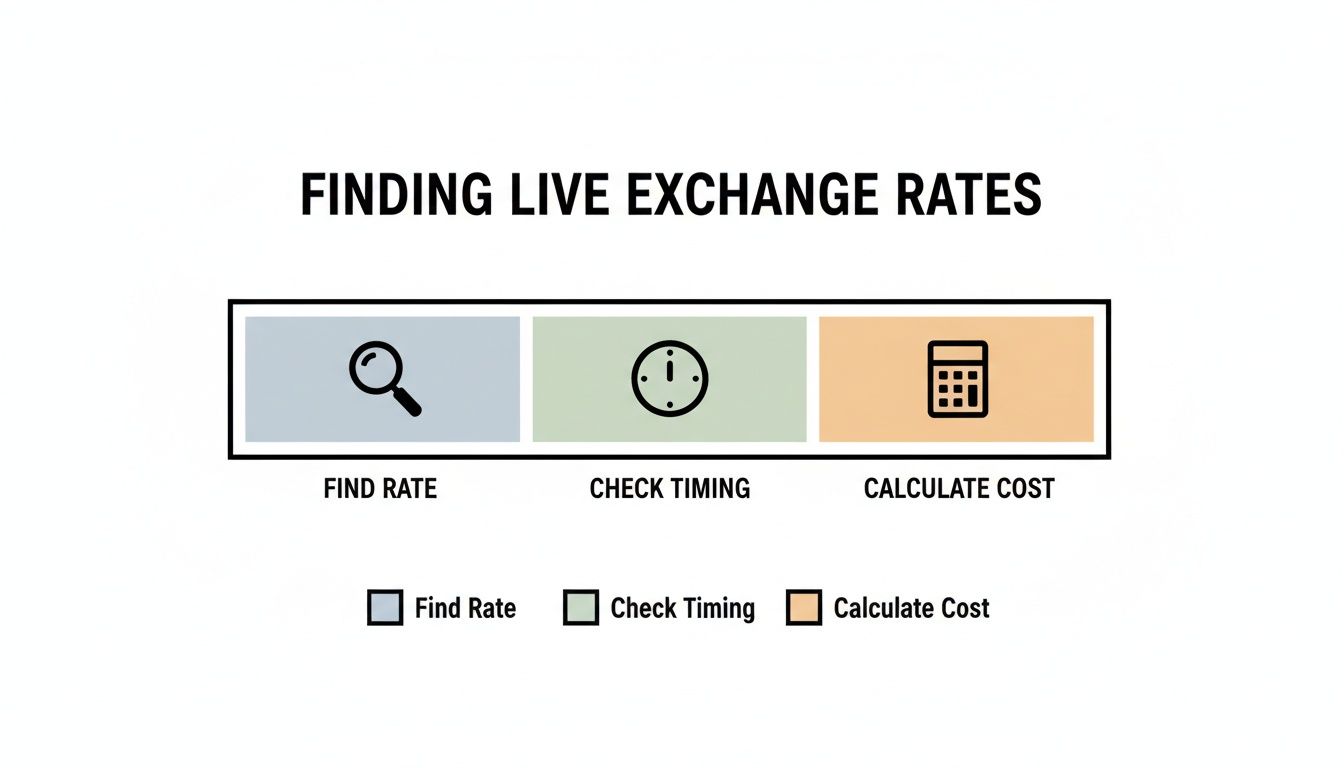
As you can see, finding the real-time rate is just the beginning. The real work is in calculating the total cost.
Your Complete Cost Checklist
To get a true picture of what an international payment costs, you need to audit the entire transaction. It’s the only way to uncover all the deductions.
Here’s what to look out for:
- Exchange Rate Spread: As we've covered, this is the margin the bank quietly adds to the mid-market rate. It’s often the single largest hidden cost you'll pay.
- Fixed Transaction Fees (SWIFT): Most international bank transfers rely on the SWIFT network. For that privilege, banks typically charge a fixed fee, usually somewhere between R250 and R500.
- Receiving Bank Fees: That's right—your own bank might charge you a fee just to process and deposit the incoming foreign currency into your account.
- Administrative Charges: This is often a vague, catch-all fee that banks sometimes add for the "service" of handling the transaction.
Only when you add all of these up do you see what the transfer really costs your business.
Seeing the Difference in Action
I once worked with a CFO at a mid-sized South African export company who was constantly frustrated by this. They brought in significant dollar amounts every month, but the unpredictable fees made financial forecasting a nightmare. The final rand amount was always a moving target, made worse by a volatile exchange rate.
Think about it: over the last six months to early 2026, the average rate sat around 17.0133. For a medium-sized exporter bringing in $200,000 a month, that meant an average of R3,402,660. But in 2025 alone, rand weakness cost SA's export sector an estimated R150 billion collectively. When traditional banks then layered on their typical 3-7% in fees and markups, a $100,000 payment could effectively shrink to R1,700,000 after everything was deducted. You can explore currency rate histories to see these trends for yourself.
This is exactly where a transparent fee structure provides much-needed certainty. When you switch to a modern solution that uses the real mid-market rate and charges one clear, upfront fee, it completely changes the game.
The core issue isn't just the cost; it's the lack of predictability. When you can't forecast your incoming revenue accurately, it affects everything from payroll and supplier payments to strategic investments.
To make the difference truly undeniable, let’s look at a side-by-side comparison.
Cost Comparison for a $25,000 International Payment
Here’s a practical breakdown of how a $25,000 payment stacks up when processed through a traditional bank versus a modern fintech platform like Zaro.
| Cost Factor | Traditional Bank | Zaro |
|---|---|---|
| Exchange Rate | Mid-Market + 3% Spread (e.g., 17.95 instead of 18.50) | Mid-Market Rate (18.50) |
| SWIFT Fee | R450 | R0 |
| Receiving Fee | R150 | R0 |
| Final ZAR Received | ~R448,750 | ~R462,500 (minus small, transparent fee) |
The contrast is stark. The savings on a single transaction are significant enough, but for a business that processes multiple international payments, the cumulative impact on the bottom line is massive.
Suddenly, financial certainty is no longer a luxury—it’s a competitive advantage.
A Better Way to Manage Your Business Forex
Knowing how to calculate dollars in rands is one thing, but actually managing the process to protect your profits is where the real challenge lies for South African businesses. If you're relying on traditional banks for international payments, you're likely all too familiar with their unfavourable exchange rates and a frustrating trail of hidden fees.
This old-school, reactive approach makes cash flow forecasting a nightmare and slowly eats away at your profit margins with every single transaction. A smarter way forward is to take direct control of your foreign currency, treating it less like a payment you have to convert immediately and more like a company asset.
Gaining Control with Dedicated Currency Accounts
The most effective way to handle your international finances is to use a platform that gives your business dedicated USD and ZAR accounts. This one feature is a complete game-changer.
Instead of being forced to convert a US dollar payment the second it lands, you can simply hold the funds in your dedicated USD account. This puts your business firmly in the driver's seat, giving you the power to decide when to make the conversion. You can watch the exchange rate and move your funds into rands only when the rate works for you, directly boosting your bottom line.
Holding foreign currency allows you to strategically time your conversions. You move from being a passive recipient of whatever rate the bank offers to an active manager of your company's financial assets.
This strategic edge is essential for any business navigating currency swings. It creates a much-needed buffer against market volatility and gives you the tools to maximise the value of every dollar you earn.
Features Built for How Your Business Actually Works
Beyond simply holding funds, the right platform provides tools designed for the day-to-day realities of a modern finance team. These features are built to bring much-needed efficiency and security to your international operations.
Here are a few key capabilities you should look for:
- Multi-user access: This is crucial for proper governance. It lets you assign specific roles and permissions to different members of your finance team, so everyone has the access they need—and nothing more.
- Enterprise-grade security: With robust security protocols, you can operate with confidence, knowing your funds and sensitive data are protected from any unauthorised access.
- Debit cards for international spending: Imagine having debit cards linked to your USD and ZAR accounts. You can spend internationally at the real exchange rate, neatly sidestepping the hefty markups banks usually apply to corporate card purchases abroad.
To pull all of this together, exploring solutions with robust foreign currency features can make all the difference. An integrated approach brings all your international financial activities under one, easy-to-manage roof.
From Unpredictable Costs to Financial Certainty
Ultimately, this shift in managing forex is about moving from frustrating uncertainty to solid predictability.
When you have dedicated accounts, direct access to the real exchange rate, and a clear, transparent fee structure, you get rid of the guesswork. You know exactly what a transaction is going to cost and precisely how many rands will land in your account.
For a South African business competing on a global stage, that certainty is invaluable. It leads to more accurate financial planning, protects your hard-earned profit margins, and frees up your finance team to focus on growing the business instead of hunting down the source of mysterious bank fees.
Common Questions About Calculating Dollars to Rands
Even after you've got the basics down, converting dollars to rands in the real world throws up some tricky questions. Let's tackle a few of the most common ones I hear from business owners, so you can avoid the usual pitfalls and manage your international payments more effectively.
Is There a Best Time of Day to Convert Dollars to Rands?
Absolutely. For larger transfers, timing can really make a difference. The USD/ZAR exchange rate is at its most liquid when both the New York and Johannesburg markets are buzzing with activity. More liquidity usually means tighter spreads, which is good news for your bottom line.
Think of the window between 3 PM and 5 PM South African Standard Time (SAST) as the "sweet spot." You'll often find more competitive rates then, compared to very early in the morning or late at night when the markets are quieter.
A Pro Tip from Experience: Try to avoid converting currency late on a Friday afternoon or just before a public holiday. I've seen liquidity dry up during these times, leading to wider spreads and rates that just aren't in your favour.
How Can I Protect My Business from Currency Volatility?
The rand has a reputation for being volatile, and for good reason. A great deal can turn into a loss seemingly overnight if the market moves against you.
One of the smartest moves is to use a service that offers dedicated USD and ZAR accounts. This simple feature is a game-changer. It means you can receive and hold onto your dollar payments without being forced to convert them immediately.
Holding the funds puts you back in the driver's seat. You can watch the market and choose to convert to rands when the rate is favourable, not just when the invoice gets paid. It's a simple, effective way to hedge against those sudden, gut-wrenching market swings.
Why Do Different Currency Converters Show Different Rates?
This is a classic point of confusion, and the answer comes down to what you're actually looking at. The rate you see depends entirely on the source.
- Financial News Outlets (like Reuters or Bloomberg): These guys show you the mid-market rate. Think of this as the "real" exchange rate, a pure midpoint between what buyers are willing to pay and sellers are willing to accept, with no profit margin baked in. This should always be your benchmark.
- Your Bank's Website: The rate you see here is a "customer rate." It has the bank's spread already built-in, which is why it always looks less attractive than the mid-market rate.
- Online Calculators: These are a mixed bag. Some are excellent and use the live mid-market rate, while others pull from slightly delayed data or show a rate from a specific transfer service.
To get a true picture when calculating dollars to rands, always start with a source showing the live mid-market rate. It’s the only way to know the real value and accurately judge the fairness of any quote you're given.
Ready to stop losing money to hidden fees and unpredictable exchange rates? With Zaro, you get access to the real mid-market rate, dedicated USD and ZAR accounts, and a transparent fee structure that puts you in control. See how much your business can save by visiting https://www.usezaro.com today.