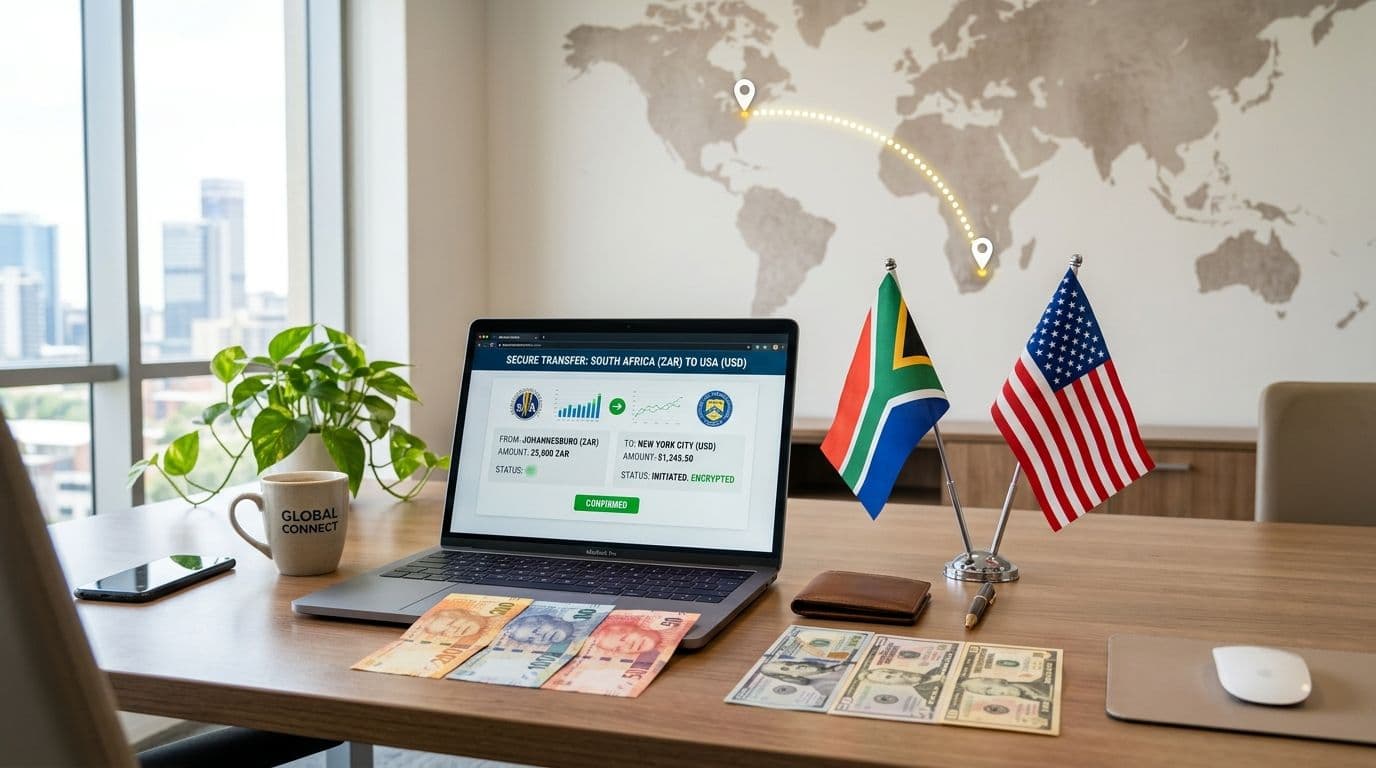
Your US supplier has issued the invoice. Treasury wants it settled this week. Operations is waiting for stock, software access, or a contractor handover. Then the friction starts. The bank asks for documents, the FX rate looks worse than expected, and the beneficiary later says the amount that arrived is short.
That gap matters more than most businesses admit. When you're paying in dollars from South Africa, the problem isn't just getting money from point A to point B. It's controlling total landed cost, keeping cash flow predictable, and getting the payment through without a compliance delay that your team could have avoided.
If you're working out how to send money to USA from South Africa for a business, treat it like a finance process, not an admin task. The right decision isn't just the provider with the nicest interface. It's the route that gives you fee visibility, clean audit trails, and fewer surprises for your supplier and your finance team.
The Hidden Costs of International Payments from South Africa
A common pattern looks like this. A South African company agrees to pay a US vendor in USD, approves the invoice, and instructs a transfer through its bank. The amount leaves the local account, but the final result still feels uncertain until the US recipient confirms what landed.
That's because the visible fee is often only part of the cost. The business may also absorb a retail FX markup, possible correspondent bank deductions, and the internal labour of chasing proof of payment, amending beneficiary details, or resubmitting documents. For a CFO, that isn't just messy. It weakens forecasting.

Where the cost usually slips in
Most businesses notice three pressure points:
- Bank transfer charges: These are the fees your bank discloses upfront for processing an international payment.
- FX spread: The exchange rate offered to your business may sit away from the market rate. That difference can matter more than the listed transfer fee.
- Intermediary deductions: If the payment moves through correspondent banks, the receiving side can get less than expected.
The frustration is that none of this shows up neatly in one line item. Finance teams end up reconciling the payment after the fact, not managing it before the fact.
Practical rule: If your supplier insists on receiving the exact invoiced USD amount, you need to evaluate the full payment path, not just your bank's sending fee.
What this means for business cash flow
International payments become expensive when finance treats them as isolated transactions. A single payment might still clear, but repeated leakage across supplier settlements, software subscriptions, and contractor payments erodes margin and creates avoidable month-end noise.
The operational burden is just as real. Someone in the business has to gather the invoice, answer compliance questions, confirm banking details, explain delays to the recipient, and investigate shortfalls. That work isn't free, even when it doesn't appear on the bank statement.
For South African businesses paying the US regularly, the smarter approach is to build a repeatable payment process with clear documents, approved beneficiaries, and a payment route that gives finance control over cost before funds leave the account.
Understanding Your Transfer Options
Businesses in South Africa usually use one of two routes to pay the US. The first is the traditional bank route. The second is a digital cross-border payment platform. Both can get money to a US recipient, but the mechanics and trade-offs are different.

The traditional banking route
When a business uses its bank for an international payment, the transfer often runs through the SWIFT network. In practice, that means your bank sends payment instructions through one or more financial institutions before the money reaches the beneficiary bank in the US.
That structure is familiar, and for some companies it fits existing controls. Treasury teams may already have banking mandates in place, signatory rules, and internal comfort with bank channels. If you send infrequent payments and prefer to keep everything within one banking relationship, this route can feel administratively simple.
The trade-off is visibility. It can be harder to see the total cost upfront, and payment tracking may depend on how many institutions touch the transfer on the way through.
The fintech route
Modern payment platforms usually work differently. Instead of relying on the same chain of correspondent banks for every leg, they tend to build local collection and payout rails, maintain currency balances, or structure the transfer in a way that reduces unnecessary handling in the middle.
For a business, the practical advantage is usually clarity. You're more likely to see what rate you're getting, what the fee is, and what amount should arrive with the beneficiary. That makes approvals easier because finance can compare options before committing.
If your payment process depends on someone emailing the bank, waiting for a callback, and then asking the supplier what arrived, the process is too opaque for a growing business.
Which route suits which payment type
The right route depends on the payment's purpose, urgency, and governance requirements.
- Large supplier invoices: Some finance teams still prefer a bank for very large, one-off settlements because the control environment is familiar.
- Recurring contractor payments: Digital platforms often work better when you need repeatability and cleaner payment tracking.
- Operational spend in USD: Software, agencies, and outsourced support usually benefit from a lower-friction digital process.
- Treasury monitoring: If your team also watches payment-adjacent market indicators, it can be useful to monitor XRP coin stats alongside broader digital asset and liquidity trends, not because that drives a supplier payment decision directly, but because CFO teams increasingly track alternative rails and sentiment within the payments space.
What usually works best
For most SMEs, the strongest payment setup isn't ideological. It's practical. Use the route that matches the transaction.
If you need legacy bank infrastructure for a specific transaction, use it with eyes open. If you want speed, clearer FX treatment, and less operational drag for day-to-day USD payments, a modern platform is usually easier to manage. The businesses that handle cross-border payments well don't romanticise banks or fintechs. They compare process quality, approval friction, and the probability of payment exceptions.
Navigating South African Exchange Control and Compliance
The biggest mistake finance teams make isn't choosing the wrong provider. It's underestimating how much the payment depends on documentation quality. A payment can be commercially legitimate and still stall because the paperwork isn't complete, aligned, or easy for the bank or provider to verify.
According to the South African Reserve Bank, incorrect or incomplete documentation is the primary reason for over 60% of delays in international payment processing for SMEs (SARB financial surveillance circulars). That should change how you think about sending money abroad. Compliance isn't a final checkpoint. It's part of payment execution.
The documents you'll usually need ready
For most business payments from South Africa to the US, finance should assemble a clean pack before the transfer is initiated.
Underlying commercial document
Usually this is the supplier invoice, contract, service agreement, or another document that shows why the payment is being made.Beneficiary banking details
These must match the recipient entity and payment instruction exactly. Small mismatches create avoidable rework.Company verification records
Providers typically ask for CIPC registration details, director or authorised signatory identification, and proof of business address.Tax and regulatory support where relevant
Some payment types or offshore activities may require additional tax clearance or supporting documents depending on the nature of the transaction.
Why banks and platforms ask for so much
Finance teams often complain that compliance requests feel repetitive. They can be. But each request usually maps to a specific regulatory obligation.
Banks and licensed providers need to know who is sending the money, who is receiving it, whether the payment reason is legitimate, and whether the transaction aligns with South African exchange control requirements. That is why KYB and KYC checks sit so close to the payment flow.
A workable internal checklist
The easiest way to reduce delays is to standardise your internal process before Treasury or AP pushes the button.
- Create a beneficiary file: Keep the legal entity name, contact person, invoice format, and banking details in one approved record.
- Check naming consistency: The invoice, contract, and beneficiary bank account should refer to the same party unless there's a documented reason for a mismatch.
- Store authority documents centrally: Don't wait until payment day to chase director IDs or signatory approvals.
- Define payment purpose codes internally: Your team should know how it categorises supplier payments, service fees, software costs, and contractor settlements.
- Escalate unusual transactions early: If the payment sits outside normal supplier trade, get compliance input before month-end pressure starts.
Clean documentation shortens approval time more reliably than almost any other intervention.
Where businesses lose time
The avoidable bottlenecks are usually mundane. An invoice has no clear description. The company name on the invoice doesn't match the bank account name. A director's ID copy is outdated. Treasury assumes tax has already reviewed the offshore payment. Nobody notices the issue until the supplier asks where the funds are.
That's why disciplined businesses separate document readiness from payment urgency. If a US payment is operationally important, the compliance pack should exist before the invoice falls due.
What a CFO should own
This isn't just an accounts payable issue. It's a governance issue. The CFO should ensure the business has:
- a documented approval chain for offshore payments
- a standard document set for each payment category
- a single owner for beneficiary maintenance
- a clear rule for when tax or legal review is required
When those controls are in place, sending money to the US becomes less of a scramble and more of a repeatable finance operation.
Cost and Speed A Head-to-Head Comparison
Most businesses compare international payment options the wrong way. They look at the advertised transfer fee, then stop. A CFO should compare total landed cost, payment traceability, and how much staff time the process absorbs.
Here's the more useful lens. Ask what the recipient is expected to receive, what exchange rate treatment applies, whether any banks in the middle can deduct charges, and how confidently your team can predict settlement timing.

What to compare before you approve a payment
A useful comparison framework looks like this:
| Metric | Traditional Bank | Fintech (e.g., Zaro) |
|---|---|---|
| Exchange rate treatment | Often a bank-set retail FX rate | Often closer to the real market rate, depending on provider model |
| Upfront transfer fee | Usually disclosed at instruction stage | Usually disclosed in-platform before confirmation |
| Intermediary fee risk | May apply if correspondent banks are involved | Often reduced or avoided, depending on payout structure |
| Amount certainty for recipient | Can be less predictable | Usually clearer before funds are sent |
| Payment tracking | Often available, but may require manual follow-up | Typically more visible inside the product workflow |
| Settlement speed | Can vary across business days | Often faster for standard business payments |
| Internal admin load | Higher when documentation and tracing are manual | Lower when onboarding and approval are digitised |
This table doesn't claim that every bank is slow or every fintech is perfect. It highlights what finance teams should test in live use.
A worked example without false precision
Assume your business needs a US supplier to receive USD 10,000. The right question isn't “What is the transfer fee?” The right question is “How many rand leave our account, and how certain are we that the supplier receives the full USD amount on time?”
With a traditional bank route, the answer can become fuzzy. The bank may quote a transfer fee, but the FX rate may include a markup, and the final amount that lands can still be affected by the payment chain. If your supplier is strict about receiving the full invoiced amount, your team may overfund the transfer just to create a buffer.
With a modern fintech route, the comparison usually starts cleaner. You can often see the exchange rate basis and fee treatment before approval, which gives finance a more reliable landed-cost view.
The cheapest-looking option on the fee schedule often isn't the cheapest option once FX treatment and payment uncertainty are included.
Speed matters when operations depend on the payment
A delayed payment doesn't just annoy the supplier. It can delay shipping, suspend service access, or push your team into exception handling. That creates a second cost layer that never appears in the payment quote.
For businesses that pay US partners regularly, this is where operational design matters. A payment method that settles reliably with fewer manual interventions often beats one that looks acceptable on paper but triggers follow-up emails, beneficiary checks, and tracing requests.
A short explainer can help teams visualise the difference in payment flow and user experience:
The CFO lens on total cost
When finance reviews providers, use these decision criteria:
- Rate transparency: Can your team see how the FX rate is derived before approval?
- Fee certainty: Are charges fixed and visible, or can deductions happen later?
- Control environment: Can you separate initiator and approver roles?
- Audit trail: Can finance retrieve payment details quickly at month-end or audit time?
- Exception handling: If a beneficiary says funds are short or delayed, how fast can your team investigate?
A bank can still be the right choice in some situations. But if your business sends recurring USD payments, a system that gives Treasury better visibility often produces the stronger commercial outcome. Better predictability improves supplier relationships, shortens reconciliation time, and protects working capital from avoidable leakage.
Best Practices to Reduce Forex Costs and Delays
A better provider helps, but it won't fix a weak treasury process. Businesses that manage cross-border payments well do a few disciplined things repeatedly. They don't leave every USD payment to the day the invoice falls due, and they don't let accounts payable carry the full burden alone.

Run payments like treasury, not admin
The first improvement is behavioural. Treat USD payments as a funding and timing decision, not just a settlement task.
- Pre-fund strategically: If your business has regular dollar obligations, holding USD when market conditions suit your budget can reduce timing pressure.
- Batch where practical: Consolidating compatible payments can cut approval friction and reduce repeated admin.
- Separate urgent from routine: Not every invoice needs same-day handling. Build a payment calendar so the urgent cases stand out.
- Confirm beneficiary details upfront: A five-minute check before payment is cheaper than a tracing process after payment.
Use the right instrument for the spend type
Not every US payment should move through the same rail. Supplier invoices, contractor fees, SaaS subscriptions, and travel-related spend often deserve different treatment.
For example, a multi-currency card can be more sensible for smaller recurring software charges than a standard corporate credit card with poor FX treatment. By contrast, formal supplier invoices usually need a bank-grade payment trail and stronger approval controls.
Reduce internal handoffs
Cross-border payments slow down when too many people own fragments of the process. Procurement has the invoice. AP has the due date. Treasury has the bank relationship. Tax has the compliance concern. Nobody owns the full path.
A cleaner model is to assign one finance owner to offshore payments with authority to coordinate documentation, payment routing, and beneficiary verification.
Operator's note: The payment itself is rarely the hardest part. The delays usually come from internal handoffs and incomplete records.
Communicate with the recipient like a commercial partner
US suppliers care about certainty. If they know when payment is scheduled, in what currency, and what reference will appear, they're less likely to escalate prematurely.
Use a simple rule. For any material payment, confirm:
- the exact beneficiary name
- the expected currency
- the remittance reference
- who will investigate if something doesn't arrive as expected
That discipline reduces dispute cycles and protects the supplier relationship. It also helps your finance team avoid duplicate payments triggered by confusion rather than actual payment failure.
FAQ for South African CFOs and Exporters
Is a bank always the safest option for paying the US
Not automatically. A bank may feel safer because it's familiar, but safety for a CFO includes process control, visibility, auditability, and reduced exception handling. A well-regulated digital provider can outperform a traditional bank on operational control if it offers stronger transparency and cleaner workflows.
Should we send rand or dollars
For most US suppliers, paying in USD is cleaner because it removes currency ambiguity for the recipient. The South African business then controls the FX decision on its side instead of pushing uncertainty to the supplier.
What causes the most avoidable payment delays
Documentation errors and mismatches cause a large share of the pain. If the invoice, entity name, payment purpose, and beneficiary details don't align, the payment is more likely to be stopped for review.
How should we evaluate a payment provider internally
Use a procurement-style scorecard rather than relying on anecdotes.
| [object Object] | [object Object] | [object Object] |
|---|---|---|
| Cost visibility | Can finance see the full charge structure before approval | Fewer surprises in landed cost |
| Control framework | Does the platform support role separation and approvals | Lower operational and fraud risk |
| Compliance workflow | How easy is onboarding, verification, and document submission | Faster repeat payments |
| Reconciliation | Can AP and Treasury retrieve clean records quickly | Better month-end close discipline |
| Recipient certainty | How clearly can the provider indicate what should arrive | Fewer supplier disputes |
Is the fastest option always the best option
No. Speed only matters if the payment lands cleanly and the compliance trail is solid. The best option is the one that balances timing, cost clarity, and governance.
When does it make sense to review our current payment setup
Review it when you start paying US suppliers regularly, when FX costs are becoming harder to explain, or when your finance team spends too much time fixing payment exceptions. If cross-border payments have become routine, the process deserves treasury attention, not occasional admin fixes.
If your business needs a cleaner way to manage cross-border payments, Zaro is worth a serious look. It's built for South African businesses that want tighter FX transparency, lower payment friction, and stronger control over how money moves in and out of USD.