
Getting started in forex trading really comes down to three things: understanding how currencies interact, picking a properly regulated broker, and, most importantly, having a rock-solid plan to manage your risk. For a South African business, this isn't about wild speculation; it's a smart, strategic way to protect your profits from the Rand's notorious ups and downs.
Your First Look at the Forex Market in South Africa
The foreign exchange (forex or FX) market is simply where currencies are bought, sold, and swapped. It's the biggest financial market on the planet, but don't let that intimidate you. It's a vast, decentralised network that you're already a part of.
Every time you pay an invoice to a supplier in dollars or receive euros from a client in Germany, you're engaging with the forex market. The difference is that by learning to trade forex proactively, you shift from being a passive price-taker to a strategic manager of your money. You can stop just accepting whatever exchange rate the bank gives you on the day and start using forex tools to lock in good rates when you see them.
Why Forex Matters for Your Business
In a global economy, managing the risks that come with currency fluctuations is non-negotiable, especially with a currency as volatile as the South African Rand (ZAR). Unexpected swings can either pad your profits or wipe them out entirely.
Here’s why you need to pay attention:
- Protecting Your Profits: Imagine the Rand suddenly weakens against the dollar right before you have to pay a big import bill. That shipment just got a lot more expensive. Hedging strategies can protect you from these kinds of costly surprises.
- Making Budgets You Can Trust: When you get a handle on your FX exposure, your financial forecasts become far more reliable. This stability is the foundation for smart, long-term business planning.
- Gaining a Competitive Edge: If you can confidently manage your currency risk, you can offer more competitive pricing to international customers because you know your profit margins are secure.
It wasn't long ago that these kinds of forex management tools were only available to huge multinational corporations. Now, accessible online platforms have levelled the playing field, giving small and medium-sized businesses the power to take firm control of their international finances.
And this isn't some niche activity; it's exploding in popularity. More and more South African businesses are turning to forex to hedge against the ZAR. In fact, South Africa is the largest forex trading hub on the continent, with a daily turnover that tops $20 billion.
The numbers speak for themselves. The entire South African foreign exchange market was valued at USD 3,861.60 million in 2024 and is expected to climb to USD 6,852.50 million by 2033. If you want to dig deeper, you can explore the full 2025 outlook for forex trading in Africa to see where things are headed. This guide is your starting point for navigating this dynamic market with confidence.
Finding the Right Broker and Opening Your Account
Your first real step into the world of forex trading is arguably the most important one: picking the right broker. This isn't just about finding a platform that looks good; it's about finding a trustworthy partner to handle your money.
For anyone trading from South Africa, the choice is simple. You absolutely must use a broker regulated by our own Financial Sector Conduct Authority (FSCA).
This is non-negotiable. An FSCA licence is your assurance that the broker meets strict financial standards. Crucially, it means they keep your funds in segregated accounts, completely separate from their own operating cash. If the brokerage ever hits hard times, your money is protected and isn't considered part of their assets.
Before you sign up with anyone, do your homework. Running through a detailed due diligence checklist is a smart way to systematically vet potential brokers on everything from their regulatory status to their fee structures and customer service.
Why FSCA Regulation is Your Safety Net
Think of the FSCA as the referee of the financial markets in South Africa. Their oversight provides a critical layer of security that offshore, unregulated brokers simply can't match.
Here’s what you get with an FSCA-regulated broker:
- Fund Security: Your money is kept safe in separate, ring-fenced accounts.
- Fair Play: The broker has to operate transparently and ethically.
- A Local Umpire: If you ever have a dispute, you have a local regulatory body to appeal to.
Unregulated brokers often try to lure traders with promises of massive leverage or big bonuses. It might look tempting, but the risks are huge. You could face problems withdrawing your money, get unfair price execution, or, in the worst-case scenario, the company could vanish with your entire investment. It’s a gamble that’s just not worth taking.
Getting Your Account Open
Once you’ve found a few FSCA-regulated brokers you like, it’s time to open an account. The process is pretty standard and feels a lot like a Know Your Business (KYB) check you'd do for a company bank account. It’s all about verifying who you are.
You’ll generally need to upload a few documents:
- Proof of Identity: A clear copy of your South African ID or passport.
- Proof of Address: A recent utility bill or bank statement (usually less than three months old).
- Business Docs (if needed): If you're opening an account in your company's name, you'll need the relevant registration documents.
This is all done online and is usually sorted within a day or two. It’s a small bit of admin that provides a massive amount of security.
The path from novice to trader really boils down to three key phases, as shown below.
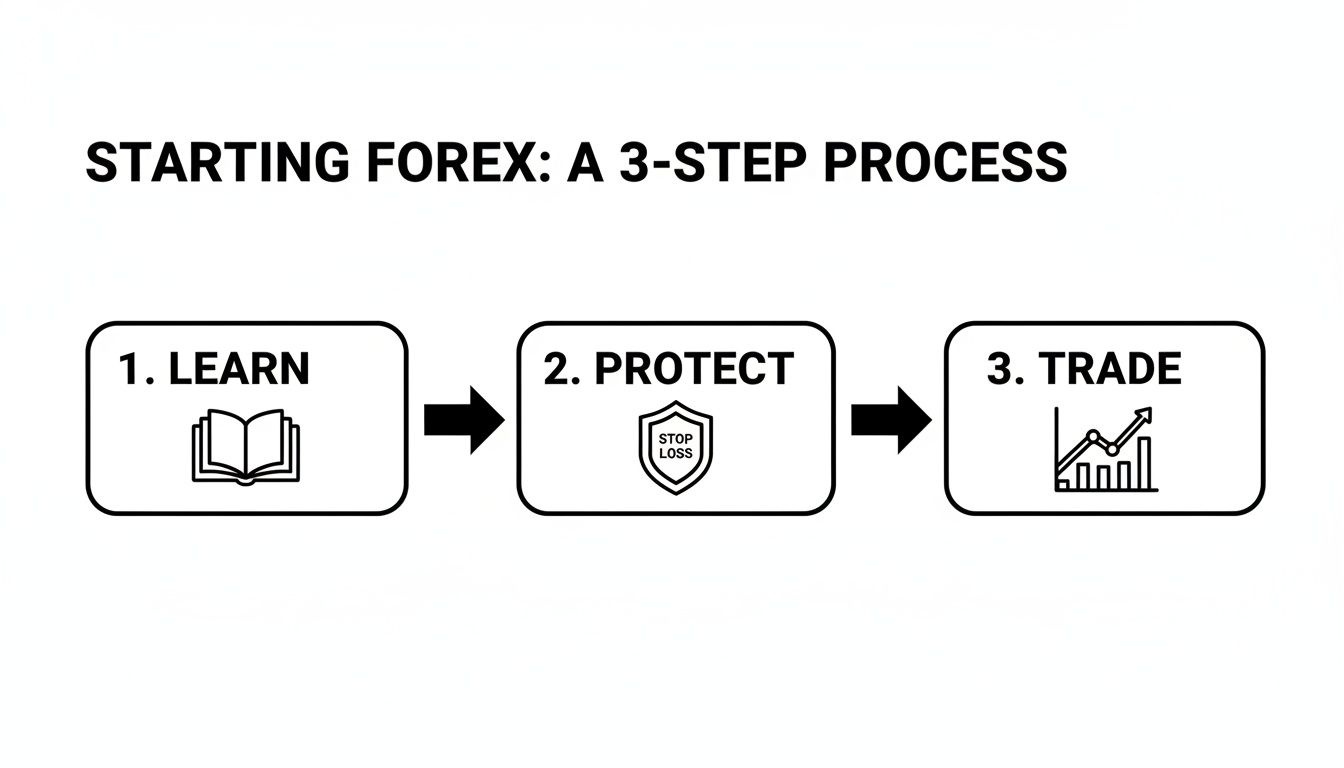
This really sums it up: learn the ropes, protect your capital, and then you're ready to actually trade.
Choosing Your Account Type
Brokers usually offer a menu of account types, but for newcomers, it really comes down to a choice between two: Standard and ECN.
| Account Type | Best For | Key Feature | Cost Structure |
|---|---|---|---|
| Standard Account | Beginners | Simple, all-in-one pricing | Costs are built into the spread (the difference between the buy and sell prices). |
| ECN Account | Experienced Traders | Direct market access, tighter spreads | Charges a flat commission per trade on top of very low spreads. |
For most people just starting out, a Standard account is the way to go. The pricing is straightforward because the broker's fee is just part of the spread. It's much easier to keep track of your costs without having to factor in separate commissions on every trade.
Once you have more experience, you might find that an ECN account's raw spreads and fixed commission structure works out cheaper for your trading style.
My Advice: Keep it simple at the start. Go with a Standard account. You can always switch to a more advanced account later on as your skills and confidence grow.
Funding Your Account in South Africa
The last step before you can trade is getting money into your account. Here in South Africa, the easiest and most secure way is a simple local bank transfer (EFT). Thanks to improvements made by the South African Reserve Bank (SARB), our electronic payment systems are excellent. This accessibility has been a key factor in the growth of the local forex market, which is now estimated to be worth USD 3,861.60 million in 2024.
Most FSCA-regulated brokers have South African bank accounts. This is a huge plus because you can transfer Rands directly. No need for complicated international wire transfers or paying currency conversion fees just to get your capital ready. It's fast, cheap, and simple.
Once your account is funded, you’re all set to place your first trade.
Getting Your First Trading Strategies Off the Ground
Okay, your account is live and funded. Now for the exciting part: learning how to actually trade. Before you even think about putting real money on the line, your broker's demo account is your best friend. Seriously.
Think of it as a flight simulator for forex. You get to practise placing trades, testing ideas, and getting a feel for the market's pulse, all with virtual money. This isn't just about learning which buttons to press. Use this time to see how different currency pairs move and, crucially, to make mistakes without paying for them. Treat your demo account like it's the real deal.
The Two Lenses of Market Analysis
Every single trading decision you'll make boils down to some form of analysis. While the strategies can get incredibly complex, they almost all spring from two core schools of thought: fundamental and technical analysis. The sharpest traders I know don't just pick one; they use a bit of both to build a complete picture.
So, what's the difference?
- Fundamental analysis is all about the "why." It's the big-picture stuff—a country's economic health, interest rate policies, and political climate.
- Technical analysis is the "when." It ignores the news and focuses entirely on price charts, believing that all information is already baked into the price and that patterns tend to repeat themselves.
Let's look at how you can actually use these in the real world.
Reading the Economic Tea Leaves: Fundamental Analysis
As a business owner, you're already doing a form of fundamental analysis. You keep an eye on interest rates, inflation, and growth because they hit your bottom line. In forex, you’re just taking that same mindset and applying it to entire countries.
For a South African business, here are a few things to watch like a hawk:
- SARB Interest Rate Decisions: When the Reserve Bank raises rates, it can attract foreign capital, which often strengthens the Rand.
- Inflation (CPI): High inflation is a currency killer. It eats away at its purchasing power.
- GDP Growth: A healthy, growing economy is usually a good sign for its currency.
Here's a practical example: Let's say your company exports wine to the US and your invoices are in US dollars. You see reports that the US Federal Reserve is about to hike interest rates to fight inflation. That's a huge fundamental signal. A US rate hike will likely make the dollar (USD) stronger against the Rand (ZAR). Armed with that insight, you might delay converting your USD revenue back into Rands, hoping for a better exchange rate that pads your profit margin.
Using Charts to Time Your Moves: Technical Analysis
While fundamentals give you a reason to trade, technical analysis helps you pick your moment. It’s a visual game, all about spotting trends and patterns on price charts to get a sense of where things might go next.
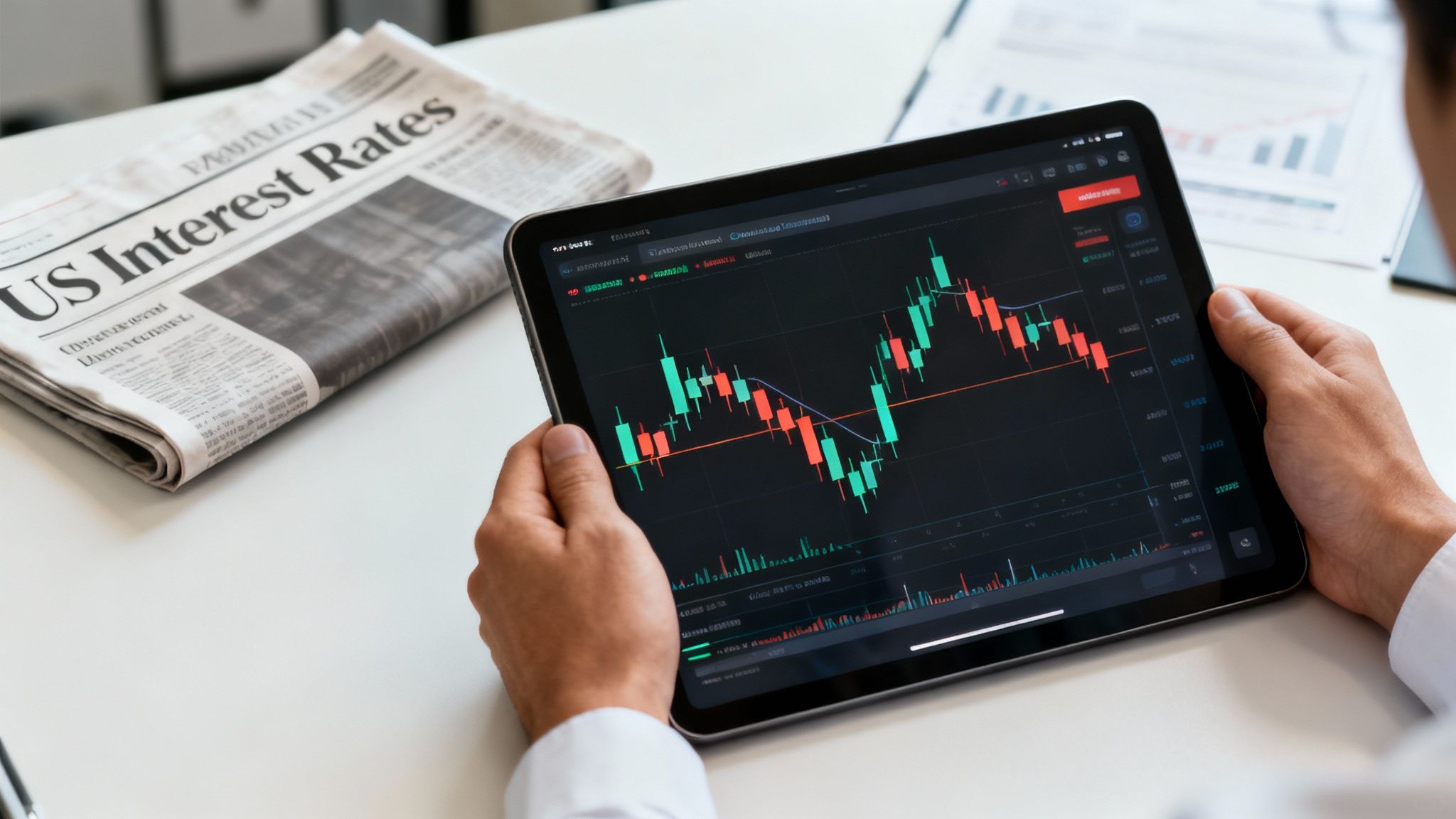
Learning the basics of reading charts is a foundational skill. If you're starting from scratch, a great place to begin is a guide like Investogy's on Technical Analysis for Beginners, which breaks down the core concepts without getting too complicated.
Technical traders have a whole toolkit, but most of it revolves around a few key ideas:
- Trends: Is the price heading up (uptrend), down (downtrend), or just chopping sideways? The oldest rule in the book is often the best: trade with the trend.
- Support & Resistance: These are simply price levels where a currency has historically stalled or reversed. Support acts like a floor, and resistance acts like a ceiling. A common tactic is to look for buying opportunities near support and selling opportunities near resistance.
- Indicators: These are just calculations based on price action that are plotted on your chart to give you signals. You’ll hear about things like Moving Averages or the Relative Strength Index (RSI) a lot.
The real power comes when you blend the two. You might use fundamental analysis to conclude that the Eurozone economy is looking strong, making the EUR/USD pair a potential buy. Then, you'd switch to your charts and use technical analysis to find the perfect entry point—maybe waiting for the price to pull back and bounce off a key support level. This balanced approach stops you from trading on gut feelings and starts you on the path to making informed, well-timed decisions.
Building Your Trading Plan and Managing Your Risk
Okay, let's talk about the single biggest reason most new traders fail. It’s not because they picked the wrong strategy. It’s because they jumped in without a plan and let their emotions run the show.
Success in the forex market isn't about lucky guesses or gut feelings; it’s built on structure, discipline, and having a set of rules you follow religiously. The moment you start treating your trading like a business is the moment you put yourself on the path to longevity.
This all starts with a written trading plan. Think of it as the business plan for your market activities. It’s a simple document that outlines what you want to achieve, how you’re going to do it, and—most importantly—how you'll protect your capital when things go sideways.
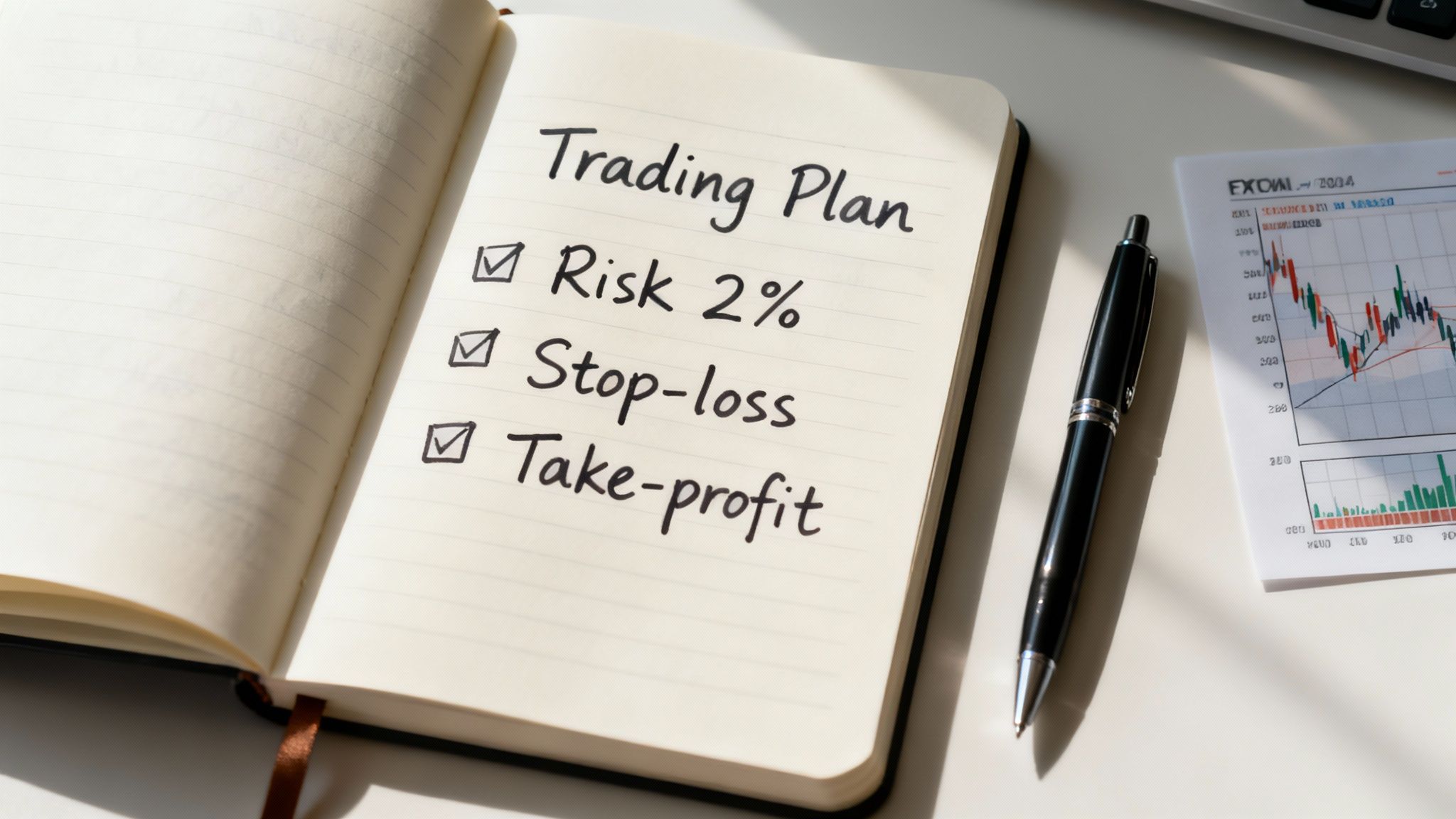
It doesn’t need to be some 50-page thesis. It just needs to be clear, written down, and followed without exception.
Defining Your Trading Rules
Your trading plan is your personal rulebook. Its main job is to take emotion out of the equation and force you to be consistent, which is absolutely vital when real money is at stake. While every trader’s plan will look a bit different, it must cover these core areas.
Your plan needs to clearly state:
- Your Goals: What are you actually trying to accomplish? Are you hedging currency risk for your import business, or are you aiming for a specific percentage return each month? Be specific and, more importantly, be realistic.
- Currency Pairs: Which pairs will you trade? When you're starting out, it’s a smart move to stick to just one or two major pairs, like USD/ZAR or EUR/USD. Trying to watch everything at once is a recipe for getting overwhelmed.
- Trading Strategy: What exact signals will prompt you to enter a trade? An example might be, "I will only buy EUR/USD if the price bounces off the 50-day moving average and the RSI is below 30." No signal, no trade. Simple.
- Exit Rules: This is crucial. How will you get out of a trade? This covers both your profit target and your maximum acceptable loss, and it has to be decided before you even click the "buy" or "sell" button.
This framework turns trading from a reactive gamble into a proactive, systematic process. It's the discipline you need to navigate the market's inevitable ups and downs without making impulsive, costly mistakes.
The Cornerstone of Survival: Risk Management
I can’t stress this enough: the most important part of your plan is risk management. This is how you protect your trading account from a catastrophic loss and ensure you can stick around long enough to actually become profitable. Without it, even the best strategy in the world can be wiped out by one or two bad trades.
The most fundamental rule here is position sizing. You must decide how much of your capital you're willing to risk on a single trade. A widely accepted rule of thumb for beginners is to never risk more than 1% to 2% of your account balance on any one position.
Say you have an R20,000 trading account. A 2% risk limit means the absolute most you can lose on a single trade is R400. This approach ensures that a string of losses—which will happen to every single trader—doesn't blow up your account.
This principle forces you to focus on capital preservation first and profits second. That's how professionals stay in the game.
Using Essential Risk Management Tools
Your trading platform provides two critical tools to enforce your risk rules automatically: the stop-loss order and the take-profit order. Using them on every single trade you take is non-negotiable.
A stop-loss is an order you set with your broker to automatically close a losing trade once it hits a certain price. It’s your safety net. A take-profit order does the opposite, automatically closing a winning trade at your predefined target.
Let’s walk through a practical example. Imagine you decide to buy the USD/ZAR pair at 18.50, expecting it to go up. Your plan dictates a 2% risk limit on your R20,000 account (R400) and a goal of making at least double your risk.
- You would place a stop-loss order at a price like 18.40. If the market turns against you and hits this level, your position is closed automatically. Your loss is capped at the amount you planned for.
- At the same time, you place a take-profit order up at 18.70. If the trade moves in your favour and reaches that price, your position is closed, and your profit is locked in.
These tools are the ultimate expression of trading discipline. They remove the temptation to bend your rules in the heat of the moment when fear or greed tries to take over.
Getting to grips with forex trading isn't just about reading charts and predicting market moves. For any South African business, it's equally important to understand the local financial landscape, which means getting familiar with the South African Revenue Service (SARS) and the South African Reserve Bank (SARB). These aren't just bureaucratic boxes to tick; they’re fundamental to trading legally and managing your finances effectively.
Any money you make from forex trading is seen as taxable income by SARS. It’s absolutely critical to keep detailed records of every single trade—your entry and exit points, the currencies you traded, and the final profit or loss. These profits get added to your business’s annual income and are taxed at the relevant rate. The good news is that any losses can usually be offset against your gains, which can help lower your overall tax bill.
Understanding SARB Exchange Controls
Beyond tax, you also need to be aware of the SARB's exchange controls. These rules exist to manage the flow of money moving in and out of South Africa and are designed to keep our financial system stable. For your business, this means knowing the allowances and reporting rules when you send capital offshore to fund a trading account or when you bring your profits back home.
Getting this right is non-negotiable. While using an FSCA-regulated broker makes it easier to fund your accounts locally in ZAR, having a solid grasp of the exchange control framework is vital for staying compliant, particularly as your trading or international business operations grow.
Key Takeaway: Don't leave tax and compliance for later. Set up a solid tracking system for all your trades from day one. It’s also wise to chat with a tax professional who knows the financial markets—it can save you a world of trouble and make sure you’re always on the right side of SARS.
Connecting Forex Trading to Your Business Operations
This is where your forex knowledge becomes a powerful tool for your actual business. Understanding how currencies move can directly shield your company's cash flow from volatility. Every time you pay an international supplier, run payroll for overseas staff, or get paid by a client abroad, you're exposed to currency risk.
For South African businesses, a sharp forex strategy can be a great way to hedge against trade imbalances. With our national exports ($121,616 million) running just slightly ahead of imports ($111,880 million), even small currency swings can eat into already thin margins. The market's recent growth has been helped by better digital infrastructure and SARB reforms that have slowly eased capital flow restrictions. If you want to dive deeper, you can read more about these forex trading statistics to see the full picture. All this means it’s easier than ever for businesses to take control and manage their finances proactively instead of just accepting whatever rate the bank gives them on the day.
Modern Solutions for FX Management
The old way of handling international payments through your bank is often riddled with hidden costs that quietly chip away at your profits. Banks typically bake their fees into the exchange rate by adding a spread or markup to the real market rate. On top of that, SWIFT fees add another layer of expense.
This is where modern financial platforms are really making a difference for CFOs and business owners. Solutions like Zaro are built to be transparent and efficient, which has a direct, positive impact on your bottom line. By giving you access to the real, mid-market exchange rate with zero spread, these platforms get rid of the hidden markups that inflate your costs.
Essentially, it means you can fund your international accounts, pay suppliers, or bring home export revenue at the true spot rate, without the unpredictable costs of the traditional banking system.
Comparing Traditional Bank FX with the Zaro Platform
To see the real-world difference, let's compare the costs and features of a conventional international payment with a modern fintech solution.
| Feature | Traditional Banks | Zaro Platform |
|---|---|---|
| Exchange Rate | Offers a marked-up rate (includes a hidden spread) | Provides the real, mid-market exchange rate with zero spread |
| Transfer Fees | Often charges high SWIFT fees for international payments | No SWIFT fees, resulting in lower transaction costs |
| Transparency | Costs can be opaque and difficult to predict | Fully transparent pricing with no hidden charges |
| Efficiency | Slower settlement times due to multiple intermediary banks | Faster, more direct transfers that improve cash flow |
For any finance team, making this switch is a game-changer. It takes you from a reactive, high-cost process to a proactive, cost-saving strategy. You get centralised control over all your international payments and clear visibility into every transaction. Suddenly, FX management is no longer just a necessary business cost—it becomes a strategic advantage that helps you protect your hard-earned capital.
Answering Your Top Questions on Forex Trading
As you gear up to put what you've learned into practice, a few practical questions are bound to pop up. Knowing the theory is one thing, but dealing with the real-world financial details is another. Here are some straightforward answers to the questions we hear most often from South African business owners, designed to help you clear those final hurdles.
How Much Money Do I Really Need to Start?
This is the big question, isn't it? The answer really hinges on what you’re trying to achieve. You’ll see brokers advertising accounts from as little as R1,500, but in reality, that’s not a practical starting point for learning.
For an individual getting a feel for the markets, a more realistic starting capital is somewhere between R5,000 and R15,000. This gives you enough breathing room to size your trades properly and absorb the inevitable losses that come with the learning curve, all without blowing up your account.
Now, for a business looking to hedge against currency risk, the capital needed is a completely different conversation. It’s tied directly to the value of the international payments you need to secure. The golden rule is to start small to get comfortable with the process, then scale up as your confidence and business needs grow. Never start with capital your business can't afford to lose.
A Quick Tip from Experience: Don't mistake the minimum deposit for the ideal starting capital. You need enough funds to stick to a sensible 1-2% risk rule per trade. Trading with too little money often forces you into taking oversized risks just to see a meaningful return, which is a recipe for disaster.
Is Forex Trading Legal in South Africa?
Absolutely. Forex trading is perfectly legal and is well-regulated in South Africa. The non-negotiable rule here is that you must use a broker licensed by the Financial Sector Conduct Authority (FSCA). Think of this as your most critical safety check.
The FSCA’s oversight forces brokers to meet strict financial and ethical standards, like keeping client money in separate bank accounts. This is a crucial protection for your business's capital. Before you even think about depositing funds, spend five minutes on the official FSCA website to verify the broker’s licence number. It’s a simple step that could save you a world of trouble.
What’s the Best Currency Pair to Start With?
When you’re just starting out, it’s wise to stick to the main stage and avoid the more obscure, "exotic" pairs. The major currency pairs are where you want to be, simply because they have the most trading activity (liquidity) and tend to be less erratic.
- USD/ZAR: This is the natural starting point for any South African. Its movements are directly linked to our local economy, news cycles, and SARB announcements, which makes it far more intuitive to follow.
- EUR/USD: This is the most traded currency pair on the planet. That means incredible liquidity and, usually, very tight spreads, which keeps your trading costs down.
- GBP/USD: Another heavyweight pair that reacts predictably to economic news from the UK and the US, offering plenty of clear trading opportunities.
These pairs are generally easier to analyse and their behaviour is more predictable, making them the perfect training ground as you build your skills.
How Does SARS Tax Forex Profits?
In South Africa, any profit you make from forex trading is considered income and, yes, it’s taxable. The South African Revenue Service (SARS) expects you to declare these earnings.
Your net profit from trading gets added to your business’s (or your personal) annual income and is then taxed at your applicable marginal rate. It is absolutely essential to keep detailed records of every single trade—both the wins and the losses. Why? Because you can often offset your losses against your gains, which can seriously reduce your final tax bill. The rules can be specific, so we highly recommend chatting with a registered tax professional to make sure you’re fully compliant.
Managing international payments and shielding your business from currency swings isn't just good practice; it's a strategic necessity. Zaro provides the tools to put you in control, with real exchange rates, zero spread, and no hidden fees. It’s time to move from simply reacting to currency markets to proactively managing them in a way that saves you money. Discover how Zaro can transform your cross-border payments.