For any South African business with global ambitions, sending money across borders is a non-negotiable part of daily operations. But it's a world away from a simple local EFT. Think of it less like a direct deposit and more like an international courier service for your cash—it has to navigate different currencies, banking systems, and a whole lot of red tape to get where it's going.
Getting this right is crucial. A smooth international money transfer means your suppliers are paid on time, your global team is happy, and your business keeps moving forward.
What an International Business Transfer Really Involves
At its core, an international money transfer is the process of moving funds from your South African Rand (ZAR) account to someone in another country, who will likely need to receive it in their own currency, like US Dollars, Euros, or British Pounds. It’s the financial plumbing that makes global trade possible, allowing you to buy raw materials from China, pay a software developer in Ukraine, or repatriate profits from an offshore subsidiary.
But here’s the catch: the money rarely travels in a straight line. It usually hops between several intermediary or "correspondent" banks before reaching its final destination. Each stop on this journey can add delays and, you guessed it, extra costs.
This roundabout route creates a few major headaches that every South African business needs to solve to protect its cash flow and bottom line.
The Three Big Hurdles Every Business Faces
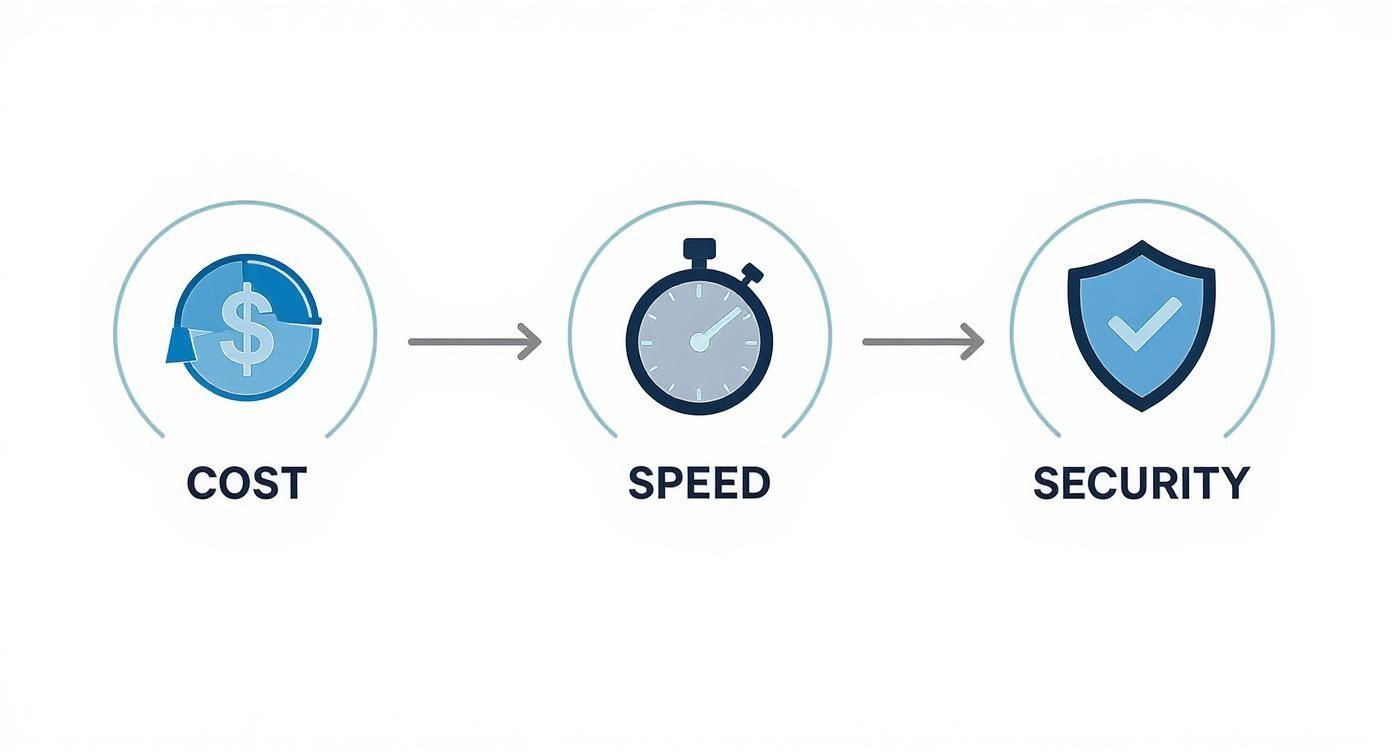
If you're managing international payments, you're constantly juggling three critical factors. Dropping the ball on any one of them can lead to shrinking profit margins, stalled supply chains, and frustrated international partners.
- The Real Cost: It's easy to focus on the upfront transfer fee, but the real damage often comes from hidden costs, especially the foreign exchange (FX) markup. A seemingly small 2% spread on the exchange rate can quietly siphon off thousands of Rands from a large supplier payment.
- The Need for Speed: In business, time really is money. A payment that arrives a few days late can halt a critical shipment from a supplier or damage the trust you have with your overseas contractors. Traditional bank transfers can take ages, leaving you in a state of uncertainty.
- The Compliance and Security Maze: Every cent that leaves South Africa is under a microscope. You have to comply with strict South African Reserve Bank (SARB) regulations, which means providing heaps of documentation to prove each payment is legitimate. On top of that, you have to keep the funds safe from ever-present fraud risks.
An effective international payment solution isn't just about getting money from point A to B. It’s about doing it cheaply, quickly, and securely—every single time. It gives your business a predictable and reliable financial engine for its global operations.
Ultimately, mastering international payments isn’t just a back-office finance task anymore. It’s a genuine strategic advantage that directly impacts your company’s ability to move quickly, stay profitable, and grow in a connected world.
Let's break down the core components you need to get right every time.
Key Factors in an International Business Transfer
This table summarises the main elements a business must get right when sending money internationally.
| Factor | What It Means for Your Business | Key Consideration |
|---|---|---|
| Exchange Rate | The single biggest cost factor. This is the rate at which your ZAR is converted into the recipient's currency. | Are you getting the real mid-market rate, or is there a hidden markup (spread) that's costing you money? |
| Transfer Fees | The upfront administrative fee charged by the provider. It can be a flat fee or a percentage of the transfer amount. | Look for transparent, low flat fees. High percentage-based fees can be costly for large-value transactions. |
| Transfer Speed | The time it takes for the funds to arrive in the recipient's account, from the moment you send it. | Can your provider guarantee a delivery time? Traditional banks often take 3-5 business days, while modern fintechs can do it in hours. |
| Compliance | Meeting all regulatory requirements from bodies like the South African Reserve Bank (SARB) and FIC. | Does your provider make it easy to submit required documents (like invoices and BoP forms) and manage your foreign investment allowance? |
| Security | Protecting your funds from fraud, cyber threats, and operational errors during the transfer process. | Is your provider regulated? Do they use multi-factor authentication and other modern security protocols to safeguard your account? |
| Recipient Details | Ensuring you have all the correct banking information for the person or company you are paying. | Incorrect details (like SWIFT/BIC codes or account numbers) are a common cause of failed or delayed payments. |
Getting a clear view of all these factors before you hit "send" is the difference between a smooth, cost-effective payment and one that causes financial and operational headaches.
The True Cost of Sending Money Abroad
When you send money internationally, the fee you see advertised is often just the tip of the iceberg. The real cost is usually tucked away in complex calculations and opaque charges that quietly chip away at your funds. For any South African business working globally, getting a handle on these hidden expenses is crucial for protecting your profit margins.
The two main culprits that inflate the cost of your transfer are the upfront fees and, more significantly, the foreign exchange (FX) spread. While a flat fee seems straightforward enough, the FX spread is where the real damage is often done.
Unpacking the Hidden Foreign Exchange Spread
The foreign exchange spread is simply the difference between the rate a provider buys currency at and the rate they sell it to you. Think of it as their built-in, often hidden, profit margin. The genuine, baseline rate is called the mid-market rate—this is the midpoint between what buyers and sellers are willing to trade a currency for on the global market. It’s the rate you see on Google or a Bloomberg terminal, but it’s almost never the rate you’re actually offered.
Let's put this into a real-world scenario. Say your business needs to pay a supplier an invoice for $10,000 USD.
- The mid-market rate is R18.50 to $1 USD.
- In a perfect world, the transfer should cost you exactly R185,000.
- But your provider quotes you a rate of R18.90 to $1 USD.
At this marked-up rate, your actual cost jumps to R189,000. That R4,000 difference is the provider's profit, taken directly from your bottom line. A seemingly tiny percentage difference has ended up costing you far more than a typical flat transfer fee ever would.
The FX spread is one of the most significant yet least transparent costs in an international money transfer. Always compare the offered rate to the mid-market rate to see how much you're truly paying.
The Unpredictable Journey Through the SWIFT Network
Beyond the exchange rate, the very system used for most traditional bank transfers adds another layer of cost and complexity. Most banks rely on the SWIFT (Society for Worldwide Interbank Financial Telecommunication) network to send payment instructions across borders.
But the money doesn't just go from point A to point B. It’s relayed through a chain of intermediary banks, especially when you're sending funds between smaller banks or less common currency routes.
Each of these intermediary banks in the SWIFT chain can take its own processing fee right out of the money you're sending. This creates a few big problems:
- Costs are unpredictable: You often have no idea how many banks will handle the payment or what they'll charge.
- The recipient gets less: Because fees are deducted from the principal amount, your supplier might receive less than you intended. This can lead to short-paid invoices and strained business relationships.
- Transfers are slower: Every stop on the journey adds time, turning a standard 2-3 day transfer into one that could easily take a week or more.
This issue is especially painful in certain payment corridors. For example, the channel between South Africa and Zimbabwe is vital for regional trade, but transfers are notoriously slow and expensive. With average remittance costs hovering around 12.7%—way above the G20's 3% target—it’s clear how these network inefficiencies directly harm economic activity. You can explore a full analysis of these regional payment challenges on imf.org.
Ultimately, the old-school model for an international money transfer forces businesses into a tough spot. You pay an obvious fee upfront, lose more on a poor exchange rate, and then watch as even more funds get shaved off by unknown banks along the way. This mix of visible and hidden costs makes it incredibly difficult to budget accurately and directly eats into your profitability.
Navigating South African Compliance Requirements
If your South African business trades globally, you know that compliance isn’t just a box-ticking exercise. It's the very foundation of every single international money transfer you make. Regulators watch every cent that crosses the border to clamp down on money laundering and maintain economic stability. Get it wrong, and your payments get blocked. Simple as that. The result? Operational chaos and some very unhappy suppliers.
The main player here is the South African Reserve Bank (SARB). SARB writes the rulebook for all foreign exchange transactions, and the banks and payment providers you use are tasked with enforcing it. The whole system is built on one non-negotiable principle: every single payment leaving the country must have a legitimate, provable reason behind it.
Think of it this way: you can't just send R1 million overseas on a whim. You have to show exactly why you're sending it – to pay an invoice for imported goods, to settle a contract with a software provider in Europe, or for some other lawful business purpose.
The Three Pillars of South African FX Compliance
To make sure your payments sail through smoothly, you need to get your head around three core compliance pillars. These are the checkpoints every transaction has to clear.
- Financial Intelligence Centre Act (FICA): This is South Africa's cornerstone for fighting financial crime. It forces financial institutions to know who their clients are. For a company, this is called Know Your Business (KYB).
- A Legitimate Underlying Transaction: This is the big one for SARB. You have to prove the reason for your payment with solid documentation. The classic example is a supplier’s invoice.
- Balance of Payments (BoP) Reporting: Every time money moves in or out of South Africa, it has to be categorised and reported to SARB. This data gives the government a bird's-eye view of capital flows and helps them manage the economy.
Stumble on any one of these, and your payment hits a wall. The responsibility to get all the information right, and on time, falls squarely on your shoulders.
Understanding Know Your Business (KYB)
Before you can even think about sending money, your payment provider needs to verify that your business is legitimate. The KYB process is designed to make sure your company is a real, operational entity and not just a shell for shady dealings. Good record-keeping is your best friend here.
You’ll be asked for a fairly standard set of documents:
- Company Registration Documents: Your CIPC certificate (like a CoR 14.3) to show you're legally registered.
- Proof of Business Address: A recent utility bill or a valid lease agreement in your company’s name.
- Director and Shareholder Information: Certified ID copies and proof of address for all directors and anyone who owns 25% or more of the company.
- Authorisation Letter: A formal letter on a company letterhead stating who has the authority to make payments on behalf of the business.
Getting your KYB pack sorted and approved before you're staring down an urgent payment deadline is one of the smartest things you can do. A bit of prep work now will save you a world of pain later.
Proving the Purpose of Your Payment
Once your business is verified, the focus shifts to each individual transaction. This is where you have to prove that "legitimate underlying transaction" we talked about.
The documents you need will depend on the BoP category you choose for the payment. For instance, if you're paying for imported goods, you’ll have to provide the commercial invoice from your supplier. That invoice needs to be crystal clear, showing the seller's details, your company's details, what you bought, and the exact amount owed.
Without this paper trail, your payment provider is legally barred from processing the transfer. It’s not their policy; it's the law. Having these documents ready and correct is just a standard part of the workflow for any South African company paying international suppliers.
Why Your Business Can't Ignore Global Payments
It’s one thing to understand the theories behind exchange rates and compliance, but it’s another to see them play out in your daily business operations. For South African companies with global ties, getting international money transfers right isn't just an admin task—it's the very engine that powers your growth, secures your supply chain, and gives you access to talent from around the world.
Think about it: every cross-border payment you make tells a story about your business strategy. Are you a retailer importing electronics from Asia? A tech startup hiring developers in Europe? Your ability to move money reliably and affordably is what gives you a competitive edge.
Let's break down the most common situations where South African businesses live and breathe global payments.
Paying International Suppliers
This is the classic scenario. Your business relies on goods or raw materials from manufacturing hubs like China, Germany, or the United States. That means you're constantly settling invoices in foreign currencies, like USD or EUR.
Success here comes down to two things: speed and cost. A payment that arrives late can halt a production line or delay a critical shipment, throwing your entire supply chain into chaos. Then there's the ever-present risk of currency volatility. If the Rand takes a sudden dip between the time you get an invoice and the moment you pay it, your costs can instantly shoot up, eating away at the profit margins you've worked so hard to build.
Managing a Global Workforce
Today's workforce isn't limited by geography. More and more South African companies are tapping into a global talent pool, hiring remote employees and freelancers from everywhere—from software engineers in Eastern Europe to marketing gurus in the UK. This is a brilliant strategy for finding the best skills, but it comes with a new layer of payroll complexity.
You have to pay these contractors in their local currency, and you have to do it on time, every single time. This means juggling multiple currencies, dealing with different banking systems, and figuring out the tax and compliance rules for each person you hire. For businesses looking to scale their global team without the headache, learning what an Employer of Record is can be a game-changer, as they handle much of this complexity for you.
A smooth payment experience is non-negotiable for keeping top international talent. If freelancers are constantly chasing you for payment or getting less than they expected because of hidden fees, they won't stick around for long.
Repatriating Funds to South Africa
For businesses that export or serve international clients, the challenge is flipped. You've earned revenue in currencies like USD, GBP, or EUR, and now you need to bring that money back home to South Africa to cover local operational costs—salaries, rent, and everything else.
The name of the game here is protecting the value of that revenue. When you convert your foreign earnings back into ZAR, the goal is to lose as little as possible to bad exchange rates and hefty receiving fees. Every percentage point you lose in that conversion is a direct hit to your company's bottom line. Managing this inward flow of money effectively is crucial for healthy cash flow.
While these business payments are vital for trade, it's worth noting the bigger picture. South Africa's remittance market is heavily weighted towards personal transfers going out of the country, which accounted for about 64% of the market's revenue in 2024. This is largely driven by individuals sending money home to support their families. Still, business-to-business transfers are a critical piece of the cross-border puzzle.
Each of these scenarios highlights a simple truth: getting global payments right is no longer a "nice-to-have." It's a core skill your business needs to survive and thrive in today's connected world.
How to Mitigate Risks in International Transfers
Sending money across borders involves more than just hunting for the lowest fee. You're navigating a complex global financial system, and it’s critical to protect your business from the risks that come with it. From unpredictable currency swings to clever fraud schemes, a poorly managed international money transfer can quickly eat into your profits and even damage your reputation.
The good news is that by understanding the threats, you can put practical strategies in place. This will safeguard your cash flow and make sure your payments get where they need to go, securely and on time.
Most of the risks you'll face fall into three buckets: exchange rate volatility, operational hiccups, and straight-up fraud. Each needs its own game plan.
Tackling Exchange Rate Volatility
The foreign exchange market is always on the move. For a South African business paying an invoice in dollars or euros, this constant fluctuation is a huge headache. The ZAR/USD rate can shift dramatically in a few days—sometimes even a few hours.
Imagine you get an invoice, but by the time you pay it a week later, the Rand has weakened. Suddenly, that same dollar amount costs you significantly more in Rands. This kind of volatility makes budgeting and forecasting a real challenge.
A volatile exchange rate is a hidden cost that can turn a profitable deal into a loss. The key isn't to try and predict the market, but to remove the uncertainty from the equation.
One of the best tools for the job is a Forward Exchange Contract (FEC). An FEC lets you lock in an exchange rate today for a payment you need to make in the future, even up to 12 months from now. It gives you complete certainty on the ZAR cost of your transaction, shielding your business from any nasty surprises if the currency moves against you.
This means you can plan your finances knowing exactly what your international payments will cost, no matter what the market does.
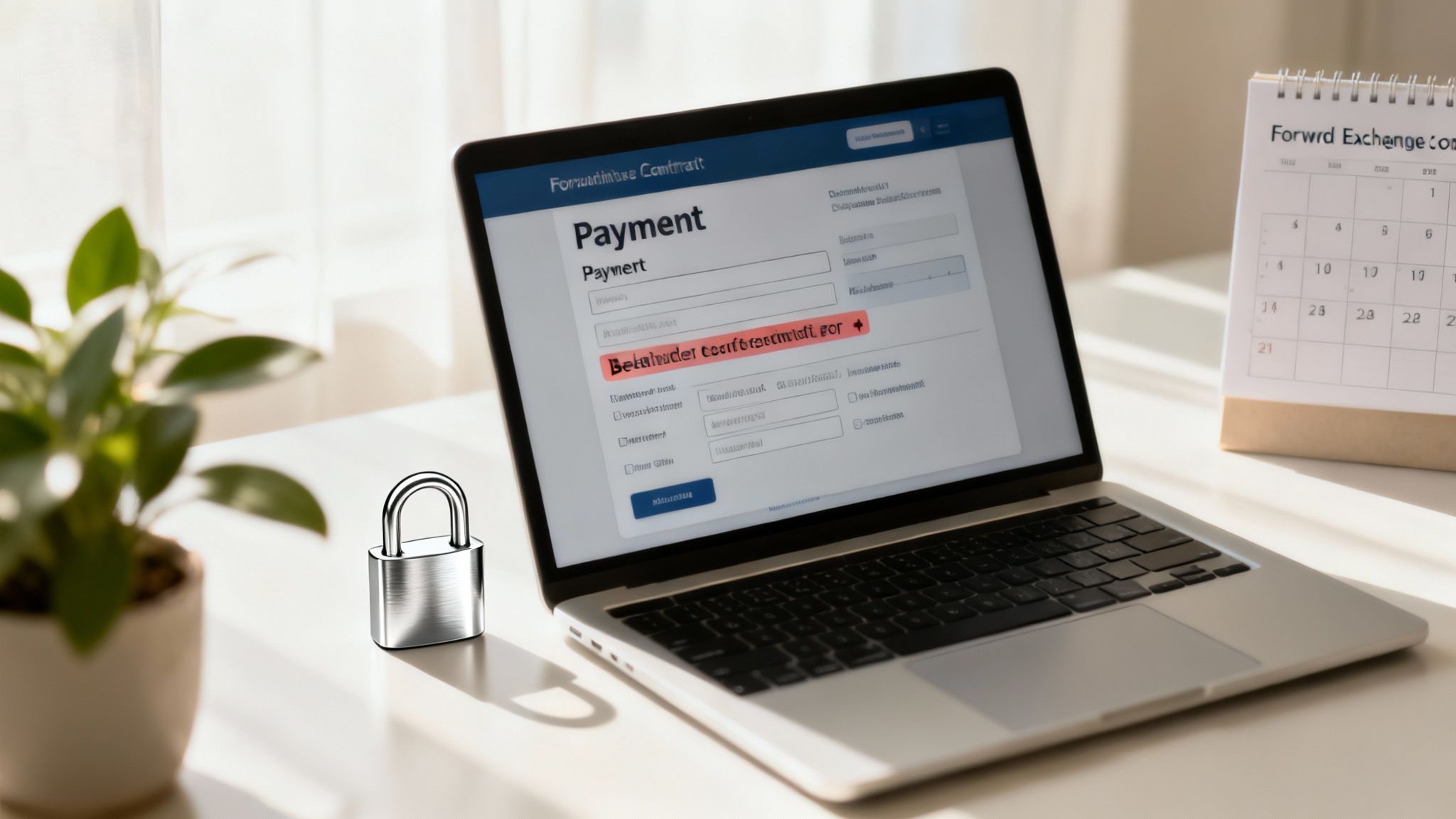
Ultimately, FECs give you cost certainty, which is a massive advantage for any business managing payments abroad.
Preventing Payment Errors and Delays
It might not be as dramatic as a market crash, but a simple typo is one of the most common reasons international payments fail. One wrong digit in an account number or an incorrect SWIFT/BIC code can send your money into a black hole. The payment gets rejected, delayed, or worse, lands in the wrong person's account, kicking off a long and frustrating recall process.
To cut down on these operational risks, you need a rock-solid verification process:
- Double-Check All Details: Always confirm the beneficiary’s banking details directly from an official invoice or communication. Never work from memory.
- Use Beneficiary Lists: For suppliers you pay regularly, save and verify their details once. This avoids having to re-enter everything from scratch and reduces the chance of errors.
- Confirm with the Recipient: For a large payment or the first time paying someone, it’s smart to send a small test amount first or simply pick up the phone to confirm the details before sending the full amount.
Defending Against Fraud and Security Threats
As digital payments have become the norm, so has sophisticated fraud. One of the biggest threats to watch out for is Business Email Compromise (BEC). This is where a fraudster impersonates a senior executive or a supplier over email, tricking someone on your finance team into sending money to a fraudulent account. These emails can look incredibly convincing.
Protecting your business takes a mix of smart technology and good old-fashioned human diligence. Always verbally verify any request to change payment instructions or add a new beneficiary. Use a phone number you know is correct—never trust an email alone.
It also pays to use a payment platform with strong security features. Look for things like multi-factor authentication (MFA) and segregated user permissions, which ensure no single person can authorise a payment without a second set of eyes on it.
Fintech Platforms vs Traditional Banks
For decades, if your South African business needed to send money overseas, you had one real choice: your bank. But that landscape has completely changed. A new wave of financial technology (fintech) companies has arrived, and they're not just offering a slightly better service—they're rewriting the rules of international payments.
This leaves businesses at a crossroads. Do you stick with the familiar, established high-street bank, or do you explore the more modern, technology-first alternative?
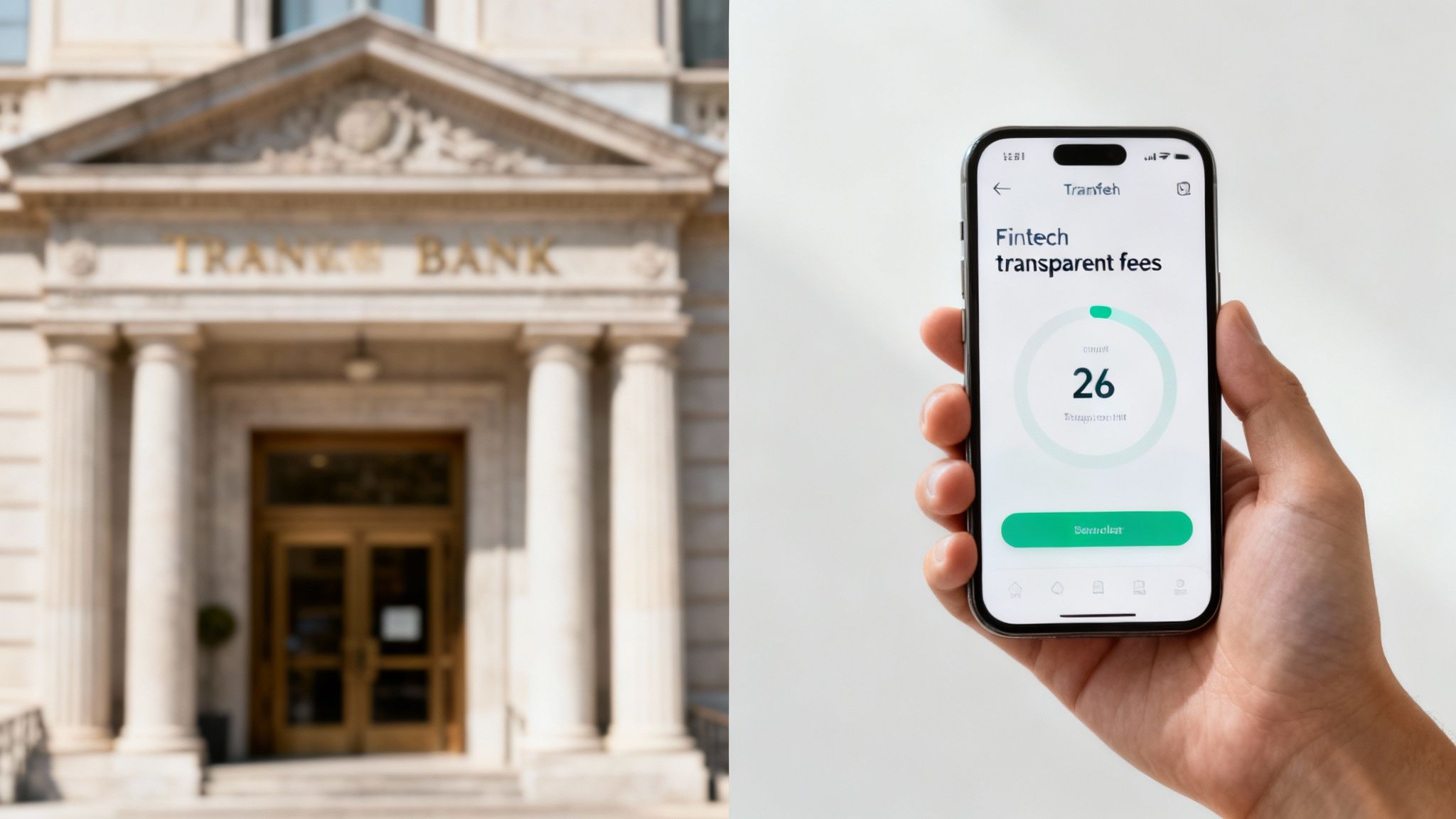
The old way, through traditional banks, often comes with some serious baggage. Think opaque fees buried in the exchange rate, settlement times that stretch for days thanks to the clunky SWIFT network, and an experience that still feels rooted in paperwork and branch visits. Fintechs were born out of frustration with this very system, and they’ve built their platforms from the ground up to fix these exact problems.
Speed and Automation
One of the biggest differences you'll notice is sheer speed. Fintechs leverage smart automation like straight through processing (STP) to move money with minimal manual intervention. By building more direct payment corridors that often sidestep the tangled web of intermediary banks, they can get your funds where they need to go in a fraction of the time.
This shift towards faster, digital channels is part of a much bigger trend in our region. Between 2016 and 2024, formal remittance outflows from South Africa to the SADC region exploded, growing from around R6 billion to over R19 billion. The volume of these transactions also shot up from 4.8 million to 15.7 million in the same timeframe—a move accelerated as more people and businesses embraced formal digital systems during the pandemic.
Transparency and Cost
This is where the difference becomes crystal clear. Banks have historically made a good portion of their profit from the foreign exchange spread—that hidden markup on the exchange rate. Leading fintechs, on the other hand, throw that model out the window.
Zaro gives you direct access to the real mid-market exchange rate with no spread. This means the rate you see is the actual rate we get. We don't hide our costs in the numbers; what you see is what you get, which is the single biggest way to cut the hidden cost of an international transfer.
By avoiding the complicated correspondent banking system, fintechs also eliminate those unpredictable intermediary bank fees that can mysteriously shrink the amount that lands in your recipient's account. The result is total cost certainty, which is crucial for protecting your profit margins.
For your business, this all adds up to a smarter, more efficient, and far more affordable way to handle global payments. It means better cash flow, less time wasted on admin, and ultimately, stronger relationships with your international suppliers, contractors, and partners.
A Direct Comparison
Let's put the two side-by-side. The table below breaks down the key differences to show how these two approaches stack up for a growing business.
Fintech Platforms vs Traditional Banks for International Transfers
| Feature | Traditional Banks | Fintech Platforms (e.g., Zaro) |
|---|---|---|
| Exchange Rate | Offers you a marked-up rate with a hidden spread, which costs your business more. | Provides the real mid-market exchange rate with zero spread. Simple and transparent. |
| Transfer Fees | Often includes high upfront fees and hidden intermediary (SWIFT) fees along the way. | Typically charges low, transparent fees with no SWIFT charges. |
| Transfer Speed | Slow. Payments usually take 2-5 business days because they rely on the SWIFT network. | Much faster. Payments often arrive within hours or on the same day. |
| User Experience | Can involve complex paperwork, trips to the branch, and clunky online portals. | A fully digital, user-friendly platform with simple document uploads and tracking. |
| Support | Support is often through generic call centres with little specialised knowledge. | Provides dedicated, expert support from a team that lives and breathes cross-border payments. |
The choice is becoming increasingly obvious. While banks offer familiarity, fintech platforms deliver the efficiency, transparency, and cost-savings that modern businesses need to compete on a global stage.
Got Questions? We’ve Got Answers.
When it comes to moving money across borders, a few questions pop up time and time again. Let's tackle the most common ones we hear from South African businesses, so you can handle your international payments with confidence.
These aren't just academic points; they're practical answers to the real-world hurdles you face with documentation, timing, and managing risk.
What’s the Single Most Important Document for an International Transfer?
If there’s one piece of paper you can't get wrong, it's the commercial invoice or the underlying service agreement. Think of it as the passport for your payment. The South African Reserve Bank (SARB) is very clear on this: every cent that leaves the country needs a legitimate reason, and this document is your proof.
It needs to spell out exactly what was bought or sold, who was involved, and the specific amount due. If that invoice is missing key details or looks dodgy, your payment will get stuck in compliance limbo. So, always get this sorted before you even think about hitting 'send'.
How Long Does a Standard SWIFT Transfer Really Take?
Going the traditional bank route with SWIFT? You should budget for 2 to 5 business days. But honestly, that’s just a guideline. Delays are part of the game.
What trips things up? A whole host of things:
- A public holiday in the destination country that you didn't know about.
- Major time zone differences messing with banking hours.
- A simple typo in the beneficiary’s bank details.
- Extra security checks from one of the many intermediary banks involved.
This is where newer fintech platforms really shine. They often sidestep the messy parts of the SWIFT network, using smarter payment rails to get the money there much faster, sometimes even on the same day.
Pro tip: If you're paying a critical supplier with a tight deadline, don't leave a SWIFT transfer to the last minute. Build in a buffer for potential delays to keep your supply chain running smoothly.
Can I Lock in an Exchange Rate for a Payment I Need to Make Later?
You certainly can. The tool for the job is called a Forward Exchange Contract (FEC). It lets you book today's exchange rate for a payment you plan to make anytime in the next 12 months.
This is a game-changer for budgeting and protecting your bottom line. An FEC takes all the guesswork out of the equation. You completely eliminate the risk of the Rand taking a dive and making your invoice way more expensive than you planned. It gives you something every business craves: cost certainty.
Ready to eliminate hidden fees and simplify your global payments? Zaro offers South African businesses access to real exchange rates with zero spread, ensuring you get the most out of every international money transfer. Learn more and get started today.