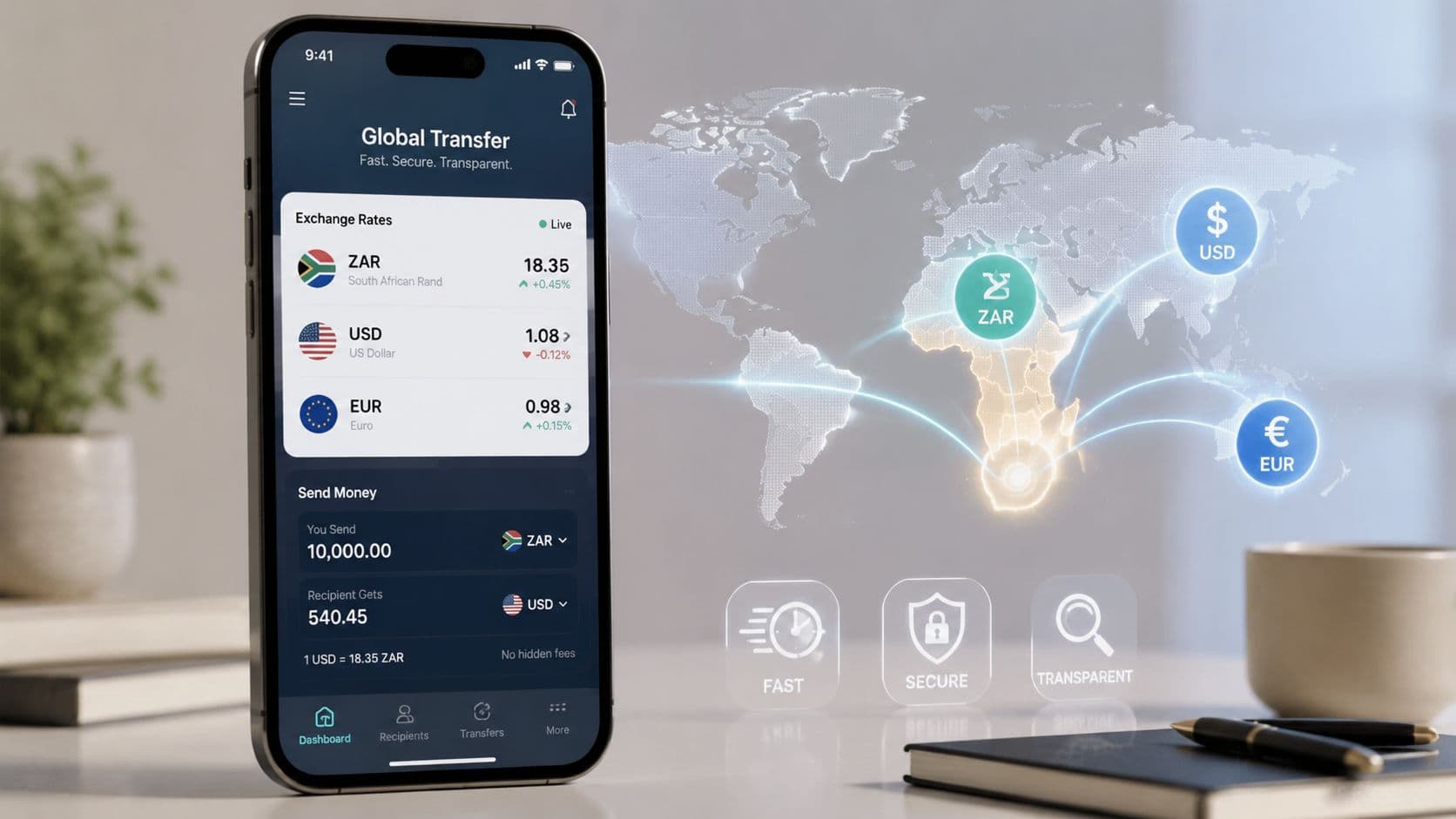
You approve a supplier payment. Treasury releases the funds. A few days later the supplier says the amount received is short. Your bank statement shows one fee, the FX rate looked passable at first glance, and yet the final landed amount still missed the invoice value.
That gap is where many South African SMEs lose money.
The problem usually isn't the transfer itself. It's the layers around it. A marked-up exchange rate, intermediary deductions, receiving-bank charges, and weak visibility before the payment leaves your account. Consumer content about an international money transfer app often focuses on convenience. A CFO cares about something else: what the beneficiary receives, what the business pays, and whether that difference was predictable before approval.
This matters more now because cross-border payment demand keeps rising. South Africa's personal remittances received grew to roughly US$1.2 billion in 2024 from about US$0.9 billion a decade earlier, according to World Bank data referenced by Bankrate. That isn't only a consumer trend. It reflects a broader environment where sending and receiving money across borders is becoming a normal operating requirement for importers, exporters, agencies, BPOs, and distributed teams.
The Hidden Costs in Your International Payments
A common finance mistake looks harmless at the start. A business owner compares two options and picks the bank because the stated transfer fee seems manageable. The payment goes out, the supplier receives less than expected, and finance then spends part of the week reconciling why the invoice is still outstanding.

That shortfall usually comes from costs that weren't visible in one place before the transfer was approved. The bank fee is only one line item. The exchange rate may include a spread. The payment may move through intermediaries. The receiving side may also deduct charges. By the time the funds land, the invoice value has changed without anyone in your business making a deliberate decision to accept that loss.
What finance teams often miss
An advertised fee is not the same as the full cost of payment. For South African firms paying foreign suppliers, the actual question is simple: how much ZAR leaves my business, and how much foreign currency lands with the beneficiary.
Three hidden cost buckets tend to matter most:
- FX markup: The provider offers a rate worse than the live market rate, and the spread becomes part of the transfer cost.
- Intermediary deductions: A payment routed through correspondent banks can lose value on the way.
- Receiving-bank charges: The supplier's bank may credit less than the invoiced amount.
Practical rule: If your provider can't show the all-in amount before you approve the payment, you're not controlling transfer cost. You're discovering it afterwards.
Why this has become a board-level issue
Cross-border payments used to sit in the background for many SMEs. Now they touch purchasing, payroll, revenue collection, and supplier relationships. If you import materials, invoice offshore clients, or pay remote contractors, poor transfer visibility affects margin and working capital.
That's why the business case for an international money transfer app has changed. It's not about having another app on a phone. It's about replacing a payment model that obscures total landed cost with one that shows the economics clearly before money moves.
Defining the Modern Money Transfer App
For a business, an international money transfer app isn't just a simpler remittance tool. It's a cross-border payments operating layer. The strong platforms don't just help you send funds. They help your finance team quote, approve, execute, reconcile, and audit payments with less guesswork.
A consumer app is usually built around one sender and one recipient. A business platform has to support internal controls. It needs multi-user access, approval logic, transaction history, document trails, and clear visibility over who initiated what and when.
What makes a business-grade platform different
A business-focused platform usually combines several functions that traditional banking often splits across channels, forms, and manual follow-up:
- Multi-currency account capability: Finance can hold or receive value in more than one currency instead of forcing immediate conversion every time.
- Centralised payment visibility: Teams see rates, fees, and status in one place.
- Role-based access: Treasury, finance operations, and management can work in the same environment without sharing one login.
- Clearer reconciliation: Payments, conversions, and account movements are easier to match against invoices and internal records.
That's the distinction. A proper international money transfer app for business isn't only about sending money faster. It's about giving the company more control over the payment lifecycle.
What it replaces in practice
Traditional banking still works for many firms, but the experience is often fragmented. The rate comes from one system or desk. The payment instruction sits elsewhere. Supporting documents travel by email. Final settlement details may only become clear after the transaction has already created a variance.
A modern platform compresses that process. It gives the CFO a clearer answer to operational questions such as:
| Business question | What you need from the platform |
|---|---|
| What rate are we getting? | A visible, current quote before approval |
| What will the beneficiary receive? | A clear estimate or confirmed payout amount |
| Who approved this payment? | User-level audit history |
| Can we support more than one team member? | Permissions and approval controls |
| What happened if a transfer was delayed? | Status tracking and reconciliation records |
If a tool is built only for one-off personal transfers, it usually breaks down the moment a finance team needs approvals, auditability, and predictable supplier settlement.
Why this matters in South Africa
South African businesses often operate with tighter sensitivity to FX movement than consumer senders do. A small pricing difference can affect inventory cost, contractor payouts, or the margin on exported services. That's why a business-grade international money transfer app should be evaluated as part of treasury operations, not as a convenience tool.
How These Apps Bypass Traditional Bank Fees
The old model is route-heavy. A bank transfer often travels through a chain of institutions before the recipient gets paid. Each handoff can add delay, deductions, or both. For a business payer, that means more uncertainty between the instruction you approve and the amount that arrives.
Modern transfer apps change the route.

Think of it like booking travel
A traditional wire resembles a multi-stop trip booked through several carriers. Your baggage may arrive, but every connection introduces delay and another opportunity for something to go wrong. A modern platform tries to book the closest thing to a direct route by using local payout rails where possible.
That matters because the transfer doesn't always need to move in the old, linear way finance teams are used to. The provider can accept funds on one side, convert at the quoted rate, and settle locally on the other side through a more efficient route. Fewer moving parts usually means fewer surprise deductions.
Why FX transparency is a technical design choice
Good pricing isn't just a commercial promise. It comes from architecture. The more capable transfer platforms separate the quoting function from the settlement function so the customer sees a usable FX price first, then the system finds the right payout path.
As Zymr's guide to transfer app architecture explains, modern platforms emphasise FX transparency by separating the quote engine from the payout orchestration layer. That design lets the provider lock a real spot rate for the user and then choose the most efficient local payout route, which reduces hidden cost and volatility compared with older bank-style systems.
What works and what doesn't
What works:
- Live FX quoting: The user sees a current rate rather than a vague indication.
- Rate locking: Once approved, the transfer isn't repriced mid-process without visibility.
- Dynamic routing: The platform can choose a cheaper or faster corridor based on actual payout conditions.
- Clear fee calculation: Charges are shown centrally rather than scattered across multiple institutions.
What doesn't work:
- Monolithic bank processes: One institution controls the customer relationship but not every leg of the payment route.
- Opaque conversion: Finance sees the amount sent, but not the true cost of the rate used.
- Manual exception handling: Teams discover settlement issues only after the beneficiary complains.
The cheapest-looking payment isn't always the cheapest route. The route determines the deductions. The rate determines the hidden margin. You need visibility into both.
For a CFO, that's the key shift. A strong international money transfer app doesn't merely lower a headline fee. It redesigns the payment path so there are fewer places for cost leakage to occur.
Key Business Benefits for South African SMEs
The commercial case comes down to four outcomes: lower cost, faster settlement, better forecasting, and tighter control. If a platform can't improve at least three of those, it's probably just repackaging the same old bank process with a nicer interface.
Lower cost where it actually counts
The clearest comparison is the gap between bank pricing and app-based pricing. Traditional bank wire fees often range from US$15 to US$50 per transfer, with an exchange-rate loss of US$10 to US$15, while money transfer apps typically charge US$0 to US$5 with a smaller FX loss of US$3 to US$8, according to this market comparison.
For an SME paying overseas suppliers or recurring contractors, that gap affects real margin. Not once. Repeatedly.
A business making regular cross-border payments doesn't need a dramatic fee reduction on one transaction to feel the benefit. It needs a consistent reduction in waste across every payment cycle.
Faster settlement and fewer supplier headaches
Speed matters less for vanity and more for operations. If suppliers don't trust your payment timing, they tighten terms. If contractors can't predict receipt, they spend time chasing remittance updates. If export proceeds arrive through a clunky process, finance loses flexibility.
Modern platforms often improve this by shortening the route and reducing manual intervention. That doesn't eliminate every delay, but it usually gives businesses a more usable operational flow than a legacy wire process.
Better budgeting through visible pricing
A CFO needs to budget against known variables, not post-payment surprises. Transparent quoting lets the business estimate invoice settlement more accurately, approve payments with better confidence, and reduce the noise created by unexplained variances.
That also improves internal communication. Procurement, finance, and management can work from the same numbers instead of reconciling three different interpretations of transfer cost.
More control inside the finance team
A business should never have to choose between speed and governance. The stronger platforms support both.
Look for controls such as:
- Multi-user access: More than one team member can operate the account without credential sharing.
- Permission levels: Payment initiation and approval can sit with different people.
- Transaction history: Finance can review decisions and track exceptions.
- Audit support: Supporting information stays attached to the transaction record.
One example is Zaro, which offers South African businesses cross-border payments using spot-rate FX, no SWIFT fees, KYB onboarding, and multi-user controls. That combination is useful when a company wants lower transfer friction without giving up governance.
A Checklist for Choosing Your Transfer Provider
The easiest mistake is comparing providers on the advertised transfer fee alone. That's how finance teams end up selecting a “cheap” option that still lands short because the rate is poor or downstream deductions weren't surfaced upfront.
The better approach is due diligence around all-in landed cost.

The questions worth asking before you sign
The World Bank's Remittance Prices Worldwide analysis as referenced by Wise consistently shows that the total cost of a transfer is driven by both explicit fees and exchange-rate margins. In plain terms, a low-fee provider can still be expensive if the FX rate is weak.
Use this checklist when you evaluate an international money transfer app:
What rate are you giving me? Ask whether the quote reflects the spot rate or a marked-up internal rate. If the provider avoids the question, assume the margin is part of the product.
What will the beneficiary receive?
Don't stop at “fees from our side”. Ask about intermediary deductions and receiving-bank charges. The payment only succeeds commercially if the supplier receives what you expected.Can you support our actual corridors?
Some providers look strong on major routes and weak elsewhere. Check the specific countries and currencies your business uses, not the generic coverage map.How are approvals handled?
A founder login might work in month one. It won't work once finance operations mature. You need permissions, role separation, and a usable audit trail.What happens when a payment stalls?
Ask how exceptions are managed, how status is communicated, and what reconciliation support exists when a payment doesn't land cleanly.Can we forecast cash flow around this process?
Predictability matters as much as price. If treasury can't plan funding and settlement confidently, the process is still costly.
A practical review process for finance teams
If you're comparing providers internally, build the shortlist around landed cost and control rather than brand familiarity. It also helps to align the transfer review with the rest of your finance stack. Teams evaluating spend oversight and payment visibility often review adjacent tooling at the same time, which is why it can be useful to view Xpenses subscription options alongside your cross-border payments workflow.
Decision test: If two providers have similar headline fees, choose the one that makes the final delivered amount, approval path, and exception handling easiest to verify.
Red flags that should slow you down
- The quote looks simple, but the FX methodology is vague
- Support can't explain corridor-specific deductions
- There's no clean separation between initiator and approver
- Transaction records are hard to export or audit
- The provider markets to consumers but can't explain business controls
A CFO doesn't need the slickest app. They need one that makes payment outcomes less ambiguous.
Common Use Cases for Global South African Businesses
The value becomes clearer when you look at how companies use these platforms in day-to-day finance operations.

Paying an overseas supplier without guesswork
An importer buying from a supplier in China usually cares about two things: the supplier must receive the right amount, and finance must know the landed cost before approving the transfer. A modern platform helps by making the rate and payout path clearer upfront.
That changes the supplier relationship. Instead of debating why an invoice is still partially unpaid, the business can send with more confidence and reconcile faster once the payment is complete.
Receiving foreign revenue with less leakage
A South African BPO or agency billing a US client in USD faces a different problem. The pain point isn't sending money out. It's receiving funds and converting them without unnecessary loss.
When the provider offers better visibility on conversion and account activity, finance can time conversions more deliberately, track incoming revenue more cleanly, and avoid the “what rate did we get?” discussion after funds arrive.
This short video gives a useful overview of how international transfer tools fit into cross-border business workflows:
Paying remote contractors like a grown-up finance function
Tech firms and digital agencies now hire beyond South Africa as a matter of routine. Paying a developer in Europe or a specialist contractor elsewhere shouldn't require ad hoc banking work every month.
An international money transfer app helps standardise that process. Finance can schedule payments more consistently, keep internal records together, and reduce the manual back-and-forth that usually comes with international contractor payouts.
When cross-border payments become operationally normal, they should be handled by a repeatable system, not by whoever in finance happens to know the bank's process best.
Across these scenarios, the benefit isn't novelty. It's repeatability. The company gains a cleaner process for supplier payments, foreign revenue collection, and offshore payroll obligations.
Navigating Security and Compliance in South Africa
For most CFOs, pricing is only half the decision. The other half is whether the platform can support South African compliance requirements without creating extra manual work for finance.
That's where weaker tools fall away quickly. A consumer-style app may look efficient until the business needs business verification, user permissions, reporting, or transaction monitoring that stands up to internal scrutiny.
What serious platforms build in
For South African businesses, compliance-aware automation is a core feature, not an add-on. As outlined in this money transfer app development guide, top-tier platforms use modular systems for KYB, transaction monitoring, and reporting so multi-user access and cross-border payments can meet regulatory requirements while preserving a clear audit trail.
In practical terms, that means the platform should support:
- Business onboarding through KYB: The company is verified properly before transacting.
- Transaction monitoring: Payments can be reviewed against risk and compliance rules.
- Reporting discipline: Finance and compliance teams can retrieve records without rebuilding the story from emails.
- User governance: Initiation, review, and approval can sit with different people.
Why this reduces operational risk
Security isn't only about encryption and passwords. It's also about process design. If your firm relies on one person, one inbox, or one online banking token for international payments, the risk isn't abstract. It sits inside your workflow.
That's why finance leaders should pair cross-border payment decisions with broader operational hygiene. For teams reviewing account-linking risk and safer controls, this guide to safer financial management is a useful companion read.
The South African lens
South African companies also have to think about exchange control and bank-compliance realities around cross-border transactions. The right platform doesn't remove those obligations. It handles them more cleanly by embedding checks into onboarding and transaction flow rather than leaving finance to patch compliance together manually.
Strong cross-border infrastructure should let finance move faster without lowering control. If speed rises but auditability falls, the platform isn't solving the right problem.
The result is straightforward. A well-chosen international money transfer app gives your business tighter pricing visibility, cleaner approvals, better records, and fewer payment surprises. That makes it a treasury decision, not just a payments decision.
If your team is tired of losing margin to hidden FX markups and unclear international payment costs, Zaro is worth evaluating as part of your cross-border payments stack.