
For businesses in Johannesburg, currency exchange isn't just a back-office task—it's a critical lever for profitability. If you’re not actively managing how you handle foreign currency, you’re almost certainly leaving money on the table. Between the volatility of the South African Rand (ZAR) and the hidden costs baked into international payments, protecting your bottom line requires a smart strategy. This guide is your roadmap to navigating the local forex landscape.
Why Mastering Johannesburg Currency Exchange is Critical

If your Johannesburg company operates internationally, foreign exchange (forex) is simply part of the game. You might be an exporter getting paid in US dollars, an importer paying suppliers in euros, or a tech firm paying for overseas software subscriptions. In every case, the way you handle these currency conversions directly hits your financial results. Get it wrong, and profit margins can vanish surprisingly quickly.
Let's make this real. Imagine your export business just landed a $100,000 payment from a US customer. The exchange rate you get isn't just a number; it dictates how many Rands actually end up in your bank account. A seemingly tiny difference of 2% in that rate—often disguised in spreads and opaque fees—means you’ve just lost R38,000 on that one deal. Add that up over a year, and the financial drain becomes enormous.
The Core Challenges for Local Businesses
Johannesburg companies face a unique set of hurdles when making or receiving international payments. Getting to grips with these is the first step toward a more robust financial operation.
Here’s what you’re up against:
- ZAR Volatility: The Rand is famously volatile. Its value can swing based on anything from global commodity prices to local political news. This makes it incredibly difficult to accurately forecast your costs and revenue in ZAR terms.
- Hidden Fees and Markups: This is the big one. Traditional banks often build their profit into the "spread"—the gap between the rate they buy a currency at and the rate they sell it to you. On top of that, you have SWIFT fees and charges from intermediary banks that inflate the total cost.
- Complex Regulations: Dealing with the South African Reserve Bank (SARB) and the Financial Intelligence Centre (FIC) adds a layer of administrative headache. Every cross-border payment needs careful documentation and reporting to stay compliant.
- Slow Transaction Speeds: International wire transfers can take days to clear. That lag creates cash flow uncertainty and can mean delays in paying key suppliers or partners, which nobody wants.
Effectively managing Johannesburg currency exchange isn't about trying to time the market for the "perfect" rate. It's about putting a system in place that gives you transparency, cuts out unnecessary costs, and shields your business from risk.
Think of this guide as your GPS for the local forex market. We’re going to cut through the confusing jargon and give you clear, actionable advice. You’ll learn how to see the true cost of a transaction, how to properly compare different providers, and how to implement strategies that put your finance team back in control. The goal is simple: to transform forex from a reactive, unpredictable expense into a well-managed part of your operations.
Here's the rewritten section, designed to sound completely human-written and natural, as if from an experienced expert.
Decoding ZAR Exchange Rates and Spotting the Hidden Costs
Before you can start managing your business’s currency costs, you first have to get a clear picture of what you’re actually paying. The price of converting your Rands isn't just one number; it’s a mix of the rate you see on the screen and several less obvious costs that can seriously eat into your profits. Getting your head around these elements is the first step in building a smart currency exchange strategy in Johannesburg.
The Rand is always on the move, pulled and pushed by a mix of what’s happening here at home and what’s going on globally. As a commodity-driven economy, the ZAR often tracks the price of our key exports like gold, platinum, and coal. When those prices go up, the Rand tends to strengthen. When they fall, it can weaken.
Then there’s the South African Reserve Bank (SARB). Their decisions on interest rates play a massive role. Higher rates can pull in foreign investment, creating more demand for the Rand and bumping up its value. Of course, things like economic data, investor mood, and political stability all add to this complex, constantly shifting picture.
Why the Rate on Google Isn't Your Rate
When you type "ZAR to USD" into a search engine, the number that pops up is the mid-market rate. Think of this as the true, wholesale price of a currency—it’s the midpoint between what global buyers are willing to pay and what sellers are asking. It’s the purest rate out there, but it’s a rate your business will never actually get from a traditional bank or forex provider.
They use the mid-market rate as their starting line, but then they add their own markup to create the customer rate. That markup is exactly where they make a big chunk of their money.
The crucial takeaway here for any finance team is that the rate you see online is a benchmark, not a reality for your actual transactions. The gap between that mid-market rate and the one you’re quoted is your first hidden cost.
Getting to Grips with the Bid-Ask Spread
To really understand that markup, you need to know about the bid-ask spread. Picture a fruit vendor at a market. They might buy apples from a farmer for R5 each (the ‘bid’ price) but sell them to you for R7 each (the ‘ask’ price). That R2 difference is their profit margin, or their spread. It's the exact same principle in currency exchange.
- Bid Price: This is what a provider will pay to buy a foreign currency from you. For instance, buying your USD and giving you ZAR.
- Ask Price: This is the price at which they will sell a foreign currency to you. For example, selling you USD in exchange for your ZAR.
The gap between these two numbers is the bid-ask spread. The wider the spread, the more a transaction costs your business. For major currency pairs like USD/ZAR, this spread is usually quite tight. But for less common or "exotic" currencies, the spread can be much wider, making those transfers a lot more expensive.
This spread is a primary, often unspoken, cost in any Johannesburg currency exchange. It’s how many providers can claim they offer "zero commission" transfers while still earning a healthy profit from your trade.
Comparing Your Currency Exchange Provider Options
Picking the right partner for your international payments isn't just an admin task—it's a financial decision that hits your bottom line directly. For any business in Johannesburg, the options for swapping Rands have grown far beyond just popping into your local bank branch. Getting to grips with the pros and cons of each is the key to a smart, cost-effective forex strategy.
At a high level, you have three main choices: the old-school banks, walk-in bureaux de change, and the newer fintech platforms. They all get the job done, but how they do it—and what they charge for it—is worlds apart. The best fit for you will come down to your business's specific needs, how much you transact, and what you value most.
Before you can compare, you need to know what you're looking at. This decision tree cuts through the noise and shows you the first, most important step: understanding the rate you're actually being offered versus the one you see on Google.
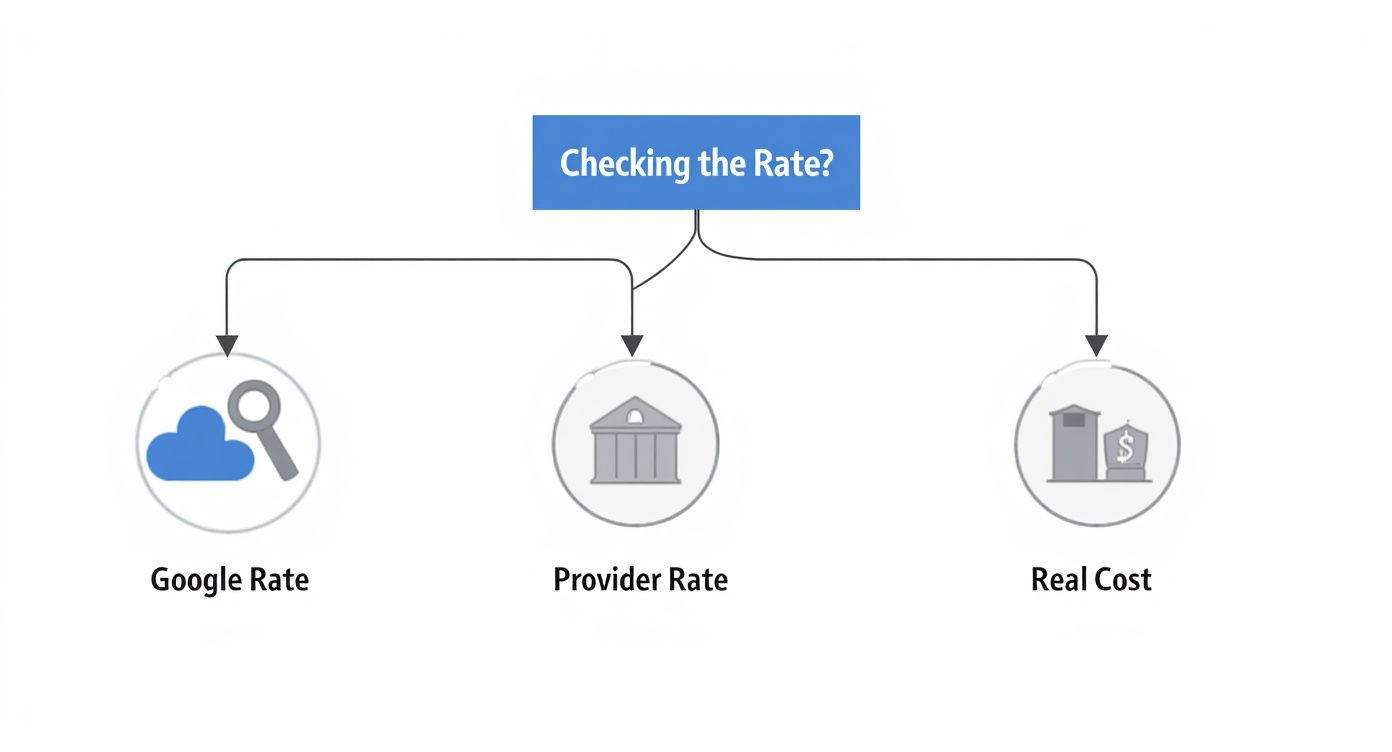
As you can see, the rate you find online is just a benchmark. The real price is what a provider offers you, and that always includes their markup.
The Traditional Banks
For most established companies, the big South African banks like Standard Bank or FNB have long been the go-to for international payments. There’s a certain comfort in familiarity and the ease of keeping all your finances in one place. But that convenience usually comes with a hefty, often hidden, price tag.
Banks are notorious for offering less-than-great exchange rates, building a chunky profit margin into the spread. On top of that, their fee structures can be a maze of confusing charges, including:
- SWIFT Fees: A standard charge just for using the global SWIFT network to send your money.
- Intermediary Bank Charges: Nasty surprise fees that get skimmed off by other banks along the payment's journey.
- Administrative Fees: Fixed charges they tack on for the "service" of processing the transaction.
These costs stack up fast, especially if your business is making regular international payments. While they’re undoubtedly secure, the banks are almost always the most expensive way to handle your currency exchange in Johannesburg.
The Bureaux de Change
You’ve seen them in airports and shopping centres. Bureaux de change are masters of one thing: physical cash exchange. They're great for a tourist needing a bit of holiday money, but they simply aren’t built for business-to-business transactions.
Their exchange rates are often even worse than the banks, and their entire model is based on high-volume, low-value cash deals. Trying to pay an overseas supplier invoice or process your export revenue through a bureau de change is just not practical, and you'll pay a premium for the trouble.
The Rise of Fintech Platforms
This is where the real change has happened. Specialised fintech platforms have completely shaken up the currency exchange market by focusing on transparency, lower costs, and a much better customer experience. When exploring your options, understanding the latest Fintech industry solutions can give you a massive advantage.
These digital-first companies run on lean operational models, which means they don't have the huge overheads of traditional banks. They pass those savings directly on to you.
Their key advantages usually boil down to:
- Tighter Spreads: Their rates are much closer to the mid-market rate, which means more money arrives at its destination.
- Transparent Fees: Many have done away with SWIFT and intermediary fees altogether, instead using a small, clearly stated percentage or flat fee. No more guesswork.
- Faster Transactions: Payments can often land on the same day, which is a game-changer for managing cash flow.
- Superior Technology: Their platforms offer finance teams better tracking, reporting, and integration. It’s part of a wider industry trend; even the JSE is working with cloud providers to modernise its systems.
To put it simply, fintechs offer a smarter, more efficient way to manage international payments. To help you weigh your options, here's a direct comparison of the three provider types.
Comparing Business Forex Providers in Johannesburg
| Feature | Major South African Banks | Bureaux de Change | Fintech Forex Platforms |
|---|---|---|---|
| Exchange Rate Spread | Wide; includes a significant profit margin for the bank. | Very wide; often the least competitive rates available. | Narrow; much closer to the mid-market "real" rate. |
| Fee Structure | Complex and often opaque (SWIFT fees, admin fees, hidden charges). | High fees, especially on smaller transactions; rates include large markups. | Simple and transparent; often a small percentage or flat fee. |
| Transaction Speed | Slow; can take 2-5 business days via SWIFT. | Instant for cash, but not designed for B2B transfers. | Fast; often same-day or next-day settlement. |
| Transparency | Low; difficult to calculate the total cost upfront. | Moderate for cash, but overall cost is high. | High; total cost is clearly displayed before you commit. |
| Best For | Businesses with existing deep banking relationships and low transaction volume. | Tourists or individuals needing small amounts of physical cash. | Businesses of all sizes making regular international payments. |
| Convenience | Integrated with existing business accounts, but often requires branch visits or clunky online portals. | Walk-in service for physical currency. | Fully digital platforms accessible 24/7 online. |
This table makes it clear that while each provider has its place, their value propositions for a modern business are drastically different.
For a CFO or financial manager in Johannesburg, the primary benefit of a fintech provider is the shift from an opaque, fee-heavy process to a transparent, cost-effective one. It puts control back into the hands of the business.
Choosing a provider isn't a one-off decision. You're looking for a long-term partner who fits how you work. Think about speed, usability, customer support, and, of course, regulatory compliance. For most forward-thinking businesses, a specialised fintech platform delivers a powerful mix of cost savings and efficiency that the old guard just can't match.
Navigating South African Forex Regulations and Compliance
Making international payments from South Africa involves more than just hunting for a good rate. You’ve also got to stay on the right side of the country's financial regulators. For any business based in Johannesburg, getting this right is non-negotiable—it's what keeps your payments moving smoothly and avoids any costly delays or penalties.
The two main bodies you'll interact with are the South African Reserve Bank (SARB) and the Financial Intelligence Centre (FIC). While they have different jobs, their rules work together. SARB is all about exchange controls and keeping the broader economy stable by managing the flow of money in and out of the country. The FIC, on the other hand, is our watchdog against financial crime, like money laundering and terrorism financing.
Their combined regulations create the framework that every financial institution, and by extension your business, has to operate within. This isn't just bureaucratic red tape; it's a critical system for protecting the integrity of South Africa's entire financial ecosystem.
Why “Know Your Business” (KYB) is a Big Deal
Before any forex provider can move a single cent for you, they are legally required to verify who you are and what your business does. This is called Know Your Business (KYB). Think of it as a detailed ID check for your company, designed to make sure every transaction is legitimate.
One of the smartest things you can do is get your KYB documents ready before you even start onboarding with a new provider. It saves so much time. While the exact list might differ slightly from one provider to the next, you'll almost certainly need:
- Company Registration Documents: Your official CIPC papers.
- Proof of Business Address: A recent utility bill or another official document showing where you physically operate.
- Director and Shareholder Info: ID documents and proof of address for all directors and major shareholders (typically anyone holding 25% or more of the company).
- Tax and VAT Registration: Your company’s registration proof from SARS.
This process isn't meant to be a hurdle. It's how forex providers fulfil their legal duties to the FIC and SARB, keeping the whole financial network secure. In fact, a provider with a thorough, transparent KYB process is a good sign—it shows they're professional and compliant.
Getting to Grips with Balance of Payments (BOP) Reporting
Once you're verified and ready to transact, every international payment you make or receive has to be reported to SARB. This happens through a system known as Balance of Payments (BOP) reporting. Each transaction must be tagged with a specific category code that describes its purpose.
BOP reporting isn’t just an admin task—it’s a legal requirement. This data gives SARB a real-time view of the country's economic health, tracking everything from import/export balances to foreign investment flows.
For instance, if you're an importer in Joburg paying a supplier in Germany for a shipment of machine parts, you’d use a specific BOP code for importing goods. If you’re an exporter getting paid for your products, that would need a different code entirely. Using the wrong code is a surefire way to get your payment delayed or even rejected.
Here are a few common BOP categories you'll likely come across:
- 101: Importing physical goods.
- 202: Exporting physical goods.
- 401: Paying for services, like an overseas software subscription or consultant fees.
- 602: Repaying a foreign loan.
The good news is that modern fintech platforms have made this much easier. They often build the BOP code selection right into the payment process, guiding your finance team to choose the correct one. Nailing this classification every single time is fundamental to keeping your global operations running without a hitch.
Strategic Ways to Reduce Your Forex Costs and Risk
Simply hunting for a provider with a low headline fee is just scratching the surface of a smart forex strategy. To truly protect your profit margins, Johannesburg businesses need to stop reacting to the market and start getting ahead of it. This means actively managing your exposure to the Rand's famous volatility and using the right tools to lock in some financial certainty.
A well-thought-out forex strategy can turn currency exchange from a nagging cost centre into a real competitive advantage. By planning ahead and using the right financial instruments, you can shield your bottom line from unexpected market shocks and build much more predictable cash flow for your business.
Locking in Rates with Forward Contracts
One of the most powerful tools in the arsenal is a forward exchange contract—often just called a forward contract. It’s pretty simple: you agree with your forex provider to buy or sell a set amount of foreign currency on a future date, but at an exchange rate you both agree on today.
Let's make that real. Imagine your business needs to pay a $50,000 invoice to a US supplier in three months. If the ZAR takes a dive during that time, the Rand cost of that invoice could balloon, wiping out your profit on those goods. A forward contract takes that risk completely off the table. You lock in a ZAR/USD rate now, and in three months, that’s the exact rate you’ll pay, no matter what the live market is doing. It gives you absolute certainty over your costs.
This works just as well for exporters. If you're waiting on a big payment in a foreign currency, a forward contract lets you secure the ZAR value of that income today. You’re protected if the Rand suddenly strengthens, which would otherwise mean less money in your local account.
Using Market Orders for Strategic Timing
Another brilliant tool is the market order. This is basically an instruction you give your provider to automatically make a currency exchange for you, but only when the rate hits a specific level you’ve chosen. It’s a fantastic way to take advantage of good market movements without being glued to the charts all day.
There are two main types you'll use:
- Limit Order: This tells your provider to buy or sell a currency at your target rate or even better. For instance, you could place an order to buy US dollars only if the rate drops to R18.50 or lower, making sure you get the price you want.
- Stop-Loss Order: Think of this as your safety net. It sets a "worst-case" rate that will trigger a trade automatically to prevent further losses if the market moves sharply against you.
By combining forward contracts for payments you know are coming with market orders for more opportunistic trades, a finance team can build a really solid hedging strategy. You move from just reacting to bad news to proactively managing your risk.
Auditing Your Provider and Finding the Hidden Costs
This is a crucial, ongoing task: regularly auditing the real cost of your forex transactions. Don't just accept the final amount that lands in your account. You need to dig into the details to understand every single charge that was applied along the way.
Start by creating a simple checklist to run through every international payment:
- Benchmark the Rate: How did the exchange rate you got stack up against the mid-market rate at that exact time? The gap between the two is your provider’s spread.
- Itemise All Fees: Ask for a full breakdown. Were there sending fees, SWIFT charges, or hidden intermediary bank fees that weren't mentioned upfront?
- Calculate the Total Cost: Add the spread (as a percentage) and all the fixed fees together. That number is the true, all-in cost of your Johannesburg currency exchange.
This simple exercise is often a real eye-opener, revealing just how much traditional providers can actually cost. For businesses looking to fine-tune their financial operations, exploring broader solutions like outsourcing financial services can introduce efficiencies that ripple through to areas like international payments.
By systematically reviewing these costs, you can build a powerful business case for switching to a partner who is more transparent and cost-effective. This isn’t just about saving a few Rands here and there; it’s about strategic financial management.
Your Johannesburg Currency Exchange Questions Answered
If you're running a business in Johannesburg, dealing with foreign currency can feel like navigating a maze. Let's clear up some of the most common questions finance teams have about the local forex market.
What’s the Best Way to Get a Good ZAR Exchange Rate?
The single best thing you can do is to look beyond your main business bank. It's often the default option, but rarely the most cost-effective.
Instead, start actively comparing providers. Newer fintech platforms are often your best bet, as they’re built on leaner models with lower overheads. This means they can usually offer you an exchange rate much closer to the real mid-market rate you see on Google. Planning ahead helps, too. If you have a large conversion coming up, some providers might give you a sharper price, so it can pay to bundle smaller payments together. The golden rule? Always check the rate you're quoted against the live mid-market rate—that’s how you’ll see the true cost you're being charged.
How Can My Business Avoid High International Transfer Fees?
Start by demanding total transparency. Before you hit "send" on any transfer, ask for a complete breakdown of every single cost. Don't just look at the upfront transfer fee; you need to know about any potential SWIFT charges or intermediary bank fees that could be sliced off before the money even arrives.
This is another area where modern payment platforms are changing the game for Johannesburg businesses. Many have built their networks to sidestep the old, clunky SWIFT system entirely, using local payment channels instead. This simple change can slash those surprise fees and make sure the full amount you send is the amount that gets received.
The most effective way to avoid high fees is to choose a provider whose fee structure is simple and transparent from the start. A single, clear percentage or flat fee is always preferable to a complex web of hidden charges.
What Is BOP Reporting and Why Is It Mandatory?
Balance of Payments reporting, or BOP, isn't optional—it's a legal requirement for every single cross-border transaction your business makes. You have to declare each one to the South African Reserve Bank (SARB).
Think of it as the government's way of keeping a detailed logbook of all the money flowing in and out of South Africa. This data is essential for tracking the country's economic health. For every international payment you make or receive, you’ll need to assign the correct BOP category code that explains the nature of the transaction.
Can I Lock in an Exchange Rate for a Future Payment?
Yes, you absolutely can. The tool for this is called a forward contract. It lets you agree on an exchange rate with your provider today for a transaction that will happen at a set date in the future.
This is a powerful strategy for managing your risk. If the Rand takes a nosedive, you’re protected. It gives you certainty on your future costs and revenues, which is crucial for locking in profit margins on international deals.
Ready to eliminate hidden fees and access real exchange rates for your international payments? Zaro offers a transparent, cost-effective platform designed for South African businesses. See how much you can save by visiting the Zaro website.