
Learning how to trade forex isn't about becoming a high-stakes speculator—for a business owner, it's about gaining a critical operational skill to protect your profits from currency volatility. At its heart, it’s about understanding the mechanics of international payments and receipts so you can shield your bottom line when exchange rates move against you. This knowledge turns a potential financial threat into a manageable part of your business strategy.
Building Your Foundation in Forex
Diving into the foreign exchange (forex or FX) market can feel intimidating, but if your business deals with international trade, it's an area you can't afford to ignore. Try to think of it less like the fast-paced, high-risk world of day trading and more like an essential tool for sound financial management. Your goal isn't to "play the market" but to use it strategically to safeguard your company's cash flow.

That distinction is everything. A speculative trader is hunting for quick profits from short-term price swings. A business, on the other hand, uses FX knowledge for practical risk management, like locking in a favourable rate for a future payment to a supplier.
Understanding the Language of Forex
Before you can start managing your currency risk, you need to speak the language. Getting a handle on just a few core concepts will demystify the entire process and give you the confidence to make smarter decisions.
To make this easier, here’s a quick-reference table that defines these essential terms from a business perspective.
Core Forex Concepts for Business Owners
| Term | Simple Definition | Why It Matters for Your Business |
|---|---|---|
| Pips | "Percentage in point"—the smallest price change a currency pair can make. | A small pip movement on a large invoice (e.g., USD/ZAR) can mean thousands of Rands gained or lost. It quantifies your exposure. |
| Lots | The size of a transaction. | Instead of thinking in "lots," you'll think in terms of real transaction values, like a €50,000 payment to a German supplier. |
| Leverage | Using borrowed capital to control a larger position. | Mostly irrelevant and risky for business operations. Your focus is on unleveraged transactions to settle commercial payments directly. |
These terms aren't just abstract theory; they have a massive local context. South Africa is the continent's undisputed forex trading powerhouse, with daily trading volumes hitting over $2.21 billion—a figure that completely dwarfs other African nations.
This incredibly active market gives South African businesses, especially small and medium-sized exporters, direct access to real-time currency exchange. That’s a huge advantage for managing cross-border payments without getting stung by the high fees charged by traditional banks. You can dive deeper into this in a comprehensive African forex trading report.
Key Takeaway: For business owners, learning about forex isn't for speculation. It’s a defensive financial skill—understanding market movements to protect your revenue and expenses from the natural risk of currency fluctuations.
Once you have this foundational knowledge, you can start seeing exchange rates not as an uncontrollable threat, but as a variable that can be managed with a bit of foresight and the right tools.
Gaining Hands-On Experience Without the Risk
Theory will only get you so far. The real learning in forex begins the moment you start putting that knowledge into practice. Of course, for any business owner or financial manager, the thought of using company funds for "practice" is a complete non-starter. This is exactly why a demo account—often called a paper trading account—is so incredibly valuable.
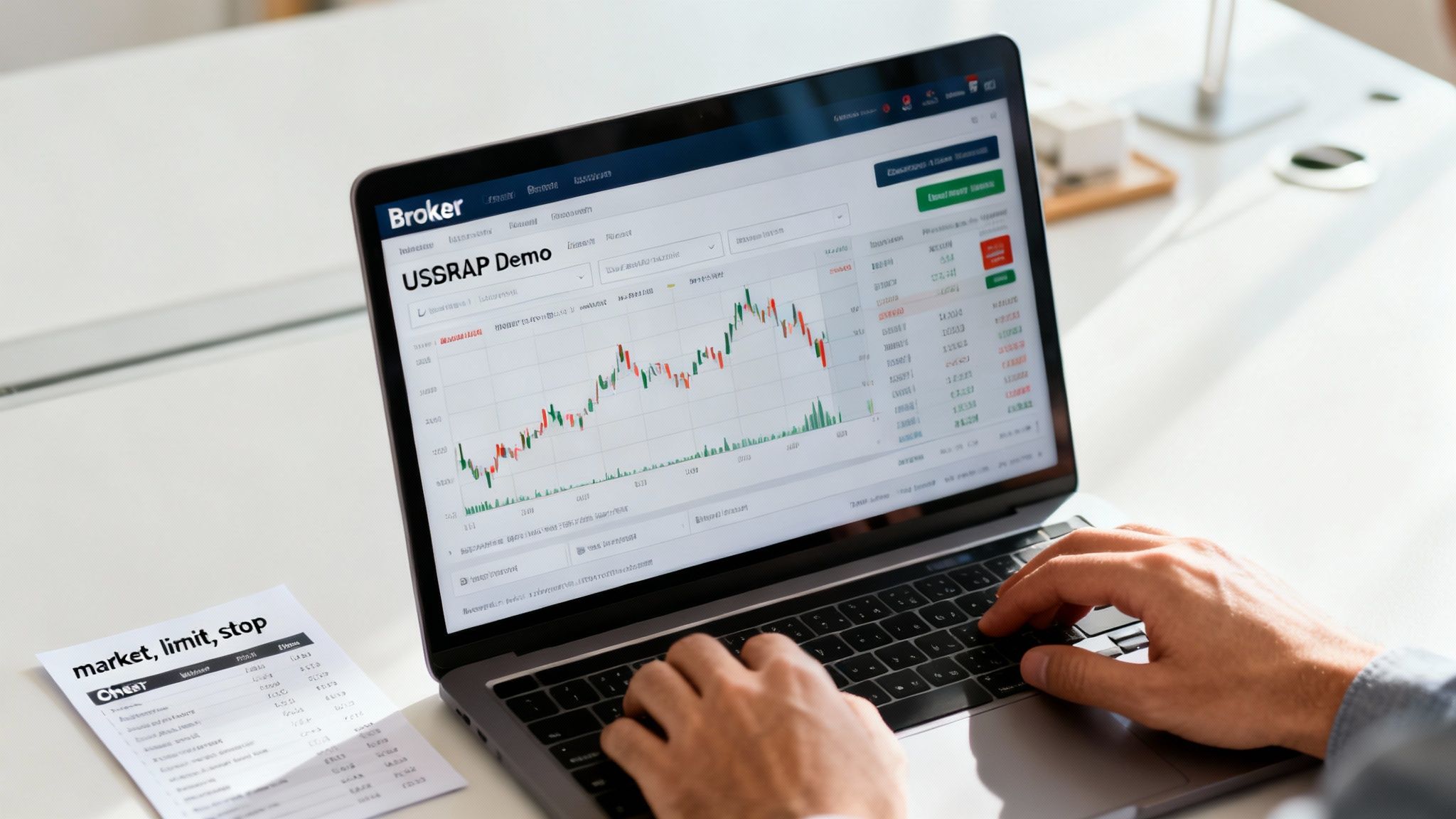
Think of a demo account as a high-fidelity flight simulator for the forex market. It runs on real-time market data and gives you a chunk of virtual cash to trade with, letting you place orders and manage positions without any actual financial exposure. It’s the perfect sandbox to turn abstract concepts into practical skills.
Before you even think about committing real capital, it's absolutely vital to get your hands dirty. You can easily learn about paper trading and how to start risk-free to test your strategies and build the confidence needed to manage real transactions later on.
Making Your Practice Count
Don't just jump in and place random trades. Your time on a demo account needs to be purposeful. The goal is to simulate the real-world scenarios your business will actually face, ensuring the skills you develop are directly relevant to your operational needs.
For instance, if you're a South African exporter, your world revolves around the US Dollar (USD) and the Rand (ZAR). It makes sense, then, to focus your practice almost exclusively on the USD/ZAR currency pair. Getting a feel for its unique volatility, liquidity, and the economic news that moves it is far more valuable than dabbling in exotic pairs you'll never touch in your business operations.
Use the demo account to get comfortable with the nuts and bolts of placing different order types until it's second nature. Specifically, work on:
- Market Orders: For when you need to execute a trade instantly at the current price.
- Limit Orders: To set a specific price you're willing to buy or sell at, giving you control over your entry.
- Stop-Loss Orders: Your safety net, designed to automatically close a position if the market moves against you.
Key Insight: The real goal of a demo account isn’t to rack up a massive fictional profit. It's about building a repeatable process, understanding how the market behaves, and developing the discipline to stick to your risk management plan, even when things get choppy.
Bridging the Gap from Simulation to Reality
Treat every single trade in your demo account as if real money is on the line. I mean it. Document your trades, analyse what went right and what went wrong, and constantly refine your approach. Did you correctly predict how the market would react to that interest rate announcement? Was your stop-loss placed in a way that minimised a potential loss without getting triggered prematurely?
This kind of deliberate practice is what builds the bridge between knowing the theory and executing trades in the real world. The confidence you build here is what will allow you to eventually manage your company’s international payments with skill and precision, protecting your bottom line from currency swings. This experience is the foundation for making calm, informed decisions when it truly matters.
Mastering Risk to Protect Your Bottom Line
When you're learning forex for your business, the entire game changes. Forget chasing speculative profits—this is all about hardcore capital preservation. Your main goal is to protect the operational funds you use for essentials like paying suppliers and running payroll, so every decision has to be viewed through a risk management lens.
This mindset shift is everything. For businesses, successful forex management hinges on solid, non-negotiable routines designed to minimise any potential downside.
A cornerstone of this approach is the 1% rule. While it's a staple for traders, it applies perfectly to corporate hedging: never risk more than 1% of your total capital on a single currency position. It’s a simple guardrail that prevents you from over-committing and exposing the business to unnecessary danger.
Know Your Exit Before You Even Get In
One of the most powerful tools in your arsenal is the stop-loss order. Think of it as your emergency exit, planned well in advance. Before you execute any currency exchange or hedge, you must decide the exact point at which you'll automatically close the position if the market moves against you.
A stop-loss isn't admitting you might be wrong; it's a concrete plan for when you are. It takes emotion out of the driver's seat, ensuring one bad call doesn't spiral into a major financial headache.
Setting a stop-loss is an indispensable part of risk management. It’s the discipline that ensures your hedging activities are actually reducing financial uncertainty, not accidentally adding more.
Is the Juice Worth the Squeeze?
Before pulling the trigger on any FX transaction, you need to weigh the risk-to-reward ratio. This simple metric tells you if a potential hedge is even worth the effort.
Let's say you stand to protect R10,000 from an unfavourable rate swing (your reward). Your stop-loss is set to limit your maximum potential loss to R2,500 (your risk). That gives you a very healthy risk-to-reward ratio of 1:4.
Making this calculation a mandatory part of your process forces a disciplined, business-first mindset. It pushes you to justify every move with cold, hard numbers instead of just a gut feeling.
This discipline should also extend to the platform you use. When you work with a service like Zaro, which gives you real-time exchange rates with zero spread, you’re already dodging a massive hidden risk—the inflated markups that banks quietly build into their rates. Transparent pricing means the rate you see is the rate you get, protecting your capital right from the start and making your risk management far more effective.
Your 180-Day Forex Learning Timeline
Learning to trade forex isn't a sprint; it's a marathon. Trying to master it all overnight is a recipe for disaster. A much smarter approach is to break the journey down into manageable chunks. Think of it as a six-month roadmap to build real, practical skills and the confidence to use them.
This isn't about becoming a Wall Street wizard in half a year. It's about building a solid foundation, piece by piece, so you can make informed decisions. Let’s map it out.
The First 30 Days: Getting Your Bearings
Your first month is all about immersion without the risk. The goal isn't to make a profit; it's to get comfortable with the tools and the rhythm of the market. Forget about real money for now—your demo account is your new best friend.
- Daily Practice: Hop into your demo account for at least 30 minutes every day. Stick to one or two currency pairs that actually matter to your business, like the USD/ZAR, to keep your focus sharp.
- Keep a Journal: Document every single trade you make. Why did you enter the trade? Where did you place your stop-loss? What was the outcome? This practice is less about winning and more about learning to analyse your own thinking.
- Review the Basics: Spend some time each week going back over the core concepts. Make sure you're crystal clear on terms like pips, lots, and the fundamentals of risk management.
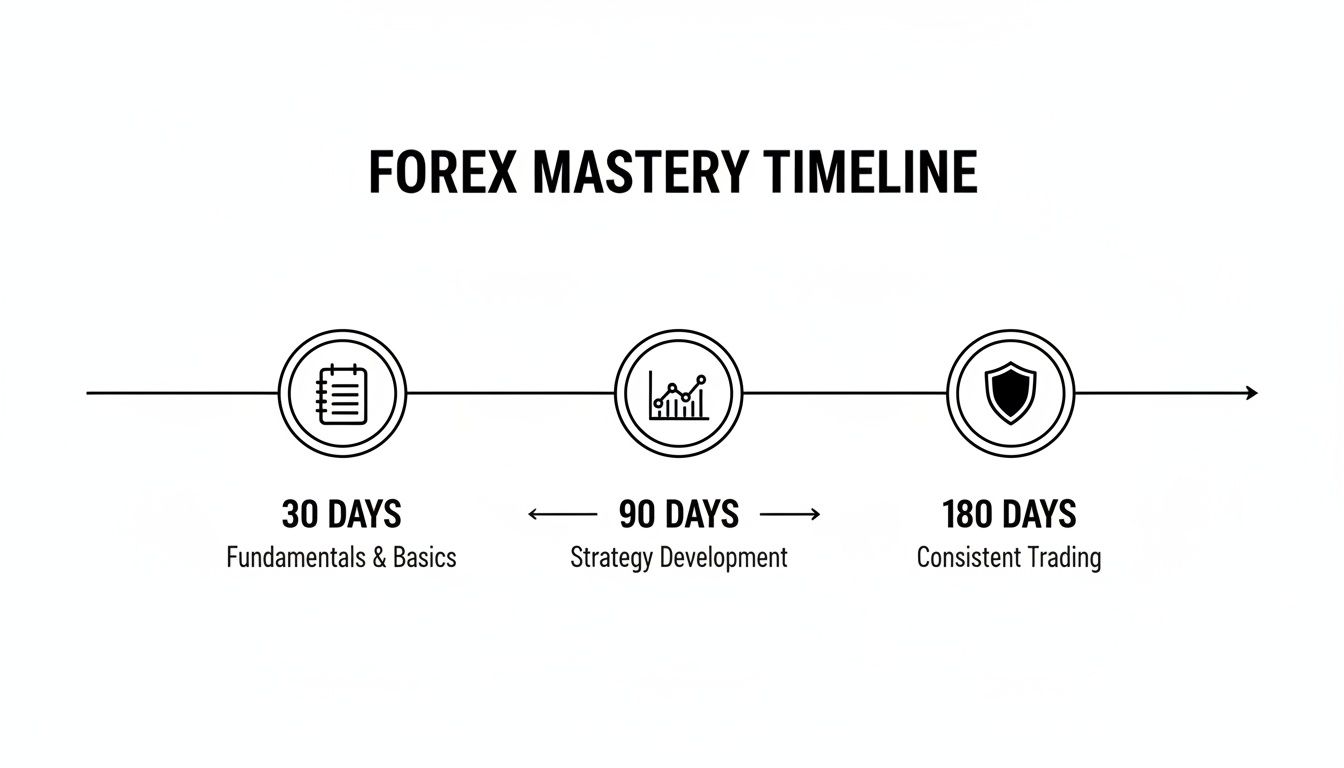
This timeline really helps visualise how each stage builds on the one before it, moving you from simply clicking buttons to making strategic choices.
The Next 60 Days: Building Your Strategy
Once you hit the 90-day mark, the mechanics of trading should feel second nature. Now it’s time to shift your focus. You'll move from just placing trades to making informed decisions based on a simple, repeatable plan.
This is where you start connecting the dots between the news and market movements. You’ll begin to pay attention to economic announcements—things like interest rate decisions from the South African Reserve Bank or new trade balance data—and watch how the Rand reacts. It’s all about developing a basic framework for your trading decisions.
It’s an exciting time to be learning this skill in South Africa. A 450% surge in trading activity among young people (ages 18-25) in just two years shows how valuable these skills are becoming. This massive growth, driven by better internet access and mobile platforms, is changing the game. You can dig deeper into forex trading trends in Africa to see the bigger picture.
The 180-Day Milestone: From Theory to Practice
After six months of dedicated learning and practice, you should be ready to apply your knowledge to real-world business scenarios. The objective now is to confidently manage small, real-money transactions and implement basic risk management strategies.
Key Milestone: By this point, you should be able to execute a simple forward cover to lock in an exchange rate for a future international invoice. This is where your skills directly protect your business from currency volatility and start saving you money.
Remember, this timeline is a guide, not a rigid set of rules. The real goal is to build a durable skill set that serves you for years to come.
Your Forex Learning Milestones
To help you stay on track, here’s a quick summary of what you should be focusing on at each stage of your journey.
| Timeline | Key Focus | Actionable Exercises |
|---|---|---|
| First 30 Days | Foundational Knowledge | Open a demo account. Practise placing trades daily. Keep a detailed trade journal. Study core forex terminology. |
| By Day 90 | Strategy Development | Follow a simple trading plan. Analyse economic news (e.g., SARB announcements). Backtest a basic strategy on one currency pair. |
| By Day 180 | Practical Application | Refine your risk management rules. Execute your first small, live trade or hedge. Confidently manage a basic FX exposure for your business. |
This table provides clear, actionable steps to turn an intimidating subject into a series of achievable goals, building your confidence along the way.
Applying Your Forex Skills in Business
This is where the rubber meets the road. All that time you spent learning the ins and outs of forex trading is about to become a real, tangible advantage for your business. It can feel like a big leap, moving from a demo account to decisions that directly affect your bottom line, but this is exactly how you start protecting your company’s profits.

Let's walk through a real-world scenario. Say you run an export business from Cape Town and you've just been paid $100,000 by a US client. Your analysis of the USD/ZAR pair suggests the Rand might weaken a little over the next week.
Instead of converting the dollars immediately, you decide to hold off for a few days. If the rate shifts from R18.20 to R18.35 in that time, that small, calculated delay just earned your business an extra R15,000. That’s a direct result of putting your FX knowledge to work.
Practical Hedging for Importers
The same logic works in reverse when you're trying to manage costs. Imagine you’re the CFO for a manufacturing firm that needs to pay a €50,000 invoice for German machinery in 90 days. You're concerned about potential ZAR weakness, so you use your understanding of the market to lock in the current EUR/ZAR rate with a simple hedge.
Three months down the line, the Rand has weakened significantly. While other importers are now facing much higher costs, your company’s bill is fixed. This isn't speculative gambling; it's just smart financial planning that gives you cost certainty and keeps your budget stable.
This kind of practical FX management is becoming more important in a rapidly growing market. South Africa's forex market is set to expand from USD 3,861.60 million in 2024 to USD 6,852.50 million by 2033. For SMEs, this growth means fantastic liquidity, making it easier than ever to handle cross-border payments. You can dig into more data on the South African foreign exchange market and its future trajectory.
The Right Tools for Execution
A great strategy is only half the story. Your sharpest decisions can be completely undermined by poor execution tools—specifically, traditional banks that hit you with hidden spreads and steep fees. A 2% spread on a $100,000 transaction instantly wipes out $2,000, eating away at the very advantage you worked so hard to create.
This is exactly why your choice of platform is so critical. Zaro gives businesses access to the real, mid-market exchange rate, cutting out spreads and hidden fees entirely. It makes sure the favourable rate you identified through your analysis is the rate you actually get.
The Bottom Line: For a business, mastering forex isn't about chasing wild profits on currency swings. It's about preserving the value of your hard-earned revenue and controlling your costs with surgical precision.
When you pair your skills with a transparent platform, you turn theory into real savings and gain much greater financial control. Of course, once you start generating value from your forex activities, you need to manage those outcomes wisely. A great next step is to explore essential tax saving tips for investors and business owners to maximise what you keep. This holistic view ensures your forex strategy contributes directly to a healthier, more predictable business.
Got Questions About Learning Forex? We've Got Answers
When you're just starting out in forex, especially from a business angle, it's completely normal for a flood of questions to hit you. It’s easy to get tangled up in the jargon or just feel plain overwhelmed. Let's tackle some of the most common queries we hear from South African business owners, with straightforward answers to get you moving in the right direction.
How Much Money Does a Business Actually Need for Forex?
This is a big one, and the answer really boils down to what you're trying to achieve.
If your goal is managing operational FX—like paying an overseas supplier—your "capital" isn't for speculating. It's the actual cash value of your payment, say, $20,000 for an invoice. Here, the entire point is to protect that $20,000 from getting eaten away by a bad exchange rate, not to trade it for profit.
Now, if you're learning to trade on your own time, you can start small. Many people dip their toes in with R1,500 to R3,000. But honestly, the starting amount is far less important than having rock-solid risk management rules in place. For your business, though, the transaction size is simply whatever your operations demand, and protecting that capital is always job number one.
Is Forex Trading Legit and Regulated in South Africa?
Yes, it absolutely is. Forex trading is legal and properly regulated in South Africa, with the Financial Sector Conduct Authority (FSCA) keeping a close watch. It is non-negotiable that any broker you even think about using must be fully licensed by the FSCA. Partnering with an unregulated platform is just asking for trouble and puts your business at massive risk.
Expert Tip: Before you even think about sending money, check for a broker's FSCA license. It takes a few minutes and is your single best defence for protecting your company’s funds and staying on the right side of the regulations.
The same goes for payment platforms handling your international transfers. A service like Zaro, for instance, operates under strict regulatory controls, including thorough Know Your Business (KYB) checks. This provides the kind of enterprise-grade security you need for every cross-border payment.
What are the Classic Beginner Mistakes I Should Avoid?
I’ve seen the same mistakes trip people up time and time again.
For individuals just starting out, the classic blunders are risking way too much on one trade, "revenge trading" (trying to aggressively win back money you just lost), and failing to use a stop-loss order on every single position.
For a business, the biggest mistake by far is treating operational FX like a casino bet. You are not speculating. The goal is to manage risk and lock in cost certainty for your imports or exports. Another common pitfall? Just blindly accepting whatever exchange rate your bank gives you. Using a transparent platform that shows you the real, mid-market rate without hidden spreads is the easiest way to sidestep this costly error from day one.
Seriously, How Long Does It Take to Get Good at This?
There’s no magic number here, but building a solid, working knowledge takes real effort. Realistically, you should plan on spending at least six to twelve months practising on a demo account before you’ll feel truly comfortable making informed decisions with real money on the line.
Our 180-day plan is designed to get you to a place where you can confidently manage the basic FX needs of your business. But mastering advanced hedging strategies? That’s a much longer game. True expertise in this field is a journey of continuous learning, not a finish line you cross.
Ready to put your knowledge to work with a platform that actually values transparency? Zaro gives your business direct access to real exchange rates with zero spread and no hidden fees, making sure your smart decisions aren't undermined by high costs. Take a look at how Zaro works.