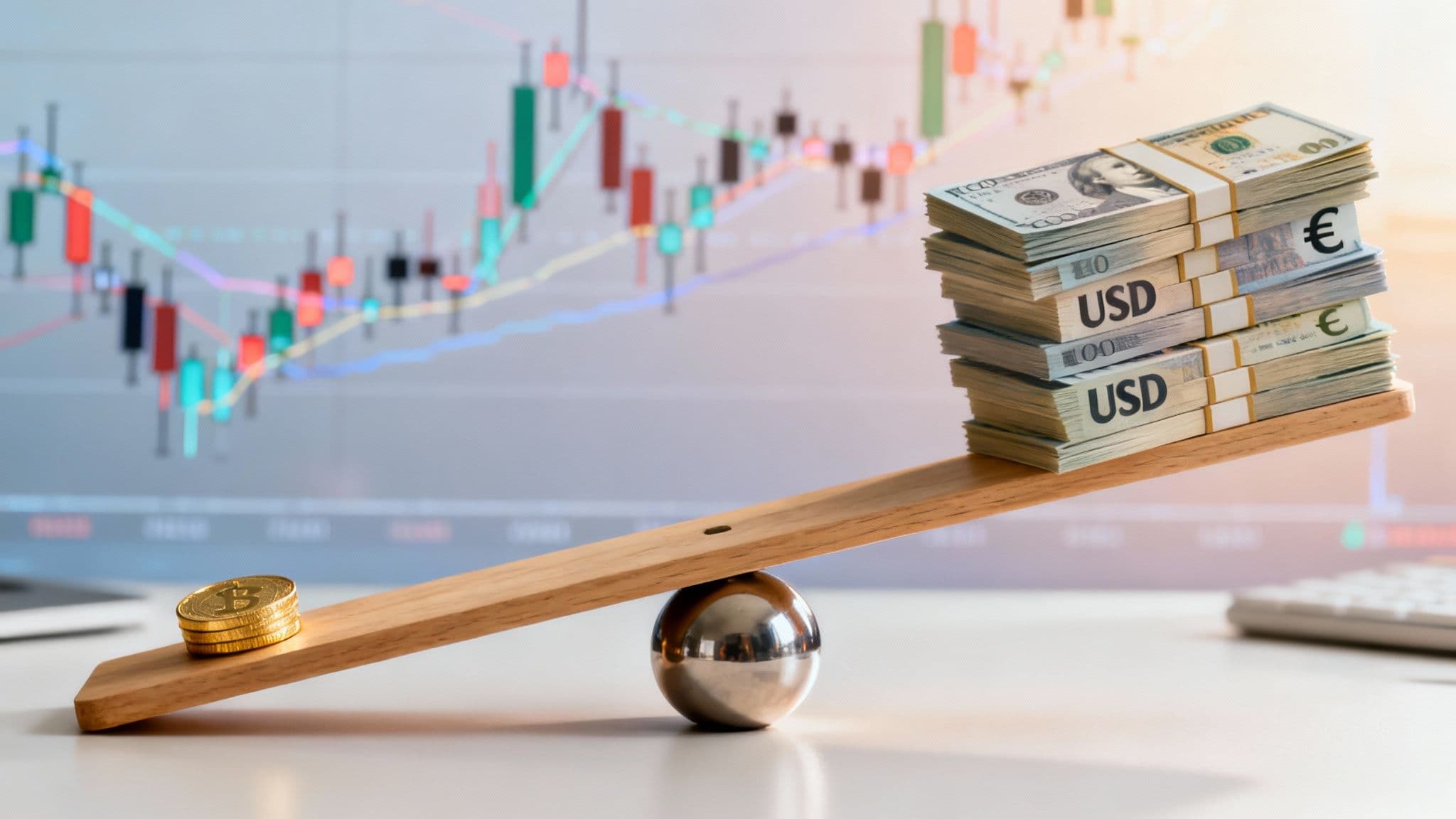
At its core, forex leverage is a bit like getting a loan from your broker. It lets you control a much larger position in the currency market than your own cash would normally allow. Think of it as a tool that dramatically boosts your trading power.
What Is Leverage in Forex Trading
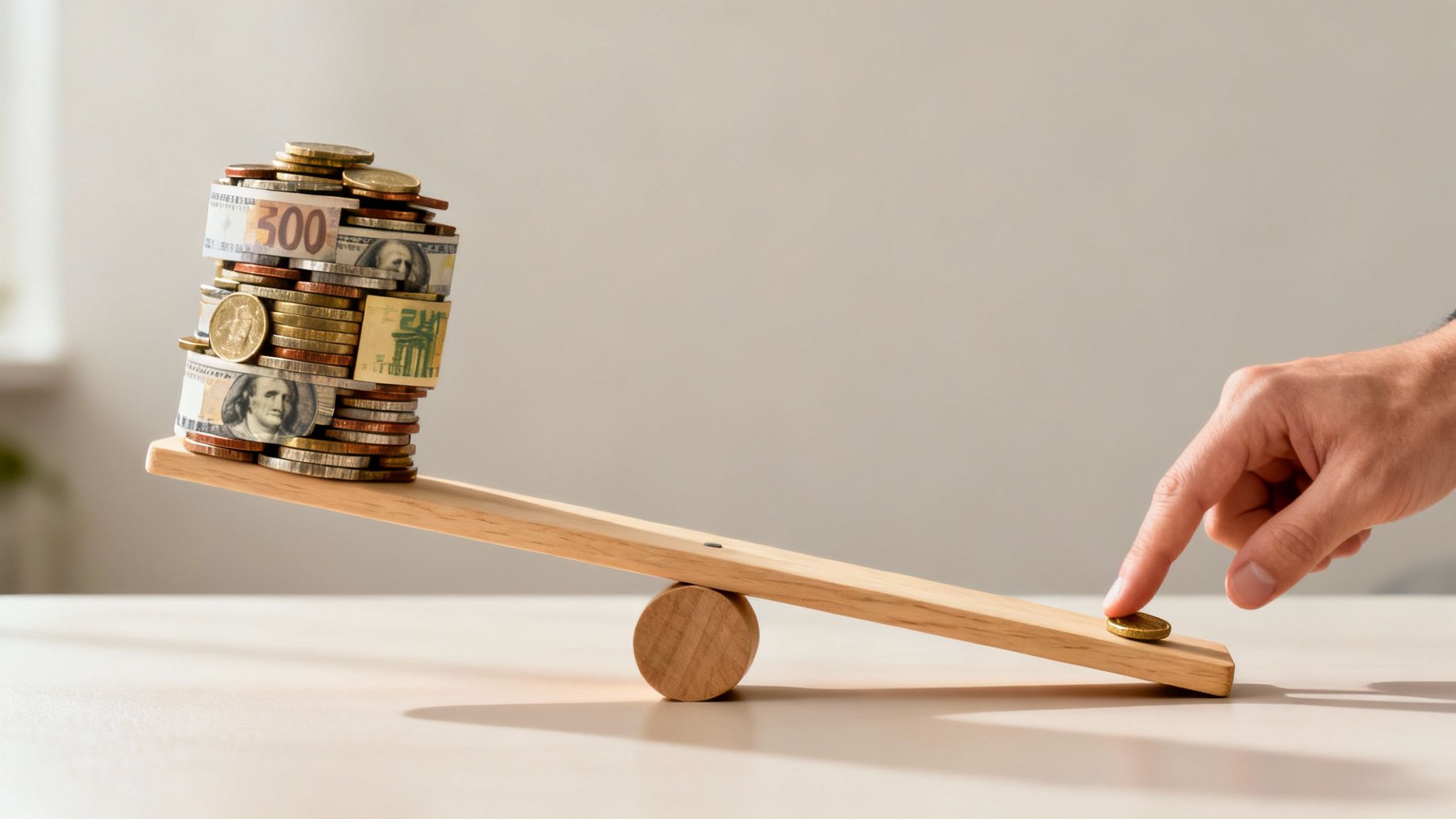
Imagine you want to buy R100,000 worth of a currency pair. Without leverage, you'd need to have R100,000 sitting in your account. With leverage, you only need a fraction of that.
Leverage is always shown as a ratio, like 1:100 or 1:500. A 1:100 ratio means that for every R1 you put up from your own account, your broker effectively lets you control R100 in the market. So, with just R1,000 of your money, you can open a trade worth R100,000.
This is why forex trading is so accessible. You don't need a fortune to get started. The small amount you put up is called margin – it’s like a good-faith deposit to secure the larger position.
To get comfortable with these ideas, let's break down the main terms you'll hear when discussing leverage.
Understanding Leverage Key Terms
| Concept | Simple Explanation |
|---|---|
| Leverage | A ratio (e.g., 1:100) that shows how much your broker "lends" you versus your own capital. |
| Margin | The actual money from your account that you need to put down as a deposit to open a leveraged trade. |
| Position Size | The total value of the trade you are controlling, including the leveraged amount. |
| Pip | The smallest price move a currency pair can make, which determines your profit or loss. |
These concepts are all interconnected. Your leverage ratio determines the margin required for your desired position size, and every pip movement is magnified by that same leverage.
The Power of Amplification
Here's the most important thing to remember: leverage magnifies everything. It’s a classic double-edged sword.
When the market moves in your favour, even a tiny bit, your profits are supercharged. This is the big appeal – it creates the opportunity for significant gains from small price movements.
But the flip side is just as real. If the market moves against you, your losses are also amplified at the exact same rate.
Leverage offers the potential for enhanced returns but also comes with an equivalent increase in risk. A small adverse market movement can lead to considerable losses, potentially even exceeding your initial deposit.
Before you even think about using leverage, you have to get your head around this dual nature. It's a powerful feature that demands respect and, more importantly, a solid risk management plan to keep your capital safe.
How Leverage and Margin Work Together
To really get your head around leverage in forex, you have to understand its other half: margin. You can't have one without the other. Think of leverage as the tool that lets you trade bigger, and margin as the good-faith deposit you put down to get access to that tool.
These two concepts are completely intertwined. The leverage ratio your broker gives you sets the exact amount of margin you need to lock away for any trade. So, higher leverage means you tie up less of your own money (a smaller margin) to control the same-sized position.
Let's walk through a simple, real-world example to see how this plays out.
A Practical Scenario: Margin and Leverage in Action
Say you want to open a trade on a currency pair, and the total value of that position is $100,000. If you had no leverage (a 1:1 ratio), you’d need the full $100,000 sitting in your account. That’s a huge ask for most people.
But what if your broker offers you a leverage ratio of 1:100?
Here’s how the maths breaks down:
- Total Position Value: $100,000
- Leverage Ratio: 1:100
- Margin Required: $100,000 / 100 = $1,000
Suddenly, things look very different. You only need to put up $1,000 of your own capital as margin. This $1,000 deposit lets you control the much larger $100,000 position. Your broker is essentially fronting you the other $99,000 so you can trade on a scale that would otherwise be out of reach.
This is the heart of leveraged trading. Your margin isn't a fee you pay; it's more like a security deposit that your broker holds while your trade is live. Once you close your position, that margin is released back to you, along with any profits or minus any losses.
This is what makes forex trading so accessible, but it also underscores the importance of managing your risk properly. To see how these numbers work in a live environment, you can Explore Forex Trading Tools that help calculate these figures instantly. The key is always making sure you have enough capital to cover not just the margin, but also any unexpected market moves that might go against you.
A Realistic Example of a Leveraged Trade
Theory is one thing, but seeing how leverage plays out in a real trade is where it all clicks. Let's walk through a practical example to really get a feel for how leverage works—both when a trade goes your way and when it doesn't.
Think of it this way: your deposit is the starting point, the broker provides the leverage to boost it, and the result is a much larger position in the market.

This process is the heart of leveraged trading. You're using a relatively small amount of your own money to control a significantly larger slice of the market.
Let's imagine you have R10,000 in your trading account. Your broker offers a leverage ratio of 1:100. You've got your eye on the EUR/USD pair and you’re convinced the Euro is about to climb against the US Dollar.
With that 1:100 leverage, your R10,000 deposit (your margin) gives you the power to open a trade worth R1,000,000 (R10,000 x 100).
Now, let's see how this could unfold.
Scenario 1: The Winning Trade
Your analysis pays off! The EUR/USD exchange rate moves up by 50 pips in your favour, just as you predicted.
A 'pip' is the tiniest price move a currency pair can make. On a R1,000,000 trade like yours, each pip is worth about R100. So, a 50-pip gain means you've just made a profit of R5,000 (50 pips x R100/pip).
This is the magic of leverage that traders need to grasp. Your R10,000 stake just pulled in a R5,000 profit. That’s a massive 50% return on your capital from a tiny flutter in the market.
For perspective, if you had traded without leverage, that same 50-pip move with your R10,000 would have only made you R50.
Scenario 2: The Losing Trade
Now for the flip side. What if the market turns against you? Instead of rising, the EUR/USD rate drops by 50 pips.
Leverage is a double-edged sword; it magnifies losses just as powerfully as it magnifies gains. That 50-pip drop translates into a R5,000 loss (50 pips x R100/pip).
In an instant, 50% of your initial deposit is gone. This stark reality is why leverage must be handled with extreme care and why regulators step in.
Here in South Africa, the Financial Sector Conduct Authority (FSCA) keeps a close watch on brokers to protect traders from taking on too much risk. This is why you'll find that most reputable local brokers cap leverage for retail clients at around 1:100—it's a measure to prevent these kinds of rapid, devastating losses. You can dig deeper into local trends by checking out the latest African forex trading report on fnforex1.com.
The Two Sides of Trading with Leverage
Any honest conversation about leverage in forex has to acknowledge its dual nature. Think of it as a powerful amplifier – it can make the good stuff great, but it can also make the bad stuff disastrous. To use it well, you need a clear-eyed view of both the potential rewards and the very real dangers.
The Upside: What Makes Leverage So Appealing?
The main attraction is obvious: magnified profit potential. Suddenly, those tiny price ticks in a currency pair, the ones that barely seem to move, can generate substantial returns on your trading capital. Leverage makes it possible to aim for meaningful profits from market movements that would otherwise be insignificant.
It also makes your capital far more efficient. Because you only need to put down a small margin deposit to control a much larger position, the rest of your trading funds are freed up. You can keep that capital safe or deploy it for other opportunities without tying everything up in a single trade.
The Downside: Where It Can All Go Wrong
The dangers of leverage are the perfect mirror image of its benefits. Just as your profits are amplified, so are your losses.
A small price shift against your position can trigger losses that are completely out of proportion to your initial deposit. In a worst-case scenario, and without proper safeguards, these losses can wipe out your entire account.
This leads directly to the dreaded margin call. If a trade goes against you and your account equity falls below the broker's required level, you'll get a notification. You'll either have to deposit more money immediately or be forced to close your losing positions, locking in what could be a very painful loss.
Understanding leverage means accepting that it doesn't just increase your buying power; it increases your exposure. Every decision carries more weight, turning small mistakes into costly errors.
Let's break down the pros and cons side-by-side.
The Two Sides of Trading with Leverage
| Potential Benefits | Potential Risks |
|---|---|
| Magnified Profits: Turn small market moves into significant gains. | Amplified Losses: Minor adverse moves can lead to huge losses. |
| Capital Efficiency: Control large positions with a small margin deposit. | Margin Calls: Risk of being forced to close positions at a loss. |
| Access to Markets: Trade larger volumes than your capital would normally allow. | Rapid Capital Depletion: A few bad trades can wipe out an account. |
| Increased Opportunities: Free up capital to pursue multiple trades or strategies. | Emotional Trading: The high stakes can lead to fear-based or greedy decisions. |
As you can see, for every major benefit, there's an equally potent risk waiting on the other side.
To safely navigate these risks, it's essential to look beyond just the trade itself and implement broader strategies for managing overall investment risk. A disciplined framework is non-negotiable.
Ultimately, leverage is a professional's tool. For traders who have a solid risk management plan and the experience to back it up, it can be a game-changer. But for the unprepared, misusing it can drain your trading capital with frightening speed.
Choosing a Leverage Ratio That Fits Your Strategy
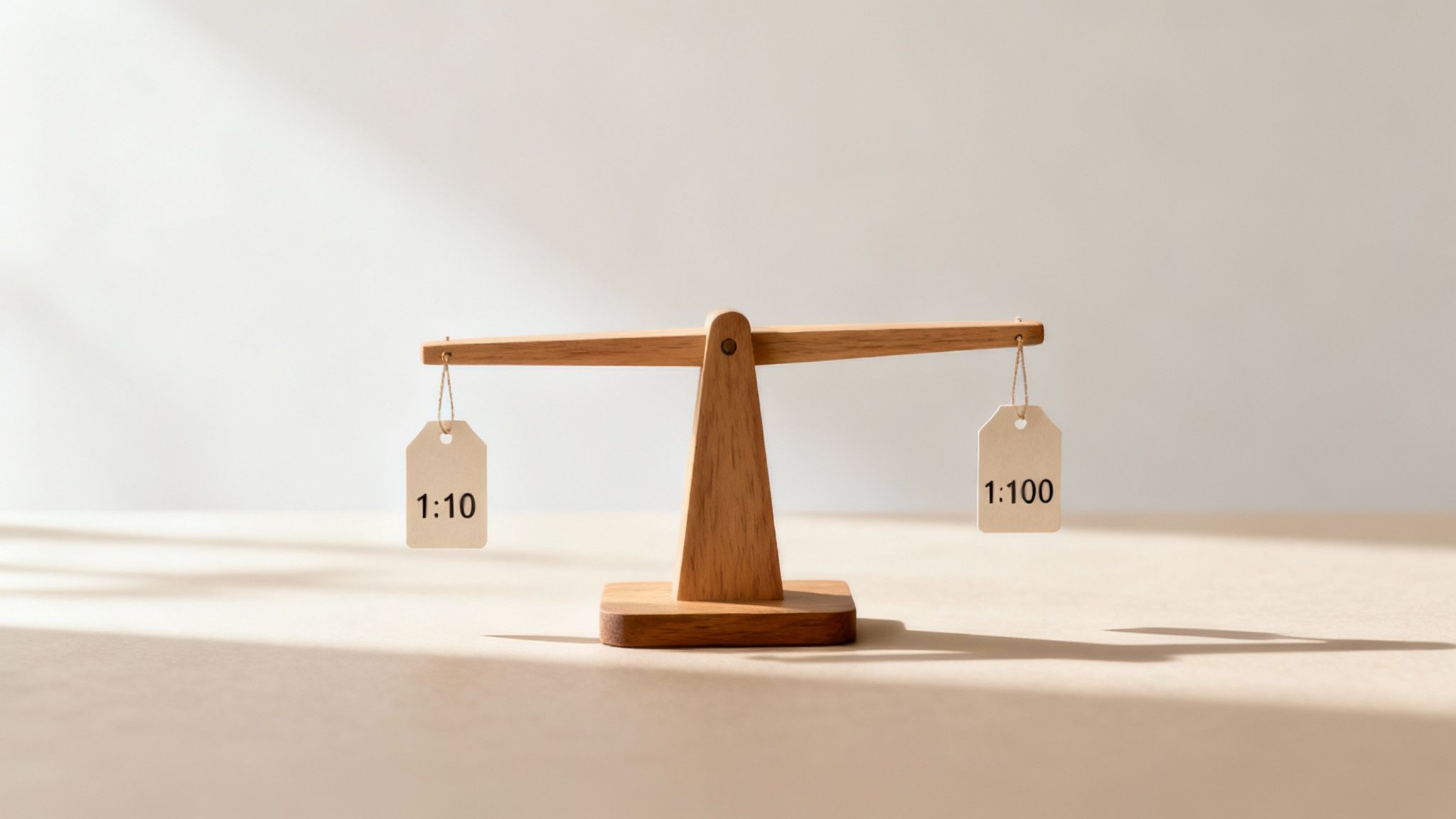
When your broker offers you sky-high leverage, it can be tempting to grab it. But hold on a second. One of the biggest mistakes new traders make is thinking that maxing out leverage is the fast track to big profits.
The truth is, picking the right ratio is more of a delicate balancing act. It’s about finding the sweet spot between your trading strategy, how much risk you’re comfortable with, and your overall experience.
A massive leverage ratio might look powerful, but it leaves you with almost no room for error. A tiny market swing in the wrong direction can trigger a margin call and wipe out your account before your trade even has a chance to play out. This is where truly understanding the leverage definition forex traders work with becomes so important.
That's why you’ll find most experienced traders taking a much more measured and conservative approach, especially when they were starting out.
Aligning Leverage with Your Trading Style
The right amount of leverage for you is directly linked to the way you trade. Different strategies come with their own approaches to managing risk and capital.
Think about it like this:
- Scalping (Short-Term): Scalpers jump in and out of trades within minutes. They might use higher leverage to try and squeeze profits from tiny price flickers. Make no mistake, though—this is an extremely high-risk game.
- Day Trading (Intraday): Day traders, who close all their positions before the market shuts, often opt for moderate leverage. They need enough oomph to make daily price swings worthwhile, but they also want to avoid the risks that come with holding trades overnight.
- Position Trading (Long-Term): Traders holding positions for weeks or even months use very low leverage, if any at all. Their main goal is to ride out the market’s inevitable ups and downs over the long haul without getting stopped out by a margin call.
Selecting a leverage ratio isn't about chasing the biggest possible profit on a single trade. It's about ensuring you have enough breathing room to stay in the market and manage risk effectively across all your trades.
Here in South Africa, the regulatory landscape also guides your choice. The Financial Sector Conduct Authority (FSCA) keeps a close watch to protect traders, often capping leverage at ratios like 1:100 or even lower for brokers under its regulation.
This helps maintain a stable market and has supported a sustainable 30% annual increase in retail trading since 2023. For a deeper dive into these regional trends, you can explore the growth of forex trading in Africa on contentworks.agency.
Common Questions About Forex Leverage
As you get to grips with how leverage works in the forex market, a few common questions are bound to pop up. Let's clear up some of the most frequent points of confusion to make sure you're on solid ground.
Think of this as a quick-fire round to nail down the essentials. Getting these concepts right is what separates a calculated strategy from a reckless gamble.
Is Higher Leverage Better in Forex?
Not at all. In fact, for most people, it's the opposite. While a huge leverage ratio looks tempting because it can amplify your wins, it does the exact same thing to your losses. This is a classic double-edged sword.
A small market move against you can wipe out your entire account in the blink of an eye. For beginners, and even many seasoned traders, a lower, more conservative leverage ratio is much smarter. High leverage is not a shortcut to success; it’s a powerful tool that can backfire spectacularly if you don't know exactly what you're doing.
What Is a Margin Call?
A margin call is that dreaded notification from your broker telling you to add more money to your account, and fast. It’s triggered when your trades go against you and the funds in your account (your equity) drop below the minimum amount required to keep those positions open.
A margin call is a serious red flag. It means your capital is in immediate danger. If you ignore it, your broker will start closing your trades automatically to cut their losses—and yours—often at the worst possible moment.
You have two choices: deposit more funds to meet the margin requirement or start closing out losing positions yourself to free up your existing margin.
Can I Trade Forex Without Leverage?
You certainly can. This is known as trading at a 1:1 ratio. The catch? You need a huge amount of capital, which most retail traders simply don't have.
For example, to trade a standard lot of 100,000 currency units, you'd need the full 100,000 units sitting in your account. The whole point of leverage is to open up the forex market to people who aren't starting with a massive bankroll, allowing them to participate with a much smaller initial deposit.
Managing foreign currency isn't just for traders. For South African businesses dealing with international suppliers or clients, getting the best exchange rate is critical. Zaro offers a powerful solution by providing real spot exchange rates with zero hidden fees, helping you protect your bottom line from unpredictable bank markups. Secure your financial operations and make global payments with confidence by visiting the official Zaro website.