
When you hear about the foreign exchange market, you're mostly hearing about the "majors." These are the world's most traded currency pairs, and they all have one thing in common: the US Dollar (USD). Think of them as the A-list celebrities of the financial world—always in the spotlight, driving the market, and setting the trends.
What Are Major Pairs In Forex

So, what exactly makes a currency pair a "major"? It's a simple formula: the US Dollar paired with another powerful, high-demand currency from a major global economy. This exclusive club forms the very backbone of the forex market, largely because of the sheer volume of trades they attract every single day.
The US Dollar's role here is key. As the world's primary reserve currency, it’s part of the vast majority of international transactions, from buying oil to financing trade deals. This universal demand means any currency pair involving the USD is naturally going to be highly liquid and influential.
The Seven Major Forex Pairs
Here's a quick look at the seven currency pairs that hold the "major" title. You'll often hear traders and analysts refer to them by their nicknames, which are a handy shorthand.
| Currency Pair | Currencies | Common Nickname |
|---|---|---|
| EUR/USD | Euro / US Dollar | "Fibre" |
| USD/JPY | US Dollar / Japanese Yen | "Gopher" |
| GBP/USD | British Pound / US Dollar | "Cable" |
| USD/CHF | US Dollar / Swiss Franc | "Swissy" |
| AUD/USD | Australian Dollar / US Dollar | "Aussie" |
| USD/CAD | US Dollar / Canadian Dollar | "Loonie" |
| NZD/USD | New Zealand Dollar / US Dollar | "Kiwi" |
Knowing these pairs isn't just for traders; it's fundamental for any South African business dealing with international payments.
If you're paying a supplier in Germany, settling an invoice in London, or receiving funds from a client in the United States, you're dealing with a major pair. The good news is their high trading volume usually means tighter spreads—the difference between the buy and sell price—which translates directly to lower transaction costs and more stable pricing for your business.
A strong grasp of the major pairs provides a clear lens through which to view global economic health. Their movements often signal broader shifts in financial markets, offering valuable insights for strategic business planning.
The popularity of these pairs is soaring right here in South Africa. The local market now sees a daily forex trading volume of over $2.21 billion, and the majors like EUR/USD, USD/JPY, and GBP/USD make up more than 60% of that action. This insight comes from the 2025 African Forex Trading Report, which you can explore in this forex market analysis.
Getting comfortable with these core concepts is the first, most crucial step before diving into the more advanced strategies we'll cover next.
Why Major Pairs Drive The Global Economy
Ever wondered why a small handful of currency combinations, the major pairs, seem to hold so much sway over the entire global financial system? It all comes down to one critical idea: liquidity.
Think of it like this. Selling a rare, antique chair might fetch a high price, but finding the right buyer could take ages. Now, imagine selling a brand-new, popular smartphone. You'd likely have a buyer in hours because there's a huge, active market for it.
That’s precisely how major pairs work. They're the smartphones of the forex world—always in demand, with a colossal volume of transactions changing hands every single day. This constant churn of buying and selling means you can almost always find someone on the other side of your trade at a fair price.
The Power of High Liquidity
This non-stop activity brings some very real benefits to the table, especially for a South African business dealing with international payments. High liquidity delivers:
- Tighter Spreads: The gap between the buying and selling price (the spread) is razor-thin for major pairs. For you, this means lower costs every single time you convert ZAR into another currency, or vice versa.
- Price Stability: Because millions of participants are trading at any given moment, it’s much harder for one big transaction to send prices on a rollercoaster ride. This creates more predictable exchange rates, which is a lifesaver for budgeting and forecasting.
- Faster Execution: Your currency trades are completed almost instantly. No more waiting around for a payment to clear while the market moves against you.
High liquidity isn't just a trader's buzzword; it's the grease in the wheels of global trade. For your business, it means less friction and lower costs when moving money across borders.
This unique mix of stability and low cost is why the major pairs are so much more than just trading symbols on a screen. They act as a real-time report card on global economic health.
When the EUR/USD pair moves, it’s not just numbers changing; it reflects the shifting confidence in the European and American economies. Central banks, multinational corporations, and investors all watch these movements like hawks, making the majors a true barometer for financial sentiment worldwide. Their influence reaches far beyond the trading floor, directly impacting the cost of your imported goods, the value of your overseas investments, and the flow of capital into and out of South Africa.
Understanding The Personalities Of Top Major Pairs
Not all major forex pairs behave in the same way. Each one has its own distinct ‘personality’, shaped by the unique economic forces, central bank policies, and market moods of the countries they represent. Getting to know these personalities is vital for any South African business managing international payments.
Think of it like knowing the difference between a high-performance sports car and a reliable bakkie. Both are brilliant at what they do, but you need to understand their individual strengths and weaknesses to use them effectively. In the same way, knowing what drives each major pair helps you anticipate how it might move.
This infographic below breaks down the core characteristics that define major pairs in the global economy.
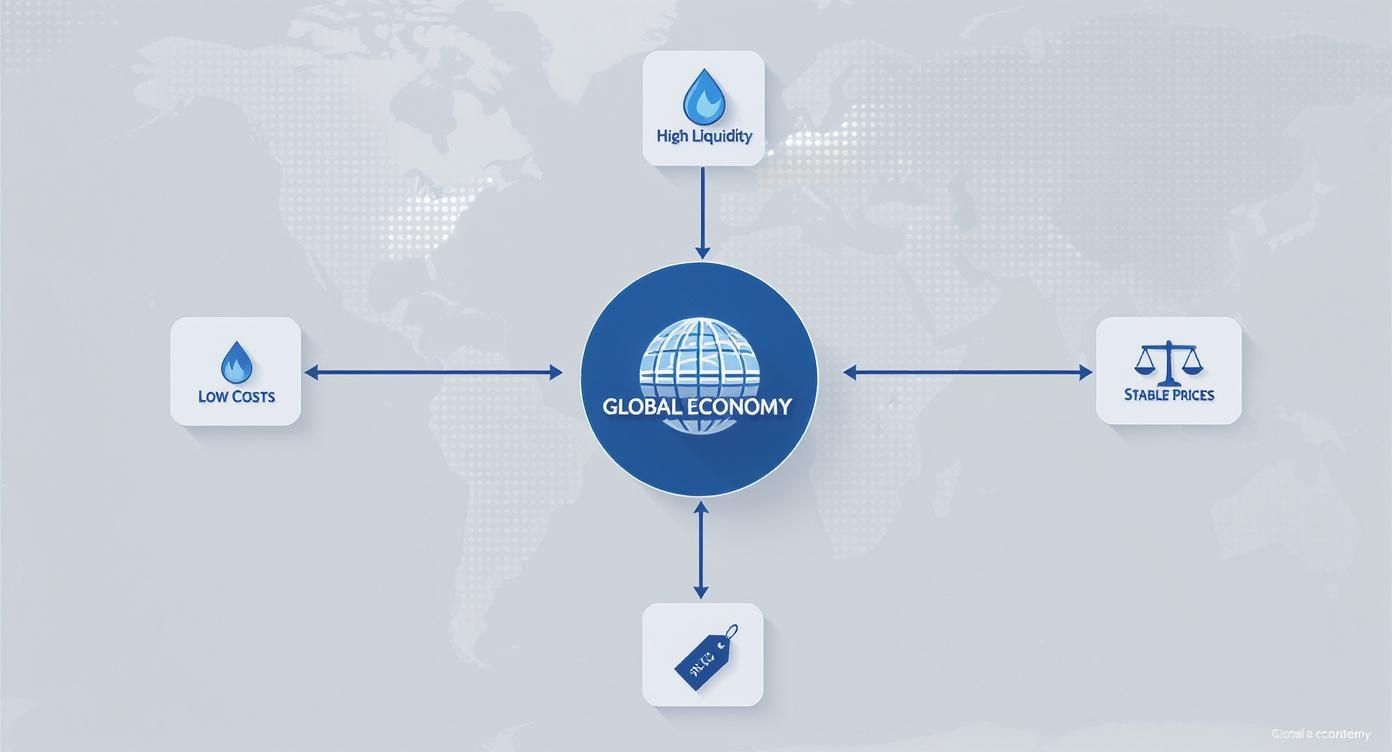
As you can see, high liquidity, low transaction costs, and stable pricing are central to their role, making them the bedrock of international trade and finance.
EUR/USD: The Market Bellwether
The EUR/USD is the most traded currency pair on the planet, often viewed as a barometer for the health of the global economy. Its movements are heavily influenced by interest rate decisions from the European Central Bank (ECB) and the US Federal Reserve (Fed).
When the Fed signals a rate hike, the US dollar typically strengthens, pushing the EUR/USD pair down. On the flip side, positive economic news from the Eurozone, like strong GDP figures, can boost the Euro and send the pair higher. For a local business importing French wine, a strengthening Euro (a rising EUR/USD) would directly increase the Rand cost of their next shipment.
GBP/USD: The Volatile Player
Known in trading circles as "Cable," the GBP/USD is famous for its volatility. This pair often makes sharp, sudden moves, reacting strongly to UK economic data like inflation reports and employment figures, as well as announcements from the Bank of England (BoE). Political events also play a massive role.
Imagine a South African tech company importing specialised equipment from the UK. They have to watch this pair like a hawk. An unexpected announcement from the BoE could cause the Pound to surge, dramatically increasing their import costs if they haven't hedged their exposure.
USD/JPY: The Safe-Haven Indicator
The USD/JPY pair behaves quite differently from the others. The Japanese Yen (JPY) is considered a safe-haven currency, meaning investors tend to buy it up during times of global economic uncertainty or market stress. This flight to safety causes the Yen to strengthen and the USD/JPY pair to fall.
Because of this, the pair acts as a powerful indicator of global risk sentiment. A South African investor with US-based assets might notice that when global markets get fearful, the value of their holdings could be impacted not just by falling stock prices, but also by a strengthening Yen.
Comparing The Top Major Forex Pairs
To give you a clearer picture, this table compares the characteristics of the most popular major pairs. It highlights their typical volatility and the key economic drivers that you need to watch.
| Currency Pair | Key Economic Drivers | Typical Volatility Level |
|---|---|---|
| EUR/USD | Interest rates (ECB & Fed), GDP growth, inflation, political stability in the EU. | Low to Medium |
| GBP/USD | Bank of England policies, UK inflation and employment data, political news (Brexit). | Medium to High |
| USD/JPY | Global risk sentiment, interest rate differences (Fed vs. Bank of Japan), trade data. | Low to Medium |
Understanding these drivers is the first step toward making more informed decisions for your business. Whether you're paying an invoice, receiving foreign currency, or managing investments, knowing what makes these pairs tick can help you protect your bottom line from unexpected currency swings.
Protecting Your Business From Currency Volatility

Knowing the major forex pairs is a great start, but the real test is using that knowledge to protect your bottom line. After all, a single bad swing in an exchange rate can wipe out the profit margin on an international deal you spent months putting together. This is currency risk in a nutshell, and it’s a constant headache for anyone doing business across borders.
Luckily, you don’t have to leave your profits to chance. There are proven strategies to shield your business from this volatility. The most common method is called hedging—think of it as taking out an insurance policy on your international payments. It’s all about removing the guesswork.
Locking In Your Future Exchange Rate
One of the simplest and most effective hedging tools is a forward exchange contract (FEC). This is an agreement that lets you lock in an exchange rate today for a transaction that will happen down the line.
Let's use a real-world example. Imagine a South African wine exporter has just secured a deal to sell a big shipment to an American buyer for $100,000. Payment is due in 90 days. The current USD/ZAR rate looks good, but what will it be in three months?
- The Gamble (No Hedging): If the Rand strengthens against the Dollar over those 90 days, the exporter gets fewer Rands for their $100,000. That profitable deal could suddenly become a loss-maker.
- The Smart Move (With Hedging): The exporter uses a forward contract to lock in today's rate. They agree to sell $100,000 in 90 days at that exact rate, regardless of what the live market does in the meantime.
This simple move swaps uncertainty for predictability. Hedging isn't about outsmarting the market; it's about removing market risk from the equation. It lets you focus on running your business with a clear, predictable cash flow.
For any business involved in global trade, this level of foresight is a game-changer. Of course, managing your shipping and logistics is just as critical. For a closer look at this, understanding Delivery Duty Paid (DDP) shipping is a fantastic resource for importers who need to keep a tight grip on their costs. When you pair smart hedging with clear shipping terms, you build a solid defence against the unpredictable world of currency markets.
How To Implement A Currency Hedging Strategy
Putting a plan in place to shield your business from currency swings can feel daunting. But when you break it down, it's a straightforward process that starts not with the markets, but with a good, hard look at your own operations. You need to know exactly where your financial risks are before you can do anything about them.
The first move is to map out your currency exposure. This means doing a full audit of all your international transactions, both the money coming in and the money going out. Ask yourself the simple questions: Which currencies do we use to pay our suppliers? And in which currencies do our customers pay us? This simple exercise gives you a clear snapshot of your net exposure.
Building Your Hedging Plan
Once you know the size and nature of your risk, you can start building a strategy. It really comes down to choosing the right tools for the job. While the major pairs forex market has a whole host of instruments, most businesses stick to a few tried-and-tested solutions that offer one crucial thing: certainty.
Here are the most common hedging tools for South African businesses:
Forward Exchange Contracts (FECs): This is the workhorse of hedging. An FEC lets you lock in an exchange rate today for a transaction that will happen in the future. It completely removes exchange rate volatility from the equation for that specific payment.
Currency Options: These offer a bit more flexibility. An option gives you the right, but not the obligation, to exchange currency at a set rate on a future date. This is great because it protects you from a bad move in the market but still allows you to benefit if the rate moves in your favour.
Let’s be clear: the goal of hedging isn't to speculate or try to beat the market. It’s about creating financial predictability. You’re turning a massive unknown variable into a fixed, manageable cost, which makes budgeting and forecasting so much more accurate.
Finally, have a conversation with a trusted financial partner. This could be your bank or a specialist forex provider. There's no one-size-fits-all solution here; what works for one business might not work for yours. A good partner will dig into your specific needs and cash flow cycle to recommend the right tools. They can help you structure a plan that’s not just effective, but also cost-efficient, giving you the confidence to manage your currency risk properly.
Still Have Questions About Major Pairs and Hedging?
Even with the best game plan, it's natural to have a few questions when you're getting to grips with major currency pairs and how to protect your business. Let's tackle some of the most common queries we hear from South African business owners to clear things up.
Are Major Pairs the Only Ones I Should Care About?
Not at all. While the majors are your foundation—they're the most traded and generally the most stable—your business's unique trading map dictates where you should focus.
If you're regularly paying suppliers in China or invoicing clients in India, you'll absolutely need to keep a close eye on pairs like USD/CNY or even our own USD/ZAR. The key is to watch the currencies that actually flow through your business.
That said, you can never go wrong by understanding the majors. Their sheer volume means they often set the tone for the entire forex market. A big swing in the Euro or the US Dollar can send ripples everywhere, affecting almost every other currency pair.
How Do I Actually Start Hedging Here in South Africa?
Getting started is simpler than you might think. The first step is to look inwards. You need to get a crystal-clear picture of your foreign currency exposure. Sit down and map out every single payment you make and receive that isn't in Rands.
Once you know the scale of your exposure, it's time to chat with a financial partner. This could be your bank, but a specialist forex provider is often better equipped to help. They’ll walk you through the practicalities, from setting up the right accounts to explaining the best tools for the job. For many South African businesses, forward exchange contracts (FECs) are the go-to tool for locking in an exchange rate for a future date.
Think of it this way: Forex trading is about seeking risk for potential profit. Business hedging is about eliminating risk to protect the profit you've already made.
Is Hedging Just Another Name for Forex Trading?
This is a common mix-up, but they are polar opposites. Forex trading is pure speculation. A trader buys or sells a currency hoping its value will move in their favour, aiming to make a profit from that shift. It’s all about taking on risk.
Hedging, on the other hand, is a defensive move. It’s what a business does to shield its profit margins from being wiped out by a sudden, unfavourable swing in the exchange rate. The goal isn’t to make more money; it's to create certainty and protect what’s already yours.
Do I Need to Be a Financial Whiz to Do This?
Absolutely not. You don't need to turn into a forex market analyst glued to a screen all day. That's the whole point of a good hedging strategy—it’s meant to take the complexity and unpredictability out of your international finances.
Your job is to understand your business's cash flow and where your currency risks are. From there, you work with a trusted forex partner who handles the heavy lifting. They can set you up with straightforward tools like forward contracts that put your currency protection on autopilot, freeing you up to focus on what you do best: running your company.
Ready to eliminate currency risk and simplify your international payments? Zaro offers transparent, real-time exchange rates with no hidden fees, giving your business the predictability it needs. Learn more and get started today.