
When you first step into the world of foreign exchange, you'll hear a lot about the "majors." These aren't just any currency pairings; they are the absolute titans of the forex market. In fact, the major pairs are the seven most frequently traded currency pairs on the planet.
Think of them as the blue-chip stocks of the currency world. Every single one of them involves the US Dollar, which isn't a surprise given its role as the world's go-to reserve currency.
Why Do These Seven Pairs Dominate Forex Trading?
Imagine the global currency market is a massive, sprawling city. The major pairs are the main highways—they're the busiest, most reliable, and most travelled routes connecting the biggest economic centres.
These seven pairs are the backbone of the market. They offer incredible stability and high liquidity, which is just a fancy way of saying you can buy and sell them easily without dramatically shifting their price. This makes them a great starting point for newcomers and a dependable field for seasoned pros.
So, who are these big players? The exclusive club of major pairs includes:
- EUR/USD (Euro/US Dollar)
- USD/JPY (US Dollar/Japanese Yen)
- GBP/USD (British Pound/US Dollar)
- USD/CHF (US Dollar/Swiss Franc)
- AUD/USD (Australian Dollar/US Dollar)
- USD/CAD (US Dollar/Canadian Dollar)
- NZD/USD (New Zealand Dollar/US Dollar)
Their popularity is no accident. It's a direct reflection of the enormous economic clout of the countries they represent. For any South African business trading internationally, getting to grips with these pairs isn't just helpful—it's essential for navigating the global economy.
We're seeing this interest boom right here at home, as digital platforms make forex more accessible than ever. South African retail forex volumes have shot up by about 18% year-over-year, a clear sign that more people are getting involved. You can read more about Africa's forex trading growth on fnforex1.com.
Understanding these majors is the perfect foundation before you dive into more complex currency relationships.
Meet the Seven Major Currency Pairs
In the world of forex, not all currency pairs are created equal. A select group, known as the "major pairs," accounts for the lion's share of daily trading volume. Think of them as the superstars of the currency market—the ones everyone is watching.
Every single one of these major pairs includes the US Dollar (USD), which is the world's primary reserve currency. The other side of the trade is one of the other most powerful global currencies. Getting to know them is the first step to understanding the entire market.
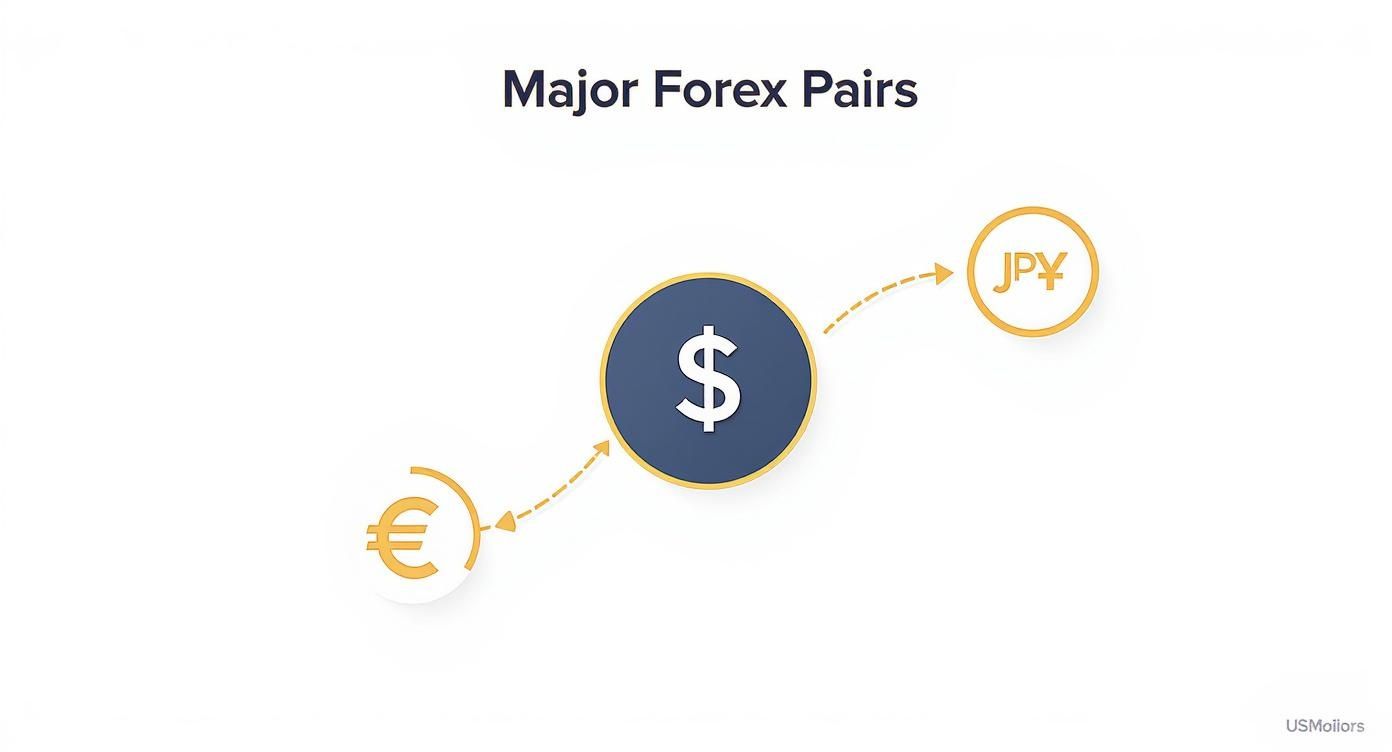
As the infographic shows, the USD sits at the centre of the action. Its movements create ripples that affect every other currency, making these pairs the most important indicators of global economic health.
The Heavyweights: EUR/USD and GBP/USD
Let's dive into the personalities of the most traded pairs. Each has a nickname that traders use as a kind of shorthand, and understanding what moves them is crucial.
EUR/USD ("The Fiber"): This is the undisputed king of forex, pairing the world's two largest economies. Its movements are heavily influenced by interest rate announcements from the European Central Bank (ECB) and the US Federal Reserve. When these two central banks speak, the Fiber listens.
GBP/USD ("The Cable"): The nickname is a nod to the old transatlantic telegraph cable that used to connect London and New York, transmitting currency prices. This pair is famously volatile, often reacting sharply to political news out of the UK and policy decisions from the Bank of England.
Here’s a crucial takeaway for any business: these pairs don’t operate in a vacuum. A major policy announcement from the US Federal Reserve won't just move the EUR/USD; it sends waves across the market, affecting everything from the British Pound to commodity-linked currencies.
The Commodity-Linked Crew
Some major currencies are closely tied to the fortunes of natural resources. For a resource-rich nation like South Africa, understanding this connection is especially important as it can offer clues about future market direction.
AUD/USD ("The Aussie"): Australia is a global powerhouse in commodities like iron ore, coal, and copper. Consequently, the Australian Dollar's value often moves in step with global commodity prices. It's also very sensitive to economic data coming out of China, its biggest customer.
USD/CAD ("The Loonie"): The Canadian dollar is nicknamed the "Loonie" after the bird on its one-dollar coin. As Canada is a massive oil exporter, the Loonie's value has a strong relationship with crude oil prices. When oil prices rise, the Canadian dollar tends to strengthen against its US counterpart.
To help you keep track, here’s a quick-reference table that summarises the key characteristics of the most popular major pairs.
A Snapshot of the Major Forex Pairs
| Currency Pair | Nickname | Key Economic Drivers | Typical Volatility |
|---|---|---|---|
| EUR/USD | The Fiber | ECB & US Fed interest rates, EU/US GDP | Low to Medium |
| GBP/USD | The Cable | Bank of England policy, UK political news | High |
| USD/JPY | The Gopher | Bank of Japan policy, global risk sentiment | Medium |
| AUD/USD | The Aussie | Commodity prices (iron ore), Chinese economic data | Medium |
| USD/CAD | The Loonie | Crude oil prices, Canadian economic reports | Medium |
| USD/CHF | The Swissy | Safe-haven demand, Swiss National Bank policy | Low |
By familiarising yourself with these nicknames, drivers, and behaviours, you start to see the market differently. You move from looking at abstract ticker symbols on a screen to recognising distinct opportunities, each with its own rhythm and personality.
Why Liquidity Makes Major Pairs So Popular

So, what’s the big deal with the major pairs in forex? Why do they get all the attention? It really boils down to one word: liquidity.
Think of it this way. Trying to sell a rare, classic car might take weeks to find the right buyer at the right price. But selling a popular, high-demand car? You’ll have buyers lining up the same day. That’s liquidity in action. The major pairs are the high-demand cars of the forex world; there's an enormous pool of buyers and sellers at any given moment.
This constant buzz of activity is precisely why they're a go-to for businesses. If you're handling international payments, you can't afford delays or uncertainty. You need things to happen smoothly and reliably, and that’s what high liquidity delivers.
How Liquidity Keeps Your Costs Down
The most immediate win from high liquidity is the impact on your transaction costs. In the currency market, this cost is called the spread – that small gap between the buying and selling price of a currency pair.
For major pairs, the sheer volume of trades keeps this spread incredibly narrow, or "tight." With so many transactions happening every second, brokers can facilitate trades for a fraction of a penny. This is a massive plus for South African businesses making regular international payments.
A tighter spread means you keep more of your money with every single transaction. Those small savings on each conversion might not seem like much at first, but they add up fast, protecting your profit margins from getting eaten away by fees. For an exporter getting paid in Euros, for example, converting those funds back to Rand is simply more cost-effective.
But it’s not just about saving money. High liquidity also brings a sense of calm and order to the market.
Predictability and a Strategic Edge
Because so many different people and institutions are trading the major pairs, their price movements tend to be much smoother. You see fewer of the wild, unpredictable price jumps that can catch you off guard with less-traded currencies. For a CFO trying to manage a company’s currency risk, this stability is worth its weight in gold.
This predictability offers a few clear advantages:
- Deeper Market Data: The huge trading volume creates a rich history of data, which is fantastic for analysing trends and managing risk.
- Reduced Slippage: When you place an order, you’re far more likely to get the price you expected. This helps avoid nasty surprises when you’re executing a large transaction.
At the end of the day, the high liquidity of major forex pairs creates a trading environment that is more efficient, more affordable, and far more predictable. For any business looking to build a sound financial strategy for its global operations, that’s a winning combination.
Why USD/ZAR is South Africa’s Unofficial Major Pair
When traders talk about the "majors," they're usually referring to pairs like the Euro versus the Dollar. But from a South African viewpoint, the currency pairing that truly dominates the conversation is the USD/ZAR (US Dollar/South African Rand).
On the world stage, the Rand is technically an ‘exotic’ currency. But here at home, its importance can't be overstated. For local businesses, especially an exporter using Zaro to manage international payments, the USD/ZAR is the most critical pair to watch. It's not just a number on a screen; it’s a direct indicator of financial health and opportunity.
What Makes the Rand Move
The big global currencies tend to dance to the tune of massive central banks like the US Federal Reserve. The Rand, however, has its own rhythm, influenced by a unique mix of local and international factors. This blend often creates significant volatility—presenting both challenges and strategic openings.
Here’s what typically pulls the strings:
- Commodity Prices: South Africa is a powerhouse exporter of resources like gold, platinum, and coal. When the global prices for these commodities shift, the Rand often follows suit.
- Political Stability: Any hint of political uncertainty or major policy changes can send ripples through the currency markets, causing the ZAR to strengthen or weaken rapidly.
- SARB Policy: The South African Reserve Bank (SARB) plays a huge role. Its decisions on interest rates and monetary policy are carefully watched by everyone with a stake in the Rand.
While pairs like EUR/USD and GBP/USD dictate global market trends, the USD/ZAR is the heartbeat of the South African economy. Its notorious volatility, fuelled by these local drivers, makes it one of the most dynamic and closely watched pairs for anyone doing business in the region.
This means that while the global majors provide a sense of broad market stability, the USD/ZAR offers a real-time reflection of the nation's economic pulse. You can track the latest movements and get more detailed analysis directly from the South African Reserve Bank.
How Currency Pairs Affect South African Businesses
For most people, the forex market is something that happens on a trader's screen or gets a brief mention on the evening news. But for any South African business with international customers or suppliers, understanding the major forex pairs isn't just theory—it's a core part of protecting your profits.
Every time a local company pays for imported parts or receives payment for exported goods, they’re stepping into the forex market. A slight shift in a currency pair can wipe out a profit margin, turning a great quarter into a financial headache. Suddenly, knowing your way around forex becomes a crucial business skill.
An Exporter’s Story: From Profit to Peril
Let's walk through a real-world scenario. Imagine a wine exporter in Stellenbosch who lands a fantastic deal with a German distributor. The invoice is for €100,000, and they plan to manage the payment through a platform like Zaro to get a fair exchange rate.
When they sign the contract, the rates look like this:
- EUR/USD: 1.08
- USD/ZAR: 18.50
The exporter does a quick calculation. The €100,000 payment will first be converted to US Dollars, giving them $108,000. That amount is then converted into Rands, landing them a final figure of R1,998,000. They've based all their financial planning on this number.
But fast-forward a month to when the payment actually hits their account. New economic data out of the US and Europe has nudged the market.
The new rates are:
- EUR/USD: 1.05 (The Euro is now weaker against the Dollar)
- USD/ZAR: 18.50 (The Rand/Dollar rate hasn't changed)
Now, that same €100,000 is only worth $105,000. When they convert it to Rands, the total comes to just R1,942,500.
A tiny-looking fluctuation in the EUR/USD pair cost the business over R55,000. That money vanished straight from their bottom line, purely due to market movements completely outside their control.
This example drives home just how connected the global currency market is. Even when your deal is in Euros, the US Dollar's performance can dramatically change how much Rand you end up with. For any South African business trading internationally, getting a handle on these currency dynamics is non-negotiable for safeguarding revenue.
Getting Started with Forex in South Africa
For a growing number of South Africans, the foreign exchange market isn't just about abstract numbers on a screen; it’s a tangible way to build a new financial future. In a tough economic climate, learning how to trade currencies offers a valuable skill and a potential new source of income. This is why getting the fundamentals right from the start is so important.
The journey into forex trading has to begin with a healthy respect for risk and the discipline to manage it. The smartest move any newcomer can make is to start with the major pairs in forex. They offer a much more stable training ground, with high liquidity and lower costs, letting you learn the ropes without the wild swings you'd see in less common currencies.
Your Path to Confident Trading
It's no secret that South Africa's high unemployment rate, particularly among young people, has pushed many to look for alternatives like forex. And with trading platforms now more accessible than ever, the barrier to entry is low. You can read more about how the local economy is fuelling interest in forex trading on newzimbabwe.com.
But to make it work, you need a plan. A structured approach is key.
- Learn the Market: Dive into quality resources to understand what really moves the major currency pairs.
- Build a Strategy: Create your own rulebook for when to enter and exit a trade, and how much you're willing to risk.
- Practise, Practise, Practise: Use a demo account to get a feel for the market and test your strategy without putting any real money on the line.
There's no secret formula for success in forex. It's about building a solid strategy you can stick to, managing your risk like a hawk, and making decisions based on good analysis, not gut feelings.
A crucial part of building that confidence is to rigorously backtest your trading strategies. This lets you see how your plan would have performed in the past, giving you the proof you need to trade effectively from day one.
Ready to manage your international business payments with the real exchange rate? Zaro gives South African businesses the power to send and receive global payments with zero spread and no hidden fees. Take control of your foreign exchange and protect your profits. Sign up today at https://www.usezaro.com.