
For any South African business with global ambitions, sending money across borders is a non-negotiable part of the daily grind. But let's be honest—it’s often a process loaded with frustrations. Hidden fees chip away at your profits, slow transfers strain supplier relationships, and opaque exchange rates make it impossible to know the true cost.
What if you could turn that operational headache into a genuine competitive advantage? That’s what this guide is all about.
Your No-Nonsense Guide to International Business Payments
Welcome. If you’re tired of the costs, delays, and sheer complexity that come with international payments, you’re in the right place. We’re going to pull back the curtain on the entire process, showing you how to move past the clunky, outdated systems holding your business back.
Think of this as your roadmap. We’ll cover everything from the old-school banking networks to the smarter fintech alternatives that are changing the game. The goal is simple: to help you save money, speed up your payments, and give your business the edge it needs to thrive globally.
Why We Need Better Ways to Pay
The need for fast, reliable, and affordable international payment solutions has never been more critical. As more South African businesses expand their reach—whether that’s paying overseas suppliers, managing remote teams, or even selling globally on Amazon—mastering the flow of money is essential. Commerce is borderless, and the financial systems supporting it need to catch up.
This isn't just a niche problem; it's a massive economic shift. Just look at the flow of money from South Africa into the SADC region. It exploded from R6 billion in 2016 to over R19 billion recently. During that same period, the number of transactions shot up from 4.8 million to 15.7 million.
When the pandemic hit in 2020 and travel ground to a halt, the informal cash networks that many relied on were suddenly cut off. This forced a huge migration to formal, digital channels, accelerating a trend that was already underway.
What to Expect in This Guide
We’re going to break down these complex topics into simple, actionable advice. No jargon, no fluff. Just a practical understanding of how you can make your cross-border payments cheaper, faster, and far more transparent.
Here’s a sneak peek at what we'll cover:
- How Your Money Actually Moves: We’ll demystify the journey your funds take from point A to point B.
- Finding the Real Cost: You'll learn how to spot the hidden fees and markups that are quietly costing you a fortune.
- Getting Compliance Right: We'll explain the essential Know Your Business (KYB) checks in plain English.
- Solving the Biggest Headaches: We’ll tackle the most common frustrations head-on with practical solutions.
By the end of this guide, you’ll have the confidence to choose the right payment partner and build a strategy that turns a necessary cost into a powerful tool for your business's global growth.
How International Money Transfers Really Work
Have you ever wondered what actually happens after you hit ‘send’ on an international payment? It’s tempting to think your money zips straight from your account to your supplier's, almost like an email. But the reality, especially when using traditional banks, is a whole lot more complex and far less direct.
The best way to picture the old-school banking system, built on something called the SWIFT network, is to think of it as a long-haul flight with a few layovers. Your money doesn’t take a direct route. Instead, it gets passed between several intermediary banks before it finally gets to where it’s going.
And just like an airline might charge for baggage handling at each stop, every bank in that chain takes a small slice for its part in processing your transaction. Each of these "layovers" adds delays and, more importantly, costs.
Tracing the Journey of Your Payment
Let's walk through what happens to a hypothetical payment of R150,000 from your business in Johannesburg to a supplier in Germany.
- Departure: You tell your local South African bank to send the funds. They debit your account and switch the Rands into Euros, usually at an exchange rate that includes their own markup.
- First Stop (Correspondent Bank): Your bank probably doesn’t have a direct line to your supplier's small local bank in Hamburg. So, it uses the SWIFT network to send the payment instructions to a much larger "correspondent" bank, maybe one in London or Frankfurt.
- Processing and Fees: This middleman bank processes the payment, skims its fee off the top, and then forwards what's left to another bank in the network that’s closer to the final destination.
- Arrival (with Deductions): After maybe another stop, the money finally lands in your supplier’s bank account in Hamburg. The problem? The amount that arrives is less than what you sent. Each bank along the way has quietly deducted its service charges.
This is exactly why a traditional international transfer can take anywhere from three to seven business days, and why the final amount received is often a nasty surprise. The moment the money leaves your account, you lose all control.
The image below shows this evolution, moving away from these clunky, multi-step processes toward something far more efficient.
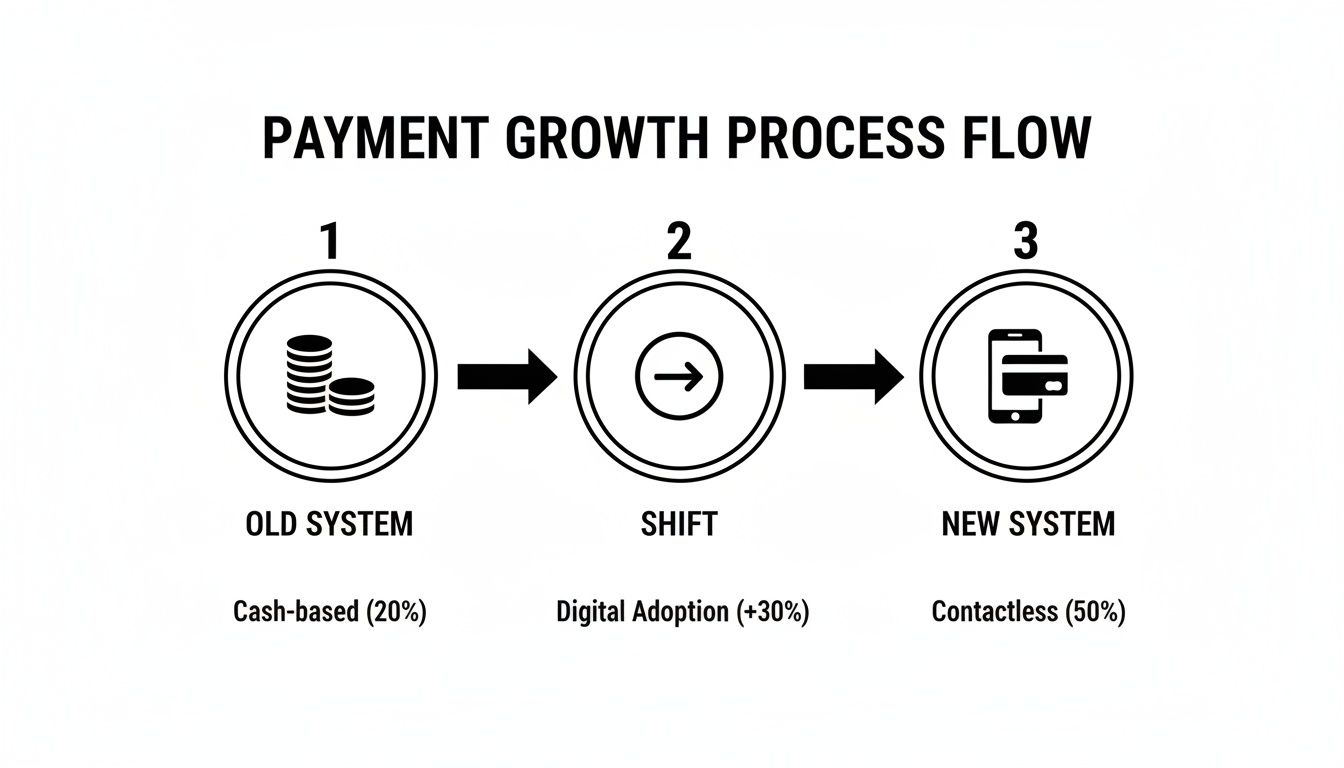
This journey from old to new gets to the heart of the problem that modern financial technology is trying to solve: getting rid of those expensive and slow "layovers" in global finance.
The Modern Alternative: A Direct Flight
Fintech platforms offer a completely different approach—a much more direct route for your money. They've essentially built their own payment highways that bypass the need for all those intermediary banks.
A core principle of efficient finance is minimising the number of hands that touch the money. The fewer intermediaries involved, the lower the cost and the faster the settlement. This is the fundamental advantage fintechs bring to international payments.
Instead of sending your money on a world tour, these platforms use a clever network of local bank accounts in different countries.
When you send money to Germany, the platform will take your Rands into its South African account and then, almost simultaneously, pay your supplier in Euros from its German account. Your money never really crosses a border in the old-fashioned sense. It’s a local transfer on both ends, all managed by one provider.
This "direct flight" model gives you some massive advantages:
- Speed: Payments can be settled in a matter of hours or 1-2 business days, not an entire week.
- Cost Savings: By cutting out the intermediary bank fees, the total cost of the transaction drops dramatically.
- Transparency: You know exactly how much money will land in the recipient's account because there are no surprise deductions waiting to happen.
This is a fundamental change in how international payments work, and it's a game-changer for businesses. It turns a slow, expensive, and murky process into one that is fast, affordable, and completely predictable. It puts you back in control of your company's cash flow.
Unpacking the True Cost of Sending Money Abroad
When you need to send money overseas, the fee you see advertised upfront is almost never the full story. Think of it as just the tip of the iceberg. The real cost of moving money across borders is often tucked away in complex calculations and hidden markups that quietly chip away at your profits.
Focusing only on that low, advertised transfer fee is one of the most common—and costly—mistakes a business can make. To get a real grip on what you're paying, you need to pull back the curtain on the three distinct cost drivers that work together to inflate your expenses.

The Three Layers of International Payment Costs
Let's break down the total cost into its different layers. Each one adds to your final bill, but usually, only one is shouted from the rooftops.
- The Fixed Transaction Fee: This is the most obvious cost. It's the flat fee the bank or provider charges you just for processing the payment, often marketed as something like "R250 per transfer." It’s easy to see and easy to compare.
- The Exchange Rate Spread: Here’s the big one—the most significant hidden cost by far. The spread is the difference between the 'real' mid-market exchange rate (the one you see on Google or Reuters) and the less favourable rate your provider actually gives you. This markup is pure profit for them and a direct loss for your business.
- Intermediary Bank Charges: As we touched on earlier, payments sent via the SWIFT network can get "nibbled" on along the way. Each bank in the chain can deduct its own handling fee, and these charges are often unpredictable and taken from the money you’re sending before it even reaches the recipient.
These three components combine to determine the true, all-in cost of your international money transfer. And more often than not, the spread is the biggest culprit, draining far more from your funds than any flat fee ever could.
How a Small Spread Snowballs into a Big Loss
Let's put this into a real-world scenario. Imagine your South African business needs to pay a US supplier $5,300. Your accountant gets ready to send the Rand equivalent, which comes to R100,000.
Now, let's say the real, live mid-market exchange rate is R18.87 to $1. A provider offering a zero-spread rate would simply convert your R100,000 at that exact rate, and your supplier would receive the full $5,300. Simple.
But what happens when your bank applies a seemingly tiny 2% spread? That 2% markup on R18.87 bumps their offered rate up to R19.25.
At this inflated rate, sending $5,300 would now cost your business R102,025 (5300 * 19.25). That "small" 2% spread just cost you an extra R2,025 on a single transaction, completely separate from any fixed transfer fees.
This example shows just how quickly a minor percentage difference can translate into thousands of Rands lost. Imagine that happening across dozens of payments a year—it’s a serious drain on your company’s profitability.
Calculating Your All-In Rate
To safeguard your bottom line, you have to stop looking at the upfront fee and start calculating your all-in rate. This just means figuring out the total cost—including all fees and the spread—as a single percentage of the transaction value.
Here's a simple comparison to illustrate this. Let’s look at the true cost of that R100,000 transfer with two different providers.
| Cost Component | Traditional Bank (Example) | Zaro (Zero-Spread Model) |
|---|---|---|
| Transaction Amount | R100,000 | R100,000 |
| Exchange Rate Spread | 2% (Hidden cost = R2,025) | 0% (No spread) |
| Advertised Fee | R250 (Fixed Fee) | 0.5% (Transparent Fee = R500) |
| Total Cost | R2,275 | R500 |
| SAVING | R1,775 |
As the table shows, the bank's low fixed fee was a smokescreen for a much larger cost hidden in the rate. By choosing the transparent provider, you save R1,775 on this one payment alone.
The key takeaway is this: always demand clarity on the exchange rate you’re being offered and compare it against the live mid-market rate. That’s the only way to uncover the true cost of your international money transfer and keep your money where it belongs.
Getting Through Compliance and Business Verification
Before a single rand leaves South Africa, every financial institution has a critical checkpoint to clear: compliance. It might feel like a mountain of red tape, but these rules are what keep the global financial system secure. They’re there to stop fraud, money laundering, and other financial nasties. For any business making an international money transfer, this step is unavoidable.
The core of this process is something called Know Your Business (KYB). Think of it as a background check for your company. Your payment provider needs to be absolutely sure your business is legit, who the real owners are, and what you actually do. This is all tied into strict Anti-Money Laundering (AML) regulations that require them to keep an eye out for any dodgy-looking transactions.
These checks aren't designed to trip you up; they're there to protect everyone. A solid verification process ensures the platform isn’t being abused, which keeps the entire payment network trustworthy and secure for all businesses.
The Old Way vs. The New Way
How a financial provider handles compliance can make or break your ability to operate smoothly. The difference between old-school banks and modern fintech companies is often night and day.
The traditional banks often get stuck in slow, paper-based systems. This usually means:
- Dragging yourself to a physical branch for in-person visits to hand over papers.
- Filling out endless paperwork that needs multiple signatures and manual capturing.
- Waiting… and waiting. Verification can take weeks, leaving your business in limbo.
This clunky approach creates a massive bottleneck, delaying payments to your suppliers or holding up funds from overseas customers. In stark contrast, modern fintechs have designed their systems for a digital world from the ground up.
The point of modern compliance isn't to create roadblocks; it's to build trust using technology. By automating verification, fintechs can get a business onboarded securely in a fraction of the time, turning a week-long headache into a process that's often done and dusted in a day.
Fintech platforms use technology to make this whole ordeal faster and a lot less painful. You can typically upload your documents online, and automated systems verify your company registration and director details almost instantly. It means you can get set up and start trading globally in a matter of hours, not weeks, all while meeting the highest regulatory standards.
What Documents Will You Need?
While the specifics might differ slightly between providers, most will ask for a standard pack of documents to get your KYB done. Having these ready to go will make the whole thing much quicker.
You’ll almost certainly need:
- Company Registration Documents: Your official CIPC registration certificate that proves your company legally exists in South Africa.
- Proof of Business Address: A recent utility bill or bank statement in your company's name, showing where you operate from.
- IDs for Directors and Shareholders: Certified ID documents for all directors and any major shareholders (usually anyone who owns more than 25% of the business).
- Proof of Bank Account: A letter from your bank confirming your business account details.
Getting a handle on these requirements is especially important for businesses with international ties. For instance, some may need to navigate additional compliance hurdles, like figuring out the process for opening a UK business bank account as a non-UK resident.
At the end of the day, a slick and transparent compliance process is a great sign you’ve found an efficient payment partner. It shows they respect your time and have built the right tech to make your move into global markets as seamless as possible.
Solving Common International Payment Headaches
For many South African businesses, sending money overseas feels less like a simple transaction and more like navigating an obstacle course. These payments are often riddled with frustrating delays and hidden costs that put a handbrake on growth, creating friction where things should be seamless. From unpredictable cash flow to strained supplier relationships, these headaches are all too real.
The good news? These problems are entirely solvable. By pinpointing the core issues, we can see how modern financial platforms are built specifically to eliminate them, bringing much-needed predictability and efficiency back to your global operations.

Unpredictable Cash Flow and Eroding Margins
Forecasting is one of the biggest challenges for any finance team. You meticulously plan your budgets, but when an international payment comes up, that plan often gets thrown out the window. Why? Because volatile exchange rates and hidden fees make it nearly impossible to know what a transaction will actually cost you in the end.
Let’s say you agree to pay a supplier €10,000. On Monday, that might equate to R195,000. By the time your bank processes the payment on Wednesday, a slight market shift plus their surprise spread could easily push the final rand cost to R198,000. That R3,000 difference comes directly out of your profit margin.
This isn't just an accounting problem; it's an operational one. If you can’t predict your costs with certainty, you can’t confidently price your own goods or services for international customers.
Modern payment platforms tackle this head-on by offering fixed, transparent costs. You get to lock in a real exchange rate with zero spread, meaning the price you see is the price you pay. This turns a volatile expense into a predictable one, giving you the financial clarity to forecast accurately and plan with confidence.
Operational Drag from Slow Settlements
Another major headache is just how long it takes for money to get from A to B. A traditional money transfer international payment can take up to seven business days to finally land in your supplier’s account. This operational drag creates a cascade of problems right through your supply chain.
Think about a real-world scenario. Your business in Cape Town needs a critical component from a manufacturer in China to fulfil a big customer order. You send the payment, but it gets stuck somewhere in the SWIFT network for a week.
While you wait, a few things happen:
- Your supplier won't ship the goods until the funds clear, delaying your entire production schedule.
- The delay strains your relationship with the supplier, who might see it as you paying late.
- Your own customer gets frustrated waiting for their order, which can seriously damage your reputation.
In today's fast-moving global economy, speed is a genuine competitive advantage. Slow payments are more than an inconvenience; they’re a direct barrier to efficient operations and strong international partnerships.
Modern systems solve this by completely bypassing the slow, multi-step SWIFT network. They use local payment rails on both ends of the transaction, which allows them to settle funds in as little as 1-2 business days—and often even faster.
This speed breaks the operational bottleneck. Your supplier gets paid on time, goods are shipped promptly, and your business can move with the agility needed to compete globally. Plus, with real-time tracking, you always know exactly where your money is and when it will arrive, finally removing the anxiety of the unknown.
Choosing the Right International Payment Partner
After wrestling with hidden costs, sluggish settlement times, and maddening compliance checks, one thing becomes crystal clear: the old way of moving money across borders is broken for modern businesses. The fix isn't about finding a slightly less frustrating version of the old system. It's about switching to a new model built from the ground up for transparency, speed, and control.
A truly modern financial platform tackles the root causes of high costs and delays by simply changing the rules. Instead of hiding a markup in the exchange rate, this new approach gives businesses the real, mid-market rate—the same one you’d find on Google or Reuters—with zero spread. This one change gets rid of the biggest and most confusing cost in cross-border payments.
What you get is a move from financial guesswork to total certainty. When you know the exact exchange rate and see a single, clear fee upfront, you can plan and budget in a way that traditional banks just don’t allow for.
Giving Businesses Real Control and Efficiency
Saving money is great, but the right partner does more. It gives your finance team the tools they actually need to manage global cash flow without the headache. This isn't just about firing off a single payment; it's about creating a solid financial operation that can handle international growth without the usual administrative burden.
This is all made possible with practical features designed specifically for businesses:
- Multi-Currency Accounts: You can fund and hold balances in major currencies like ZAR and USD. This lets you manage payments in and out without being forced into expensive conversions for every single transaction.
- Payments at the Spot Rate: Send money at the live exchange rate, making sure you lock in the best possible value the second you hit "send".
- Complete Team Control: Give your finance department multi-user access with permission levels you can customise. This ensures proper oversight and governance for every transaction.
These features turn international payments from a reactive, costly chore into a strategic tool for managing your finances.
A modern payment platform should make sending money internationally feel as simple and secure as a local transfer. By cutting out the middlemen and hidden markups, businesses can finally move funds at their true cost and take back control of their global finances.
The Real-World Benefits of a Modern Platform
So, what does all this mean for your daily operations and your bottom line? The advantages are straightforward and immediate.
For a South African exporter, it means bringing USD revenue back home without seeing a huge slice disappear due to a bad exchange rate. For an importer, it means paying overseas suppliers with confidence, knowing the exact Rand amount needed without stressing about last-minute currency swings or surprise bank fees.
Ultimately, it’s about turning a volatile cost centre into a predictable, manageable operating expense.
Choosing a platform like Zaro isn't just about finding a cheaper way to send money. It's an investment in financial clarity, operational speed, and strategic control. When you remove the friction and guesswork that plague the old systems, your business can optimise its cash flow, build stronger relationships with suppliers, and compete far more effectively on a global scale.
A Few Common Questions
When you're dealing with cross-border payments, a few questions always seem to pop up. Let's tackle some of the most common ones that South African businesses face, so you can make smarter decisions with your money.
What Is the Cheapest Way to Send Money Internationally for a Business?
It’s easy to get fixated on the upfront transfer fee, but that’s rarely the whole story. The real cost culprit is almost always the hidden exchange rate markup, often called the 'spread'. Because it's a percentage, this hidden fee can easily dwarf a flat transaction charge, especially on larger transfers.
The most cost-effective method is to find a provider who gives you the real mid-market exchange rate with no hidden spread. When you combine that with a simple, transparent fee structure, you get the full picture. You'll know exactly what you're paying and can be confident you’re getting the best possible value for your international payment.
How Long Does an International Bank Transfer Usually Take?
If you’re using the traditional banking system, you’re looking at a wait. A standard international transfer sent via the SWIFT network typically takes anywhere from 3 to 7 business days to land. Why so long? Your money has to hop between several intermediary banks on its way to the final destination, and each stop adds time and, sometimes, extra costs.
This is where modern fintech platforms have completely changed the game. By using smarter payment rails and local accounts, they cut out the middlemen. This means an international money transfer can often be completed in just 1-2 business days — sometimes even faster. That's a huge win for keeping your operations running smoothly.
What Documents Do I Need for a Business Money Transfer?
Before you can send any funds, you’ll have to go through a Know Your Business (KYB) process. Think of it as a standard identity check for your company. It's a non-negotiable compliance step designed to prevent financial crime and confirm everything is above board.
You’ll generally need to have these documents handy:
- Your official company registration papers.
- Proof of your business's physical address.
- Certified ID for all company directors and key shareholders.
- An invoice or similar proof for the payment itself, which is a key requirement under South Africa’s exchange control regulations.
Ready to transform your international payments with zero-spread exchange rates and complete transparency? Join the growing number of South African businesses choosing Zaro for faster, cheaper, and more predictable global transactions. Get started with Zaro today.