
Sending money overseas is, at its core, the simple act of moving funds from a bank account in one country to someone in another. But for a South-African business, it’s rarely that straightforward. It’s a crucial part of paying international suppliers, pulling in revenue from exports, or managing a global payroll. How well you handle these transfers has a direct, and often significant, impact on your bottom line.
Why Your Approach to Overseas Money Transfers Matters
For any South-African business owner or CFO, sending money abroad can feel like navigating a maze blindfolded. You're often dealing with hidden fees, frustrating delays, and a mountain of confusing paperwork.
Think of it like shipping a critical package overseas. You'd want to know the exact route, the all-in cost, and precisely when it will land. Anything less is a gamble. A single misstep in a money transfer can strain a vital supplier relationship or quietly chip away at your profit margins.
Unfortunately, sticking with the old-school banks for these transfers often creates more problems than it solves. These systems just weren't built for the speed and clarity that today's global businesses need.
The Common Headaches for SA Businesses
Talk to enough business owners and you'll hear the same stories. The frustrations with traditional international payments are universal, creating financial headaches and adding hours of admin work nobody has time for.
Here’s what typically goes wrong:
- ** murky exchange rates:** Banks rarely give you the real market rate. Instead, they add a hidden markup – the foreign exchange (FX) spread – into the rate they quote. It’s an extra cost, but it's not itemised, so you're paying more without even realising it.
- Glacial transfer speeds: The standard SWIFT network can take 3-5 business days for a payment to clear. That kind of delay creates cash flow uncertainty and can even hold up shipments.
- The compliance slog: The paperwork for Know Your Business (KYB) and anti-money laundering (AML) checks is often a manual, time-consuming nightmare that slows the whole process to a crawl.
For any business competing on a global stage, these aren't just minor annoyances. They're direct threats to your financial health. A delayed payment can sour a partnership, and those hidden fees silently eat away at the profits you’ve worked so hard to build.
The Scale of South Africa's Cross-Border Payments
The need for a better way to send money is growing fast. The South-African cross-border transfer market is already valued at around USD 330 million. That figure shows just how much money is constantly flowing in and out of the country.
While a big chunk of that is personal remittances sent home to family, business payments for international goods and services are a massive, vital part of the picture—especially for our export-focused SMEs. This is exactly why a modern, efficient approach to overseas money transfers is no longer a "nice-to-have"; it's essential for staying competitive. You can discover more insights about the South African remittance market and its potential for growth.
What Really Happens When You Send Money Overseas?
Ever wondered what actually happens after you click ‘send’ on an international payment? It's easy to picture your money flying directly from your account to your supplier's, but the reality is much clunkier. It’s less like a direct flight and more like an old-fashioned postal service with multiple, expensive layovers.
This journey almost always relies on the SWIFT network. But here's the crucial bit: SWIFT doesn't actually move money. It's a messaging system that sends secure payment orders between banks. Think of it as a high-tech telegram service for finance.
Your payment order hops between several correspondent banks—financial institutions that act as middlemen because your bank and your supplier's bank don't have a direct relationship. Each stop adds time and, you guessed it, a fee. This is precisely why a "simple" transfer can take 3-5 business days to land, with every bank in the chain taking a slice of your money for their trouble.
Where Does Your Money Actually Go?
The total cost of sending money abroad is never just the upfront fee you see advertised. Several hidden costs quietly chip away at the final amount your recipient gets, directly eating into your profit margins. Knowing what these are is the first step to fighting back.
Let's break down the usual suspects:
- Sending Fees: This is the flat fee your bank charges just to get the process started. It's the most obvious cost.
- Intermediary Bank Fees: These are the charges levied by each correspondent bank that handles your payment along its SWIFT journey. They are often unpredictable and can stack up.
- Receiving Fees: Believe it or not, the recipient's bank often charges a fee just to process the incoming funds.
- The FX Spread: This is the big one. It's the markup your bank adds to the real exchange rate (the one you see on Google). They buy currency at a wholesale price and sell it to you at a much higher one, pocketing the difference.
The foreign exchange (FX) spread is often the single largest expense in an international transaction, yet it never appears as a line item on your statement. It's a hidden fee disguised as a rate.
To make sure your transactions are watertight from the start, it's vital to get your documentation right. Using professional tools like proforma invoice templates for export can prevent costly errors before a payment is even initiated.
A Real-World Example: How Your R100,000 Shrinks
Let's put this into practice. Imagine your South African business needs to pay a supplier R100,000 in the United States.
- The Hidden FX Spread: The real, mid-market exchange rate is R18.50 to $1. But your bank offers you their "special" rate of R18.90. That 40-cent spread means your R100,000 is instantly worth just $5,291, not the $5,405 it should be. You've already lost $114 (over R2,100) before the money has even left the country.
- The Visible Fees: Your bank adds a R450 sending fee. Along the way, two intermediary banks each skim off a $20 fee. Finally, the supplier’s US bank charges a $15 receiving fee. That's another R450 + $55 (around R1,017) in combined charges.
By the time it arrives, your R100,000 has been whittled down to just $5,236. The total cost of this one transfer was over R3,500, but only a tiny fraction of that was clearly disclosed to you upfront.
This whole process is riddled with frustrations for businesses, as this image shows.
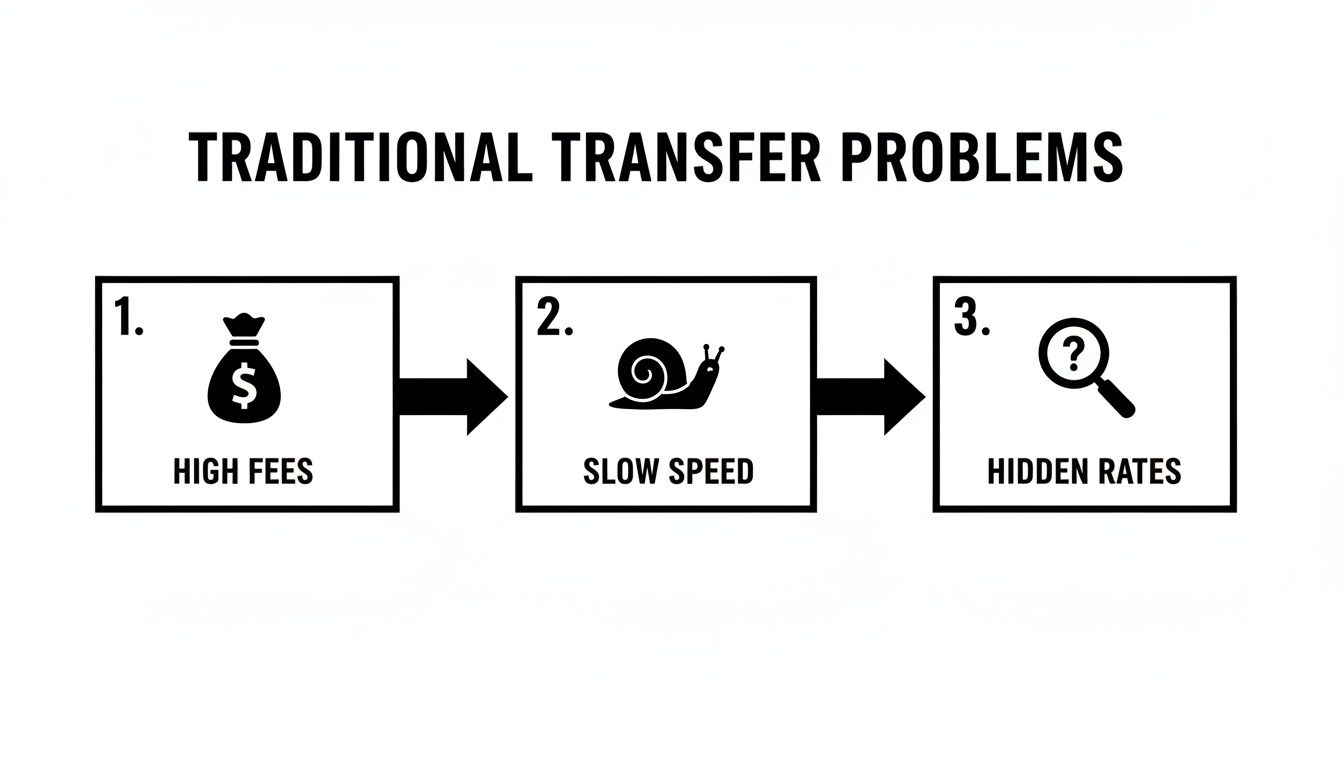
It’s a system where high fees, sluggish speeds, and hidden rates create a nightmare for any company trying to manage its international cash flow. Once you understand how the game is played, you can start looking for a better way to play it.
Comparing Your International Payment Options
Choosing the right partner for your overseas money transfers is a massive decision for any South African business. It’s not just about sending money; it’s about your bottom line, your operational speed, and the relationship you have with your international partners. The provider you choose directly impacts how much of your hard-earned money actually arrives at its destination.
Let's break down the three main players in this space: the old-school banks, the specialist brokers, and the new fintech challengers. Each has its own way of doing things, and understanding the differences is key to finding the best fit for your company, whether you’re paying suppliers in China or collecting revenue from Europe.
The Old Guard: Traditional Banks
For most businesses, the first thought for an international payment is their everyday bank. It’s familiar, it feels safe, and hey, all your accounts are already there. You can pop into a branch or log into an often-clunky online portal to get the job done.
But that convenience comes at a serious cost. Banks are well-known for offering some of the worst exchange rates out there. They build in hefty hidden markups—the FX spread—that can easily skim 2-5% off the top of your transfer value. Add in high SWIFT fees and a snail-like pace of three to five working days, and that feeling of convenience starts to wear thin very quickly.
The Focused Alternative: Specialist FX Providers
Next up are the specialist Foreign Exchange (FX) providers, or brokers. These companies live and breathe international payments, so they’re a definite step up from the banks. You’ll almost always get a much better exchange rate and lower fees. Many also throw in personalised service and handy risk management tools, like forward contracts to lock in a rate.
While they are a far better option than a bank, transparency can still be an issue. Some brokers aren't completely upfront about their margins, and their online platforms can feel a bit dated compared to what's now available. The sign-up process can also be a bit slow. They're a solid choice, but maybe not the nimble, digital-first solution a modern business needs.
The biggest change we're seeing in international finance isn't just about chasing lower fees. It's about a demand for total transparency. Businesses now want—and should expect—to see the real, live mid-market exchange rate and a clear breakdown of every single cost before they hit 'send'.
The New Challengers: Modern Fintech Platforms
This is where the game has really changed. Fintech companies like Zaro were built specifically to fix the problems created by the older systems. They operate with a technology-first mindset, focusing on giving businesses direct access to the real mid-market exchange rate with absolutely no hidden spreads.
Their biggest advantage is speed and simplicity. By using smarter payment networks instead of just the old SWIFT system, transfers can often land on the very same day. Onboarding is a quick, digital affair, and the platforms are built to be intuitive. You can manage payees, track every payment in real-time, and pull financial reports with a few clicks.
As you weigh your options, looking into the broader world of alternative payment methods can also open your eyes to new ways of operating that save time and keep your customers or suppliers happy.
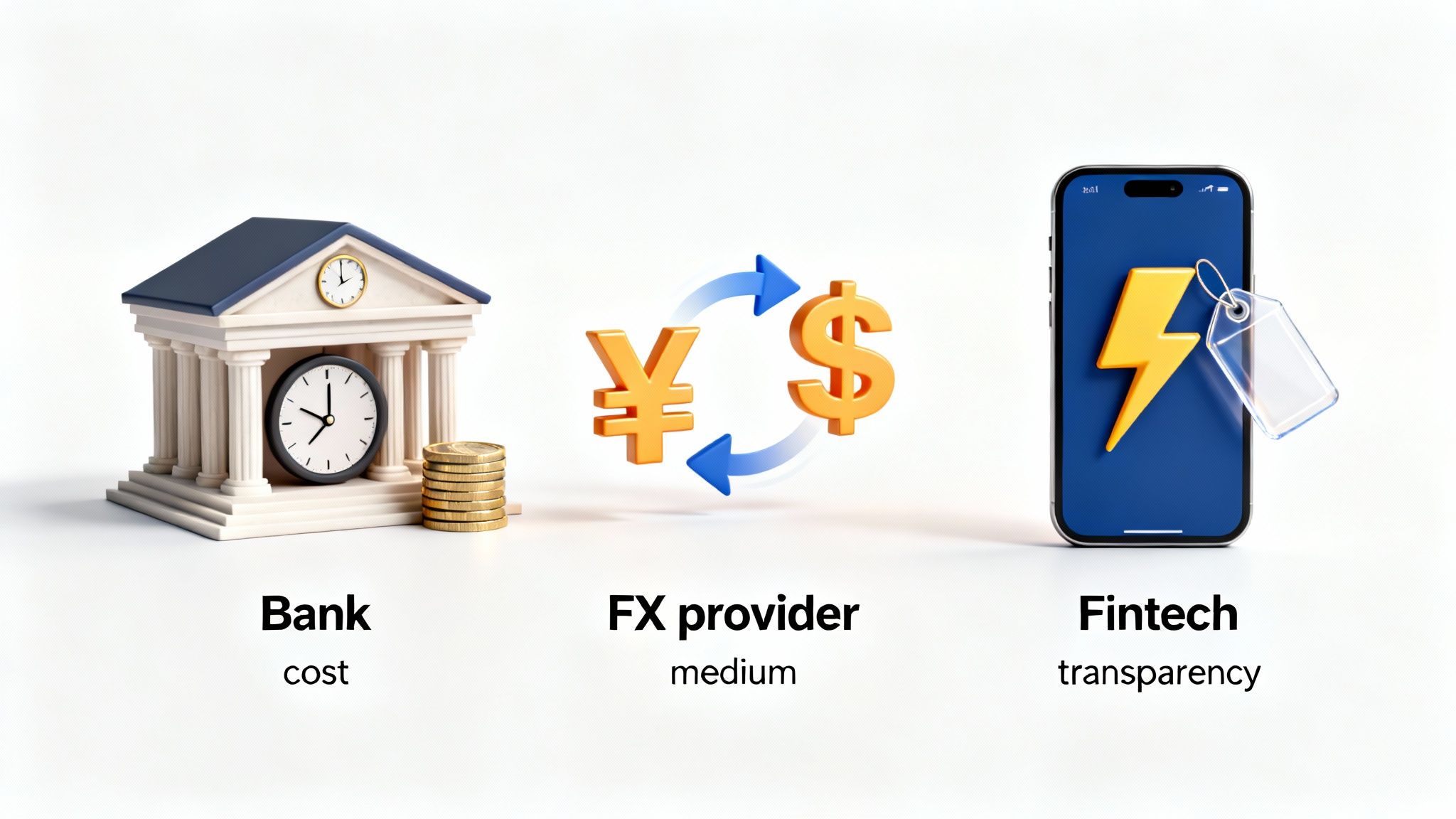
Comparison of International Payment Methods for SA Businesses
To make things even clearer, let's put these three options side-by-side. The table below cuts through the noise and shows you how they stack up on the factors that actually matter to your business.
| Feature | Traditional Banks | Specialist FX Providers | Modern Fintech Platforms |
|---|---|---|---|
| Exchange Rate | Poor (High hidden spread) | Good (Lower spread) | Excellent (Real mid-market rate) |
| Fees | High (SWIFT & hidden fees) | Moderate (Lower sending fees) | Low to Zero (No SWIFT fees) |
| Transfer Speed | Slow (3-5 business days) | Moderate (1-3 business days) | Fast (Same-day or instant) |
| Transparency | Low (Opaque costs) | Moderate (Clearer fee structure) | High (Full cost breakdown) |
| Ease of Use | Clunky (Often requires branch visits) | Moderate (Varies by provider) | Excellent (Digital-first, intuitive) |
Ultimately, the right choice really boils down to what your business prioritises. If saving money, moving faster, and having complete clarity on every single transaction are at the top of your list, then a modern fintech platform is, without a doubt, the smartest way to handle any serious overseas money transfer.
Getting to Grips with South African Compliance and Regulations
When your South African business sends money overseas, compliance isn't just a formality—it’s the backbone of every single transaction. The whole system is governed by powerful bodies like the South African Revenue Service (SARS) and the South African Reserve Bank (SARB), and their rules are there to keep things transparent and shut down illegal activity.
Trying to sidestep these regulations is a non-starter. You’re looking at hefty penalties, frozen funds, and the kind of delays that can wreck supplier relationships and throw your cash flow into chaos. The only way to ensure smooth, predictable international payments is to get your compliance in order from day one.
First Things First: What Are KYC and KYB?
At the centre of all this are two acronyms you’ll see everywhere: KYC and KYB. They sound almost the same, but they cover different ground when it comes to proving who you are and who you're paying.
- Know Your Customer (KYC): This is all about verifying an individual’s identity. To fight fraud and money laundering, financial institutions have to be sure their customers are exactly who they claim to be.
- Know Your Business (KYB): This is the business equivalent, and it’s a much deeper dive. A payment provider will scrutinise your company’s registration documents, ownership structure, and directors to make sure they’re not dealing with a shell company or a front for something else.
What this means for you is simple: before a single rand can leave the country, your payment provider has to do their homework on your company. It's a non-negotiable step that protects the entire financial system.
How to Prepare Your Paperwork for a Hassle-Free Transfer
More often than not, the biggest hold-up in an international payment is missing or incorrect paperwork. Getting your documents organised ahead of time is the single best thing you can do to avoid painful delays. The exact list can change slightly depending on the provider, but here’s what you’ll almost certainly need:
- Business Registration Documents: This is your proof of legal existence, like your CIPC registration papers.
- Proof of Address: A recent utility bill or another official document showing your business's physical address.
- Director and Shareholder Information: Up-to-date, valid identification for all the key people in the business.
- Tax Clearance Certificate: SARS needs to give you the green light, so an up-to-date certificate is often mandatory.
- Supporting Invoices: For every transfer, you’ll need a commercial invoice from your supplier to justify the payment.
Think of this paperwork as your passport for global trade. If it’s not in order, your money isn't going anywhere. Building a habit of gathering and organising these files is a game-changer for an efficient payment process.
The sheer scale of payments leaving South Africa shows why these rules are so critical. Formal payments to neighbouring SADC countries have exploded, rocketing from R6 billion in 2016 to over R19 billion by 2024. This massive growth, partly driven by the pandemic pushing people away from informal cash channels, makes robust verification essential to manage these flows securely. You can dive deeper into these trends in a detailed report from the SARB.
The good news? Modern fintech platforms have made this a lot less painful. Gone are the days of manually submitting stacks of paper and waiting weeks. Now, you can upload documents to a secure online portal, where automated systems help verify them in a fraction of the time. This cuts down the admin and gets your business approved and ready to transact globally much, much faster.
Building a Smarter International Payment Workflow

Understanding the mechanics of international payments is one thing. Actually putting that knowledge to work to save your business real money is another game entirely. For South African companies, moving from a reactive, costly process to a strategic one can transform a routine expense into a source of savings and smarter operations.
This isn't just theory; it's a practical workflow your finance team can start using today. By following these steps, you can methodically cut costs, reduce risk, and get a much firmer grip on your company’s global cash flow.
Step 1: Meticulously Verify Beneficiary Details
Before you even think about sending money, getting the details right is non-negotiable. A tiny typo in a beneficiary’s name, account number, or SWIFT/BIC code can get the payment rejected. That doesn’t just cause delays; it means your money gets bounced back, often minus hefty fees from every bank that touched it along the way.
Always double-check every single detail against the official supplier invoice. If you're paying someone for the first time, it’s a great idea to send a small "test" transfer to confirm everything is correct before committing to the full amount. This simple precaution can save you from a world of financial and administrative pain.
Step 2: Strategically Time Your Transfers
Foreign exchange markets never sleep, and the rate you get can swing wildly even in a single day. You can't predict the market, but you can be much smarter about when you decide to transact. The golden rule? Avoid urgent, last-minute payments where you're forced to take whatever rate is on the table.
Instead, keep an eye on exchange rate trends. If your payment isn't due immediately, you can wait for a moment when the ZAR strengthens against the destination currency. For large or regular payments, this is where specialist providers shine. They offer tools like forward contracts, which let you lock in a favourable exchange rate for a future date, taking market volatility completely out of the picture.
Step 3: Select the Right Payment Method for the Job
Not all transfers are the same, and your payment method should match the task. Defaulting to your traditional bank might be easy, but as we’ve seen, it's rarely the most cost-effective option. Their steep fees and hidden FX spreads can eat away at your bottom line.
For most business payments, a modern fintech platform that offers the real mid-market exchange rate will deliver the best value. This strips away the hidden markup—often the single biggest cost in any overseas transfer—giving you full transparency and significant savings, especially if you make frequent or large payments.
The core idea behind a smart payment workflow is to stop being a passive participant. Instead of just accepting default costs, you actively hunt for transparency and efficiency at every stage, from verifying details to executing the payment.
Step 4: Use Multi-Currency Accounts for Greater Control
For any business that deals internationally on a regular basis, a multi-currency account is a powerful tool. It allows you to hold funds in different currencies—like US Dollars, Euros, or British Pounds—directly in one place.
This is a complete game-changer for South African exporters. Imagine receiving a payment in USD. Instead of being forced to convert it back to ZAR at whatever the day's rate is, you can simply hold it as USD. You can then use those dollars to pay your own international suppliers directly in their currency, bypassing a costly FX conversion altogether. This single strategy offers incredible flexibility and can save your business thousands of Rands over time.
So, What's the Bottom Line for Your Business?
If you've followed along this far, the takeaway for your South African business should be crystal clear: the era of simply accepting slow, costly, and confusing international payments is well and truly over. Knowing what’s really going on with FX spreads and the old-school SWIFT network isn't just a nice-to-have. It’s a must for your financial health and a critical part of competing globally.
For years, the default choice has been a system that works against your bottom line, quietly skimming profits off every single transaction. But that model is finally being put out to pasture.
It's Time to Take Back Control
There's a major shift happening, and it's being led by fintechs that prioritise transparency and put you back in the driver's seat. The future isn't about getting a slightly less terrible exchange rate. It's about seeing exactly where every cent is going, every step of the way. It’s about using smart technology to bypass intermediary bank fees and finally get access to the real mid-market exchange rate—the one banks usually keep for themselves.
When you adopt this new way of thinking, your international payments stop being a frustrating cost centre and become a genuine strategic advantage. Choosing a modern platform isn't just about saving a few rand here and there; it’s about building a leaner, more resilient financial backbone for your entire operation.
Efficiency and transparency are where you'll find your biggest competitive edge. Take a hard look at how you're paying suppliers or getting paid from abroad. You’ll almost certainly uncover hidden costs and risks that are holding your business back on the world stage.
The time to act is now. We strongly urge you to audit your current international payment process. Tally up every fee you’re paying—both the ones you can see and the ones you can't—and stack them up against the transparent alternatives now available. Test-driving a modern financial platform isn't just a minor upgrade; it's a fundamental move to cut costs, reduce risk, and build a much stronger financial future for your business.
Frequently Asked Questions
Sending money across borders can feel like navigating a maze. It’s natural to have questions. We’ve tackled some of the most common ones we hear from South African businesses to give you clear, straightforward answers.
What’s Genuinely the Cheapest Way to Make an Overseas Money Transfer?
It’s tempting to look for the service with the lowest advertised fee, but that’s rarely where the real cost lies. The true expense is almost always buried in the exchange rate.
Many services will quote a low fee but then apply a hefty markup to the exchange rate—what’s known as the FX spread. This hidden charge can easily skim 2-5% off the top of your transfer value without you even noticing.
The most cost-effective way to send money isn't about finding the lowest fee; it's about finding the provider who gives you the real, mid-market exchange rate. Full transparency means you know exactly what you’re paying, and more of your money actually gets where it needs to go. A small, clear fee with a great rate beats a "low fee" with a bad rate every time.
How Long Does an International Transfer from South Africa Actually Take?
Waiting for money to land can be stressful, impacting everything from supplier relationships to your own cash flow. The time it takes varies wildly depending on who you use.
- Traditional Banks (via SWIFT): This is the old-school route, and it’s usually the slowest. You can expect funds to take 3 to 5 business days to clear. The delay happens because the payment has to bounce between several intermediary banks before reaching its final destination.
- Modern Fintech Solutions: These platforms bypass the sluggish, multi-step SWIFT network in favour of more direct payment rails. The result? Transfers are significantly faster, often landing on the same day or even almost instantly. For any business dealing with tight deadlines, this is a massive advantage.
What Paperwork Do I Need for a Business Transfer Out of South Africa?
South African exchange control regulations, overseen by bodies like SARS and the SARB, require businesses to provide documentation to prove the legitimacy of an overseas payment. Getting your documents in order upfront is the secret to a smooth, delay-free transfer.
You’ll generally need to have these on hand:
- Proof of Business Registration: Your CIPC documents confirming your company is a registered entity.
- Commercial Invoice: The official bill from your international supplier, clearly detailing what you’re paying for.
- SARS Tax Clearance Certificate: A current certificate to show your tax affairs are compliant and up to date.
- KYB (Know Your Business) Details: This usually involves ID documents for all company directors and information clarifying your ownership structure.
The good news is that modern platforms have taken the pain out of this process. Forget stacks of paper and endless emails. You can now simply upload your documents to a secure online portal for fast, streamlined verification, getting you ready to trade globally in no time.
Ready to stop overpaying on international payments? Zaro gives South African businesses the real exchange rate with zero hidden fees, making sure your money works as hard as you do. See for yourself how much faster, clearer, and more secure your overseas money transfers can be. Get started with Zaro.