If your South African business makes or receives international payments, you've likely come across the term "pips in forex". So, what is it? Simply put, a pip is the smallest, most basic unit of change in a currency pair's exchange rate. While it represents a tiny fraction of a cent, this small measure is what directly impacts the final cost of every single cross-border transaction you make.
Your Introduction to Forex Pips

Think of a single pip like one grain of rice. By itself, it’s tiny, almost insignificant. It's easy to dismiss. But when you're dealing with a large shipment, thousands of those little grains add up to a substantial weight and value. That's exactly how pips work in foreign exchange—they accumulate across large transactions, quietly eating into your profit margins.
This isn't just technical jargon for traders glued to their screens. It's a real, measurable cost baked into every international invoice you pay, every foreign sale you settle, and every bit of revenue you bring back to South Africa. Getting a handle on pips is the first real step towards controlling your foreign exchange costs.
Why Pips Are a Business Essential
Many businesses make the mistake of only looking at the final rand amount sent or received. They completely miss the subtle costs hidden within the exchange rate itself, and these costs are measured in pips. Once you understand this, you can start to see precisely how traditional banks and payment providers build their profits on your transactions.
Here’s why getting to grips with pips is so crucial for your operations:
- It Exposes Hidden Costs: Pips are used to measure the "spread"—the gap between the buy and sell price of a currency. This spread is one of the main ways financial institutions mark up your transaction cost.
- It Allows for Real Cost Comparison: Once you can spot the number of pips in a spread, you can accurately compare quotes from different providers. You'll know instantly who is offering the better deal.
- It Sharpens Financial Planning: A solid understanding of pip-driven costs leads to more accurate budgeting and cash flow forecasting for all your international dealings.
Learning to see the pips is like learning to read the fine print on a forex quote. It turns a confusing price into a clear, transparent calculation, empowering your finance team to make smarter, more cost-effective decisions.
This guide will break down what pips in forex really mean, starting with the basics and moving into practical calculations. We’ll show you how your business can navigate and reduce these expenses, beginning with the simple power of knowing what you're looking at. For a wider view of the financial environment that affects these costs, you can explore the Forex industry landscape.
So, What Exactly is a Pip?
To get a real handle on your international payment costs, you first need to speak the language of the foreign exchange market. The most fundamental word in that language is the pip, which is short for "Percentage in Point". It's the smallest standardised change in value between two currencies, and it’s the bedrock of all forex pricing.
Think of it like this: when you measure distance, you use metres or kilometres. When you measure a currency’s movement, you use pips. This universal standard allows everyone, from a bank in London to your finance team in Johannesburg, to talk about currency fluctuations in the same way.
Spotting a Pip in Your Forex Quote
For most currency pairs your business deals with, like the Euro against the US Dollar (EUR/USD) or the British Pound against the US Dollar (GBP/USD), the pip is simply the fourth digit after the decimal point.
Let’s make that real. Imagine your business needs to pay an invoice and you get a quote for EUR/USD at 1.0750. If that rate then nudges up to 1.0751, it has moved by exactly one pip. It’s a tiny shift, representing just 0.0001 of the total exchange rate.
A pip is the essential building block of a forex quote. Learning to see it is the first step toward uncovering the hidden costs tucked inside the exchange rates offered by traditional banks and brokers.
The main exception to this rule involves pairs with the Japanese Yen (JPY). For pairs like USD/JPY, the pip is the second decimal place (0.01). So, if the rate moves from 145.50 to 145.51, that’s a one-pip change.
Meet the Pipette: A Fraction of a Pip
As trading technology has become more sophisticated, forex pricing has gotten even more precise. You'll often see quotes that go out to a fifth decimal place (or a third for JPY pairs). This tiny, fractional unit is known as a pipette.
A pipette is simply one-tenth of a standard pip. So, if you see a EUR/USD quote of 1.07505, that final '5' is the pipette. While this extra bit of precision is useful, the industry still anchors its core measurements and costs around the full pip.
Here’s a quick-glance guide to help you spot pips and pipettes in the wild.
Pip and Pipette Value at a Glance
| Currency Pair Type | Pip Decimal Place | Pipette Decimal Place | Example Quote |
|---|---|---|---|
| Most Major Pairs (e.g., EUR/USD) | 4th Decimal (0.0001) | 5th Decimal (0.00001) | 1.07515 |
| Japanese Yen Pairs (e.g., USD/JPY) | 2nd Decimal (0.01) | 3rd Decimal (0.001) | 145.515 |
This table makes it easy to quickly identify the key digits in any currency quote you receive.
Why This Matters for Your Bottom Line: Pips and the Spread
Now we get to the crucial part for your business. Pips are used to measure the spread, which is the difference between the 'buy' (bid) price and the 'sell' (ask) price you’re offered. This gap isn't just a random market feature; it's where providers often hide their markup.
For instance, a bank might offer to sell you US Dollars at a USD/ZAR rate of 18.50, but they’ll only buy them back from you at 18.45. That 0.05 difference is a 500-pip spread. This is a direct cost to your business, completely separate from any "wire fees" or admin charges they list on your statement.
By learning to count the pips in a spread, you can instantly see the real cost of a forex transaction and start making smarter financial decisions.
How to Calculate the Real Cost of Pips in Rands
It’s one thing to know what a pip is, but it’s another thing entirely to see what it costs your business on the balance sheet. This is where we get practical and turn the tiny, abstract concept of a pip into a hard Rand value.
Calculating this cost strips away the confusing jargon. It lets you see exactly how much each fractional movement in an exchange rate is actually costing you, turning a small decimal into a concrete financial metric you can finally track and manage.
The Formula to Find a Pip's Value in Rands
To work out the real-world value of a single pip in any given transaction, you just need three key bits of information: the pip size, the current exchange rate, and how much you're trading (your transaction or lot size).
The formula is surprisingly simple:
Pip Value = (Pip in Decimal Form / Exchange Rate) x Transaction Size
Let's quickly break down what each part means:
- Pip in Decimal Form: For most currency pairs, this is always 0.0001. The only common exception is when you’re dealing with the Japanese Yen (JPY), where it's 0.01.
- Exchange Rate: This is simply the current market rate for the currency pair you're looking at.
- Transaction Size: This is the total amount of the foreign currency you need to buy or sell—for example, $10,000.
This formula is your key to translating the small movements of pips in forex into a clear cost in Rands and cents.
A Practical Example: Paying a USD Invoice
Let’s put this formula to the test with a scenario that happens every day. Imagine your South African business has a $10,000 USD invoice to pay an international supplier.
You get a quote from your bank for the USD/ZAR exchange rate at 18.5000.
So, what do we have?
- Pip in Decimal Form: 0.0001 (since USD/ZAR doesn’t involve the Yen)
- Exchange Rate: 18.5000
- Transaction Size: 10,000 (in US Dollars)
Now we plug those numbers into our formula to find the value of one pip in the quote currency, which in this case is ZAR.
Pip Value (in ZAR) = (0.0001 / 18.5000) x 10,000
The result? For this specific $10,000 transaction, every single pip movement costs your business about R0.054. That might not sound like much, but forex spreads can easily be hundreds of pips wide.
Think about it: If another provider offers a rate of 18.5500 instead of 18.5000, that's a 500-pip difference. For this $10,000 payment, that 500-pip spread would cost your business an extra R2,700!
Suddenly, that small decimal has a very real impact.
The infographic below shows just how simple it is to spot the pip in any standard currency quote.
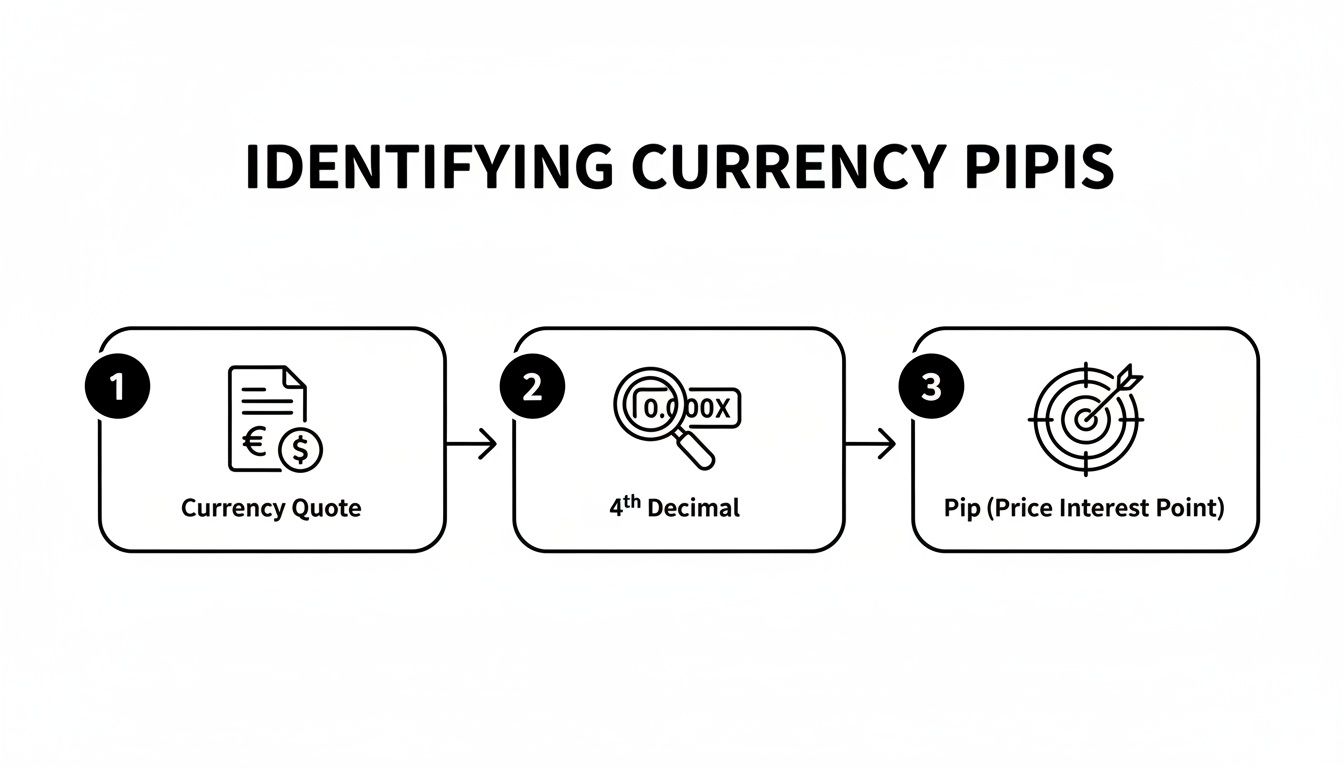
As you can see, it’s usually just a matter of looking at the fourth number after the decimal point.
The Shortcut for ZAR Transactions
The good news for South African businesses is that things get much simpler when the Rand is the second currency in the pair (the 'quote' currency), like in USD/ZAR or GBP/ZAR. In these cases, the value of a pip becomes a fixed, easy-to-remember number based on your transaction volume.
For these direct ZAR pairs, the pip values are wonderfully straightforward:
- For every 100,000 units of currency (a standard lot): one pip is worth R10.00.
- For every 10,000 units (a mini lot): one pip is worth R1.00.
- For every 1,000 units (a micro lot): one pip is worth R0.10.
Knowing this is a game-changer. If a provider's spread on a $100,000 transaction is 200 pips, you can instantly see that it’s a R2,000 hidden cost (200 pips x R10). This practical shortcut is your most powerful tool for taking back control of your international payment costs.
How Pips Quietly Impact South African Businesses
Knowing the theory is one thing, but the real wake-up call is seeing how pips in forex directly affect your company’s bottom line. This is where those tiny numbers, four decimal places deep, jump off the screen and land squarely on your balance sheet, often silently eating into revenue that should be yours.
Let's move this from an abstract idea to a real-world business headache. We'll follow the story of a Cape Town-based company that exports premium rooibos tea to a distributor in Germany.
A Tale of Two Invoices
Picture this exporter, let's call them "Rooibos Roots," landing a big order and invoicing their client for €100,000. When the time comes to bring that money home and convert it to Rands, they get an exchange rate from their bank.
The true mid-market rate for EUR/ZAR at that moment is 20.4500. But the rate the bank offers them is 20.4000.
At first glance, that 50-cent difference might not seem like much. But let’s look at it through the lens of pips. The gap between the real market rate (20.4500) and the offered rate (20.4000) is 0.0500. In forex speak, that's a 50-pip spread.
So, what does this 50-pip spread actually cost Rooibos Roots on this one invoice?
- At the real rate (20.4500): €100,000 should convert to R2,045,000.
- At the bank's rate (20.4000): €100,000 only gets them R2,040,000.
That 50-pip spread just cost the business a cool R5,000 on a single transaction. This isn't a line-item fee you’ll find on a statement; it's a hidden cost baked right into the rate, completely invisible if you're not looking for it.
This is the quiet danger of wide forex spreads. A seemingly insignificant decimal difference, once applied to a large transaction, becomes a material loss that directly chips away at your net profit.
The Slow Bleed: A Year of Hidden Costs
Now, let's zoom out. Rooibos Roots is doing well and processes a similar €100,000 transaction every month. If they're hit with the same 50-pip spread on every single payment, the financial damage starts to stack up fast.
A R5,000 loss per month, multiplied by 12 months, becomes a R60,000 hole in their annual profits. That’s money that could have gone into new machinery, a digital marketing push, or even staff bonuses. Instead, it vanished into the bank’s profit margin, all because of a few pips.
The ZAR Volatility Factor
For South African businesses, this problem is even more pronounced thanks to the Rand's notorious volatility. The USD/ZAR pair, for example, can swing dramatically, making every single pip even more critical to your cash flow.
The rollercoaster nature of USD/ZAR shows just how quickly pip movements turn into real cash-flow risks. Consider a local firm billing US$250,000 monthly. A one-Rand shift in the exchange rate creates a R250,000 swing in revenue. At this scale, even a modest 20-pip difference in the execution price can mean R5,000 per transfer, or R60,000 a year on just one client. With imports and exports forming a huge part of our economy, a massive number of local businesses are exposed to these swings. You can explore more data on South Africa's currency trends on TradingEconomics.com.
This makes managing pip-related costs more than just good financial hygiene—it’s an essential survival strategy. What might be a rounding error for a business in a more stable currency environment can be a serious financial risk for a South African enterprise. Understanding pips in forex is the first step to taming that risk and protecting your hard-earned revenue.
How Banks Hide Fees in Forex Spreads

When you get a foreign exchange quote from a traditional bank, you’ve probably seen them advertise "low fees" or even "zero commission." It’s a comforting thought, but this marketing often creates a false sense of security. The truth is, the biggest cost isn't on any fee schedule—it's quietly built right into the exchange rate you’re offered.
This hidden cost lives in what’s known as the bid-ask spread. Put simply, it’s the gap between the price a bank will buy a foreign currency from you (the ‘bid’ price) and the price they will sell it to you (the ‘ask’ price).
That difference, measured in pips, is the bank’s profit margin on your transaction. It’s a markup that has nothing to do with any other administrative fees they might charge.
Pulling Back the Curtain on Bank Rates
To grasp just how much this spread can cost you, you need to know about the interbank rate. Think of this as the 'true' mid-market exchange rate that banks use when trading massive currency volumes with each other. It's the real-time, wholesale price of a currency, completely free from any retail markup.
Your business, however, almost never gets this rate from a typical provider. Instead, they give you a rate that has been widened—lowering the bid price and raising the ask price—to create a profitable pocket for themselves.
The wider the spread, the more pips are being charged as a hidden fee. This is the primary way traditional financial institutions profit from your cross-border payments, turning what seems like a simple transaction into an opaque cost centre.
It’s a bit like a currency convenience store. The shop buys its stock at a wholesale price but sells it to you at a marked-up retail price. The spread in forex works exactly the same way.
Seeing the Hidden Cost in Action
Let’s put some real numbers to this. Imagine your business needs to send $100,000 to a supplier in the US. You check a reliable source and see the true interbank rate for USD/ZAR is 18.50.
Now, let's see how a typical bank quote might stack up against the real market rate.
| Rate Type | Bid Price (Bank Buys USD) | Ask Price (Bank Sells USD) | Spread in Pips |
|---|---|---|---|
| True Interbank Rate | 18.5000 | 18.5000 | 0 Pips |
| Typical Bank Quote | 18.4500 | 18.5500 | 100 Pips |
In this scenario, the bank has created a 100-pip spread around the true rate. When you buy your $100,000, you’re forced to pay their higher 'ask' price of 18.5500. That 100-pip difference translates into an immediate hidden cost of R10,000 on this single transaction.
This is a massive issue for South African businesses managing international payments. While South Africa's FX position on TradingEconomics.com points to national stability, companies on the ground often get hit with margins of 50–150 pips on standard transfers. If even a fraction of quarterly forex flows faced an avoidable 80-pip markup, the collective cost to local businesses would be staggering.
By understanding the bid-ask spread, you can finally see the true cost of pips in forex. This knowledge gives you the power to question the rates you receive and start looking for more transparent financial partners who don't rely on hidden markups to make their money.
Smart Moves to Cut Pip Costs and Protect Your Profits
Knowing how hidden costs pile up through pips in forex is one thing; actually plugging that financial leak is another. By making a few savvy moves, your business can stop being a passive victim of bad rates and start actively managing its foreign exchange costs. The result? A healthier bottom line.
The single biggest change you can make is to move away from financial partners who bury their fees in wide, murky spreads. Instead, look for transparent FX providers—the ones who give you the real spot rate and charge a clear, separate fee. This simple switch transforms an unpredictable, hidden cost into a predictable, upfront one, giving you total control over every transaction.
Find a Truly Transparent FX Partner
The old-school banking model pretty much relies on you not knowing the true interbank exchange rate. They profit from that information gap. Newer fintech platforms, on the other hand, are often built on the idea of transparency.
When you choose a platform that gives you the raw spot rate, you sidestep the whole hidden markup game. The cost of your transaction is no longer a mystery baked into a complicated rate; it’s a simple, declared fee. This makes budgeting a breeze and kills the risk of a nasty spread eating into your profits on a big payment.
It all comes down to this: your business shouldn't have to pay a penalty for a lack of transparency. The right tools give you access to the same sharp rates that massive corporations get, putting your international operations on a level playing field.
Time Your Big Payments Wisely
You can't control the market's wild swings, but you can be smart about when you pull the trigger on large transfers. Currency markets aren't equally busy 24/7; they have peaks and troughs of liquidity. Spreads tend to get wider when liquidity is low—think overnight or right around a major economic news release—because there are simply fewer buyers and sellers.
If a large payment isn't urgent, it pays to watch the market with your FX partner. Pushing the transaction through during peak liquidity hours, which is usually when the London and New York markets overlap, often means you'll get a tighter, better spread. Those saved pips can really add up.
Use Hedging Tools to Nail Down Your Rate
For any business dealing with regular or significant foreign currency payments, hedging is a game-changer for managing risk. Tools like forward contracts let you lock in an exchange rate today for a transaction that will happen weeks or months down the line.
This strategy is all about certainty. You know precisely how many Rands you’ll get for your exports or have to pay for your imports, no matter which way the market lurches between now and then. It effectively takes the guesswork—and the sting of unexpected pip costs—out of your financial planning.
The power of managing pips in forex hits home for South African exporters. As our trade volumes have expanded, so has our exposure to currency risk. For a local exporter invoicing US$5 million annually, even tiny movements in the USD/ZAR rate can swing their yearly revenue by more than R10 million. In this climate, finding a platform with no hidden pip markups can convert a typical 20–40 pip invisible cost into tangible savings on every single payment. For more context, you can explore the latest South African trade data at the World Bank.
Your Pip Questions Answered
Once you get the hang of what pips are, you naturally start to wonder how they work in the real world. Let's tackle some of the most common questions that pop up when businesses start applying this knowledge to their international payments.
Is a Pip Always the Fourth Decimal Place?
Most of the time, yes. When you're dealing with major currency pairs—think EUR/USD or GBP/USD—the pip is the fourth decimal place (0.0001). That's the industry standard.
The big exception to this rule comes into play with the Japanese Yen (JPY). For any pair involving the Yen, like USD/JPY, a pip is actually the second decimal place (0.01). It's a small detail, but a critical one to get right. You might also spot quotes with a fifth decimal place; that extra digit is a ‘pipette’, which is simply one-tenth of a pip.
How Can I Check the Real-Time Spread?
To get a true picture of the market, you need to see the interbank spread—the rate banks use with each other. You can find this benchmark on reliable financial news sources like Bloomberg or Reuters.
With that number in hand, ask your bank for their quote. The gap between their 'buy' or 'sell' price and the interbank rate is their spread, measured in pips. Fortunately, some modern fintech platforms are cutting out the guesswork completely by offering the real spot rate, which means there's zero spread added on.
The goal is simple: shrink the gap between the rate the banks get and the rate your business pays. Knowing the real-time spread gives you the power to demand that transparency from your bank or payment provider.
Why Can My Business Not Just Ignore Pips?
It’s tempting to focus only on the final amount that lands in the account, but ignoring pips means you're overlooking a sneaky, hidden cost. For a single small payment, the difference might seem trivial.
But what happens when your business makes regular international payments, or handles large transactions? Those seemingly small pip costs stack up fast, eating directly into your profit margins. Understanding pips in forex lets you put a number on that hidden expense, compare providers on a level playing field, and make smart decisions that protect your bottom line.
This knowledge shifts you from being a passive price-taker to a savvy financial manager who's truly in control. You're no longer in the dark about what your international payments are actually costing you.
Ready to eliminate hidden pip costs and take control of your international payments? With Zaro, you get the real exchange rate with zero spread and no SWIFT fees. See how much your business can save by visiting the official Zaro website today.