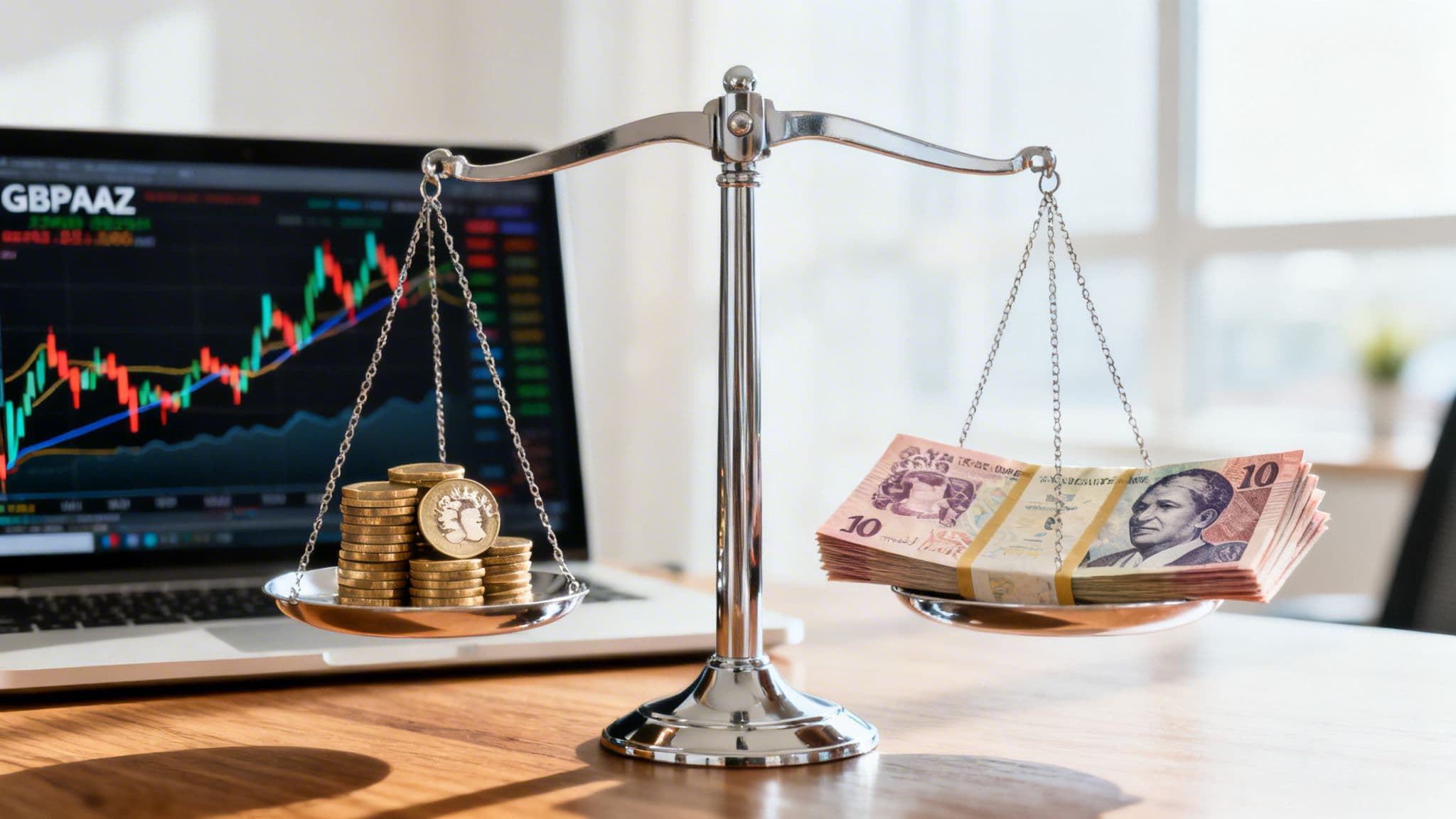
For any South African business working with the UK, trying to make a rand pound prediction can feel less like financial forecasting and more like betting on a rollercoaster. The relentless swings of the GBP/ZAR rate can turn a great deal into a loss in the blink of an eye, throwing your entire financial plan into disarray. This isn't just an abstract number on a screen—it's a real-world force that directly impacts your profit margins.
Riding the GBP/ZAR Exchange Rate Rollercoaster

The GBP/ZAR exchange rate is a constant, often unpredictable, factor in your business's story. One month, a strong pound might give your export revenues a welcome boost. The next, a sudden drop could send the cost of your UK imports soaring, putting a serious squeeze on your bottom line.
It's a familiar story for many SA businesses. Let's say your manufacturing company secures a £100,000 order from a British client. With the exchange rate at R24/£1, you're budgeting for a healthy R2.4 million in revenue. But by the time the payment lands a month later, the rand has strengthened to R22.50/£1. Suddenly, that revenue is just R2.25 million—a R150,000 shortfall that vanishes straight from your profit.
The Real Cost of Currency Swings
This isn’t just a bad-luck scenario; it’s a reality of the market. The numbers back this up. Just last year, the rand took a beating against the pound, with the GBP/ZAR rate peaking at 25.2552 on 10 December 2025. Yet in the same year, the rate also hit a low of 22.4733. You can see these dramatic trends for yourself using historical data from sources like Pound Sterling Live.
Think about the headache this creates for a CFO at a South African BPO serving UK clients. A sudden 12% swing from the year's high to its low can demolish quarterly bonuses or trigger a scramble to cover payroll. This kind of uncertainty makes accurate budgeting feel almost impossible.
The real challenge isn't about perfectly predicting the rand-pound exchange rate. It's about accepting you can't control the market, but you can control how much your business is exposed to its whims.
Stop Gambling and Start Strategising
Leaving your company's finances at the mercy of the currency market is a high-stakes gamble. Simply waiting to see what the rate does on payment day can have serious consequences:
- Shrinking Profit Margins: An unexpected rate move can wipe out the profitability of a deal you thought was solid.
- Budgeting Chaos: Forecasting your revenues and costs with any degree of confidence becomes a nightmare.
- Losing Your Competitive Edge: If you’re an importer, your costs can spike. If you’re an exporter, your pricing might suddenly become uncompetitive.
The good news? You don’t have to be a victim of this volatility. By understanding what drives the exchange rate and adopting a proactive financial strategy, you can shield your business from the worst of these swings. It’s time to shift from being a spectator to becoming a strategist who actively manages risk. This guide will show you exactly how to do that.
The Forces Driving Your Rand Pound Prediction
Trying to predict the rand's movement against the pound can feel like navigating a boat on a wild ocean. To get your bearings, you need to understand what's actually steering the ship. The ZAR/GBP exchange rate is constantly being pushed and pulled by two main currents: massive global waves and strong local tides.
Getting a handle on both is the secret to seeing where your money might be heading. On one side, you have powerful global factors completely outside of South Africa's control. On the other, you have our own unique domestic issues. Let's break down how to connect what you see in the news to the real-world value of your international payments.
Global Waves That Move the Market
First, you need to know that the South African rand is what traders call a risk-on currency. Think of it as a nimble speedboat in the vast ocean of global finance. When investors are feeling optimistic and confident about the world economy (risk-on), they're happy to steer their capital towards emerging markets like ours. This influx of investment strengthens the rand.
But when fear and uncertainty creep in (risk-off), those same investors scramble for perceived safe havens, like the US dollar. This rush for the exits causes the rand to weaken, sometimes dramatically. A major geopolitical event, like the recent conflict escalation in the Middle East, is a classic 'risk-off' moment that sends investors running for cover and puts immediate pressure on the rand.
Another huge global driver is commodity prices. As a country, we're a major exporter of precious metals like gold, platinum, and palladium, and what the world is willing to pay for them matters—a lot.
- Higher Commodity Prices: When the price of these metals goes up, it’s great news for South Africa's export earnings. More foreign currency flows in to buy our resources, which increases demand for the rand and helps strengthen it.
- Lower Commodity Prices: Naturally, the opposite is also true. When commodity prices fall, our export revenues shrink, demand for the rand drops, and it tends to weaken against currencies like the pound.
Think of it this way: The rand's value is deeply tied to the value of the resources South Africa sells to the world. A boom in gold prices often means a stronger rand, and vice versa.
Local Tides Shaping the Rand’s Path
While global sentiment sets the big-picture trend, our own local factors create the unique currents that can really change the rand's course. The single most influential local driver is the South African Reserve Bank (SARB) and its decisions on interest rates.
Imagine the SARB is trying to attract foreign investment, which is like water flowing into a reservoir. By raising interest rates, it makes holding rand-based assets more appealing to foreign investors looking for better returns. This inflow of capital is a powerful force that strengthens the rand. When the SARB cuts rates, however, that capital can flow back out, weakening the currency.
Then you have the domestic challenges that everyone in South Africa is all too familiar with. These directly impact economic confidence and, by extension, the rand.
Loadshedding is the perfect example. The constant power cuts disrupt manufacturing, cripple small businesses, and frankly, signal deep economic instability to the rest of the world. This erodes investor confidence, making them hesitant to put their money here, which ultimately weakens the rand. On the flip side, any genuinely positive news about energy reform can provide a much-needed boost.
Finally, South Africa’s political climate is always under a microscope. Any hint of political instability or uncertainty about future policy makes foreign investors nervous, often prompting them to sell their rand holdings. A stable, predictable political environment is absolutely critical for attracting the foreign investment our currency needs to stay strong. Watching these local dynamics is every bit as important as tracking global trends when you're forming your own rand pound prediction.
Right, we've unpacked the forces that buffet the rand-pound exchange rate. Now, let's move from theory to practical foresight. Trying to pinpoint an exact rand pound prediction is a fool's errand, but preparing for what could happen? That’s just smart business.
By mapping out a few plausible scenarios for 2026, you can start stress-testing your financial plans and build a far more resilient strategy. We'll look at three potential paths for the rand: an optimistic case (a stronger rand), a pessimistic one (a much weaker rand), and a baseline scenario where it continues its volatile, sideways dance. Each path is grounded in the real-world global and local drivers we’ve already discussed, helping turn abstract risks into concrete business implications.
Scenario 1: The Optimistic Case (Stronger Rand)
In this best-case future, the rand finds its feet and strengthens, potentially pulling the GBP/ZAR rate down towards the R21.50 – R22.50 range. What would it take to get there? A potent mix of positive local reforms and a happy global backdrop.
Picture this: South Africa finally makes sustained, meaningful progress in resolving the energy crisis. This single act would unleash business confidence and boost economic output. At the same time, the global mood is 'risk-on', with international investors feeling bold and actively hunting for returns in emerging markets like ours. A strong demand for South Africa’s commodities would pour fuel on the fire, and the inflow of foreign currency would give the rand’s appreciation serious momentum.
- For Importers: This is fantastic news. Your costs for UK goods and services would drop, either widening your profit margins or letting you pass on savings to customers.
- For Exporters: This scenario presents a real challenge. Your earnings from the UK would translate into fewer rands, putting a tight squeeze on profitability. Finding cost efficiencies would become paramount.
The infographic below unpacks the key global and local drivers that feed into these scenarios.

As you can see, a positive shift in local factors, like energy stability, can combine with global investor sentiment to give the currency a powerful lift.
Scenario 2: The Pessimistic Case (Weaker Rand)
On the flip side, a more pessimistic outlook could see the GBP/ZAR rate climbing towards the R25.00 – R26.00 mark, or perhaps even higher. This would be our "perfect storm" – a nasty combination of negative domestic events and a harsh global economic climate. Think heightened political instability or a complete failure to tackle structural issues like loadshedding, which would send investor confidence plummeting.
Now, imagine that happening during a global 'risk-off' period, where investors are dumping emerging market currencies and fleeing to safe havens like the US dollar. The rand would be under immense selling pressure. If a global recession also hits and dampens commodity prices, we’d lose a key pillar of support, and the rand's decline would accelerate. For any business, the impact would be sharp and immediate.
A weakening rand is a double-edged sword. It might offer a temporary revenue bump for exporters, but it’s also a flashing red light for underlying economic instability. Crucially, it drives up the cost of almost everything we import, from fuel to factory machinery.
Scenario 3: The Baseline Case (Sideways Volatility)
The most probable scenario? Often, it's more of the same. This baseline case sees the rand trading in a volatile but ultimately sideways range, bouncing roughly between R22.50 and R24.50 against the pound. This is a future where progress on local reforms is agonisingly slow and inconsistent—two steps forward, one and a half steps back. Any good news seems to be quickly cancelled out by another setback.
This rollercoaster reflects the constant tug-of-war between our local headaches and shifting global tides. Just look at the past year leading into 2026: the GBP/ZAR depreciated by 8.25%, swinging wildly in a 52-week range between 21.3612 and 25.4830. You can explore the historical trends yourself on Investing.com. This is the reality of persistent pressure from global events, like Middle East tensions driving up oil prices for an import-heavy SA, mixed with a domestic scene where the SARB has had to keep interest rates high.
For your business, this baseline scenario means currency risk is a constant operational headache. Budgeting becomes a nightmare, and your profit margins are permanently exposed to sudden, gut-wrenching swings. In this environment, a proactive risk management strategy isn't just a good idea; it's an absolute necessity for survival and growth.
Building Your Business's FX Risk Management Plan

Knowing what drives the rand is one thing; having a practical plan to shield your business from currency shocks is another entirely. It's time to stop trying to be a market wizard with a perfect rand pound prediction. The real win lies in building a financial shield that protects your bottom line, no matter which way the market swings.
This means shifting your mindset from forecasting to active risk management. It’s all about creating certainty for your business in a fundamentally uncertain environment. The good news? You don't need complex economic models to achieve this. A few powerful, straightforward tools can help you manage your exposure and lock in your budget. While managing the big swings, don't forget the small leaks—learning how to avoid currency conversion fees can also make a significant difference to your margins over time.
So, What Is Hedging Really?
At its core, hedging is simply a way of locking in a price today for a transaction that will happen down the road. Think of it like pre-paying for your company's petrol at a set price for the next six months. Sure, you might miss out on a few cents if the price drops, but you’re completely protected if it skyrockets. For a business, that kind of certainty is invaluable.
Two of the most common and effective tools for this are forward contracts and currency options.
1. Forward Contracts: Lock In Your Rate
A forward exchange contract (FEC) is a straightforward agreement. You commit to exchanging a specific amount of one currency for another on a future date, but at a rate you agree on today. It completely removes the exchange rate risk from your future transaction.
A forward contract is your ultimate tool for budget certainty. You know exactly how much rand you will pay or receive, which makes financial planning simple and reliable.
2. Currency Options: Keep Your Options Open
A currency option offers a different kind of protection. It gives you the right, but not the obligation, to exchange currency at a pre-agreed rate on a future date. For this flexibility, you pay an upfront premium.
It’s like buying insurance for your exchange rate. If the market moves against you, you’re covered. If it moves in your favour, you can simply let the option expire and transact at the better spot rate.
Case Study: A Service Company Invoicing The UK
Let's make this real. Imagine your South African digital agency has just landed a £20,000 project with a client in London, with payment due in three months. The current exchange rate is R23.50/£1, so you’ve budgeted to receive R470,000.
No Hedging: You simply wait three months and hope for the best. If the rand strengthens to R22.00/£1, your payment is suddenly only worth R440,000. That’s a R30,000 hole in your profit, created entirely by currency movement.
With a Forward Contract: You lock in the R23.50/£1 rate today. In three months, it doesn’t matter if the rate is R22.00 or R25.00—you are guaranteed to receive your R470,000. Your budget is secure.
With a Currency Option: You buy an option to sell your £20,000 at R23.50. If the rand strengthens to R22.00, you exercise your option and get your R470,000. But if the rand weakens to R25.00, you can let the option expire and convert your pounds at the better market rate, netting you R500,000 (minus the small premium you paid for the option).
Choosing Your FX Hedging Strategy
Deciding between these tools comes down to your business's risk appetite and operational needs. If you need absolute certainty to protect tight margins, a forward contract is often the best fit. If you want downside protection but are willing to pay a premium for the chance to still benefit from favourable market moves, an option provides valuable flexibility.
This table provides a simple comparison of these common hedging instruments to help you decide on the right approach for your business.
| Hedging Strategy | How It Works | Best For | Key Advantage | Key Disadvantage |
|---|---|---|---|---|
| Forward Contract | Obligation to buy/sell at a set rate on a future date. | Businesses needing absolute budget certainty (e.g., importers). | Eliminates all downside risk and provides perfect cost predictability. | You cannot benefit if the exchange rate moves in your favour. |
| Currency Option | Right (not obligation) to buy/sell at a set rate. | Businesses wanting protection from losses but a chance to gain from upside. | Provides downside protection while retaining upside potential. | Requires paying an upfront premium, which is a fixed cost. |
Ultimately, the goal isn't to outsmart the market. It's to take control of your currency exposure so you can focus on what you do best: running your business. By implementing a clear hedging strategy, you replace unpredictability with stability.
Right, you've done the hard work. You've analysed the rand-pound exchange rate, mapped out your potential risks, and built a solid hedging strategy. But even the smartest plan can fall apart at the execution stage. This is where the rubber really meets the road.
A strategy sitting in a spreadsheet doesn't protect your profits. The real challenge is putting that plan into action without getting stung by the very things you're trying to avoid—hidden bank fees, padded exchange rates, and frustrating delays that quietly eat into your bottom line.
This is exactly where a platform like Zaro comes in. It’s designed to bridge that gap between your strategy and the real-world execution, giving you a way to act on your rand pound prediction with clarity, speed, and control that traditional banks often can't match.
From Strategy to Payment: The Zaro Approach
Let's walk through a real-world scenario. Say you have a £15,000 invoice due for a supplier in the UK.
You know the drill with a traditional bank. You’ll get a single quote for the day, often with the real exchange rate hidden behind a significant markup. Then, you cross your fingers and hope unexpected SWIFT or intermediary fees don’t get skimmed off before the money arrives. With Zaro, that whole process looks very different.
Here’s how your finance team would handle it:
- Load Your Wallets: First, you fund your Zaro accounts. It's a straightforward local bank transfer into your secure ZAR and USD wallets, getting your capital in place and ready to go.
- Watch the Live Market: Instead of accepting a take-it-or-leave-it rate, you can see the live interbank exchange rate right on the platform. This is the true rate, the one banks use with each other, with no hidden spread. You see what the market sees.
- Execute the Payment: When the rate looks right and you're ready to pull the trigger, you execute the payment. Zaro converts your funds at that live spot rate and sends the payment. Your supplier gets the full amount, with no surprise deductions along the way.
This simple workflow directly counters the most common pain points for South African businesses. That typical 2-4% spread the banks quietly add on top of the rate? It’s gone. That saving goes straight back to your business on every single transaction.
The goal is to make paying an international supplier feel as straightforward and cheap as a local EFT. By stripping out the hidden markups and fees, you can budget with real numbers and protect your hard-earned revenue.
The Controls a Finance Team Actually Needs
For any CFO or finance manager, giving up control is a non-starter. A robust FX operation isn't just about getting a good rate; it’s about having strong governance, security, and a clear line of sight over every rand that leaves the company. This is another area where modern platforms have moved lightyears ahead of old-school banking portals.
Zaro was clearly built with this in mind, offering the kind of features that give finance leaders peace of mind.
- Multi-User Access & Roles: You can set up your whole team with different levels of authority. For instance, a junior accountant can be set up to prepare payments, but only the CFO or finance manager has the final sign-off to actually send the money.
- A Clear Audit Trail: Every single action on the platform—from funding a wallet to executing a payment—is logged and time-stamped. This creates an unchangeable record, making reconciliations and compliance checks completely painless.
- Bank-Level Security: Naturally, security is paramount. With advanced encryption and strict protocols, you can be confident that your company's funds and data are properly protected, even when you're managing major cross-border payments.
These aren't just nice-to-haves; they're essential for running a tight ship. When you combine a well-thought-out hedging strategy with a powerful execution tool like Zaro, you close the loop. Your insightful rand pound prediction is no longer just an idea—it becomes a practical, cost-saving, and secure action plan for your business.
Your Questions on Rand-Pound Predictions Answered
After digging into the drivers and potential futures for the rand-pound rate, you're bound to have some questions. It’s one thing to understand the theory, but quite another to apply it when your company’s bottom line is at stake.
Here, we’ll tackle the questions we hear most often from South African business owners and finance managers. The goal is to give you clear, practical answers that empower you to act decisively.
What Is the Most Reliable Way to Predict the Rand-Pound Rate?
Honestly? There isn't one. Anyone who tells you they have a foolproof method for predicting exchange rates is selling something. The market is a chaotic mix of global investor sentiment, economic data, and unpredictable political events, making perfect accuracy impossible.
The most reliable approach isn't to become a market-predicting guru, but a savvy risk manager. Instead of trying to outguess the currency markets, focus on understanding the key drivers we’ve covered—things like SARB interest rate decisions, UK economic health, and commodity price swings. Use that knowledge to build a hedging strategy that shields your business from nasty surprises, no matter which way the rate moves.
Your goal shouldn't be to perfectly time the market, but to make market timing irrelevant to your budget. Protecting your profit margins with tools like forward contracts is a far more dependable path to success.
How Often Should I Review My Forex Strategy?
Your forex strategy can't be a document you write once and file away. In a market this fluid, a static plan becomes a liability very quickly. As a rule of thumb, a formal review each quarter, timed with your financial reporting cycle, is a smart rhythm to get into.
This regular check-in lets you see if your hedges are working as intended and allows you to adjust your plan based on new forecasts or changes in your business. That said, you also need to be ready to act between those formal reviews.
You should pull your team together for an immediate review if a major event happens, such as:
- A surprise interest rate change from the SARB or the Bank of England.
- Sudden political news in either country that could rattle the currency.
- A big change in your own business exposure, like landing a major new client in the UK.
Can My Small Business Really Hedge Against Currency Risk?
Yes, absolutely. A persistent myth suggests that hedging is some complex, expensive game reserved for huge corporations with dedicated treasury teams. That’s simply not true anymore.
Modern platforms have made these essential risk management tools accessible and affordable for businesses of all sizes. For instance, you can now book forward exchange contracts for much smaller amounts, allowing even a small enterprise to lock in a future exchange rate. This gives you certainty over your budget and protects your profit margins—a benefit that’s arguably even more critical for a small business managing tight cash flow.
What Is the Difference Between the Spot Rate and the Rate My Bank Gives Me?
Getting your head around this is vital because it directly impacts your costs on every single international transaction.
The spot rate is the live, mid-market exchange rate you see on Google or financial news sites like Bloomberg. Think of it as the "real" wholesale price of a currency at any given moment, before anyone has added their mark-up.
The rate your bank gives you, on the other hand, is almost always the spot rate plus a "spread" or margin. This is the bank’s profit, and it's often hidden in the rate they quote you. This spread can quietly add 2-4% or even more to your costs, eating directly into your profits. Using a service that offers the true spot rate with a clear, fixed fee is the only way to get total transparency and control over your costs.
Ready to put this strategy into action and stop losing money to hidden bank fees? With Zaro, you can execute all your international payments at the true spot rate, giving you the clarity and control your business deserves.
Open your Zaro account today and experience a smarter way to manage your international payments.