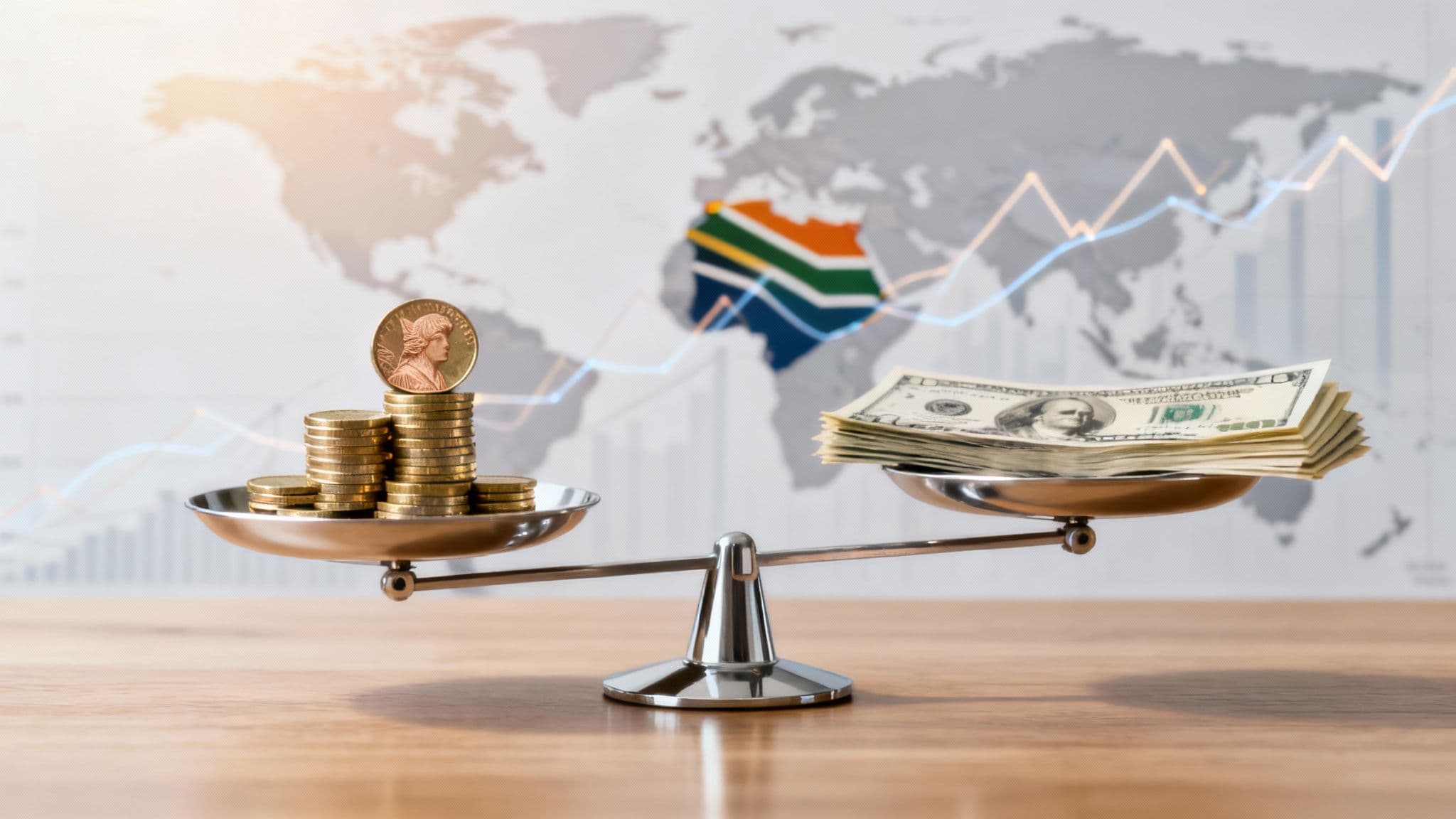
At its heart, SA currency exchange is simply the act of swapping our South African Rand (ZAR) for another currency, like the US Dollar or Euro, or the other way around. The critical part of this transaction is the exchange rate you get. This rate isn't set in stone; it's constantly on the move, meaning the value of your money can literally change from one day to the next.
Let’s break down why this happens and how you can get your head around it.
Why the Rand's Value Is Always Changing
Have you ever noticed that the cost to buy Dollars with your Rands is different today than it was last week? It helps to think of currencies like you would fresh produce at a local market. The price isn't fixed; it bobs up and down based on supply, demand, and what’s happening in the world.
The exchange rate is just the price of one currency when bought with another. So, if the USD/ZAR rate is 18.00, it simply means one US Dollar will set you back 18 South African Rands. This price is decided in the enormous, worldwide foreign exchange (forex) market, where currencies are bought and sold around the clock.
The Key Players in SA Currency Exchange
This isn't some secret club meeting in a single room. The forex market is a vast, interconnected network of buyers and sellers, and their combined actions are what give the Rand its value on any given day.
The main players in this global game include:
- The South African Reserve Bank (SARB): As our country's central bank, the SARB's decisions carry immense weight. A change in interest rates, for instance, can directly influence the Rand's strength and stability.
- Commercial Banks and Financial Institutions: These are the heavy hitters, trading colossal volumes of currency for their own accounts and on behalf of their biggest clients.
- Corporations: Think of any business involved in global trade. Exporters selling our wine overseas need to convert their foreign earnings back to Rands, while importers buying electronics need foreign currency to pay suppliers.
- Investors: International investors are constantly watching South Africa. If they feel optimistic about our economy, they buy ZAR to invest here, which drives up its demand and value. If they get nervous, they sell, and the value drops.
- Individuals: Every time you buy something from an overseas website, send money to family abroad, or swap cash for a holiday, you’re participating in the forex market, too.
What Makes the Exchange Rate Move
Ultimately, the Rand's value is a reflection of how the world sees the health of the South African economy. When our economy is doing well, international investors are keen to bring their money here. This increases the demand for the Rand and, naturally, strengthens its value.
On the flip side, any hint of bad economic news, political instability, or even major shifts in global commodity prices can make investors skittish. They might start selling their Rand holdings, which weakens the exchange rate. The physical money we use, known as fiat currency, gets its value from the government that backs it and the public's trust in how that economy is being managed.
Think of the exchange rate's constant movement as a live report card on a country's economic health and its standing on the world stage. Every single transaction, from a multi-billion Rand corporate deal to your R500 online purchase, plays a part.
To get a deeper appreciation for how value is created, it's interesting to explore the fundamental differences between fiat and cryptocurrency, as their values are determined in vastly different ways. Grasping these basics is the first real step to making smarter currency exchange choices.
What Makes the Rand Go Up or Down?
Ever wondered why the Rand's value seems to be on a rollercoaster ride? It's not just a random number. The exchange rate is a direct reflection of South Africa's economic health and its standing on the world stage. Think of it as a constant tug-of-war between powerful global and local forces.
At its heart, it all boils down to simple supply and demand. When foreign investors want to buy South African bonds, stocks, or even just our wine and fruit, they need Rands to do it. This demand for ZAR pushes its value up. On the flip side, if global sentiment sours and investors start selling off their South African assets, they flood the market with Rands, causing its value to drop.
The Heavy Hitter: Commodity Prices
South Africa's economy is built on its incredible mineral wealth. We’re a powerhouse in precious metals, so it’s no surprise that the global prices of these commodities have a massive say in the Rand's strength.
You can almost picture the Rand and the price of gold as dance partners. When gold, platinum, or palladium prices climb, our mining companies earn a fortune in US Dollars. But to pay their staff and cover local costs, they have to swap those dollars for Rands. This creates a huge surge in demand for our currency, and the Rand strengthens.
Of course, this relationship is a double-edged sword. When commodity prices slump, that inflow of foreign cash dries up, and the Rand feels the pressure. This tight link is why the ZAR is often called a commodity currency.
The Guardian of the Rand: The SA Reserve Bank
The South African Reserve Bank (SARB) is like the conductor of our economic orchestra, and its decisions carry immense weight. Its primary tool? The repo rate—the interest rate it charges commercial banks.
When the SARB hikes interest rates, it sends a powerful signal to international investors. Suddenly, holding South African assets becomes much more appealing because they can earn a higher return here than in many other countries. This pull of foreign capital boosts demand for the ZAR and makes it appreciate.
The SARB's interest rate moves are more than just numbers; they're a statement to the world about our commitment to fighting inflation and ensuring stability. A decisive central bank inspires confidence, while indecisiveness can spook the market.
We've seen this play out dramatically. The Rand has swung wildly against major currencies, reacting to both global events and the SARB's policies. For instance, the USD/ZAR rate hit a peak of 19.93 in April 2025 when the Rand was weak. Yet, by late October 2025, it had recovered to around 17.1, partly driven by a rally in precious metal prices. You can dig into these historical currency trends to see just how closely these factors are linked.
The Mood of the Market: Confidence and Politics
Beyond the hard data, exchange rates are also a barometer of feeling and perception. Political stability and clear, predictable economic policies are absolutely vital for keeping foreign investors happy.
Here's how this "market mood" affects the Rand in real life:
- Credit Ratings: An upgrade from an agency like Moody's or S&P is like a gold star for the country's finances. It boosts investor confidence, often strengthening the Rand. A downgrade, on the other hand, can send investors running for the exit.
- Political Headlines: National elections, major policy shifts, or even just whispers of political turmoil create uncertainty—and investors hate uncertainty. The mere hint of instability can cause them to pull their money out, weakening the Rand overnight.
- Economic Reports: Key figures like GDP growth, inflation, and unemployment are constantly under the microscope. Good news builds confidence; bad news can shatter it in an instant.
In the end, the ZAR exchange rate is a complex cocktail mixed from global commodity markets, central bank strategy, and the fickle sentiment of international investors. Grasping these forces gives you a much better understanding of why the value of your money changes and what to look out for when you're planning your next SA currency exchange.
Choosing Your Best Exchange Provider
Finding the right place for your SA currency exchange can save you a surprising amount of money and hassle. It’s not a one-size-fits-all situation; the provider you choose directly impacts how much foreign currency you get for your Rand, or vice-versa. Your main options generally fall into three camps: the traditional banks, walk-in bureaux de change, and the more modern online fintech services.
Each of these serves a different need. The best one for you really boils down to what you prioritise most—is it the convenience of a familiar face, getting the absolute best rate, or simply needing cash in your hand right now? Let's break down the real-world pros and cons of each to help you decide.
This decision tree shows just how many economic, global, and political factors feed into the Rand's value. That value, in turn, dictates the rates these providers can offer you.
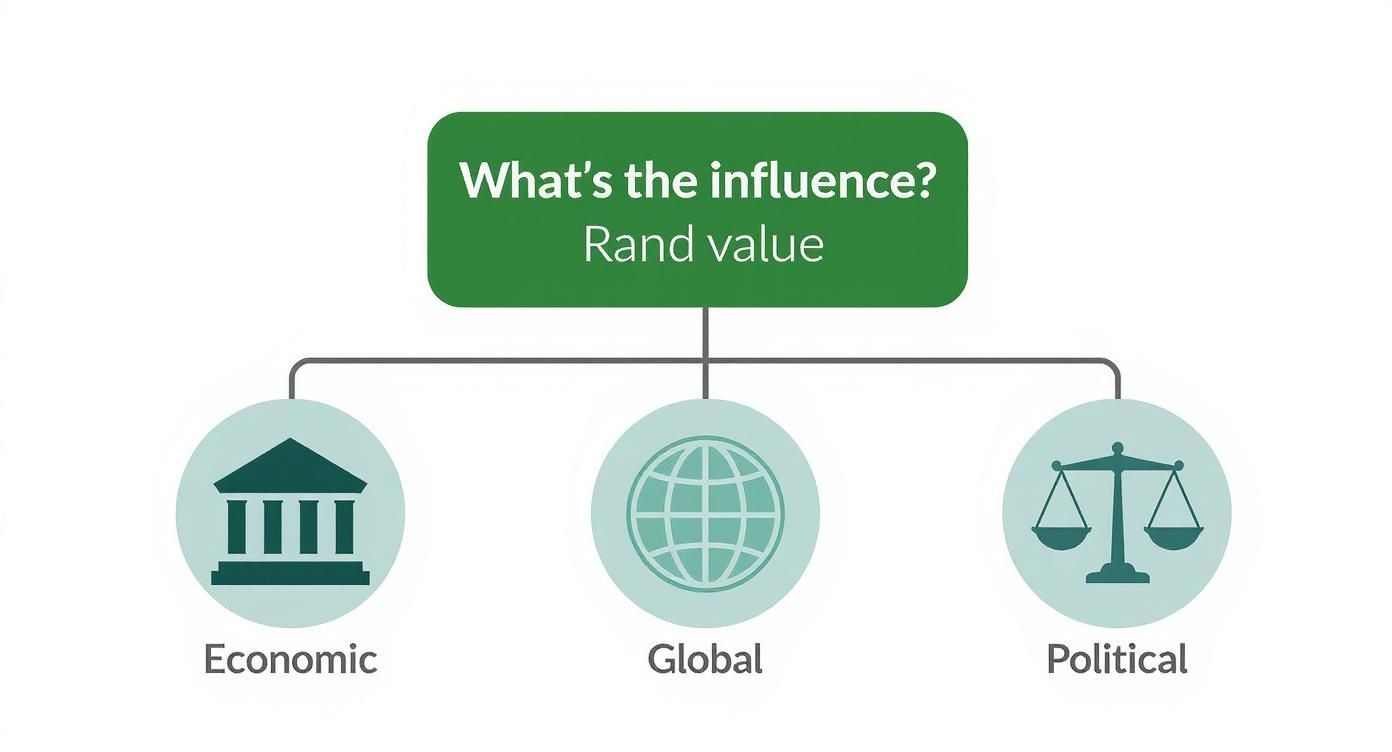
As you can see, the exchange rate is a complex beast influenced by forces far beyond any single provider's control. This makes it absolutely crucial to shop around and compare their specific offerings on the day.
Traditional Banks
For many South Africans, the first port of call is their high-street bank. It feels safe, secure, and straightforward. You know the process: walk in, chat with a teller, and walk out with your foreign currency.
But that comfort often comes at a steep price. Banks are well-known for offering some of the least competitive exchange rates out there. They typically build a significant margin, or "spread," into the rate and often add hefty administrative or transfer fees on top. It all adds up.
- Good for: A high level of security and trust; convenient if you're already at the bank for other errands.
- Not so good for: Getting value for money. Poor exchange rates and high fees are common, and the process can be slow and bogged down in paperwork.
Bureaux de Change
You’ll spot these specialist currency exchange offices everywhere from airports and shopping centres to major tourist hubs. Their entire business is swapping currencies, so they’re set up for quick, over-the-counter transactions.
While they can sometimes offer slightly better rates than the big banks, the ones located in airports are notorious for uncompetitive rates, banking on last-minute travellers who don't have other options. They’re great for grabbing a small amount of cash in a pinch, but they're rarely the most cost-effective choice for larger sums.
A classic trap to watch out for is the "zero commission" sign. It sounds like a great deal, but it often means the provider is just hiding their profit in a much worse exchange rate. It’s a cost, just a less obvious one.
Online Fintech Platforms
The newest players on the scene are online platforms and fintech companies. These digital-first services operate with much lower overheads than traditional brick-and-mortar institutions, and they can pass those savings directly on to you.
They almost always offer rates much closer to the mid-market rate (the "real" rate you see on Google) and are far more transparent about their fees, which are usually significantly lower. For businesses making regular international payments, the efficiency and cost savings are a game-changer. Exploring modern platforms like Revolut Business can give you a good sense of how these digital solutions streamline the process.
- Good for: Highly competitive exchange rates; low, transparent fees; a fast and convenient online process.
- Not so good for: Getting physical cash. These services are primarily digital and require an online setup first.
A Head-to-Head Comparison
To make the choice crystal clear, let's put these providers side-by-side and see how they stack up on the factors that matter most to your wallet.
Comparing SA Currency Exchange Providers
This table compares the key features of different types of currency exchange providers to help you choose the best option for your needs.
| Provider Type | Typical Exchange Rate | Common Fees | Best For | Potential Drawbacks |
|---|---|---|---|---|
| Traditional Bank | Poor (high margin) | High transfer & admin fees | Security-conscious users; existing bank customers | Expensive rates; slow processing times |
| Bureau de Change | Moderate to Poor | Commission or poor rates | Last-minute cash for travel | Inconvenient for large sums; airport locations are costly |
| Online Fintech | Excellent (low margin) | Low, fixed transfer fees | Businesses; regular transfers; best value for money | Requires online account setup; not for physical cash |
In the end, for most businesses and individuals looking for the best value on their SA currency exchange, online fintech providers almost always win. While banks offer a sense of familiarity and bureaux provide instant cash, the superior rates and lower fees of digital platforms mean more money stays where it belongs—in your pocket. The key is to look past the old habits and compare the final amount you’ll actually receive.
Getting to Grips with Exchange Fees and Hidden Costs
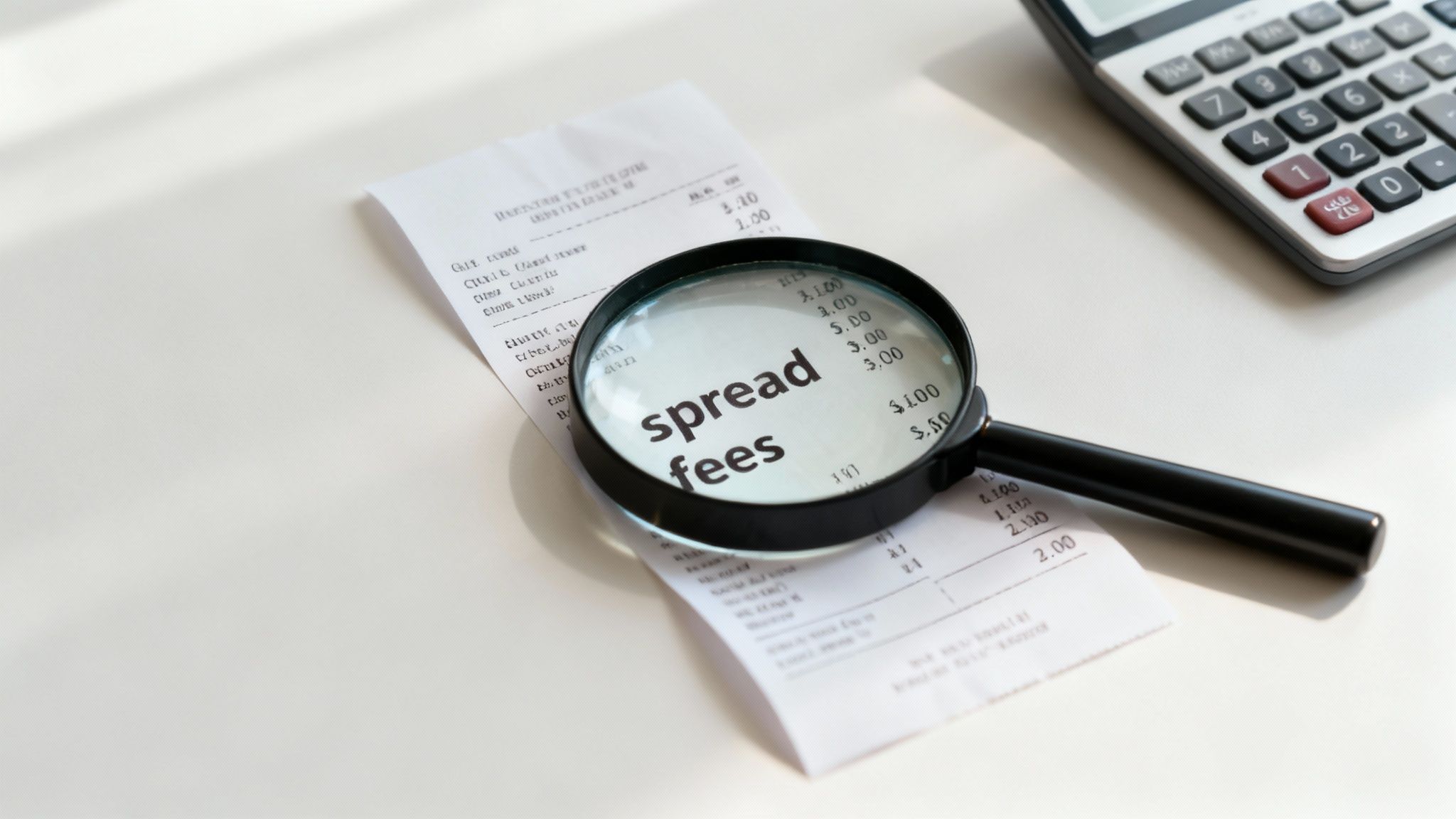
When you’re dealing with any SA currency exchange, the biggest trap isn't the flashy rate you see advertised. The real cost is often tucked away in the fine print. It’s a combination of fees, commissions, and—most importantly—the provider's profit margin on the rate itself, all of which quietly chip away at your money. Learning to spot these hidden costs is the single best thing you can do to get a genuinely fair deal.
At the heart of it all is something called the mid-market rate. Think of this as the "true" exchange rate, the one banks and large financial institutions use to trade currencies with each other. It’s the rate you see on Google or Reuters, representing the exact midpoint between what buyers are willing to pay and what sellers are asking for a currency on the global market.
But here’s the catch: that’s almost never the rate you, as a customer, will be offered. Instead, providers make their money on what’s known as the spread.
Understanding the Spread
The spread is simply the provider’s markup. It’s the difference between the wholesale mid-market rate they get and the less favourable retail rate they pass on to you. A wider spread means a bigger profit for them and less foreign currency in your pocket. It’s as simple as that.
For example, let's say the mid-market rate for the US Dollar to the Rand is 18.50. A provider might offer to sell you dollars at 18.90, or buy your dollars back from you at 18.10. That R0.40 difference on either side of the mid-market rate is their spread. It might not sound like much, but on a large transaction, that margin can easily add up to thousands of Rands.
The spread is the most common hidden cost in currency exchange. If a provider is shouting about "zero commission," they are almost certainly making up for it with a wider, less competitive spread on the rate itself.
Spotting Other Common Fees
On top of the spread, many providers—especially the more traditional ones—will layer on extra charges. Being able to identify these is crucial if you want to compare your options properly.
Keep an eye out for these usual suspects:
- Commission Fees: This is a straightforward percentage-based fee charged on the total value of your exchange. You’ll often find this at traditional banks and bureaux de change.
- Transfer Fees: Usually a flat fee, this covers the administrative work of sending money internationally, particularly for wire transfers that use the SWIFT network.
- Service or Admin Fees: This is a bit of a catch-all term for fixed charges that some providers add to every transaction, no matter how big or small.
To get the full picture, you have to look past the advertised rate and ask for a final, all-inclusive quote. The only number that really matters is how much foreign currency will actually land in the recipient's bank account.
The Myth of "Zero-Fee" Transfers
The promise of "zero-fee" or "no-commission" transfers is incredibly tempting, but it pays to be sceptical. Providers are businesses, and they have to make a profit somewhere. If they aren't charging an obvious, upfront fee, you can bet they are making their money from an inflated exchange rate spread.
To protect yourself, always follow this simple three-step process:
- Check the Mid-Market Rate: Before you do anything else, do a quick search online to find the current mid-market rate.
- Get a Final Quote: Ask your provider for the exact amount of foreign currency you will receive for your Rands after all fees and spreads have been applied.
- Calculate the True Cost: Compare the amount you were quoted with what you would have received at the pure mid-market rate. The difference between the two is the true cost of your transaction.
By pulling back the curtain on these fees and understanding how the system really works, you put the power back in your hands. It ensures you’re the one making the smart decisions for every SA currency exchange you make.
Understanding South African Forex Regulations
Exchanging currency in South Africa isn't just about hunting for the best rate. There's a set of rules you need to play by, designed to manage the flow of money in and out of the country. This system is called exchange control, and it’s managed by the South African Reserve Bank (SARB). It might sound intimidating, but the basics are actually quite simple and crucial for keeping your transactions above board.
Think of exchange controls as a set of guardrails for the economy. The SARB uses them to help keep the demand and supply of the Rand in balance, which is vital for protecting its value. If you’ve ever followed the Rand's rollercoaster journey, you’ll know why this matters. Its ups and downs can impact everything from the price of petrol to the cost of imported goods. For a real deep-dive into this, the historical data on the St. Louis Fed's economic data site paints a fascinating picture of these long-term cycles.
For you and me, these regulations mostly boil down to annual allowances. These are simply limits on how much money you can legally move offshore each year.
Your Annual Allowances Explained
Every South African resident gets a couple of allowances for sending money abroad. They're pretty generous and cover most people's needs, whether you're planning a holiday or making a serious investment.
Here are the two main allowances you need to know about:
Single Discretionary Allowance (SDA): This is your everyday, no-fuss allowance. You can send up to R1 million offshore each calendar year without needing any special tax clearance. It’s perfect for personal things like travel expenses, sending cash gifts, making donations, or helping out family living overseas.
Foreign Investment Allowance (FIA): If you're looking to move a larger sum for investment purposes, this is the one for you. On top of your SDA, you can transfer an extra R10 million per calendar year. This is specifically for buying assets abroad, like property or shares on a foreign stock exchange.
A quick heads-up on the Foreign Investment Allowance: it's a bit more formal. You'll need to get a Tax Clearance Certificate from SARS to prove your tax affairs are in order before you can use it.
The Paperwork for Bigger Transactions
For smaller transfers using your R1 million SDA, the process is usually quick and requires minimal paperwork. But when you step up to the FIA, you’ll need to get official approval first.
Your bank or forex provider won't be able to process a transfer under the FIA without a valid Tax Clearance Certificate for Foreign Investment Allowance. This is simply a document that confirms to the SARB that your money is clean and that you're in good standing with the tax man.
Getting to grips with these rules makes sure your SA currency exchange is not only cheap but also completely compliant. When you know your allowances and what documents you need, you can manage your international payments without any hassle or nasty surprises down the line.
Actionable Tips for a Better Exchange Rate
Knowing how exchange rates work is one thing, but actually using that knowledge to keep more money in your pocket is another. It’s all about turning theory into savings. These practical tips will help you get the most out of every SA currency exchange, making sure your money goes further.
The biggest mistake people make? Leaving their exchange to the very last minute. Those airport kiosks and walk-in bureaus in tourist hotspots know you're in a hurry, and their rates reflect it. Planning, even just a day or two in advance, puts the power back in your hands and helps you sidestep these expensive convenience traps.
Monitor and Compare the Market
You wouldn't buy the first car you see, so why take the first exchange rate you're offered? These days, it’s incredibly simple to track currency movements and compare different providers in real-time.
- Use Online Tools: Set up rate alerts on financial websites or download a currency app to keep an eye on how the ZAR is doing against the currency you need. This helps you get a feel for the trends and pounce when the rate looks good.
- Compare the Final Quote: Don't get fixated on the advertised rate alone. The only number that truly matters is the final amount that will land in the recipient's account after all fees and spreads are taken off.
This one step—shopping around—is often the biggest decider between a good deal and a bad one. It makes providers compete for your business, which can only mean better value for you.
Time Your Exchange Strategically
Nobody can predict the market perfectly, but you can definitely make an educated guess. If you aren't in a massive rush, waiting for a better rate can make a real difference, especially if you're moving a large sum of money.
For businesses that make regular international payments, even a tiny improvement in the exchange rate adds up to huge savings over a year. A forward contract can also be a smart move, letting you lock in a rate now to protect yourself from any nasty surprises down the line.
If you often deal with foreign currencies, look into a multi-currency account. These accounts let you hold money in different currencies, so you can choose to make the exchange only when the rate is in your favour, instead of being forced to convert on the day you need to pay.
Verify Your Provider's Legitimacy
Last but certainly not least, put your security first. Before you hand over your money to any provider, especially one you've just found online, do a quick background check. A fantastic rate means nothing if your funds disappear.
- Check for FSCA Authorisation: In South Africa, any legitimate financial services provider must be authorised by the Financial Sector Conduct Authority (FSCA). You can check their official website to see if a company is on their list.
- Read Reviews: See what other people are saying. A quick search on sites like Google or Trustpilot will give you a good sense of what to expect from their service and reliability.
By combining a bit of planning, smart comparison, strategic timing, and some basic security checks, you can navigate the world of SA currency exchange with confidence. These habits empower you to make smarter decisions and get the maximum value from every Rand you convert.
Your Top SA Currency Exchange Questions, Answered
Let's face it, swapping currencies can feel a bit confusing. You've got rates, fees, and rules to think about. To cut through the noise, we’ve put together some straight-to-the-point answers to the questions we hear most often.
What’s the Cheapest Way to Exchange Currency in South Africa?
Nine times out of ten, you’ll find the best deal with online fintech platforms or dedicated forex specialists. They don't have the massive overheads of a high-street bank or an airport kiosk, and that means they can offer you much better exchange rates and lower fees.
The golden rule? Always look at the final amount you'll receive after every single cost has been taken off. A flashy advertised rate means nothing if it’s eaten up by hidden charges.
How Can I Tell if I’m Getting a Good Exchange Rate?
A great rate is one that’s hugging the mid-market rate as tightly as possible. Think of the mid-market rate as the "true" exchange rate—it's the one you see on Google or Reuters, representing the midpoint between what buyers are willing to pay and what sellers are asking for a currency.
The difference between that mid-market rate and the rate you're offered is the provider's profit, often called the "spread".
It's simple: the smaller the spread, the better the deal for you. The best providers are upfront about this, showing you the mid-market rate right next to their own so you can see exactly what you're paying.
Can I Take Rands Out of South Africa for My Trip?
Absolutely, but there are rules. The South African Reserve Bank (SARB) has exchange control regulations in place. For South African residents, this includes the Single Discretionary Allowance (SDA), which lets you take up to R1 million out of the country per calendar year for things like travel, gifts, or investments abroad without needing a tax clearance certificate.
If you’re a non-resident, the rules are different. You can take out the Rands you have left over from your trip, but you'll need the original receipt from when you first converted your foreign currency into Rands. This is to prove where the money came from.
For South African businesses tired of hidden fees and poor exchange rates, Zaro offers a better way. We provide access to real exchange rates with zero spread and no hidden costs, ensuring your money goes further. See how much you could save on your next international payment at https://www.usezaro.com.