
If you've ever sent money overseas for your business, you know the feeling. It often feels like a black box – opaque fees, confusing delays, and exchange rates that seem to work against you, slowly chipping away at your profits. For South African SMEs, this old-school, bank-first model just doesn't cut it anymore.
A modern approach, however, flips the script. It’s all about putting control back in your hands with transparent pricing and efficient technology.
Your New Playbook for International Payments
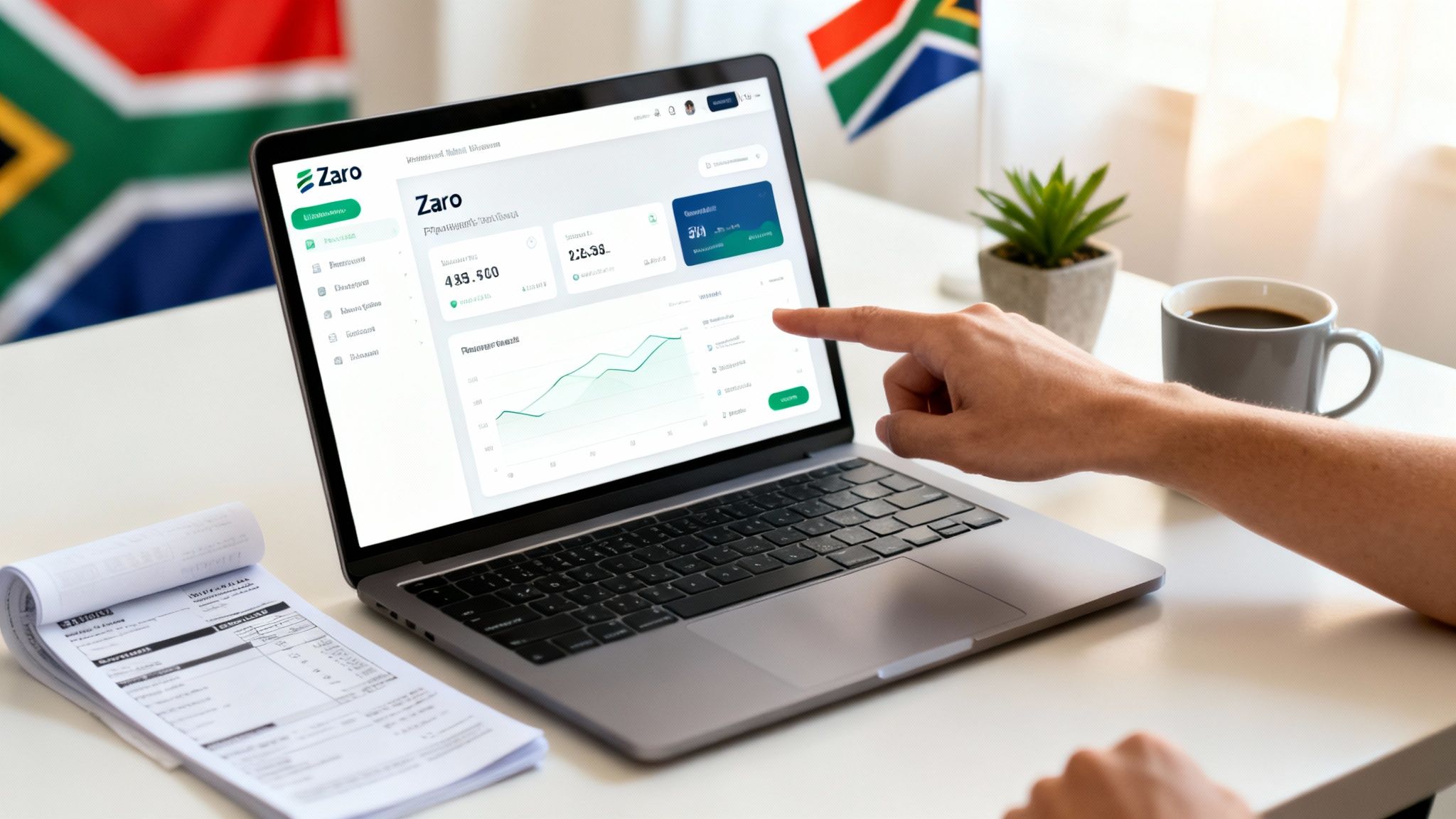
For years, the default for sending money internationally was a classic bank wire. It’s a familiar process, sure, but it wasn't designed for the speed and agility that modern businesses need. Finance teams get stuck in a slow, expensive loop that hits the bottom line before the money even lands.
This legacy system creates some serious headaches for South African companies. You’re dealing with hidden costs buried in the exchange rate, a frustrating lack of clarity on where your money actually is, and settlement times that can mess with your cash flow and even damage supplier relationships. These aren't just minor annoyances; they're real operational roadblocks holding back your growth.
Moving From Legacy Systems to Smart Efficiency
The alternative is a much cleaner, tech-driven model built to solve these exact problems. Modern fintech platforms like Zaro offer a clear, straightforward playbook for global payments, finally pulling back the curtain on the old banking system. This new way of working is based on a few core ideas:
- Total Transparency: You see the real mid-market exchange rate. No hidden markups, no surprise spreads. What you see is exactly what you get.
- Predictable Costs: When you cut out the web of intermediary bank fees and get a clear cost structure, you can actually forecast your international payment expenses with accuracy.
- Real Control: You get enterprise-level features that give you a bird's-eye view of the entire process, from sending the funds to final settlement, all backed by solid security and team permissions.
This isn't just about saving a few rand on one transaction. It's about building a smarter, more strategic financial operation that helps your business compete on the global stage.
Why This Matters for Your SME
Let's make this real. Say you need to pay an international software supplier. With your bank, a 2-3% markup on a R200,000 invoice could easily cost you an extra R4,000 to R6,000 in hidden exchange rate costs alone. Over a year, that adds up to a serious, and completely avoidable, expense.
This guide is your practical roadmap to leaving those old inefficiencies behind. We'll walk you through everything—from getting your compliance docs in order and choosing the right payment rails to calculating the true cost of your transfers. Our goal is to give your finance team the confidence and know-how to manage international payments smartly, unlocking savings and making your operations smoother. Think of it as learning the new rules of global finance.
Getting Your Paperwork in Order: Compliance and Documentation
Before you even start worrying about exchange rates and how fast your money will get there, you’ve got to tackle compliance. I know, it sounds like a chore, but getting this right is the bedrock of every single international payment you'll make. It’s not just about ticking boxes; it's about earning your business's licence to operate on the global stage.
Any platform worth its salt will start with Know Your Business (KYB) verification. This isn't optional—it's a mandatory process for confirming your company is who it says it is. The whole point is to shut the door on financial crime, like fraud and money laundering, and it's enforced by bodies like the South African Reserve Bank (SARB) to keep the system clean.
Think of it as the digital version of walking into a bank and proving your identity. It builds that crucial layer of trust right from the start.
The Essential Document Checklist for South African SMEs
Having your documents ready to go before you even sign up will make your life infinitely easier. The exact requirements might differ slightly from one provider to another, but there’s a core set of documents you’ll almost certainly need.
Here’s a practical list of what to have on hand:
- Company Registration Documents: This is your CIPC paperwork. It’s non-negotiable proof that your business is a legitimate, registered entity in South Africa.
- Proof of Business Address: A recent utility bill or bank statement, typically no older than three months, showing your company’s physical address.
- Director and Shareholder ID: You'll need a valid SA ID or passport for all company directors and anyone who owns a significant stake (usually 25% or more).
- Proof of Bank Account: A simple confirmation letter from your bank verifying your business account details will do the trick.
My advice? Scan these and save them as digital files in a dedicated folder. It will save you a world of pain and time, especially when you're dealing with online platforms.
The Old Way vs. The New Way of Getting Verified
If you’ve ever tried to set up international payments with a traditional bank, you know the drill. It’s often a mountain of paperwork, trips to get documents certified, and multiple visits to a branch. The whole manual process can easily stretch into weeks, putting a handbrake on your plans to pay overseas suppliers or get paid by international clients.
This is where modern fintech platforms have really changed the game. They’ve moved the entire KYB process online. You just upload your documents securely through their portal, and you’re often verified within a couple of business days. It’s not just faster; it frees up your finance team from soul-crushing admin so they can focus on what actually matters.
Getting your compliance sorted upfront isn’t about jumping through hoops. It’s about building the foundation for faster, safer, and smarter global finance for your company.
One last thing to keep in mind: sometimes your documents might need to be officially translated. This can happen when you're dealing with certain countries or processing particularly large payments. To ensure everything is accepted without a hitch, you may need to use professional certified document translation services. Factoring this in from the beginning can save you from nasty surprises and delays down the road.
Choosing Your Payment Rails: SWIFT vs Fintech
Once your compliance paperwork is sorted, you’re faced with the next crucial decision: how are you actually going to send the money? This isn’t just about getting funds from A to B. The path your money takes—its "payment rail"—has a massive impact on your costs, speed, and overall peace of mind.
For decades, South African businesses really only had one choice: go to the bank and use the SWIFT network.
SWIFT, or the Society for Worldwide Interbank Financial Telecommunication, has been the backbone of global finance for nearly fifty years. It’s the established, trusted messaging system that lets banks all over the world talk to each other securely about payments.
But "trusted" doesn't always mean "efficient." Sending money via SWIFT is a bit like taking a series of connecting flights instead of a direct one. Your payment hops between several intermediary banks before it reaches its destination, and each stop introduces potential delays and, more importantly, extra fees.
The Headaches of Traditional SWIFT Transfers
For any finance team trying to manage cash flow and keep suppliers happy, the SWIFT system can be a real source of operational friction. It's a slow, murky process that often leaves you completely in the dark.
Here's what you're up against with the traditional route:
- Hidden Intermediary Fees: Each bank in the chain can slice off its own fee from the transfer amount. This means your recipient often gets less than you sent—an unpredictable and frustrating outcome.
- Glacial Processing Times: A SWIFT transfer can take anywhere from 2 to 5 business days. Throw in a public holiday or a random compliance check, and it can take even longer.
- No Real-Time Tracking: Once the money is sent, it vanishes into a black box. You have no clear, end-to-end visibility of where your funds are until they (hopefully) land.
Relying solely on SWIFT is like mailing a cheque in an age of instant messaging. It gets the job done eventually, but it’s slow, expensive, and leaves you wondering when it will actually arrive.
The Rise of Modern Fintech Rails
Fortunately, there’s a much better way. Modern fintech platforms have built entirely new, direct payment rails that bypass the tangled web of intermediary banks. Think of it as the direct flight you were looking for.
These platforms build direct relationships with banks and liquidity providers in different countries, creating a streamlined, efficient network. When you send money internationally through a provider like Zaro, the transaction is handled within this closed-loop system. The extra hops and hidden costs are gone.
What you get instead is faster settlement, transparent fees, and full visibility from start to finish.
This shift to more reliable systems is happening across the board. South Africa's formal remittance market has exploded, jumping from R6 billion in 2016 to over R19 billion in 2024. A huge 52% of that surge happened in 2020 alone, as COVID-19 travel restrictions pushed people towards trackable digital channels. You can read the full research about these payment trends to see just how much the landscape has changed.
A Real-World Scenario: Comparing the Two
Let's make this practical. Imagine your BPO firm in Cape Town needs to pay a freelance developer in Kenya USD 1,000.
Via a Traditional Bank (SWIFT): You kick off the transfer. It takes three days to arrive. Along the way, an intermediary bank in Europe deducts a $20 fee, and the receiving bank in Kenya takes another $15. Your developer gets $965 and is, understandably, confused. You're now stuck trying to figure out where the missing $35 went.
Via a Fintech Rail (Zaro): You send USD 1,000 through the platform. The fee is stated upfront, with no hidden spreads. The money lands in your developer’s account the next day, and they receive the full amount you intended. You get real-time updates and a clean audit trail.
This infographic helps visualise the decision-making process for a business choosing between these two paths.
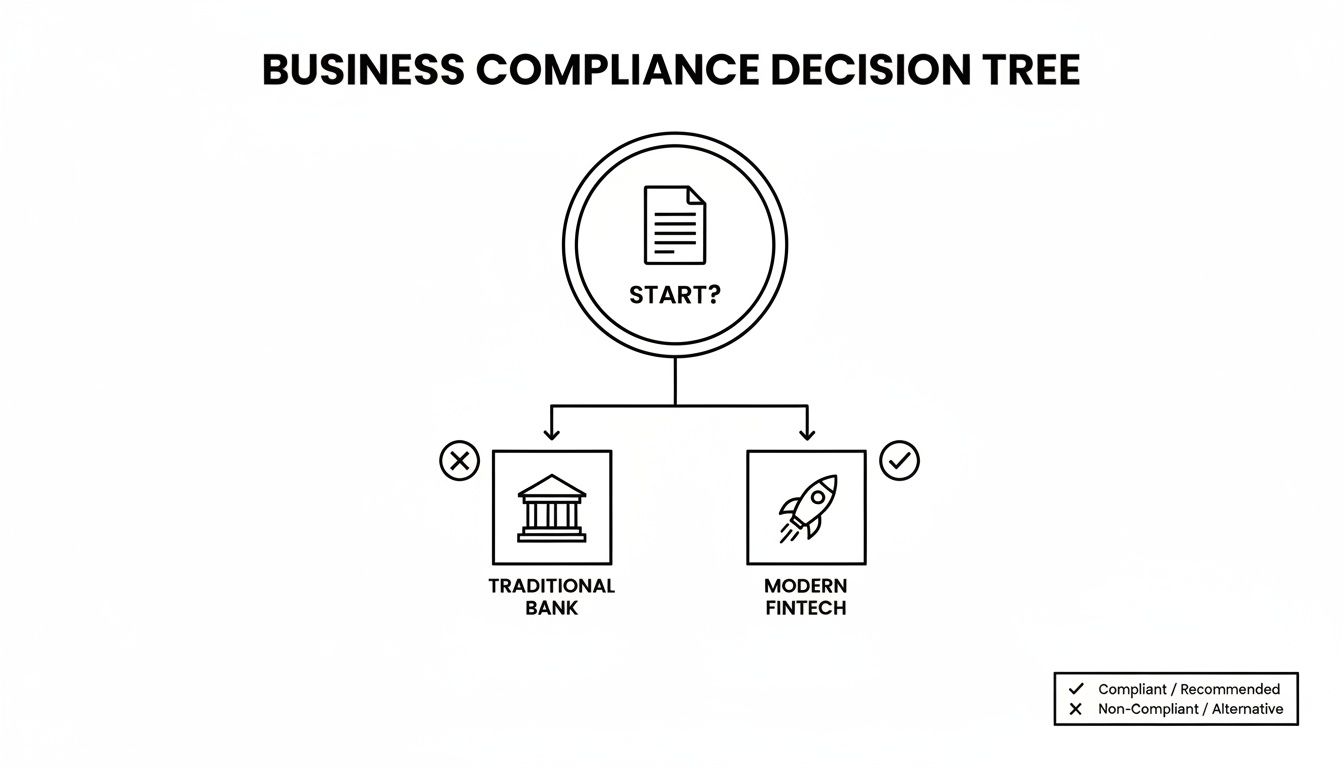
When you see it side-by-side, the choice for modern South African businesses becomes incredibly clear.
Payment Rails Compared: SWIFT vs Zaro's Fintech Rail
Here’s a direct comparison of what sending USD 10,000 looks like through a traditional bank versus a modern fintech rail. This is the kind of detail every finance team should be looking at.
| Feature | Traditional Bank (SWIFT) | Zaro (Fintech Rail) |
|---|---|---|
| Total Cost | High & Unpredictable (FX spread + multiple hidden fees) | Low & Transparent (Clear fee + competitive FX rate) |
| Speed | Slow (2-5+ business days) | Fast (Often same-day or next-day settlement) |
| Tracking | Limited to non-existent ("black box") | Real-time, end-to-end tracking with status updates |
| Recipient Amount | Often less than sent due to intermediary deductions | Guaranteed full amount arrives with the recipient |
| Reconciliation | Complicated, requires manual investigation for discrepancies | Simple, with clear digital records and predictable outcomes |
| Process | Manual forms, branch visits, complex online banking interfaces | Simple online platform, easy to use, quick to execute |
For SMEs, the benefits of moving away from the old SWIFT network are undeniable. The control, transparency, and cost-savings offered by a fintech rail give you a genuine competitive advantage.
Calculating the True Cost of Your International Transfers

The advertised fee for sending money internationally is almost never the full story. It’s usually just the tip of the iceberg, and for finance teams, focusing only on that upfront number can give you a dangerously wrong idea of what it really costs to send money international.
The true cost is often hidden in plain sight, tucked away in the exchange rate or surprise fees that pop up along the way. To get a clear picture, you need to break down the total expense into its three core parts. Miss one, and you could be losing thousands of rands on a single transaction.
The Three Layers of Transfer Costs
I like to think of the total cost as a three-layered cake. Each layer adds to the final price, and funnily enough, the biggest one is often the one you don't see advertised.
The Upfront Transfer Fee: This is what everyone sees. It's the flat fee your bank or provider charges to kick off the payment, usually somewhere between R250 and R500. It seems straightforward, but honestly, it’s mostly there to make the service look affordable and draw your attention away from where the real costs are lurking.
The FX Spread or Markup: This is where the real damage happens. The FX spread is simply the difference between the mid-market exchange rate (the real rate banks trade at among themselves) and the much less attractive rate they offer you. Banks often bake in a markup of 2-3%, which is pure profit for them and a direct loss for your business.
Intermediary Bank Fees: When you use the SWIFT network, your money doesn’t fly directly from your account to your supplier's. It often hops between several "intermediary" banks, and each one can skim a fee off the top. These charges are unpredictable and often deducted from the amount being sent, meaning your recipient gets less than you intended. A very frustrating surprise for everyone involved.
The combination of these costs is especially painful in regions where cross-border business is a lifeline. For instance, transfer costs on the critical South Africa-Zimbabwe corridor can climb as high as 12.7%. This figure is miles away from the G20's goal to bring global remittance costs down to 3%, and it shows just how much businesses are overpaying with old-school systems. The International Monetary Fund has some eye-opening reports on this very challenge.
A Practical Example: The Real Cost of Converting Revenue
Let’s make this real. Imagine your export business just received a USD 50,000 payment from a US client. You need to convert it to ZAR to pay your local team and suppliers.
Here’s how the numbers stack up when you compare a traditional bank with a modern, transparent platform like Zaro.
Scenario Assumptions:
- Mid-Market Rate: 1 USD = 18.50 ZAR
- Bank's Quoted Rate (with a 2% spread): 1 USD = 18.13 ZAR
- Bank's Transfer Fee: R500
- Zaro's Rate: 1 USD = 18.50 ZAR (the real mid-market rate)
- Zaro's Fee: A transparent, fixed fee
Calculation with a Traditional Bank:
- Amount Received (at Bank's Rate): USD 50,000 x 18.13 = R906,500
- What You Should Have Received (at Real Rate): USD 50,000 x 18.50 = R925,000
- Cost of the FX Spread: R925,000 - R906,500 = R18,500
- Total Cost: R18,500 (FX Spread) + R500 (Fee) = R19,000
In this scenario, that seemingly tiny 2% spread just cost your business a massive R18,500. The R500 fee was just a distraction from the real expense.
Calculation with Zaro: Because a platform like Zaro gives you the real mid-market rate, you completely eliminate the FX spread. The only cost is a clear, upfront fee, which means you've just saved over R18,000 on this one transaction alone.
Key Takeaway: Always, always check the mid-market rate before you make a transfer. Use a neutral source like Google or Reuters to see the real rate, then compare it to what your bank is offering. The difference between those two numbers is the hidden fee you’re about to pay.
Locking Down Your Finances: Security and Controls are Non-Negotiable
When you’re sending money internationally, getting a great rate and a fast transfer time feels like a win. But that’s only half the story. The other, arguably more critical, piece is making sure every single rand is secure and governed by solid internal controls. For any business owner or CFO, this isn’t just a nice-to-have; it’s what lets you sleep at night.
Sending funds across borders naturally comes with risk. You’ve got external threats to worry about, of course, but simple internal mistakes can be just as damaging. An incorrect beneficiary detail or a duplicate payment can become a massive, expensive headache to fix once the money has left your account. This is precisely why enterprise-grade security isn’t a luxury—it’s a fundamental requirement for any serious business.
Why a Single Login is a Recipe for Disaster
Think about how many business banking portals work: one login, shared across the whole finance team. It’s a common setup, but it’s deeply flawed. When everyone uses the same credentials, you have zero accountability. Who set up that new supplier payment? Who approved it? Who just logged in to check a balance? You have no idea. This approach creates gaping security holes and makes any kind of audit a complete nightmare.
This is a problem that modern platforms, like Zaro, were built to solve with a simple but powerful feature: multi-user access. It seems basic, but it’s a game-changer. You can create separate, secure logins for every person on your team.
Suddenly, your security posture is infinitely stronger. Every action taken—from loading a beneficiary to executing a payment—is tied to a specific individual, creating a clear and permanent record of who did what, and when.
Building a Bulletproof Payment Workflow
Once you have individual user accounts, you can start building a real system of checks and balances with custom permissions. This is how you go from just having a password to having a genuinely controlled and transparent financial workflow.
A tried-and-tested method, and one we see the smartest teams implement, is the maker-checker principle:
- The "Maker": A junior team member can be given permission to set up new beneficiaries and prepare payment instructions. They do the groundwork and get everything ready, but they don't have the final say to actually send the funds.
- The "Checker": A senior manager or the CFO gets sole permission to review and approve outgoing payments. They receive a notification, double-check all the details, and give the final sign-off before a single cent leaves the business.
This separation of duties is the bedrock of good financial governance. It dramatically cuts down the risk of both internal fraud and simple, costly human errors by ensuring at least two sets of eyes review every international payment.
The Importance of a Clear Audit Trail
While permissions stop unauthorised actions before they happen, a detailed audit trail gives you complete visibility after the fact. Any good platform should log everything. I mean everything—from a user logging in, to a new supplier being added, to a payment being approved.
This creates an unchangeable, time-stamped record of all financial activity. It’s an indispensable tool for internal reviews, preparing for your annual audit, or just tracking down a discrepancy. Instead of playing a guessing game about who did what, you have a clear, digital paper trail right there.
For a growing SME, putting these controls in place early is absolutely crucial. You’re building a scalable, transparent financial operation that supports your growth, rather than becoming a bottleneck or a security risk later on.
Of course, all these internal controls need to be backed by bank-level security. We’re talking about the essentials, like two-factor authentication (2FA) to add that critical second layer of security to every login, and end-to-end data encryption to shield your sensitive financial information. When you combine strong internal workflows with these foundational security measures, you build a resilient system that lets you manage your international payments with complete confidence.
A Real-World Example: The Zaro Difference
Theory is one thing, but seeing how these concepts play out in a real business is where it all clicks. Let's look at a classic scenario we see all the time with South African SMEs and show how a small change in process can have a massive impact on the bottom line.
Meet "Cape Crafts," a hypothetical exporter based in the Western Cape. They create beautiful artisanal goods and have a growing customer base of boutique retailers in the United States and Europe. This is great for business, but it means their cash flow depends heavily on getting USD and EUR payments back home and converted into Rand.
The Old Way: A Story of Hidden Costs
For years, Cape Crafts did what most businesses do: they used their traditional business bank for everything. Their process for handling foreign currency was slow and, as they eventually realised, painfully expensive.
Every month, their biggest US client would send them a payment of around USD 25,000. The bank handled the conversion, but the final amount that hit their ZAR account always felt a bit... off. It was never quite what they expected.
Here’s what was really going on behind the curtain:
- Opaque Exchange Rates: The bank was applying a hefty FX spread of about 2.5% below the real mid-market rate. This was never broken down or explained on any statement.
- Unpredictable Delays: Funds would take anywhere from three to four business days to actually clear. This made forecasting their cash flow a constant headache.
- Admin Overload: Their small finance team spent hours manually reconciling these payments, trying to match invoices to unpredictable ZAR amounts.
That hidden 2.5% spread on a single USD 25,000 transaction was costing them over R11,500. Every. Single. Month. Over a year, that added up to more than R138,000 lost to poor exchange rates alone—a huge slice of profit for a growing business.
The New Way: Clarity and Savings with Zaro
Fed up with the lack of transparency, Cape Crafts decided to give Zaro a try. The onboarding was surprisingly fast and completely digital. The difference was obvious from their very first transaction.
When the next USD 25,000 payment arrived, they routed it to their new Zaro USD account.
Instead of being stuck with the bank's hidden markup, they could now see the live, mid-market exchange rate right on the platform. They made the conversion at the real rate, paying only a small, clearly stated fee.
Just by cutting out the FX spread, Cape Crafts saved over R11,000 on that one payment. On top of that, the money settled the very next business day. This gave them faster access to their cash and made financial planning infinitely easier.
These kinds of capital flows are a big deal for the South African economy. In 2023 alone, remittances hit about USD 844.11 million. As the digital remittance market continues to grow, efficient platforms are no longer a nice-to-have; they're essential. You can explore more about South Africa's remittance economy here to get the bigger picture.
For a business like Cape Crafts, optimising cross-border payments isn't just a minor tweak. It's a fundamental competitive advantage.
Ultimately, this isn't just about saving money. It’s about taking back control and getting the visibility and predictability every business needs to compete on a global stage. It’s worth taking a hard look at your own international payments—how much could those hidden fees and bad rates be costing you?
Your Questions, Answered
What Exactly Is the "Mid-Market" Exchange Rate?
Think of the mid-market rate as the ‘real’ exchange rate. It's the midpoint between what buyers are willing to pay and what sellers are asking for a currency on the global market.
This rate is incredibly important because it's the baseline. Banks and traditional brokers rarely give you this rate. Instead, they add a hidden markup, often called a 'spread', which is pure profit for them and a cost to you. Platforms like Zaro, on the other hand, give you direct access to the real mid-market rate, which is a big reason why the overall cost is so much lower.
Are These New Fintech Platforms Actually as Secure as a Bank?
Absolutely. It’s a common question, and the answer is a firm yes. Reputable fintechs are held to incredibly high standards. They use the same kind of security as major banks, including advanced data encryption and sophisticated fraud prevention systems.
On top of that, they're regulated by financial authorities just like any other financial institution. In many ways, they offer even better security for a finance team's day-to-day work. Features like multi-user permissions and detailed audit trails give you much tighter control over who can do what with company funds.
Platforms like Zaro are built for modern businesses. They combine enterprise-grade security with the kind of flexible, transparent tools that finance teams need to work efficiently and securely.
How Long Does It Really Take to Get My Business Set Up?
This is where you'll notice a massive difference. Getting a business account ready for international payments with a traditional bank can sometimes drag on for weeks.
Modern fintechs have made the whole Know Your Business (KYB) process much smoother. As long as you have your standard company documents ready to go, you can often be fully verified and ready to make your first payment within just a few business days. It means you can stop overpaying and start saving much sooner.
Ready to stop overpaying on international transfers? With Zaro, you get the real exchange rate and transparent fees every time. Explore how much your business could save today.