
You get an invoice from an overseas supplier, and you brace yourself. What should be a straightforward payment often becomes a costly headache thanks to hidden fees and unpredictable exchange rates.
When sending money internationally, the real cost isn't the upfront transfer fee. It's the sneaky markups on the exchange rate that chip away at your bottom line. For many South African businesses, the whole process feels frustratingly opaque and expensive. But it doesn't have to be.
The Real Cost of Sending Money International
If you're running a South African business, this scenario probably sounds familiar. An invoice for $10,000 USD lands in your inbox. You quickly check the live exchange rate online, do a rough calculation, and budget for the ZAR equivalent.
But when you tell your bank to process the payment, the final rand amount that leaves your account is always, always higher than you planned for. That difference is the true cost of sending money internationally, and it’s a silent profit killer.

So, what's going on? The rate you see on Google isn't the rate your business actually gets. Not even close. Traditional banks add their own markup—known as a "spread"—to the real exchange rate. This spread is their profit margin, a fee hidden in plain sight. Across dozens or hundreds of transactions, these costs add up to a staggering amount.
Understanding the Hidden Fees
The exchange rate spread is just the beginning of the problem. Legacy systems, like the SWIFT network that most banks rely on, bounce your money between several intermediary banks to get it from South Africa to its final destination. Think of it like a flight with multiple layovers. Each of those banks can take a slice for their trouble, making the whole journey expensive, slow, and unpredictable.
This old way of doing things creates some serious challenges for any business that operates globally:
- No Transparency: You often don't know the final cost until the transfer is already done. This makes accurate financial planning and budgeting a guessing game.
- Shrinking Profit Margins: Every rand lost to a poor exchange rate and hidden bank fees comes directly out of your company's profit.
- Wasted Time: The mountain of paperwork, the frustrating delays, and the endless follow-ups chew up valuable hours for your finance team.
The real issue for businesses is the gap between the 'real' market exchange rate and the less favourable rate that banks and many payment providers offer. Closing this gap is the key to unlocking significant savings and improving financial control.
Thankfully, the landscape is finally changing. Modern fintech solutions were built specifically to solve these problems. By giving you access to the real exchange rate with zero spread and finding smarter routes that bypass costly intermediary banks, these platforms offer a clear, efficient, and much cheaper alternative. This guide will walk you through exactly how it all works, so you can turn a frustrating operational task into a genuine strategic advantage.
How International Payments Actually Work
Sending money across borders can feel like a black box. You hit "send," and days later, the funds arrive… maybe. To really get why modern payment solutions are so different, we first need to look under the bonnet of the traditional system that’s been running the show for decades.
Think of it this way: you need to send a parcel from Johannesburg to a supplier in Berlin. Instead of a direct flight, your courier sends it via Dubai, then London, and finally on to Germany. Each stop adds time, a handling fee, and another chance for things to go wrong. That’s pretty much how the old-school banking system handles your money.
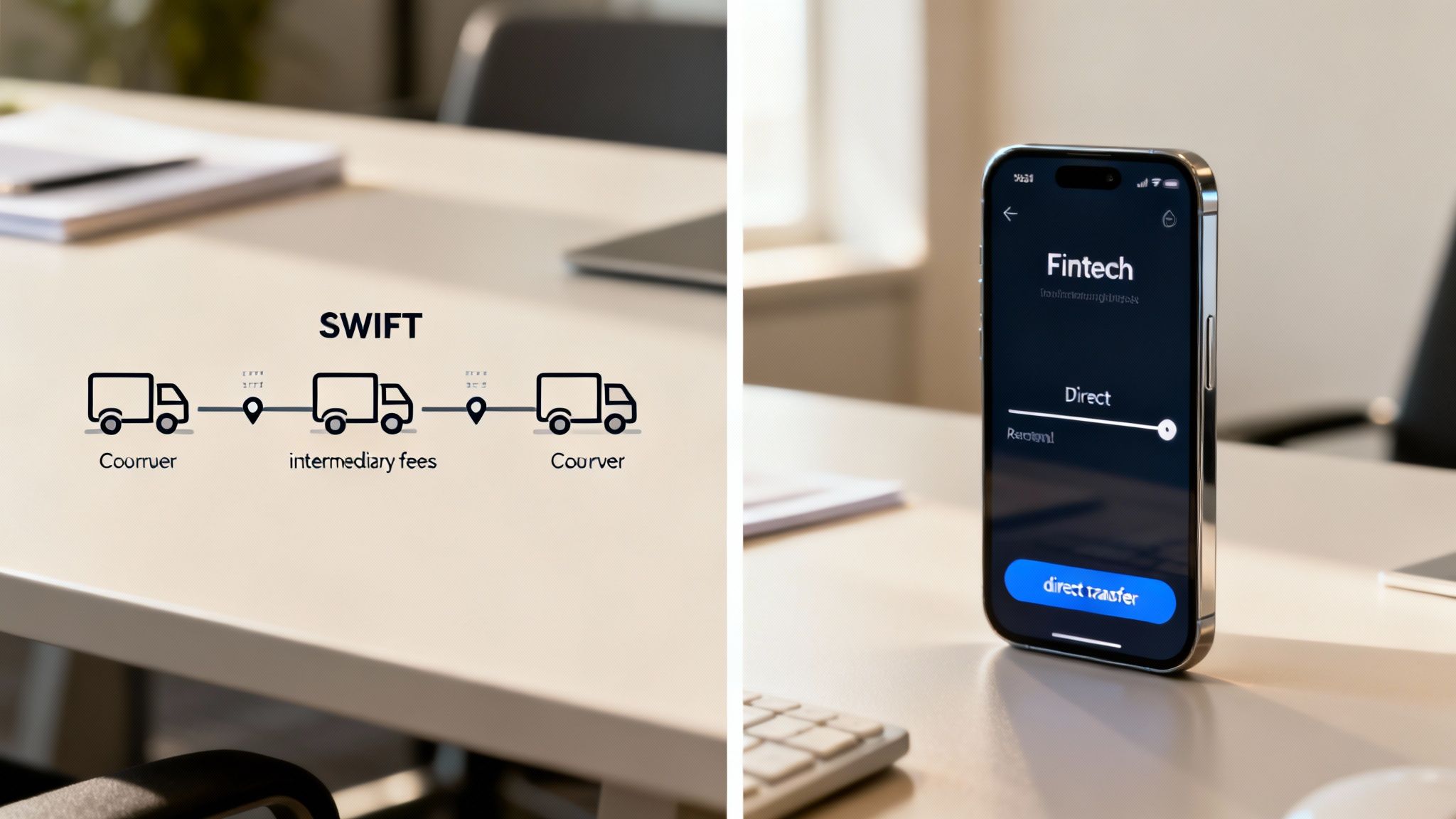
This complex journey is built on the SWIFT (Society for Worldwide Interbank Financial Telecommunication) network. SWIFT itself doesn't move money—it’s more like a secure messaging service that banks use to send payment instructions to each other.
The Traditional SWIFT Journey
When you tell your South African bank to pay that supplier in Germany, it triggers a chain reaction that bounces your payment through several "correspondent" or intermediary banks.
- Your Bank: Kicks things off by sending a SWIFT payment instruction.
- Intermediary Bank 1: Receives the message and funds, skims off a fee for its trouble, and passes it along.
- Intermediary Bank 2 (and sometimes 3): This rinse-and-repeat process can happen multiple times, with each bank taking its cut.
- Recipient's Bank: Finally gets the instructions and the now-reduced funds. It might even charge another "incoming fee" before the money lands in your supplier's account.
This roundabout route is exactly why a SWIFT transfer can drag on for 3 to 7 business days. It’s also why the amount your supplier receives is often less than what you sent. You’re left with almost no visibility into where the money is or what the final cost will be.
Demystifying Foreign Exchange: The Real Rate vs The Spread
The other big piece of the puzzle is the foreign exchange (FX) conversion. This is where a massive—and often hidden—cost creeps in. Two terms are crucial here.
- The Spot Rate: This is the ‘real’ or mid-market exchange rate. It’s the true, live price of a currency, the midpoint between what buyers and sellers are offering on the global market. It’s the rate you see on Google.
- The Spread: This is the markup a bank or broker adds on top of the spot rate. They buy currency at the real rate but sell it to you at a less favourable one, pocketing the difference.
Think of the spread as a cleverly disguised service fee. The bank might advertise a low "transfer fee," but they often make their real money on this exchange rate markup—a cost that’s much harder for you to see.
This lack of transparency makes it incredibly difficult for a business to budget accurately. A seemingly small percentage difference in the exchange rate can quickly add up to thousands of rands lost, especially on larger or regular payments.
The Modern Alternative: A Direct Route
This is where modern fintech platforms completely changed the game. They were built from the ground up to cut out the expensive and sluggish middlemen. Instead of bouncing payments around the world through correspondent banks, they create their own smart payment networks.
It’s like booking that direct flight for your parcel. It gets from Johannesburg to Berlin faster, cheaper, and with one clear cost. By holding local currency in different countries, fintech providers can often settle payments locally, meaning the money never has to make the slow, expensive journey across borders via SWIFT.
When you put the two approaches side-by-side, the differences are impossible to ignore.
Traditional Bank Transfer vs Modern Fintech Payment
This table breaks down how the old way of doing things stacks up against the new.
| Feature | Traditional Banks (SWIFT) | Modern Fintech Platforms |
|---|---|---|
| Speed | Typically 3-7 business days, with the potential for delays. | Often within the same business day, sometimes near-instant. |
| Cost | Multiple hidden fees from intermediary banks and a wide FX spread. | A transparent, often single fee with access to the real spot rate. |
| Transparency | Low visibility; you only know the final cost and timing after the fact. | High visibility with real-time tracking and upfront cost details. |
| Process | Often requires paperwork, branch visits, and a manual workflow. | A fully digital, online process with streamlined compliance checks. |
Ultimately, this shift gives South African businesses a level of control over their global payments that was unimaginable just a decade ago. What used to be a frustrating operational chore can now become a genuine source of efficiency and a competitive advantage.
Getting to Grips with South African Compliance and KYB
For many South African businesses, the mere mention of international compliance feels like hitting a brick wall. All those acronyms—AML, KYB, FICA—sound complicated and feel like they’re just there to slow you down. But they serve a vital purpose: keeping the global financial system safe from crime.
At its heart, compliance is simply about proving your business is who it says it is and that your transactions are above board. Think of it as a firm, digital handshake. Before any financial partner can help you move money across borders, they have to verify your business’s identity. This is non-negotiable for preventing fraud, money laundering, and other dodgy activities, and it’s the bedrock of a secure and trustworthy payment network.
Why All the Paperwork?
The two big ideas you’ll keep hearing about are Anti-Money Laundering (AML) and Know Your Business (KYB). AML is the umbrella term for all the laws and processes designed to stop criminals from making dirty money look clean. KYB is a critical piece of that puzzle, focusing squarely on vetting and verifying a business entity.
This isn't just box-ticking; it's a legal must-do for any regulated financial institution. Getting it wrong can lead to hefty fines, but more importantly, it leaves your business—and the broader economy—exposed to serious risk.
The point of modern compliance isn’t to put up roadblocks, but to build a foundation of trust. Smart, risk-based verification protects everyone in the chain—from you to your international suppliers—and keeps every transaction legitimate.
You can see the real-world impact of compliance friction in certain payment corridors. Take the South Africa-Zimbabwe route, where tight AML rules and a lack of competition push transaction costs to a staggering 12.7%. This directly affects the R16.6 billion that SADC migrants send home each year. It’s a stark reminder of why we need smarter, faster compliance that doesn’t penalise legitimate business—a problem that modern fintechs are specifically designed to fix. You can read more about these cross-border payment challenges in the IMF's findings.
From Manual Nightmare to Digital Onboarding
Not long ago, the KYB process was a painful, paper-drenched ordeal. The finance team would spend weeks hunting down documents, scanning them, and sending them off, only to enter a long, frustrating waiting game with the bank.
You’d be asked for a mountain of paperwork:
- Company Registration Documents: Your CIPC certificate to prove you’re a real, legal entity.
- Director and Shareholder Information: ID documents and details for the people running the show.
- Proof of Business Address: A utility bill or lease agreement to show where you operate from.
- Tax Registration Details: Your company’s VAT or income tax number.
The endless back-and-forth could easily stall a critical payment to an overseas supplier, damaging relationships and throwing your whole supply chain out of whack.
Thankfully, those days are fading fast. Modern fintech platforms have completely overhauled this process, turning it into a slick, digital experience. Instead of weeks wrestling with a scanner, you can now complete the entire KYB process online, often in one go. These platforms use clever tech to verify your documents in real-time, slashing the approval time. What was once a major business bottleneck is now a quick, one-time setup, giving you a real advantage in the global market.
A Modern Workflow for Global Payments
Let's move away from the theory and walk through what a modern international payment actually looks like on the ground. The old way of doing things—stacks of paperwork, endless phone calls, and that nervous wait—is thankfully a thing of the past. Today, a finance manager can handle a complex global transaction from their laptop in a matter of minutes.
Picture this: your South African business needs to pay a $15,000 invoice to a software supplier over in the United States. With a modern fintech platform, the entire workflow is clear, straightforward, and transparent from start to finish.
It all starts with a quick, one-time digital onboarding. Forget the days of drawn-out, back-and-forth meetings with a bank manager. The entire KYB (Know Your Business) verification is handled online, usually in a single, efficient session. This digital-first approach means your business gets approved and ready to transact far faster than you ever could with a traditional bank.
Executing the Payment Step by Step
Once you're onboarded, your finance manager can easily fund your ZAR and USD accounts using simple local bank transfers. With the funds sitting in the account, paying that invoice is just a few clicks away.
Here’s how it unfolds:
- Initiate the Transfer: Your manager logs into the secure platform, chooses the USD account, and pops in the supplier's details along with the $15,000 amount.
- Lock in the Real Rate: The platform instantly shows the real, live exchange rate with zero spread. This is a big deal. It means you see the exact ZAR cost before confirming anything, giving you complete certainty over the final amount.
- Confirm and Send: With one last click, the money is on its way. The platform’s smart routing technology bypasses the sluggish and expensive SWIFT network, ensuring your supplier gets the full amount, and fast.
This kind of slick process replaces ambiguity with total clarity. It’s no surprise the digital remittance market in South Africa is booming; businesses are demanding this level of efficiency. While personal transfers get a lot of attention, it's the business remittances for goods, services, and contractors that are really driving this shift. For any company today, access to real spot rates and fast onboarding isn't a luxury—it's a basic requirement for staying competitive.
The compliance side of things, which used to be a massive headache, is now just a seamless part of the workflow, as you can see in the diagram below.
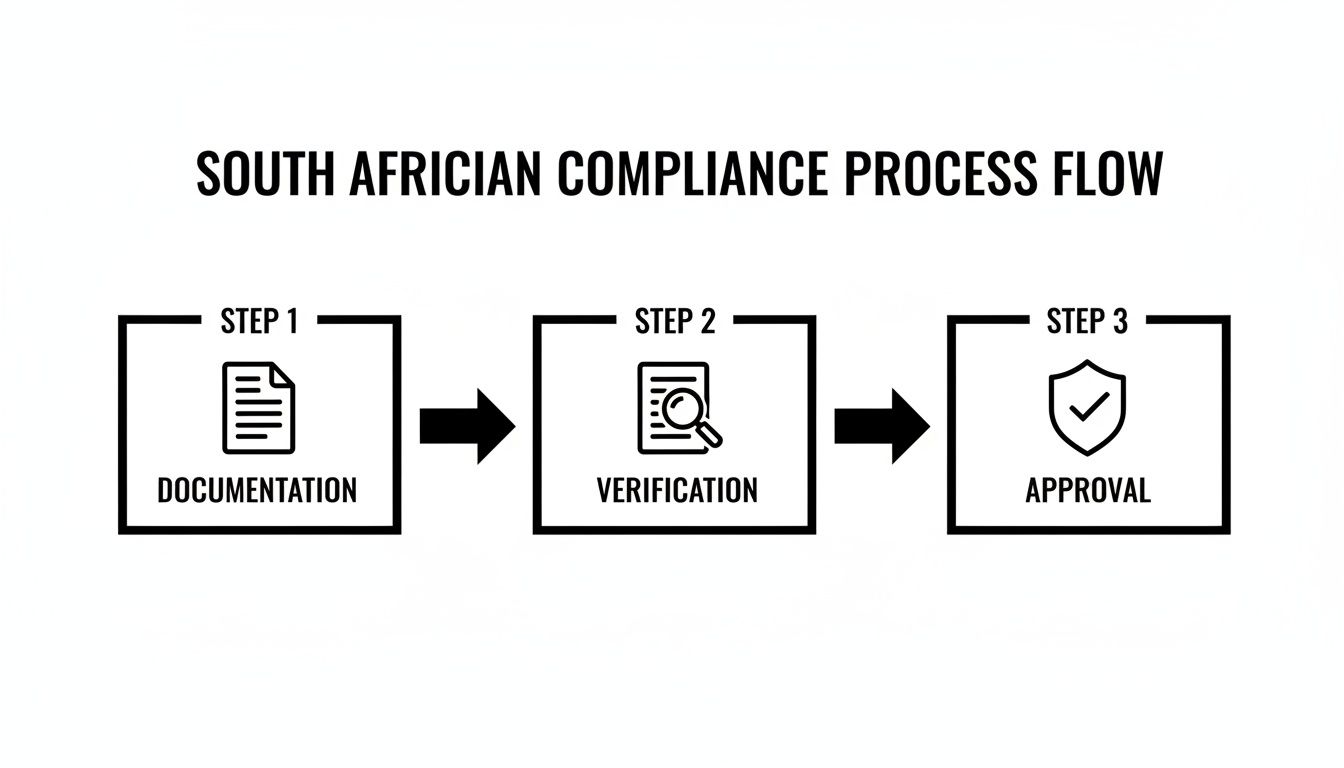
This process flow shows how modern platforms have managed to condense the complex steps of documentation, verification, and approval into a quick, automated sequence.
Beyond a Single Transaction
But the real value of a modern payment platform goes far beyond just one transfer. It becomes the central hub for managing your company’s entire international financial operations. It gives you powerful controls that empower the whole finance team.
For South African businesses, optimising the bigger picture is crucial. Adopting essential accounts payable best practices can seriously streamline your operations and improve cash flow. This is where features like multi-user access really shine. A CFO can set specific permissions for different team members, creating a workflow that’s both secure and highly efficient.
A junior accountant might be given access to prepare payments, but only the finance manager has the final authority to actually send the funds. This kind of granular control minimises risk and makes sure there's proper governance over the company’s money.
On top of that, these platforms provide a complete, real-time audit trail of every single transaction. This total visibility is a game-changer for treasury management. It allows finance leaders to track cash flow, monitor currency exposure, and make smart, data-driven decisions with confidence. It’s about transforming the finance function from a reactive cost centre into a proactive, strategic part of the business.
Managing FX Risk and Optimising Your Treasury

Simply getting a payment out the door is one thing. The real battle for any South African business with global operations is taming foreign exchange (FX) volatility. An unpredictable ZAR/USD rate can flip a profitable deal into a loss overnight, making cash flow forecasting feel more like guesswork than strategy.
This isn’t just about getting caught by a bad rate every now and then. It's about the constant, underlying risk that currency swings inject into your business. When you’re sending money internationally all the time, this volatility can seriously erode your profit margins and destabilise your finances.
Practical Strategies to Control FX Risk
The only way to win this game is to get proactive. Stop just accepting whatever rate your bank gives you on the day of payment. It's time to implement a clear strategy that puts you back in control of your international finances. For a deep dive into how financial risk is identified and managed, take a look at a complete guide to risk management.
Here are a few practical steps you can take right now:
- Demand the Real Rate: Make it a non-negotiable to use platforms that give you the real, zero-spread exchange rate. This one change cuts out the hidden markups that silently eat into your payments and gives you total clarity on your costs before you transact.
- Set Up Multi-Currency Accounts: Holding funds in both ZAR and USD is a powerful, natural hedge. If you receive USD revenue, you can let it sit in a USD account instead of being forced to convert it back to rand at a terrible time.
- Pay Suppliers from Your USD Balance: On the flip side, you can pay your USD-denominated supplier invoices directly from that same account. This simple move helps you dodge expensive and completely unnecessary double-conversions.
By holding balances in the currencies you actually use, you build a buffer against daily market chaos. You convert funds only when the timing and the rate work for your business, not just because an invoice is due.
From Cost Centre to Strategic Driver
This kind of control completely changes how your finance team functions. Instead of just being payment processors reacting to the market, they can start making genuinely strategic treasury decisions. And for South African businesses, the need for smarter financial tools has never been more urgent.
Think about this: formal cross-border outflows from South Africa have exploded, jumping from R6 billion in 2016 to over R19 billion in recent years. The number of individual transactions also shot up from 4.8 million to 15.7 million in that same timeframe. These numbers show the immense pressure businesses are under to manage costs when paying international suppliers and contractors. The old ways just aren't cutting it anymore.
Modern platforms are built to arm your team with the right tools for strategic treasury.
- Multi-Currency Debit Cards: Let your team spend directly from your USD or ZAR accounts while travelling or for online purchases, locking in low-cost FX rates on the spot.
- Granular User Controls: Assign specific permissions and spending limits to team members, ensuring tight governance and security over every transaction.
- Complete Transactional Visibility: A real-time dashboard gives you a crystal-clear overview of all currency holdings and payments, making intelligent cash flow management possible.
Ultimately, these tools shift your finance function from being a reactive cost centre into a proactive driver of your global growth. It's about giving your business the financial stability it needs to compete and win on the world stage.
Your Strategic Advantage in Global Payments
We’ve covered a lot of ground, haven't we? From the hidden costs baked into traditional bank transfers to the sheer efficiency of newer solutions. The goal wasn't just to show you how to send money, but how to think strategically about your company’s global finances. If there's one thing to take away, it's this: the right payment platform isn't just a tool; it's a genuine competitive edge.
When a South African business adopts a modern approach, a few powerful advantages click into place. The biggest one is getting access to the real exchange rate. This alone cuts out the expensive spreads that banks quietly build into their rates, which is where they make a lot of their money. That transparency means you know exactly what a transaction will cost before you hit send, bringing some much-needed predictability back to your financial planning.
Then there are the fees. You can finally wave goodbye to that frustrating chain of hidden SWIFT fees that nibble away at the money you’re sending. Using more direct payment routes means your money gets where it's going faster and in full. That simple change can make a world of difference in your relationships with overseas suppliers and contractors, turning a slow, uncertain process into a reliable part of your operations.
Real-World Scenarios Unlocked
These aren't just abstract benefits; they have a real impact on how businesses operate day-to-day. Let’s look at what this actually means for different South African companies trying to compete globally.
The Exporter: Imagine a local company selling their products in the US. They can now bring their dollar revenue home without surrendering a hefty slice of it to a bad exchange rate. Even better, they can hold onto the USD and only convert it to ZAR when the rate is in their favour, protecting the profits they worked so hard to earn.
The BPO Provider: Think of a business process outsourcing firm that relies on international contractors. They can pay their global team on time, every time, with total clarity on fees and rates. This builds incredible trust and makes them a far more attractive company for top talent around the world.
The Retailer: An importer who needs to settle an invoice with a supplier in China can lock in a great rate and send the payment instantly. This kind of certainty does wonders for managing cash flow and allows for much more accurate pricing of their products back home.
Moving to a modern payment platform is really about changing your mindset. You shift from a reactive, costly process to a proactive strategy that creates value. It gives your business the agility and control it needs to hold its own in a global marketplace.
A Partnership for Growth
In the end, choosing how you send money internationally is a major strategic decision. It touches almost every part of your business. The right partner simplifies compliance, turning what was once a mountain of paperwork into a quick, digital onboarding. They give you enterprise-grade security and controls your finance team can actually use to manage risk properly.
This is much more than a simple operational upgrade. It’s about building the financial backbone your business needs to grab global opportunities with both hands. When you cut out unnecessary costs, speed up payments, and get clear insight into every transaction, you free up cash and time. That’s capital you can pour back into what really matters: innovation, expansion, and growth. That’s your strategic advantage.
Still Have Questions? Let's Clear a Few Things Up
Diving into international payments can feel a bit like learning a new language. You're not alone if you've got questions. Here are some straightforward answers to the queries we hear most often from South African businesses.
The Real Exchange Rate vs. The Bank's Rate: What's the Catch?
Ever Googled an exchange rate, then looked at your bank's quote and felt like something was off? You're not imagining it.
The rate you see on Google or financial news sites is the real exchange rate. Think of it as the 'wholesale' price of a currency at that exact moment, with no markups. It’s the true, direct conversion price.
Your bank, however, offers you a different rate. They build in a profit margin, often called a 'spread,' by buying currency at the real rate and selling it to you at a less favourable one. That small difference on every dollar or euro is their profit, and it's a hidden cost that adds up fast. In contrast, many modern fintech platforms give you direct access to the real rate, which means more of your money actually reaches its destination.
Are These New Fintech Platforms as Safe as My Bank?
Yes, and it's a non-negotiable. Leading fintech platforms operate with bank-grade security and are held to the same high regulatory standards as any traditional bank. This means strict compliance with Anti-Money Laundering (AML) and Know Your Business (KYB) rules to fight financial crime.
They also tend to be built on newer, more secure technology. Expect features like:
- End-to-end data encryption to shield your sensitive information.
- Secure infrastructure, often housed in top-tier global data centres.
- Enterprise-grade controls, such as multi-user permissions and payment approval workflows, so you have complete oversight of who can do what with company funds.
How Long Will My International Transfer Actually Take?
The timing really depends on the pipes your money flows through. The difference between the old way and the new way is night and day.
Bank transfers using the traditional SWIFT network are famously slow, often taking 3 to 7 business days. Your payment gets bounced between several intermediary banks on its journey, and each stop adds time and, often, extra fees.
It's a different story with modern fintech solutions. They typically use more direct payment routes, cutting out the middlemen. This means transfers can often be completed within the same business day, which is a game-changer for managing cash flow and keeping suppliers happy.
Paying invoices promptly without that long, uncertain waiting period gives your business a serious competitive edge.
Ready to transform your global payments? With Zaro, you get access to the real exchange rate, zero SWIFT fees, and a secure platform designed for South African businesses. Onboard in minutes and start saving today.