
For South African business owners, the very thought of sending money internationally can bring on a headache. It's a world traditionally filled with frustrating delays, murky fees, and a mountain of paperwork. But that old, clunky reality is finally starting to give way to something better.
Modern financial technology is carving out new, smarter paths for SMEs to handle global payments. What was once a major operational burden is now becoming a source of competitive advantage.
The New Era of International Payments for SA Businesses

If you’ve ever tried to pay a foreign supplier, you know the traditional system feels broken. It was designed for massive corporations, not for small and medium businesses who have been left to grapple with sky-high costs and transfer times that are anyone's guess.
This guide is about moving past those legacy methods. We're going to lay out a clear playbook for navigating today's financial landscape, helping South African businesses take real control of their global financial operations. No more confusing jargon or hidden markups—just practical, actionable strategies that actually work.
A Growing Need for Better Solutions
The demand for simpler, more efficient cross-border payments isn't just a feeling; it's a powerful economic trend. As more South African businesses connect with the global market, the volume of payments leaving the country has shot up.
You can see this growth clearly within the SADC region. Formal remittance outflows have leaped from R6 billion in 2016 to over R19 billion in 2024. This threefold surge shows a major shift towards regulated payment channels and makes it clear that we urgently need better, more transparent solutions. You can dive deeper into these cross-border payment trends from the South African Reserve Bank.
Key Takeaway: The old way of sending money internationally is no longer the only way. By getting to grips with modern tools and strategies, your business can slash costs, speed up transfers, and gain far greater financial control.
Think of this guide as your roadmap. We’ll walk you through everything you need to know to confidently manage your money across borders. Specifically, we'll cover:
- Choosing the right payment rails that fit your business like a glove.
- Simplifying compliance and the dreaded documentation.
- Calculating the true cost of your international transfers (no more surprises).
- Optimising your payment workflow to save time and money.
Let's get started.
Choosing the Right International Payment Method
Finding the best way for sending money internationally can feel like you're navigating a maze. For South African businesses, the choice usually boils down to three main routes, each with its own quirks and benefits. Forget a generic pros-and-cons list; let’s look at this through the lens of real-world business scenarios.
Your main options are:
- Traditional Banks using the tried-and-tested SWIFT network.
- Local Foreign Exchange (FX) Brokers who specialise in currency.
- Modern Fintech Platforms offering multi-currency accounts.
Each path has its place, and the right one for your business depends entirely on what you're trying to achieve with that specific payment.
When to Stick with Traditional Banks
Believe it or not, the old-school bank transfer still has its moments.
Imagine your manufacturing company in Durban needs to buy a massive, custom-built piece of machinery from a long-standing supplier in Germany. This is a one-off, high-value transaction where the security and established relationship with your bank might just offer the peace of mind you need.
SWIFT transfers were built for these large, infrequent payments. They’re often slower and more expensive due to all the intermediary bank fees that get tacked on, but their universal acceptance provides a certain level of comfort for mission-critical purchases.
That said, for most other day-to-day business needs, relying solely on SWIFT is like using a sledgehammer to crack a nut—it’s powerful but often inefficient and costly for regular payments.
The Role of Local FX Brokers
Local FX brokers have traditionally occupied a useful middle ground. They can often provide better exchange rates and a more personalised, hands-on service than you’d get from a big, impersonal bank.
Think of a Cape Town-based importer who regularly buys goods from China. They might use an FX broker to lock in favourable exchange rates for future payments, which is a massive help in managing currency risk and protecting their margins.
These brokers can be a great option for businesses with predictable, medium-to-high-volume foreign currency needs. They build relationships and can offer specialised advice, but they might lack the sheer speed and digital convenience of the newer platforms on the block.
The Modern Approach with Fintech Platforms
Now, let's consider a scenario that's far more common for today’s SMEs. Your Johannesburg-based software company pays monthly salaries to remote developers in Nigeria, Kenya, and the UK. Using a bank for these recurring, multi-currency payments would be an administrative nightmare of high fees and slow processing times.
This is exactly where multi-currency fintech platforms shine.
They allow you to hold balances in different currencies (like ZAR, USD, and EUR), convert money at much better rates, and make fast, low-cost local payouts directly to your recipients. For businesses operating globally, this kind of agility is essential. Similarly, when evaluating diverse international payment methods, establishing a local presence through a Dubai bank account for non-residents can offer distinct advantages for South African businesses expanding into the Middle East.
To help you decide, let's break down how these three options stack up against each other.
Comparing International Payment Methods for SA Businesses
| Feature | Traditional Banks (SWIFT) | Local FX Providers | Fintech Platforms (e.g., Zaro) |
|---|---|---|---|
| Best For | One-off, very large-value payments where security is the top priority. | Predictable, medium-to-high volume payments with a need for rate-locking. | Recurring payments, payroll, paying suppliers, managing multiple currencies. |
| Speed | Slow (3-5+ business days). | Moderate (1-3 business days). | Fast (Often same-day or instant for local payouts). |
| Cost | High (High transfer fees + poor FX rates + hidden intermediary fees). | Moderate (Better FX rates than banks, but service fees may apply). | Low (Minimal transfer fees + near-interbank exchange rates). |
| Transparency | Low. Often difficult to track and see the final cost upfront. | Moderate. Generally more transparent than banks, but fees can vary. | High. Clear, upfront pricing with real-time tracking. |
| Convenience | Low. Often requires branch visits or clunky online banking portals. | Moderate. Service is personalised but may require phone calls or emails. | High. Fully digital, self-serve platform accessible 24/7. |
Key Insight: The best method for sending money internationally isn't about finding a single "winner." It's about matching the payment rail to the specific transaction's requirements—value, frequency, and urgency.
Ultimately, the goal is to build a smart payment strategy that uses the best tool for the job. For that once-off capital expenditure, a bank might suffice. But for everything else—from paying your international suppliers to managing global payroll—a modern platform offers the efficiency and cost savings that help a growing business thrive.
Navigating Compliance and Documentation Requirements

For many South African SMEs, the compliance checks for sending money internationally can feel like a mountain of red tape. The whole process, known in the industry as Know Your Business (KYB), often seems like just another frustrating bit of paperwork standing between you and your payment.
But here’s the thing: it’s absolutely critical. KYB is how banks and payment providers verify that your business is legitimate, which is a massive part of preventing fraud and money laundering. Getting this right from day one saves you from some serious headaches and delays later on.
Think of it less as a roadblock and more as the essential groundwork for smooth international payments. You’re simply proving two things: your business is a real, registered entity, and the people behind it are exactly who they claim to be.
Your Essential KYB Document Checklist
Every financial partner will have its own onboarding process, but the documents they ask for are pretty standard across the board. Having these ready to go will speed things up significantly.
You’ll almost certainly be asked for the following:
- Company Registration Documents: This is your CIPC (Companies and Intellectual Property Commission) registration certificate. It’s non-negotiable.
- Proof of Business Address: A recent utility bill or a similar official document confirming where your business operates.
- Director and Shareholder Information: Prepare certified ID copies for all directors and major shareholders—typically anyone holding 25% or more of the company.
This information gives the provider a clear, verifiable picture of who owns and controls the business, which isn't just a local requirement but a global standard.
A Practical Example: The First Supplier Payment
Let’s walk through a common scenario. Imagine your Johannesburg-based e-commerce store has just found the perfect supplier in Asia. You’re ready to pay their first invoice, but before you can, your payment provider needs to run its KYB checks.
You’ll likely be asked to upload your CIPC documents and director IDs through a secure online portal. The provider’s compliance team then gets to work, verifying these details against official records. This isn’t just about ticking boxes; it’s a crucial step in safeguarding everyone involved. Solid fraud detection in online payments is built on this foundation. Once they’re happy, your account is activated, and you get the green light to send the funds.
Why This Matters: Getting your KYB done right isn't just a formality. It creates a secure foundation for every international transaction you make. It protects your business from financial crime and helps ensure your money doesn't get flagged or frozen by a correspondent bank halfway to its destination.
By getting your documents in order before you even start, you can turn this compliance step from a potential bottleneck into a quick, one-time setup. It’s a proactive move that means when a great opportunity comes along, you’re ready to jump on it immediately.
Uncovering the True Cost of an International Transfer
That low, advertised transfer fee is almost never the full story. When you’re sending money internationally, it’s just the tip of the iceberg – a headline number designed to grab your attention while the real costs hide just beneath the surface. For any South African business, getting a handle on these hidden charges is crucial for protecting your profit margins.
The two main culprits that will quietly inflate the cost of your payments are the FX spread and intermediary bank fees. Think of the first as a hidden markup on the exchange rate, and the second as a series of unavoidable tolls your money pays as it travels across the world.
The Hidden Cost of the FX Spread
Let’s talk about the FX spread. It's simply the difference between the real, mid-market exchange rate (the one you see on Google or Reuters) and the less favourable rate your bank or provider actually gives you. This difference, or 'spread', is pure profit for them, and it can add a significant—and often invisible—cost to every single transaction.
A small percentage might not sound like much, but it adds up frighteningly fast, especially on larger or more frequent payments. It's a subtle fee that eats away at your budget without ever showing up as a line item on your statement.
A Real-World Payment Scenario
Let's make this practical. Imagine your software company in Cape Town needs to pay a US-based provider an invoice for $10,000.
- The Real Exchange Rate: On the day you need to pay, let's say the mid-market rate is R18.50 to $1.
- A Traditional Bank's Rate: Your bank might quote you a rate of R19.00 to $1. That 50-cent difference is their FX spread.
On the surface, it seems minor. But when you run the numbers, the true cost hits you.
The Financial Impact: With a transparent fintech using the real rate, the transfer costs you R185,000. With the bank's marked-up rate, that same $10,000 invoice suddenly costs you R190,000. You’ve just paid a R5,000 hidden fee before any other charges are even mentioned.
And we haven't even touched on SWIFT fees yet. These can easily add another R300 to R800 as your payment gets passed between intermediary banks on its journey to the US. All of a sudden, that "low-fee" transfer is anything but.
This high-cost reality is a huge issue across the continent. In fact, Africa has an average transfer cost of 8.2% just to send $200, with Southern Africa being even worse at 8.9%. That’s a long way from the G20's 3% target. You can dig deeper into these insights on South Africa's cross-border transfers market if you're interested.
The True Cost Comparison
When you compare the final amount your US supplier receives, the difference is even more stark.
| Cost Component | Traditional Bank Transfer | Transparent Fintech Platform |
|---|---|---|
| Upfront Fee | R250 (example) | R100 (example) |
| FX Spread Cost | R5,000 | R0 (uses real exchange rate) |
| Intermediary Fees | ~R400 (variable) | R0 (uses local payment rails) |
| Total Cost | ~R5,650 | R100 |
This breakdown really shows why focusing only on the advertised transfer fee is a mistake. The real savings are buried in the exchange rate. By finding a provider that gives you the real, mid-market rate with no spread, you can start forecasting your expenses accurately, improve your budgeting, and make sure your money is working for your business—not just covering hidden bank charges.
Fine-Tuning Your International Payment Workflow
When it comes to sending money internationally, chasing the lowest fee or the fastest transfer is only half the battle. True efficiency comes from building a smooth, reliable, and repeatable process that frees up your finance team’s time and cuts down on operational headaches. The goal is to turn global payables from a series of stressful, one-off tasks into a system that just works.
This means looking at the entire journey of a payment, from funding your account in ZAR to the final settlement in USD or EUR. Getting the small details right, like knowing the currency cut-off times, can be the difference between a payment arriving on time and a frustrating delay. Likewise, real-time tracking gives you the visibility you need to keep suppliers in the loop and maintain good relationships.
This visual breaks down the common areas where hidden costs can creep into a typical transfer, chipping away at the amount you intended to send.
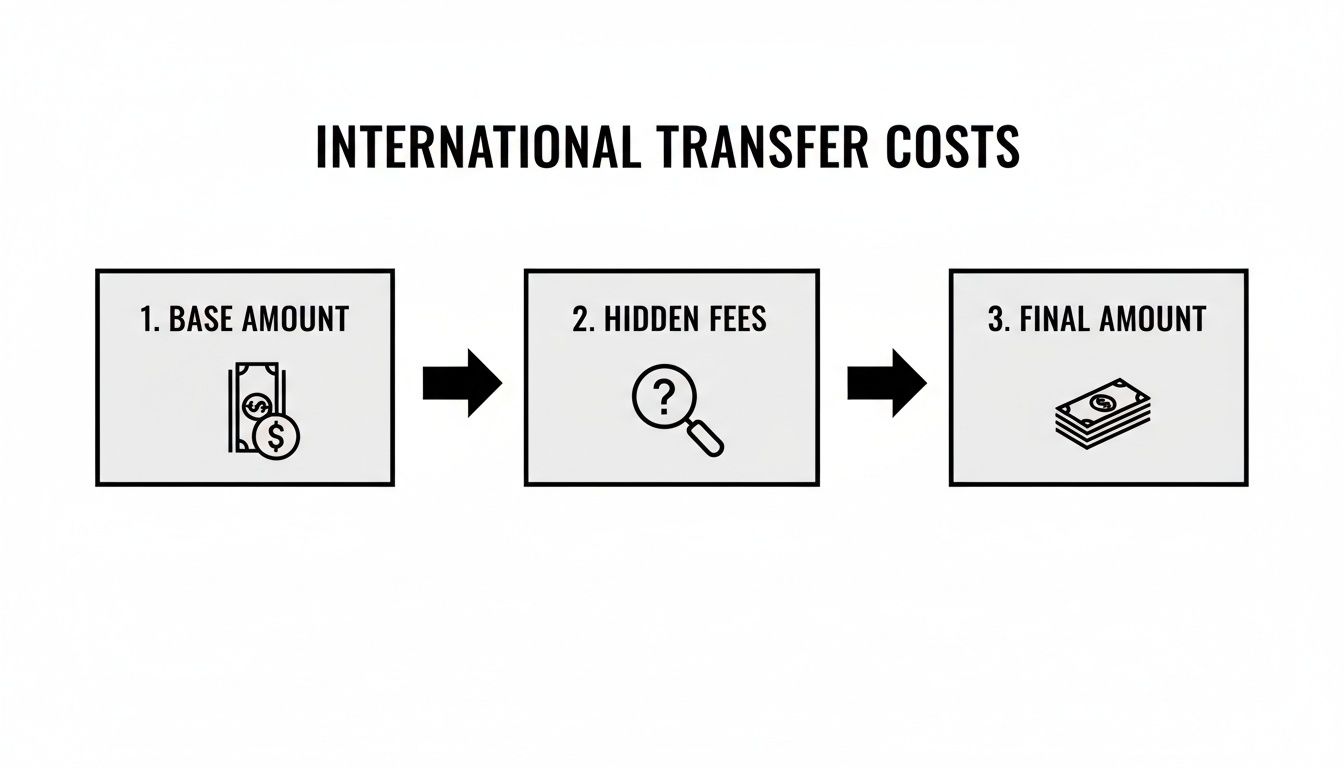
As you can see, the initial amount is often significantly eroded by mark-ups and fees before it ever lands in the recipient's account.
Streamlining Your Internal Processes
One of the biggest mistakes I see finance teams make is treating every international payment as a completely unique event. This manual approach is a huge time-sink and leaves the door wide open for errors. The real key to getting this right is standardisation and a bit of smart automation.
A great place to start is by batching your payments. Instead of jumping on every supplier invoice the moment it lands in your inbox, set aside specific days of the week to process all your foreign payments at once. This one change can dramatically reduce admin time and let your team focus without constant interruptions.
Pro Tip: Batching payments doesn't just save time; it can also save you money. Converting a larger sum of ZAR in a single go often gives you a better exchange rate and simplifies reconciliation. You'll have one clear transaction to track instead of a dozen small ones.
Another smart move is to use a payment platform that offers multi-user permissions. This lets you delegate tasks without giving up control. For instance, a junior team member could be responsible for preparing payment batches for review, while a senior manager holds the final authority to execute the transfers. This creates a secure, controlled workflow that prevents bottlenecks.
Integrating Payments with Your Accounting
The final piece of the puzzle is connecting your payments back to your accounting software. Manually punching payment data into your books is just asking for typos and wasted hours. Most modern payment platforms can integrate directly with software like Xero or Sage, or at the very least, provide clean data exports.
This integration ensures that once a payment goes out, all the important details—the exact exchange rate, fees, and final amounts—are automatically synced. This makes month-end reconciliation a breeze and gives you a crystal-clear audit trail for every single transaction.
The push for efficiency is especially critical here in Southern Africa. Consider that SADC migrants send an estimated R16.6 billion back home each year, often paying average fees as high as 8.9%. This high-cost reality presents a massive opportunity for businesses. By adopting formal, low-cost digital payment channels and building smarter workflows, you can gain a real competitive edge. You can dig deeper into this topic with insights from the FinMark Trust's cross-border remittances conference.
Ultimately, you’re not just saving a bit of money on fees—you’re building a more resilient and scalable financial operation for your business.
Got Questions About Sending Money Overseas?
Even when you've got a plan, a few practical questions always pop up once you start making international payments. Let's tackle some of the most common ones we hear from South African businesses, giving you straightforward answers to navigate these hurdles.
What Do I Really Need to Know About SARB Regulations?
The South African Reserve Bank (SARB) keeps a close eye on all money leaving the country. For your business, the most important rule is simple: every international payment needs to be for a legitimate reason, backed up by proper paperwork like a commercial invoice.
The easiest way to make sure you're always on the right side of the rules is to work with a licensed financial service provider. They're required to do all the SARB reporting for you, making sure your payments tick all the exchange control boxes. Just be sure to keep your own detailed records of every transaction for your accounts and in case of an audit.
How Can We Protect Ourselves from a Volatile Rand?
We all know the Rand can be a rollercoaster, and that volatility can eat into your profit margins. You can't control the market, but you can definitely manage the risk.
For most SMEs, the best defence is to use a payment platform that gives you the real-time exchange rate with zero spread. This means you know your exact cost at the very moment you hit 'send'. No surprises.
Some larger companies use forward exchange contracts (FECs) to lock in a rate for a big future payment, like for new machinery. But for your day-to-day supplier payments, locking in a transparent, real-time rate is the most effective strategy.
Expert Tip: Stop trying to outsmart the market. It's a losing game. Your goal should be cost certainty. When you use the real, mid-market exchange rate, you eliminate the guesswork and know exactly what you're paying, no matter how much the market is jumping around.
Should I Send Rands or Dollars?
This is a classic question, but the answer is nearly always the same: you'll save money and headaches by handling the currency conversion here in South Africa.
Think about it. If you send ZAR, the recipient's bank overseas does the conversion. They have zero incentive to give your supplier a good deal and will almost certainly add a hefty markup to the exchange rate. The result? Your supplier gets less than they were invoiced for, leading to awkward conversations about short payments.
By converting ZAR to USD or EUR yourself with a transparent provider, you control the rate. Your supplier gets the exact amount on the invoice, every single time. It's a simple way to keep your business relationships strong.
My International Payment Is Late, What Now?
Delays are a pain, and they happen most often on the old SWIFT network where your payment can get temporarily lost between different intermediary banks.
If a payment is running late, the first thing to do is grab your transaction reference number and check its status with your provider. This is where modern fintech platforms are a game-changer. Most offer live tracking dashboards that show you exactly where your money is, step-by-step.
This is a massive improvement on the slow, manual "tracing" process you have to go through with a traditional bank. Choosing a provider with excellent, real-time tracking and a support team that actually answers the phone can make a huge difference when things don't go to plan.
Ready to eliminate hidden fees and simplify your global payments? With Zaro, you get the real exchange rate with zero spread, fast settlement times, and a powerful platform built for South African businesses. See how much you can save on your international transfers at https://www.usezaro.com.