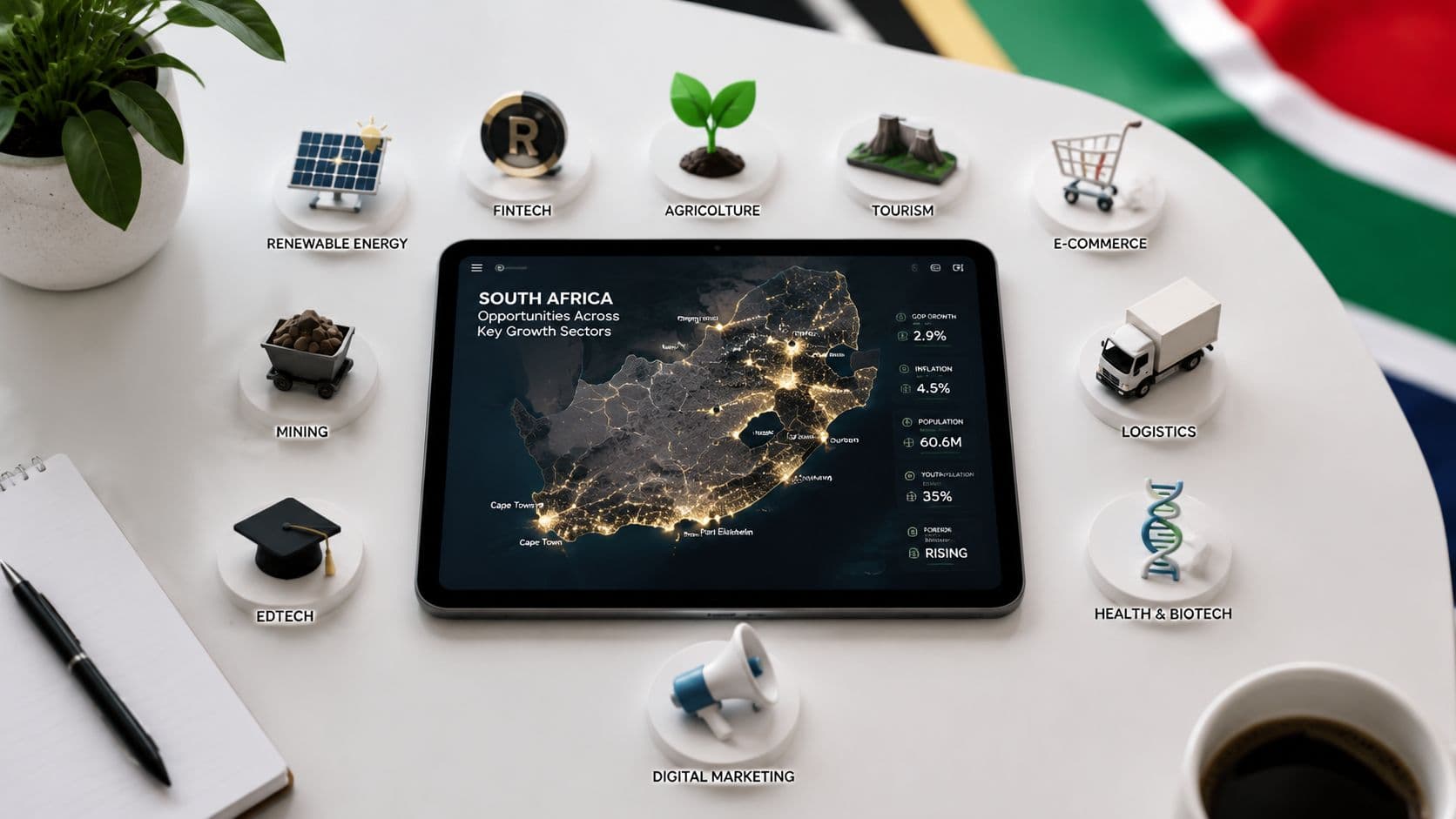
South Africa's small business environment scored 51.08 in the 2024 Small Business Growth Index, placing it in a “vulnerable zone” where more than half of small businesses may not survive the next year without urgent support, according to the 2024 Small Business Growth Index discussion. That's the striking reality behind the usual optimism around South Africa business opportunities.
Beyond the headlines, though, South Africa still offers one of the strongest launchpads on the continent for ambitious operators. It is described by the U.S. government's South Africa market opportunities guide as Africa's most advanced and broad-based economy, with preferential access to major export markets including the European Union and the Southern African Development Community. For founders, CFOs, and operators, that combination matters. You get real demand, established banking and regulatory systems, and access routes that can support regional and global growth.
The catch is operational discipline. Plenty of businesses choose the right sector and still lose margin through poor execution, especially on foreign exchange, supplier settlements, and international collections. In practice, the difference between a promising business and a durable one often comes down to quoting in the right currency, collecting faster, and avoiding hidden banking costs that slowly strip profit from every international transaction.
That's where this guide takes a different angle. These 10 South Africa business opportunities for 2026 aren't just sector ideas. They're practical plays, examined through the lens of execution, including cross-border payments and FX management.
1. Export-Based Manufacturing and Trading
Export manufacturing still ranks among the most practical South Africa business opportunities because it builds on capabilities the country already has. The strongest plays usually sit in products that travel well, hold margin after freight and compliance costs, and solve a specific buyer problem abroad. That can mean processed foods, industrial components, private-label consumer goods, specialised packaging, or contract manufacturing for overseas brands.
The opportunity is real. So is the execution risk.
Companies such as Hulamin and Aspen Pharmacare show what scaled export businesses can look like from South Africa. Smaller operators do not need to copy that model. A more realistic route is to start with a narrow product line, one or two target markets, and a sales offer built around reliability, documentation accuracy, and disciplined pricing.
Where exporters actually lose money
Product selection matters, but treasury discipline often decides whether an export business stays profitable. A manufacturer can win the order and still erode margin by quoting in the wrong currency, accepting poor conversion rates, or paying foreign suppliers at the wrong time.
A common pattern looks like this. Revenue comes in USD or EUR. Costs sit partly in ZAR, with some imported inputs priced in foreign currency. If the business converts everything into rand as soon as funds arrive, then buys dollars again later to pay suppliers, it creates avoidable FX leakage on both sides of the transaction.
Practical rule: quote in the buyer's currency, then decide conversion timing based on your payables and cash flow plan, not on the bank's default process.
That is where cross-border payment setup becomes part of operating strategy. Zaro can help teams receive foreign currency, hold balances across currencies, and pay international suppliers with better visibility over the rate being used. For an exporter, that means tighter pricing control, cleaner margin forecasting, and fewer unpleasant surprises on long sales cycles.
What works for smaller exporters
Smaller firms usually compete on responsiveness and specialisation, not scale. Overseas buyers will often accept a higher unit price from a South African supplier if lead times are dependable, samples arrive on spec, and invoicing does not create delays in customs clearance or payment release.
A practical operating model usually includes:
- Currency matching: Keep export receipts in the same currency as near-term offshore supplier obligations where possible.
- Clear approval controls: Separate sales, finance, and payment authority so discounting and FX decisions are not made by the same person.
- Documentation discipline: Align commercial invoices, shipping documents, beneficiary details, and payment references before funds move.
- Market selection: Choose export destinations where your product has enough pricing room to absorb logistics, duties, and currency swings.
This is not glamorous work. It is where export businesses protect profit.
The founders who do this well treat FX, collections, and supplier settlement as part of the commercial model from day one. In export-based manufacturing and trading, that operational discipline often creates a bigger advantage than the product itself.
2. Business Process Outsourcing Services
South Africa's BPO sector is already large enough to support specialised plays rather than generic call centre models. The Grand View Research analysis of South Africa's BPO market states that the market was valued at USD 1.85 billion in 2023 and is projected to expand at a CAGR of 10.1% through 2030, with IT and telecommunications accounting for the highest revenue share. That creates room for focused operators in customer support, back-office processing, finance operations, and technical service desks.
Examples range from TTEC and Sitel to local operators such as eThekwini Business Services. But copying a large BPO playbook won't help a smaller entrant. The practical opportunity sits in tighter niches. Think claims processing, appointment booking, after-hours customer support, SaaS onboarding, or finance admin for overseas clients.
Where smaller firms beat larger ones
Large BPOs sell scale. Smaller firms can sell responsiveness, specialist staff, and cleaner account management. International clients often care less about headcount and more about whether invoicing is predictable and contractor payments don't create chaos across borders.
If you bill a multinational in USD and pay a mix of South African staff plus foreign freelancers, hidden FX markups can distort your margins month by month. That's why transparent cross-border payment infrastructure matters more in BPO than many founders realise.
Don't underquote to win offshore work, then hand your margin to bank spreads on every invoice and payout.
Useful operating habits include:
- Invoice in client currency: If the contract is priced in USD, invoice in USD and avoid unnecessary conversion steps.
- Split permissions by function: Finance should control settlements, while operations tracks delivery and staffing.
- Build audit-ready records: Transparent transaction logs simplify client reconciliations and month-end review.
- Use card rails selectively: Debit cards can help with software subscriptions and contractor-related operational spend.
BPO is one of the most credible South Africa business opportunities because the country already has service capability, language advantages, and business infrastructure. The firms that scale are usually the ones that combine service quality with disciplined financial operations.
3. Digital Services and Software Development

Software and digital services are attractive because they don't need heavy fixed infrastructure to reach global clients. South African teams can sell development, UX design, QA, automation, SEO, paid media, and product support into overseas markets without opening foreign offices first. OfferZen, the technology behind Superbalist, and Takealot's internal technology capability all point to the depth of local digital talent.
This category looks easy from the outside. In reality, it's highly operational. Agencies and studios often win work quickly, then run into avoidable cash flow pressure because foreign collections arrive unpredictably and contractor payments go out at the wrong time.
Margin depends on your payment setup
If your clients are abroad, your finance stack becomes part of delivery. A clean setup lets you invoice in USD, keep part of the balance for offshore expenses, and convert only what you need for local payroll and overhead. A messy setup forces unnecessary conversions and slows decision-making.
For South African founders building service exports, that can be the difference between sustainable scale and permanent cash flow stress. It also affects your pricing. If you know your FX handling is transparent, you can quote with more confidence against agencies in Europe, the UK, or Australia.
A practical complement for firms in this category is bespoke software for your business, especially when your own internal systems for project costing, approvals, or client reporting are becoming bottlenecks.
- Use foreign-currency invoicing: It shortens the gap between contract value and actual receipt.
- Protect local operations: Maintain a ZAR balance for payroll, rent, and domestic suppliers.
- Control team access: Developers don't need payment authority. Finance does.
- Review subscription spend: International software tools can inflate costs if card FX is poorly managed.
Software businesses can start lean, but they shouldn't stay financially improvised. The better operators build treasury habits early.
4. E-Commerce and Online Retail

E-commerce remains one of the most visible South Africa business opportunities, but the strongest plays aren't always broad marketplaces. Takealot, Superbalist, and Zando show the scale end of the market. Smaller businesses usually do better with focused product categories, regional fulfilment discipline, and a tight handle on imported stock.
Cross-border complexity shows up fast in online retail. You may collect revenue in one currency, buy inventory in another, pay shipping in another, and still carry local costs in ZAR. If you let those conversions happen ad hoc, you won't know your true margin until too late.
The model that tends to hold up
Specialised catalogues generally outperform “everything stores” for smaller entrants. A store selling beauty devices, replacement parts, premium food products, or niche apparel can build repeat demand without carrying an impossible SKU range. The challenge is supplier payment discipline.
The best e-commerce operators don't just manage ads and stock. They manage timing. Revenue timing, reorder timing, and FX timing.
That's where transparent multi-currency handling helps. If you can collect from international customers or marketplaces and pay suppliers with less friction, you gain better purchasing control. Debit cards in the right currency also help with urgent inventory orders, platform charges, and overseas software tools.
A useful resource for operators refining the commercial side is actionable ecommerce strategies, particularly if growth has outpaced your fulfilment and purchasing systems.
Consider these habits:
- Match settlement to obligations: Keep foreign revenue available if your next inventory order is offshore.
- Reconcile daily: High-volume online transactions punish weak bookkeeping.
- Avoid broad SKU expansion too early: Complexity often kills cash before competition does.
E-commerce can scale quickly, but it only becomes a durable business when margins are measured after payment costs, not before them.
5. Import-Export Trading and Logistics
Cross-border trade runs on thin timing margins. A late supplier payment, a customs mismatch, or a poor FX conversion can turn a profitable shipment into a weak deal before the goods even arrive.
South Africa remains one of the region's more practical bases for trading and logistics businesses because the commercial infrastructure, port access, and buyer networks are already in place. That creates room for more than large incumbents. Imperial Logistics and Grindrod operate at scale, but smaller firms can still build good businesses in automotive parts, industrial consumables, textiles, packaging inputs, and regional distribution support.
A closer look at the operating environment helps frame the opportunity:
Margin is set before the shipment lands
Trading rewards operators who control detail. The commercial work starts long before delivery. Purchase terms, freight quotes, duties, insurance, warehousing, and customer credit all feed into margin. If one of those numbers is wrong, the business often notices only after stock has moved and cash is already tied up.
FX management matters here in a very direct way. If you import in USD or EUR and sell in ZAR, the margin starts moving as soon as you confirm supplier terms. If you export while paying some overseas service providers, agents, or input suppliers in foreign currency, the exposure sits on both sides of the transaction. Businesses in this category need a payment process that shows what was converted, when it was converted, and what the landed cost became.
That is where a fintech setup such as Zaro can improve execution. Multi-currency balances, clearer conversion visibility, and controlled international payouts help traders hold foreign receipts for upcoming obligations instead of converting everything by default. That reduces unnecessary FX churn and makes deal-level profitability easier to track.
A practical operating model usually includes:
- Quote with full landed cost in mind: Build in freight, duties, clearing, storage, payment fees, and currency movement.
- Match currency to exposure: If the next major supplier bill is offshore, keeping part of revenue in that currency can protect margin.
- Separate approvals: Procurement, logistics, and payments need distinct checks, even in a small firm.
- Reconcile against shipment milestones: Finance should be able to match invoices, freight documents, and collections without guessing.
The trade-off is straightforward. More control adds process, and more process can slow decisions. Good operators solve that by standardising workflows rather than improvising each transaction. In import-export businesses, speed helps win orders. Traceable payments and disciplined FX handling are what keep those orders profitable.
6. Professional Services
Professional services firms often underestimate how exportable their expertise is. South African legal, accounting, tax, compliance, and advisory businesses can serve international clients, diaspora-owned businesses, foreign investors entering the market, and African companies that need support with regional expansion. Bowmans, Deloitte South Africa, and Grant Thornton South Africa show the range of what's possible.
The practical opening for smaller firms is narrower and more profitable than “general consulting.” A focused tax advisory practice for exporters, a legal team specialising in commercial contracts, or an accounting firm that supports multi-entity growth will usually outperform a broad service menu.
Why finance operations shape credibility
In services, clients judge you on detail. If your invoices are messy, your currency conversions are opaque, or your project expenses can't be explained cleanly, you undermine your own positioning. That's especially true when you advise clients on commercial discipline.
For firms serving offshore clients, billing in foreign currency can reduce friction. It also makes project profitability easier to assess if some staff, counsel, or specialist partners are paid internationally. Transparent FX records support cleaner client billing, especially on reimbursables and cross-border project costs.
Clients forgive complexity. They don't forgive confusion on fees, timings, or expense recovery.
Useful moves include:
- Invoice in contract currency: Keep the commercial basis consistent from proposal to payment.
- Control partner access carefully: Senior staff may approve contracts, but finance should manage execution.
- Track project expenses in real time: Card-based foreign spending needs immediate coding and review.
Professional services can be one of the steadier South Africa business opportunities because expertise travels well. But firms only scale internationally when their financial processes look as polished as their advice.
7. Tourism and Hospitality Services
Tourism has always attracted attention in South Africa, but generic travel businesses face heavy competition. The more resilient opportunities sit in curated experiences, specialist tours, boutique accommodation, medical travel support, luxury transfers, and event-linked hospitality. Brands like Singita and Wilderness Safaris show the premium end, while smaller operators can build strong businesses around highly specific customer segments.
This category becomes more interesting when you look at how money moves. Deposits often arrive from foreign travellers. Some operating costs are local. Others, such as booking systems, marketing tools, and overseas partners, are international. That mix creates avoidable leakage if payment handling is weak.
The businesses that hold margin best
Operators who secure deposits early and manage currency deliberately tend to stay healthier through seasonality. Those who wait for final balances, convert immediately without a plan, or pay offshore partners through expensive banking channels often create their own pressure.
A safari operator, boutique hotel, or destination management company can benefit from collecting in the guest's booking currency, then converting in stages as local obligations come due. That approach also helps with refunds, amendments, and contractor settlements when itineraries change.
- Take deposits in the original booking currency: It reduces friction for the guest and gives the operator more control.
- Use multi-currency balances strategically: Match incoming funds to expected supplier or partner payments.
- Keep emergency payment tools ready: International cards can help when travel disruptions force urgent purchases.
Tourism businesses don't just sell experiences. They sell reliability. Financial reliability is part of that customer promise, even if the guest never sees the back office.
8. Agricultural Export and Processing

Agricultural exports are one of the most practical South Africa business opportunities because they build on existing production strengths while opening access to foreign buyers. Businesses like Outspan Group, Capespan, KWV Wines, and Afgri illustrate different points across the chain, from produce to processing to international trade relationships.
The strongest opportunities aren't limited to farming itself. Processing, grading, packaging, export coordination, and specialised buyer relationships often produce more durable businesses than pure commodity exposure. A smaller operator may do better with dried fruit, packaged produce, or niche food processing than with undifferentiated bulk supply.
Seasonality makes cash handling critical
Agriculture rarely fails on product alone. It fails on timing. Inputs are paid before revenue arrives. Foreign buyers may pay on terms. Shipping windows are fixed. A poor FX decision during a seasonal cycle can damage the entire year's result.
That's why transparent international collections and supplier payments matter here. If you're buying imported seed, chemicals, packaging, or equipment components, foreign-currency settlements need to be visible and controlled. If you're paid by international fruit importers or wine distributors, holding funds in the received currency can be useful until conversion is needed.
A complementary resource for operators focused on farm-side profitability is SteadStack's farm profit strategies.
- Tie FX decisions to crop cycles: Don't convert on habit. Convert against real obligations.
- Document buyer terms tightly: Seasonal disputes are expensive and distracting.
- Build one treasury view: Production, exports, and finance need the same numbers.
Agribusiness rewards operators who respect timing, paperwork, and margin control as much as yield.
9. Technical Training and Online Education
Education and training exports are easier to launch than many founders assume. South African providers can package technical training, compliance instruction, software education, financial literacy, professional development, and industry certification for local, regional, and global audiences. GetSmarter is the obvious benchmark, but there's also room for smaller specialist providers and corporate academies.
The commercial model improves when the training solves a direct business need. Generic courses are hard to defend. Programmes tied to cloud systems, bookkeeping tools, operational compliance, customer support skills, or trade documentation are easier to sell and renew.
Revenue quality matters more than enrolment volume
A lot of online education businesses chase sign-ups instead of payment quality. The stronger model is lower-volume, higher-trust revenue from companies, professional cohorts, and international learners who can pay in stable currencies. Once you have that, your payment setup starts to matter.
If learners are abroad, collecting in USD can simplify administration. If some instructors or course partners are outside South Africa, paying them transparently matters for retention and governance. Multi-user access is useful here because finance, faculty, and programme leads often need different levels of visibility.
- Keep offers specific: “Excel for export finance teams” sells better than “business skills training.”
- Separate delivery from finance: Academic quality and payment approvals shouldn't blur together.
- Use clean logs for recognition: Course revenue, refunds, and partner shares need traceable records.
Online education can be deceptively attractive. The businesses that last are the ones that treat it as an operating model, not just content publishing.
10. Content Creation and Digital Media Production
South Africa's creative sector has become globally relevant in production, animation, design, audio, post-production, and branded content. Triggerfish Animation Studios is a strong example at the premium end. Smaller agencies, production houses, editors, photographers, and music teams can also win international work if they package services well and manage commercial delivery tightly.
This sector often looks glamorous from the outside, but the economics can be messy. Projects involve staged approvals, foreign clients, software subscriptions, equipment purchases, and freelance collaborators in different countries. One late conversion or unexplained bank charge can throw off project profitability.
Creative work still needs financial rigour
International clients usually care about smooth delivery, clean billing, and predictable payment instructions. If your studio can invoice clearly in USD or EUR, pay collaborators without confusion, and track spend against project budgets, you become easier to buy from.
The underlying gap in the market is practical. Existing coverage rarely explains how South African exporters and BPOs can access real spot exchange rates without spread when paying international contractors or settling supplier invoices, even as fintech adoption rises, as noted in this discussion of African business opportunities and payment gaps. For media businesses, that missing layer matters because so much production spend is international.
- Invoice by milestone: Tie payment schedules to approvals, not vague completion dates.
- Use cards for global software spend: Editing, design, and hosting tools often bill offshore.
- Track freelancer payouts centrally: Project managers shouldn't run payment ops from chat threads.
Creative exports can be highly profitable. But only if the studio treats finance as part of production management.
Top 10 South Africa Business Opportunities Comparison
| Item | 🔄 Implementation complexity | Resource requirements ⚡ | 📊 Expected outcomes | Ideal use cases | ⭐ Key advantages 💡 |
|---|---|---|---|---|---|
| Export-Based Manufacturing and Trading | High, complex supply chains & compliance | High capital, production facilities, logistics | Significant export revenue; margin sensitive to FX | Commodity and finished-goods exporters (automotive, agro) | Access to global markets; Zaro zero-spread FX; multi-currency accounts |
| Business Process Outsourcing (BPO) Services | Medium, large-scale operations & HR management | Skilled labour pool, telecoms, training resources | Recurring contracts, stable cash flow with FX savings | Customer support, IT/finance outsourcing | Transparent FX for invoicing; lower contractor costs; predictable margins |
| Digital Services & Software Development | Low–Medium, agile teams, fewer regulatory burdens | Engineering talent, cloud tools, low overhead | Scalable projects, improved cash flow, faster client billing | Software agencies, app/web development, digital marketing | Real-time settlement; competitive pricing vs. West; USD invoicing via Zaro |
| E‑Commerce & Online Retail | Medium, logistics, fraud prevention, fulfilment | Inventory, marketing spend, fulfilment partners | Recurring revenue potential; margin impact from acquisition costs | Cross-border sellers, marketplaces, direct-to-consumer brands | Multi-currency collections; transparent FX; streamlined supplier payments |
| Import‑Export Trading & Logistics | High, customs, cross-border coordination | Inventory financing, logistics partners, customs expertise | High transaction volumes; scale economies; FX-sensitive margins | Trading houses, distributors, regional logistics hubs | Zero SWIFT fees; accurate cost-plus pricing; multi-currency settlements |
| Professional Services (Consulting, Legal, Accounting) | Medium, client complexity & regulatory scope | Expert personnel, compliance knowledge | High-margin engagements; predictable international billing | Consulting firms, law firms, accounting practices serving multinationals | Invoice in foreign currency; FX price certainty; easy sub‑contractor payments |
| Tourism & Hospitality Services | Medium, seasonal operations & staffing | Facilities, trained staff, booking integrations | Seasonal revenue with FX exposure; variable occupancy rates | Hotels, tour operators, travel services targeting internationals | Direct USD/EUR collection; match revenue/expense currencies; transparent fees |
| Agricultural Export & Processing | Medium–High, seasonality & cold-chain needs | Land, equipment, cold storage, export logistics | Strong export demand; seasonal cash flows; weather risk | Fruit, wine, grain exporters and processors | Zero-spread FX boosts margins; match seasonal receipts with USD accounts |
| Technical Training & Online Education | Low–Medium, content & platform delivery | Course creators, LMS/platforms, marketing | Scalable recurring revenue; low marginal cost per student | Online courses, certification providers, corporate training | USD collections; easy instructor payments; low incremental delivery cost |
| Content Creation & Digital Media Production | Medium, project-based coordination & IP | Production equipment, creative teams, software | Project-driven revenue; high margins but variable | Video/animation studios, music production, creative agencies | Competitive production costs; foreign-currency invoicing; smooth collaborator payments |
From Opportunity to Action
South Africa offers real business range. You can build in exports, services, logistics, tourism, agriculture, training, or digital production without leaving the country as your operating base. That's one reason South Africa business opportunities remain so compelling for founders and finance leaders who want both local capability and international reach.
The country's structural advantages are real. It is described in the World Bank document on SMMEs in South Africa as an economy where SMMEs employ over 8 million people, even as many struggle with access to low-cost capital and cross-border cost pressures. That tension is important. Opportunity exists, but it doesn't automatically turn into profit. Execution decides that.
Across all 10 sectors, the same operational pattern keeps showing up. Businesses that handle foreign exchange poorly lose margin imperceptibly. They accept hidden markups, absorb unnecessary transfer costs, convert funds at the wrong time, and leave too much payment control with traditional banks. Businesses that handle FX and international payments deliberately usually get clearer forecasting, better supplier relationships, and more confidence when quoting overseas clients.
That doesn't mean every company needs a complex treasury department. It means every company with cross-border exposure needs a system. Someone should own currency decisions. Approval rights should be clear. Invoicing currency should be intentional. Reconciliation should happen quickly enough to catch mistakes while they're still fixable.
The best opportunity for 2026 isn't just choosing the right sector. It's combining a sound sector choice with operational discipline that protects cash flow. That's especially true for SMEs, because weaker businesses don't have room to absorb avoidable friction.
If your business imports, exports, invoices offshore clients, or pays international contractors, your financial stack becomes part of your competitive position. A platform such as Zaro may be relevant if you want more transparent cross-border payments, access to ZAR and USD accounts, and tighter control over FX handling. Used properly, that kind of setup doesn't create demand on its own. It helps you keep more of the value your business already earns.
Pick the opportunity that fits your capabilities. Then build the payment and FX processes that let it scale cleanly.
If your business is collecting from overseas customers, paying global suppliers, or trying to reduce FX friction, Zaro is worth assessing as part of your finance stack. It gives South African businesses a way to manage cross-border payments with more transparency and operational control.