
At its core, South African exchange control is simply the set of rules that governs how money moves in and out of the country. Think of it less as a barrier and more as a traffic management system for currency. These regulations are managed by the South African Reserve Bank (SARB) to keep the nation’s economy stable and protect its foreign currency reserves, making sure cross-border payments happen in an orderly way.
What Exactly Is South African Exchange Control?

Let’s break it down with an analogy. Picture the country's supply of foreign currency—like US Dollars, Euros, and Pounds—as the water in a massive reservoir. This reservoir is crucial for the country’s economic health, as it’s used to pay for vital imports like fuel, medicine, and machinery.
The exchange control regulations act as the reservoir’s control room, complete with pipes, valves, and meters. The goal isn’t to stop water from leaving, but to manage the flow so the reservoir doesn’t suddenly run dry. When you send money abroad, you’re essentially opening a valve. The SARB just needs to know why you’re opening it and how much water you plan to use.
The Role of the South African Reserve Bank
The South African Reserve Bank (SARB) is the chief engineer of this entire system. But it doesn't check every single transaction itself. Instead, it delegates that responsibility to the major banks, officially known as Authorised Dealers.
The whole point of the system isn't to trap money in South Africa. It’s to ensure that when capital does leave, it happens in a way that supports economic stability and protects the value of the Rand.
This framework has a long history. Even in 2024, with a GDP of over USD 400 billion and the most diversified economy in Africa, South Africa is one of the few countries still operating under a formal exchange control system. The rules are largely based on old laws, namely the Currency and Exchanges Act of 1933 and the Exchange Control Regulations of 1961. For a deeper dive into the legal side of things, you can find great exchange control insights on WTS.com.
Why This Matters to You
So, why should you care? If you’re sending or receiving money across borders, these rules directly affect you. Understanding the 'why' behind them makes navigating the 'how' much simpler.
For both individuals and businesses, staying compliant comes down to a few key things:
- Allowances: Knowing the specific amounts you’re allowed to send abroad each year for various reasons, like travel or investing offshore.
- Reporting: Having the right documents ready to show your bank (the Authorised Dealer) that your transaction is legitimate.
- Purpose: Clearly stating why you’re making the payment, since different rules apply to different kinds of transactions.
Getting these basics right from the start means you can handle international payments with confidence, ensuring your money moves smoothly and without any compliance headaches.
The Story Behind Today's Forex Rules
To get to grips with why South Africa has exchange controls today, you have to rewind the clock. These aren't just modern rules dreamt up in a boardroom; they’re the legacy of decades of economic and political turmoil that forged the nation. It all started not as a uniquely South African idea, but as a wartime necessity.
The first version of these controls was put in place back in 1939 during World War II. At the time, South Africa was part of the British Sterling Area, and the main objective was simple: stop money from bleeding out of the Commonwealth. It was a defensive move to protect the financial resources everyone needed for the war. For a deep dive into this history, you can read this in-depth review from the Bank for International Settlements.
But the South African exchange control system as we know it really began to harden in response to crises at home. The rules got a lot tighter after the 1961 Sharpeville massacre, which sparked a massive outflow of capital as investors lost their nerve. The government’s reaction was to crank the handle, tightening the valves on money leaving the country to head off a complete financial collapse.
A Tool for Economic Defence
During the apartheid years, exchange control became much more than a simple capital preservation tool. It transformed into a primary weapon for economic self-defence. With international sanctions biting harder, the government leaned on these regulations to shield the economy from outside pressure and to carefully manage its dwindling foreign currency reserves.
This is the era that gave us the infamous dual-currency system, featuring the "financial rand." It was a complex setup that created two different exchange rates for the rand:
- Commercial Rand: This was for day-to-day business—paying for imports and getting paid for exports.
- Financial Rand: A separate, discounted currency for non-residents to use for investments. It was designed specifically to make it unattractive for them to cash out and leave.
In essence, this system built a fortress around the South African economy. It made it incredibly difficult and expensive for foreign investors to pull their money out and for locals to move capital offshore.
The financial rand wasn't just a policy; it was a statement. It showed the world the government was prepared to use exchange control as a bulwark against economic isolation during a time of immense global political pressure.
The Shift to Modern Supervision
With the birth of democracy in 1994 and the end of sanctions, the game changed completely. The need for such a defensive economic posture fell away. By March 1995, the financial rand was scrapped, and South Africa started the long process of plugging itself back into the global financial system.
Since then, the entire philosophy has shifted. We've moved away from rigid, iron-fisted control towards a more pragmatic approach of prudent supervision. The South African Reserve Bank (SARB) has been steadily unwinding many of the old, restrictive rules. The goal now is to encourage legitimate trade and investment, while still keeping a careful eye on capital flows to maintain overall economic stability.
This backstory is absolutely critical. It explains why South Africa, unlike most other major economies, still has a formal exchange control framework. The regulations we have today are relics of a turbulent past, repurposed for a modern, open economy. Knowing this history gives you a much better feel for the current rules and why getting compliance right, while much easier than before, is still non-negotiable.
Your Guide to Personal and Business Allowances
Now that we’ve covered the history and purpose of South African exchange control, let's get into the practical side of things. How much money can you actually move out of the country, and for what reasons? The system lays out specific allowances for individuals and businesses, each designed for different needs.
Think of these allowances as pre-approved pathways for sending money abroad. Stick to the limits, follow the procedures, and your transactions should go off without a hitch. Let’s break down the key allowances you need to know.
This infographic gives you a quick visual snapshot of the main annual allowances for South African individuals, comparing the different financial thresholds at a glance.
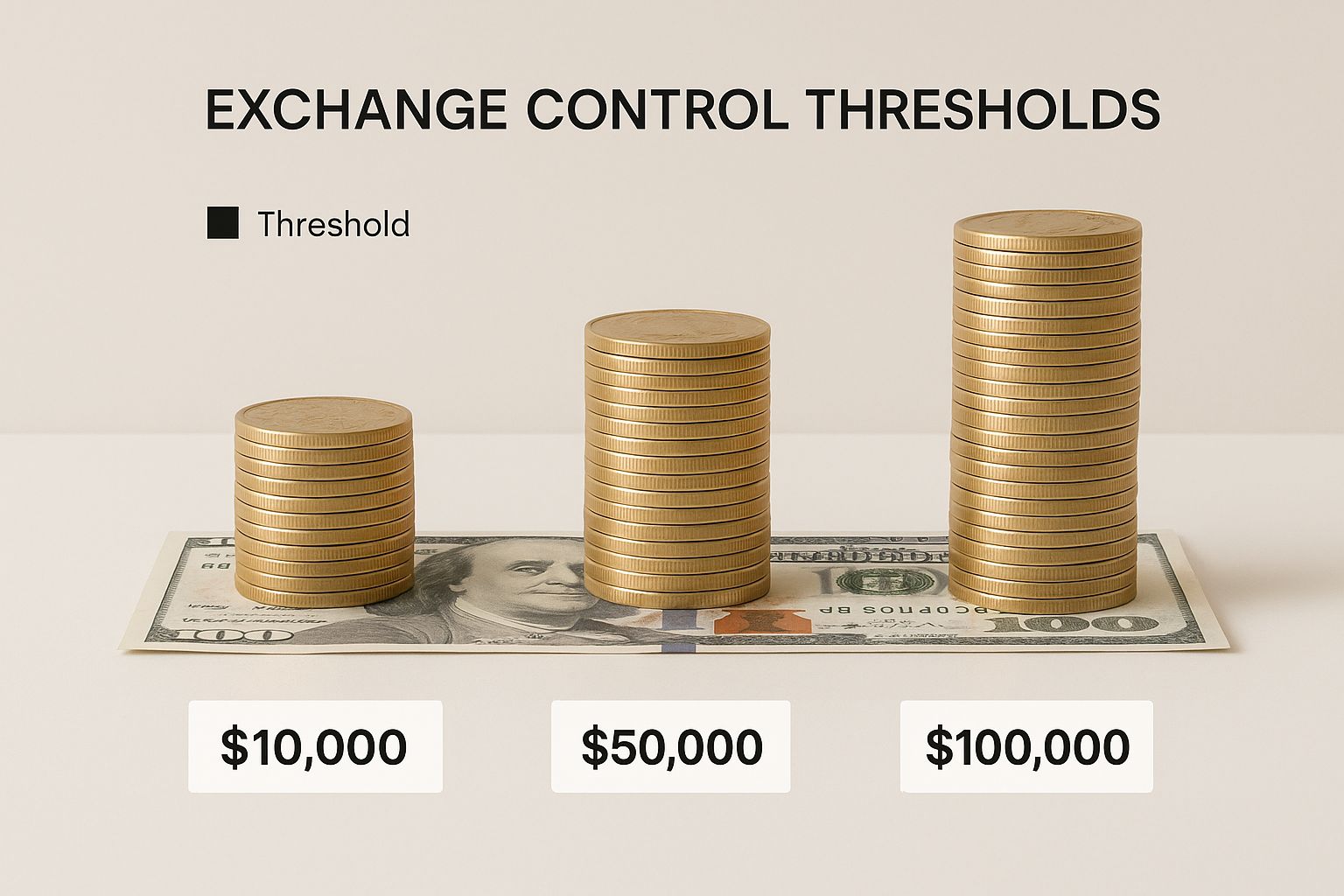
As you can see, there’s a big difference in scale between the everyday discretionary allowance and the much larger one meant for serious offshore investing.
Allowances for Individuals
For South African residents, there are two main channels for sending funds offshore. Each has a distinct purpose, with its own set of rules and limits.
1. The Single Discretionary Allowance (SDA)
This is your most flexible allowance. Every South African resident over 18 gets an annual SDA of R1 million per calendar year. The best part? You don't need a tax clearance certificate from SARS to use it, making it the go-to for most personal cross-border payments.
You can use the SDA for things like:
- Travel: Covering flights, hotels, and spending money for your overseas holidays.
- Gifts: Sending cash to family or friends living abroad.
- Donations: Supporting international charities or causes.
- Alimony and Child Support: Meeting court-ordered maintenance obligations.
- Small-Scale Investments: You can even use your SDA for offshore investments, including cryptocurrencies, without the paperwork of getting tax clearance.
2. The Foreign Investment Allowance (FIA)
When you’re ready to make more substantial offshore investments, you’ll graduate from the SDA to the Foreign Investment Allowance. This gives you an additional R10 million to invest abroad each calendar year.
The key difference here is the paperwork. Unlike the SDA, using the FIA means you first need to get a Tax Compliance Status (TCS) pin from SARS. This simply proves your tax affairs are in order before you can shift a large amount of capital offshore.
This allowance is specifically for building an offshore investment portfolio, whether that's buying foreign stocks, bonds, or property. It can't be used for everyday things like travel or gifts—that’s what the SDA is for.
Understanding Business Transactions
For companies, the rules work a bit differently. Their needs are far more varied, so there isn’t a single, neat "business allowance" like there is for individuals. Instead, the South African exchange control framework is set up to allow legitimate, trade-related transactions, as long as they are properly documented.
Key Permissible Business Transactions
- Paying for Imports: This is the most common reason a business sends money overseas. To do this, you must give your bank (the Authorised Dealer) the commercial invoices and customs documents to prove the payment is for real goods or services coming into South Africa.
- Offshore Investments: South African companies can absolutely make strategic offshore investments to grow their operations. These deals are usually more complex and often need specific approval from the SARB, depending on the investment's size and nature.
- Royalties and Licence Fees: Paying for foreign tech or intellectual property is also allowed, but again, it requires solid legal agreements that you present to your Authorised Dealer.
The guiding principle for all business payments is substantiation. You have to prove that every rand sent abroad has a legitimate business purpose. This is where a platform like Zaro becomes incredibly helpful, as it centralises all your documentation and payment records, making the whole compliance process much more manageable.
Annual Foreign Exchange Allowances for South African Residents
To help you choose the right path for your needs, this table neatly summarises the key differences between the two main allowances for individuals.
| Allowance Type | Annual Limit (per calendar year) | Tax Clearance Required? | Common Uses |
|---|---|---|---|
| Single Discretionary Allowance (SDA) | R1 million | No | Travel, gifts, donations, alimony, small offshore investments. |
| Foreign Investment Allowance (FIA) | R10 million | Yes (Tax Compliance Status Pin) | Large-scale offshore investments like property, stocks, and bonds. |
By getting to grips with these distinct allowances, both individuals and businesses can plan their international financial activities far more effectively. Knowing the limits and what paperwork you'll need ahead of time is the first step towards smooth, fully compliant cross-border transactions.
Working with Authorised Dealers for Compliance
Navigating South African exchange control on your own can feel like trying to find your way through a maze in the dark. The good news is, you don’t have to. The South African Reserve Bank (SARB) doesn't manage every single transaction itself; instead, it appoints official gatekeepers to handle the day-to-day process.
These gatekeepers are known as Authorised Dealers. For most of us, this is just a formal name for our bank. All the major South African banks are empowered by the SARB to process and approve the vast majority of international payments, effectively acting as the frontline of compliance.
Think of your bank as a helpful customs agent at the border of the financial system. Their job isn’t to block you, but to check your papers and make sure your transaction fits within the country's rules before waving it through.
The Role of Your Bank as an Authorised Dealer
Your bank is your most important partner for making sure your cross-border payments go through smoothly and legally. When you kick off an international transfer, your bank has a legal duty to check what the payment is for and confirm it complies with exchange control regulations.
This is why they ask for documentation. It’s not your bank being difficult—it’s the SARB holding them accountable for every single rand that leaves the country. By giving them the right paperwork, you give them the confidence to approve your payment quickly.
This entire system has deep roots. It’s a legacy of a much stricter time, particularly the financial rand system during the apartheid era. That parallel currency, which was in place until March 1995, was specifically designed to stop capital from leaving the country. While that system was thankfully dismantled as South Africa rejoined the global economy, the core framework of monitoring transactions remains, with Authorised Dealers still playing a key part. You can explore the history and evolution of SARB's policies to get a fuller picture.
Preparing the Right Documentation
Being prepared is everything. A little bit of admin upfront can save you a world of frustration and delays down the line. The exact documents you'll need depend entirely on the reason for your payment.
Here’s a look at some common transactions and the paperwork you should expect to provide:
- Paying for Imports: To pay an overseas supplier, you'll need a commercial invoice. This document clearly details the goods or services you're buying and proves the payment is for legitimate trade.
- Travel Allowance: If you’re getting foreign currency for a holiday using your Single Discretionary Allowance, your bank will typically want to see your flight ticket and a copy of your passport.
- Offshore Investments: For sending money abroad under the R10 million Foreign Investment Allowance, you absolutely must have a Tax Compliance Status (TCS) pin from SARS. This proves your tax affairs are in order.
Getting your documents ready before you start the payment process turns what could be a bureaucratic nightmare into a simple box-ticking exercise. It signals to your Authorised Dealer that you know what you’re doing.
This is where fintech platforms like Zaro make a real difference for businesses. They help you keep all the necessary documentation organised and attached to each specific transaction. When the bank asks for proof, it’s all right there, making compliance straightforward and efficient.
Ultimately, the best way to approach this is to see your bank as a compliance partner, not an obstacle. They have the expertise to guide you. By giving them clear and accurate information, you ensure your money moves across borders exactly as it should—seamlessly and without a hitch.
Common Exchange Control Mistakes to Avoid

Navigating South African exchange control can feel like walking through a maze, but it’s a lot less intimidating once you know where the common tripwires are. The good news is that most issues don't come from people trying to break the rules, but from simple, honest misunderstandings.
By getting to grips with a few frequent slip-ups, you can handle your cross-border payments with confidence. Let's walk through these common mistakes, using real-world scenarios to show you exactly what to look out for.
Mistaking Allowances and Exceeding Limits
One of the easiest traps to fall into is accidentally blowing past your annual allowances. It happens more often than you’d think, especially when you’re making several smaller payments over the year.
Imagine you’re using your R1 million Single Discretionary Allowance (SDA). You pay for a family holiday, do some online shopping from international stores, and send a few monetary gifts to relatives abroad. Without keeping a close eye on the total, it’s all too easy to attempt another payment that tips you over the limit, only to have it blocked by your bank. The lesson here is simple: keep a running tally of your SDA spending.
For businesses, the headache is usually less about a hard cap and more about mismatched paperwork. A payment for imported machinery might get stuck just because the invoice amount doesn't perfectly align with the payment request, or because a crucial customs form is missing. It’s all in the details.
Misstating the Purpose of a Payment
This one is a big deal. You absolutely have to declare the true reason for any payment you make. It might feel tempting to classify a small offshore investment as a "gift" to sidestep the extra admin, but this is a serious compliance breach.
Every payment category comes with its own set of rules and required documents.
- Scenario: You want to invest R50,000 from your SDA into a friend’s tech startup in London.
- The Mistake: To make it quick, you select "Gift to Family" on your banking app.
- The Problem: That's a misrepresentation. While investing is a perfectly valid use of your SDA, it must be declared as an investment. This data is vital for the SARB and Authorised Dealers to track capital flows, and incorrect reporting throws a spanner in the works.
Always be upfront and precise about why you're sending money. The entire regulatory system hinges on accurate information, and getting the purpose right from the start is your best defence against future headaches.
This is where a platform like Zaro can be a real help. It guides you with clear, specific fields for payment reasons, making sure all the necessary details are captured before you even hit 'send'. This drastically cuts the risk of an accidental misstep.
Creating Illegal Loop Structures
Now we're getting into more serious territory. A "loop structure" is a definite no-go. This happens when a South African resident sends money out of the country to set up an offshore entity—like a company or a trust—which then turns around and invests that money back into South Africa.
For example, say you use your Foreign Investment Allowance to incorporate a company in Mauritius. If that Mauritian company then buys shares in a Johannesburg-based business or purchases property in Cape Town, you've just created a loop. The SARB strictly prohibits this because it's seen as a way to sidestep the rules governing local investments.
The fundamental principle is that money sent offshore is meant for offshore activities. Bringing it back into the Common Monetary Area (South Africa, Namibia, Lesotho, and Eswatini) is a major violation of South African exchange control regulations and can attract some hefty penalties.
Confusing Crypto with Capital
Here’s a very modern-day pitfall that has caught many people out: cryptocurrencies. For a while, the assumption was that sending crypto assets offshore fell under the same rules as sending Rands. However, a pivotal court ruling in 2025 turned that idea on its head.
The case of Standard Bank v SARB clarified that, under the current regulations, crypto assets like Bitcoin are not legally defined as "capital" or "currency". This effectively places them in a regulatory grey zone for now.
But don't mistake this for a free pass. The regulatory environment is shifting fast to address this gap. If you’re involved with crypto, it’s absolutely essential to keep your ear to the ground. What’s technically permissible today could be strictly regulated tomorrow.
Where Forex Regulation and Fintech Are Headed
The world of South African exchange control is anything but static. While its roots run deep, the future is all about gradual modernisation and making things simpler. The South African Reserve Bank (SARB) and the government are performing a careful balancing act: they want to attract foreign investment and smooth the path for international business, but not at the expense of the country's economic stability.
But policy changes aren't the only story here. The single biggest force changing the game right now is financial technology, or fintech. New platforms are completely overhauling how we all deal with the rules of cross-border payments.
The future of exchange control compliance isn't about piling on more rules; it's about building smarter systems. Fintech is taking what used to be a manual, paper-drowning process and turning it into a seamless digital experience. Compliance is becoming a background function, not a roadblock.
This shift gives businesses the tools to work within the regulated system with far more confidence and ease, leaving clunky, old-fashioned methods behind.
The Rise of Smart Compliance
Anyone who’s dealt with exchange control the old-fashioned way knows the drill: endless paperwork, long phone calls with the bank, and frustrating delays. Fintech platforms are tearing down that old model by baking compliance right into the payment process itself.
Instead of hunting down invoices to manually submit to an Authorised Dealer, companies can now use systems that handle the whole thing automatically. A platform like Zaro, for example, lets a business upload supporting documents directly with each payment. This creates a perfect, auditable trail from the very start, keeping the regulators happy.
This kind of automation brings some massive advantages:
- Fewer Human Errors: The risk of sending the wrong information or mismatched documents practically disappears.
- Serious Speed: Payments that used to take days can now be cleared much, much faster, which is a game-changer for cash flow.
- Total Transparency: Businesses get a crystal-clear, real-time view of their transactions and where they stand with compliance.
A New Chapter for Cross-Border Payments
The impact of fintech goes well beyond just killing paperwork. These platforms are bringing a whole new level of efficiency and cost-effectiveness to international payments—a world that for too long has been defined by the confusing fees of traditional banks.
By giving businesses access to real exchange rates without hidden markups or massive SWIFT fees, solutions like Zaro put South African companies on a level playing field globally. It means the price you see is the price you actually get. This takes the guesswork out of international trade and helps you plan your finances with real accuracy.
It all comes together to create a remarkably smooth experience. Picture this: you fund your account with a simple local bank transfer, and minutes later, you’re paying an international supplier in dollars, with all the compliance checks handled automatically in the background. This is the new standard that fintech is setting.
As these technologies become the norm, they'll keep nudging the SARB and the big banks towards a more modern, efficient, and user-friendly way of managing South African exchange control. The future isn’t about getting rid of the rules, but about making them feel invisible.
Got Questions? We’ve Got Answers
Let's be honest, South African exchange control can feel like a maze. To help you find your way, we've tackled some of the most common questions that pop up when you're dealing with money crossing our borders. Here are some straightforward answers to get you started.
What Exactly Is an Authorised Dealer?
Think of an Authorised Dealer as a gatekeeper appointed by the South African Reserve Bank (SARB). In most cases, this will be your everyday commercial bank. They are on the front lines, making sure every international payment leaving the country ticks the right regulatory boxes.
You never deal directly with the SARB for your standard transactions. Instead, your bank has the legal responsibility to check your paperwork and confirm your payment is above board. This is why they’re so particular about documentation – they’re acting on the SARB's behalf.
Can I Buy Crypto with My Forex Allowance?
Yes, you can, but you need to tread carefully. South Africans are permitted to use their personal allowances, like the R1 million Single Discretionary Allowance, to purchase cryptocurrencies from overseas platforms.
The key here is honesty. You must declare the transaction for what it is: an offshore investment. Trying to disguise it as a gift or something else is a direct violation of the rules. Transparency is absolutely essential.
What If I Need to Send More Than My Allowance?
So, what happens if you hit your limit? If you need to send more than your annual allowance, for example, the R10 million Foreign Investment Allowance, you can't just make the payment. Your bank will simply block it.
To go beyond your yearly limits, you have to apply directly to the South African Reserve Bank for special clearance. This isn't a simple form; it involves a detailed application explaining why you need to move the extra funds, backed by a lot of supporting documents.
Approval isn't a given. Each case is judged on its own merits, and the SARB has the final say.
What’s a “Loop Structure” and Why Is It a No-Go?
A "loop structure" is a classic exchange control sin, and it’s strictly forbidden. It’s a bit of a roundabout scheme, but here’s how it works:
- A South African resident sends funds offshore, using their allowance.
- They then use that money to create an offshore structure, like a company or trust.
- Here’s the illegal part: that new offshore entity then re-invests the money back into South Africa or the Common Monetary Area (which includes Namibia, Lesotho, and Eswatini).
This is banned because it effectively creates a backdoor to get around the rules governing investments within South Africa. The whole point of sending money offshore is for it to be used offshore. Bringing it back in this way breaks that fundamental principle.
Tired of wrestling with confusing fees and endless paperwork? Zaro offers the fastest, most cost-effective way for South African businesses to make cross-border payments. With real exchange rates, zero hidden markups, and automated compliance, you can manage your global finances with complete clarity and confidence. See how much you could save with Zaro.