The spread in the foreign exchange market is one of those concepts that sounds complicated but is actually quite simple—and incredibly important for your business's bottom line. It's the difference between the price a currency dealer will buy a currency from you (the bid price) and the price they will sell it to you (the ask price).
Think of it as the dealer's built-in fee for handling the transaction. It's how they make their money.
What Is the Forex Spread and Why Does It Matter for Your Business
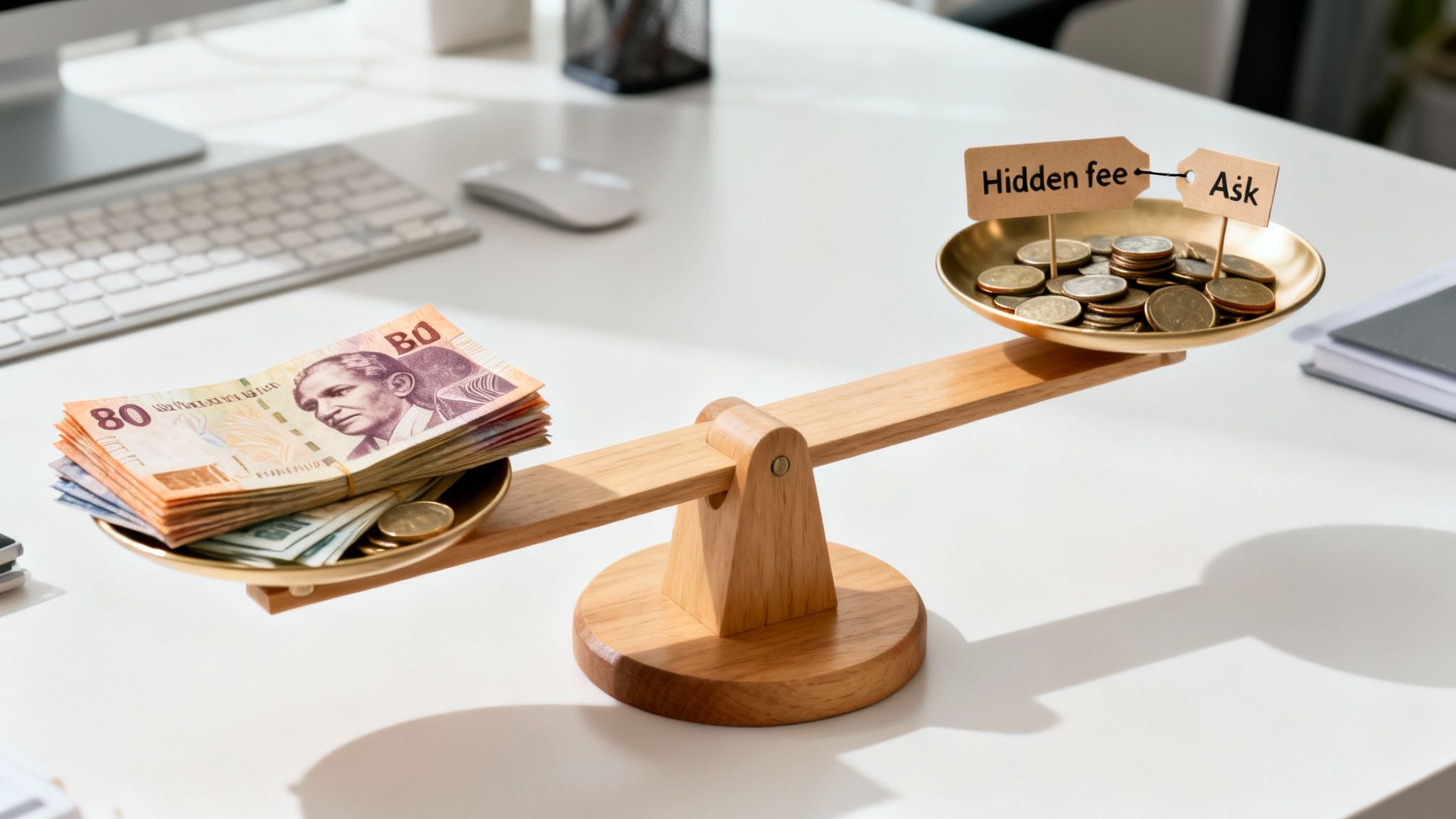
Let's use a simple analogy. Imagine you run a fruit stand. You buy apples from a farmer for R10 each and sell them to customers for R12. That R2 difference isn't pure profit; it covers your rent, transport, and your time. The foreign exchange market works on a similar, though far more complex, principle.
This gap between the buy and sell price is the spread. For any South African business trading internationally, this isn't just theory—it's a real, recurring cost that eats into your profit margins. Every single time you convert Rands to Dollars to pay a supplier or receive Euros from a customer, you're paying this spread.
Decoding Bid and Ask Prices
To really get to grips with the spread, you need to understand the two prices that create it: the bid price and the ask price.
- The Bid Price: This is the price at which a bank or broker is willing to buy a currency from you. It's their "bid" to take the currency off your hands.
- The Ask Price: This is the price at which they are willing to sell that same currency to you. It's the price they are "asking" you to pay.
The ask price is always higher than the bid price, and the difference is where the provider makes their money. For example, if a bank quotes USD/ZAR at 18.20/18.30, it means they will buy US dollars from you at R18.20 and sell them to you for R18.30. That R0.10 difference is the spread.
To help clarify these core ideas, here’s a quick summary.
Key Forex Spread Concepts at a Glance
This table breaks down the fundamental terms every business owner should know.
| Term | Simple Explanation for Business Owners |
|---|---|
| Bid-Ask Spread | The gap between the price a provider will buy a currency and the price they will sell it. It’s their profit margin and your hidden transaction cost. |
| Bid Price | The price you get when you sell a foreign currency. For example, selling USD to get ZAR. |
| Ask Price | The price you pay when you buy a foreign currency. For example, using ZAR to buy USD. |
| Pips | "Percentage in Point"—the smallest price move in an exchange rate. Spreads are often measured in pips. |
Understanding these terms is the first step, but what matters most is recognising the real-world impact.
For a business, the spread is an unavoidable transaction cost embedded within the exchange rate itself. It’s a silent fee that erodes profit margins on every single cross-border payment, making it a critical metric for any CFO to manage.
Why Every Business Owner Should Care
On a single transaction, a tiny percentage might not seem like a big deal. But for a South African SME exporting goods or importing raw materials, these costs add up fast. An exporter who receives $100,000 could easily lose thousands of Rands to an unfavourable spread when bringing that money home.
Recognising this hidden cost is the first step toward controlling it. It helps you turn foreign exchange from an unpredictable expense into a manageable part of your financial strategy. By paying close attention to the spread, you can protect your profits, improve your budgeting, and gain a competitive edge in the global market.
How Hidden Spreads Eat into the Profits of South African Exporters and SMEs

It’s one thing to talk about pips and percentages in theory, but where the rubber really meets the road is seeing how the spread in the foreign exchange market affects a real business. For South Africa’s exporters and SMEs, these hidden costs aren’t just academic—they’re a real bite out of hard-earned revenue.
This cost silently chips away at profit margins, making it one of the most significant yet overlooked expenses in international trade. Let's move from the textbook to a practical scenario to see the financial damage in action.
The Real Cost of a Typical Bank Spread
Picture a Cape Town-based SME that exports rooibos tea to a distributor in the United States. They’ve just landed a big deal and are waiting for a payment of $100,000.
Their finance team checks the news and sees the "official" USD/ZAR exchange rate—the mid-market rate—is sitting at 18.50. Simple maths tells them they should be getting R1,850,000 (100,000 x 18.50). This is the number they pencil into their cash flow projections.
But then the money lands. When the payment is converted through their traditional bank, the final amount credited to their account is nowhere near what they expected.
The bank doesn’t give them the mid-market rate. Why would they? Instead, it applies its own bid price, which includes its markup—the spread. Let’s say the bank’s bid price for buying US dollars from them is 18.25.
- Expected Revenue (Mid-Market Rate): $100,000 x 18.50 = R1,850,000
- Actual Revenue (Bank's Bid Rate): $100,000 x 18.25 = R1,825,000
Just like that, the business has lost R25,000 in a single transaction. This isn't a fee you’ll find itemised on a bank statement; it’s a cost buried inside the unfavourable exchange rate. This is the "spread cost."
How It Snowballs: The Multiplier Effect
While R25,000 might seem like a manageable hit on one deal, very few businesses do just one international transaction a year. For any active exporter, this cost multiplies with every single invoice.
The true financial damage of the spread lies in its repetitive nature. A seemingly small percentage loss on each transaction accumulates into a significant annual expense that directly erodes a company's net profit and shareholder value.
Imagine our rooibos exporter gets a similar $100,000 payment every month. That annual cost of the spread balloons to a staggering R300,000 (R25,000 x 12). Suddenly, that "small" percentage has turned into a massive, unplanned business expense that could have funded a new employee’s salary, a marketing campaign, or critical equipment upgrades.
Beyond the Numbers: The Strategic Headaches
The financial drain is only part of the story. The uncertainty and lack of transparency caused by these spreads create major strategic headaches for South African CFOs and business owners.
1. Complicated Financial Forecasting
How can you accurately forecast your ZAR revenues when you have no idea what exchange rate you’ll actually get? This fog of uncertainty makes it incredibly difficult to budget for expansion, manage operational costs, or set competitive prices for your products.
2. Eroded Competitiveness
If your pricing model doesn't account for these hidden FX costs, your profit margins will be much thinner than you planned. The alternative is to raise your prices to compensate, which risks making you less competitive in a tough global market.
3. Cash Flow Instability
Unpredictable incoming payments wreak havoc on cash flow. A management team expecting R1.85 million to cover local payroll and suppliers is left scrambling when only R1.825 million hits the account.
This problem becomes even worse during periods of high currency volatility. The South African Rand, for instance, has seen massive swings against the US dollar, moving from a peak of 19.93 to a low near 16.5—a variance of roughly 17%. When market swings like that are combined with wide provider spreads, the impact on an SME's bottom line can be devastating, making margin protection a constant battle. You can track currency performance and historical volatility to get a better sense of these market dynamics.
Ultimately, the hidden spread in the foreign exchange market is far more than a transaction fee. It’s a real barrier to growth, profitability, and financial stability for the very businesses that drive South Africa's economy.
Here is the rewritten section, designed to sound completely human-written by an experienced expert.
What Makes a Forex Spread Wider or Tighter?
Have you ever looked at a currency exchange quote and wondered why it felt so expensive? Then, just a few days later, a similar transaction seems much more reasonable. The difference isn't random; it comes down to a few key factors that cause the bid-ask spread to constantly expand and contract.
For any South African business trading internationally, getting a handle on these drivers is a game-changer. It’s the difference between blindly accepting whatever rate you’re given and knowing when a quote is fair—or when it’s time to push back. The size of the spread is really a mix of market conditions like liquidity and volatility, plus a crucial third element: the provider’s own profit margin.
The Role of Liquidity
Think of liquidity as the amount of traffic in a market. How easy is it to buy or sell a currency without dramatically affecting its price?
A currency pair like the Euro and US Dollar (EUR/USD) is like a major global highway—it’s packed with buyers and sellers 24/7. This intense volume and competition mean providers have to keep their spreads razor-thin to attract business. It's a buyer's market.
Now, consider a less common or "exotic" currency pair. This is more like a quiet country road with far fewer participants. For a provider, finding someone to take the other side of your trade is harder and riskier. To make it worth their while, they widen the spread. The USD/ZAR pair, while considered a major, is less liquid than giants like EUR/USD, so its base spread will naturally be a bit wider.
A currency pair's liquidity is the single biggest natural factor influencing its base spread. More buyers and sellers mean tighter, cheaper spreads for you. Fewer participants mean wider, more expensive ones.
The Impact of Volatility and Big News
Volatility is just a fancy word for how much a currency’s price is jumping around. When the global economy is calm and predictable, exchange rates tend to move smoothly, and spreads stay nice and tight.
But what happens when major news breaks? Think of an interest rate announcement from the South African Reserve Bank (SARB), the results of a national election, or a surprise inflation report. Suddenly, uncertainty floods the market.
These events can make exchange rates swing wildly, which is a huge risk for currency providers. To shield themselves from getting caught on the wrong side of a sudden price move, they immediately widen their spreads. That’s why you’ll often find that converting currency right before a big announcement can cost you more.
- High Volatility: Spreads get wider as providers try to protect themselves from risk.
- Low Volatility: Spreads narrow when the market is stable and predictable.
The Provider’s Markup: The Part They Control
Liquidity and volatility are market forces, but there's a final, critical layer that’s entirely up to your bank or forex provider: the markup. This is their profit margin, an extra slice they add on top of the base market spread.
This is the hidden "fee" we talked about earlier, and it's often the biggest and most opaque part of your cost. Two banks could be getting the exact same wholesale exchange rate, but one might add a 0.5% markup while the other slaps on 1.5%. For your business, that difference is massive.
This is where you can take back control. A high spread doesn't always mean the market is choppy; a lot of the time, it’s just a sign that your provider is charging an uncompetitive markup. Knowing this empowers you to shop around, negotiate, and find a partner who values transparency over burying their profit in the rate.
How to Calculate and Measure Your Real Forex Costs
It’s one thing to know the spread in the foreign exchange market is costing you money. It's another thing entirely to know exactly how much. If you want to get a real handle on your FX costs, you have to shift from being a passive rate-taker to an active auditor of every transaction. And that starts with learning how to calculate the spread yourself.
Thankfully, you don't need a degree in finance to do this. The key is to find the true mid-market rate, which serves as your benchmark. Think of this as the real, unbiased exchange rate—the halfway point between what buyers are willing to pay and what sellers are asking for a currency on the global market. You can find this rate easily on reliable sources like Reuters or even with a quick Google search. Armed with this number, you can measure any quote you receive against the real price.
Calculating the Absolute Spread in Rands
The most direct way to feel the bite of the spread is to calculate its absolute cost in Rands. This calculation strips away the jargon and shows you, in plain numbers, how much money you’re leaving on the table compared to the ideal mid-market rate.
The formula is simple:
Spread Cost (in ZAR) = (Mid-Market Rate – Your Quoted Rate) x Foreign Currency Amount
Let's look at a practical example. Say your business needs to convert a $50,000 invoice from a US client into Rands.
- The live mid-market USD/ZAR rate is 18.40.
- Your bank offers you a quoted (bid) rate of 18.15.
Plugging those numbers into the formula:
(18.40 – 18.15) x 50,000 = R12,500
That R12,500 isn't just a number on a spreadsheet; it’s the tangible cost of the spread. It’s a hidden fee that has been carved directly out of your revenue.
Finding the Spread as a Percentage
While the absolute cost hits home, calculating the spread as a percentage is crucial for comparing different quotes and providers. A percentage gives you a standardised way to see who is offering a competitive rate, regardless of how big or small the transaction is.
Here’s how you work it out:
Spread (%) = [(Ask Price – Bid Price) / Mid-Market Rate] x 100
This formula quickly reveals how wide a provider’s markup really is. The USD/ZAR pair, for example, is known for its volatility. The rate can easily swing by over 200 basis points in just a few days, and over a year, that range can stretch to more than 2,000 basis points. For any finance manager, understanding that a seemingly tiny 0.5% spread adds up across multiple transactions during these volatile periods is critical. It can amount to tens of thousands of Rands in lost value.
When you're bringing on new partners, a proper Payment Provider Integration strategy must include a close look at these percentage-based costs. Otherwise, you risk slowly eroding your profit margins with every single payment you process.
This flow diagram breaks down the main factors that drive the forex spread—market liquidity, volatility, and the provider's markup.
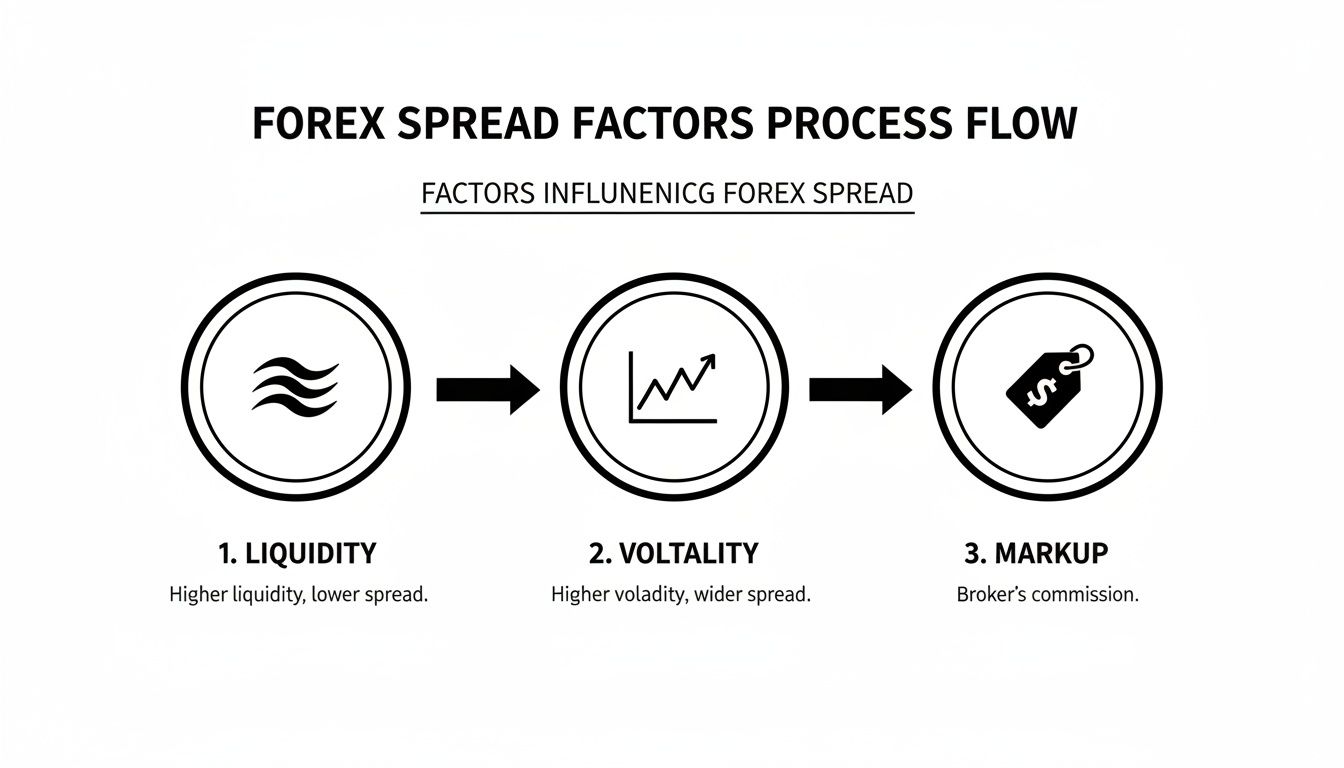
As you can see, while you can't control market conditions like liquidity and volatility, the provider's markup is the one piece of the puzzle you can—and should—actively manage.
Actionable Strategies to Minimise Spread Costs
Alright, you understand the problem of hidden spreads. That's half the battle won. Now, let's talk about solutions. The good news is you don't have to just accept the high costs baked into the spread in the foreign exchange market. With a few smart strategies and the right tools, South African businesses can slash their exposure to wide spreads and sneaky markups.
This is about shifting from being a passive rate-taker to an active manager of your company's foreign exchange. It means being more deliberate about when you make transactions and, crucially, looking for financial partners who offer a fairer, more transparent way of doing business.
Re-evaluate Your Banking Relationships
For years, big banks have been the go-to for international payments. It's just what everyone did. But their business model often depends on opaque spreads to make money—your money. The single most powerful thing you can do is to start questioning this default option.
Don't be shy about asking your bank some direct questions. Ask them what their markup is on the USD/ZAR pair. Request a full, line-by-line cost breakdown of a recent transaction. The moment you start asking these questions, you signal that you're no longer willing to accept uncompetitive rates without a fight.
A business that regularly audits its forex costs and compares providers stops being a passive customer and becomes an active financial manager. This simple change in mindset can easily save tens of thousands of Rands every year.
Time Your Transactions Strategically
You can't control the global markets, but you can certainly control when you participate in them. Spreads always get wider during periods of high volatility. Think about major economic news, like an interest rate decision from the South African Reserve Bank (SARB) or a new inflation report out of the US.
If you see a big announcement on the calendar, it’s often smarter to get your currency exchange done beforehand, assuming the market is calm. Planning your payments a few days ahead, instead of scrambling at the last minute, gives you the breathing room to sidestep these high-cost windows. It's a proactive way to avoid paying a "volatility premium" you don't have to.
Explore Modern Fintech Alternatives
The financial world has changed. New fintech companies have shown up with business models designed specifically to fix the problems that make traditional forex so expensive. These platforms can give you direct access to the real mid-market rates, getting rid of the hidden spread altogether.
Here’s what to look for in a modern solution:
- Multi-Currency Accounts: Imagine holding USD, EUR, and ZAR in one place. This lets you receive payments from overseas clients without being forced into an immediate conversion. You can hold onto the foreign currency and wait for a more favourable exchange rate before bringing it home to Rands.
- Direct Access to Spot Rates: Some providers plug you straight into the live interbank exchange rates. This means you're trading at the same rate the big banks use with each other, completely sidestepping the retail markups that have been eating into your profits for years.
- Transparent Fee Structures: Instead of hiding their fees in the exchange rate, these platforms usually charge a small, clearly stated transaction fee. You know exactly what you're paying, which makes financial planning far more accurate and gets rid of nasty surprises.
Of course, currency exchange is just one piece of the puzzle. Getting a handle on all the costs of international trade, like customs charges, is also vital. Actively saving on brokerage fees is another important part of a smart cost-cutting plan.
By putting these strategies into practice, you can fundamentally change how your business handles foreign exchange. It stops being an unavoidable cost and becomes a strategic part of your business you can optimise for major savings. This frees up your hard-earned profits to be reinvested where they belong: back into growing your business.
Cutting Through the Noise: The Zero-Spread Solution
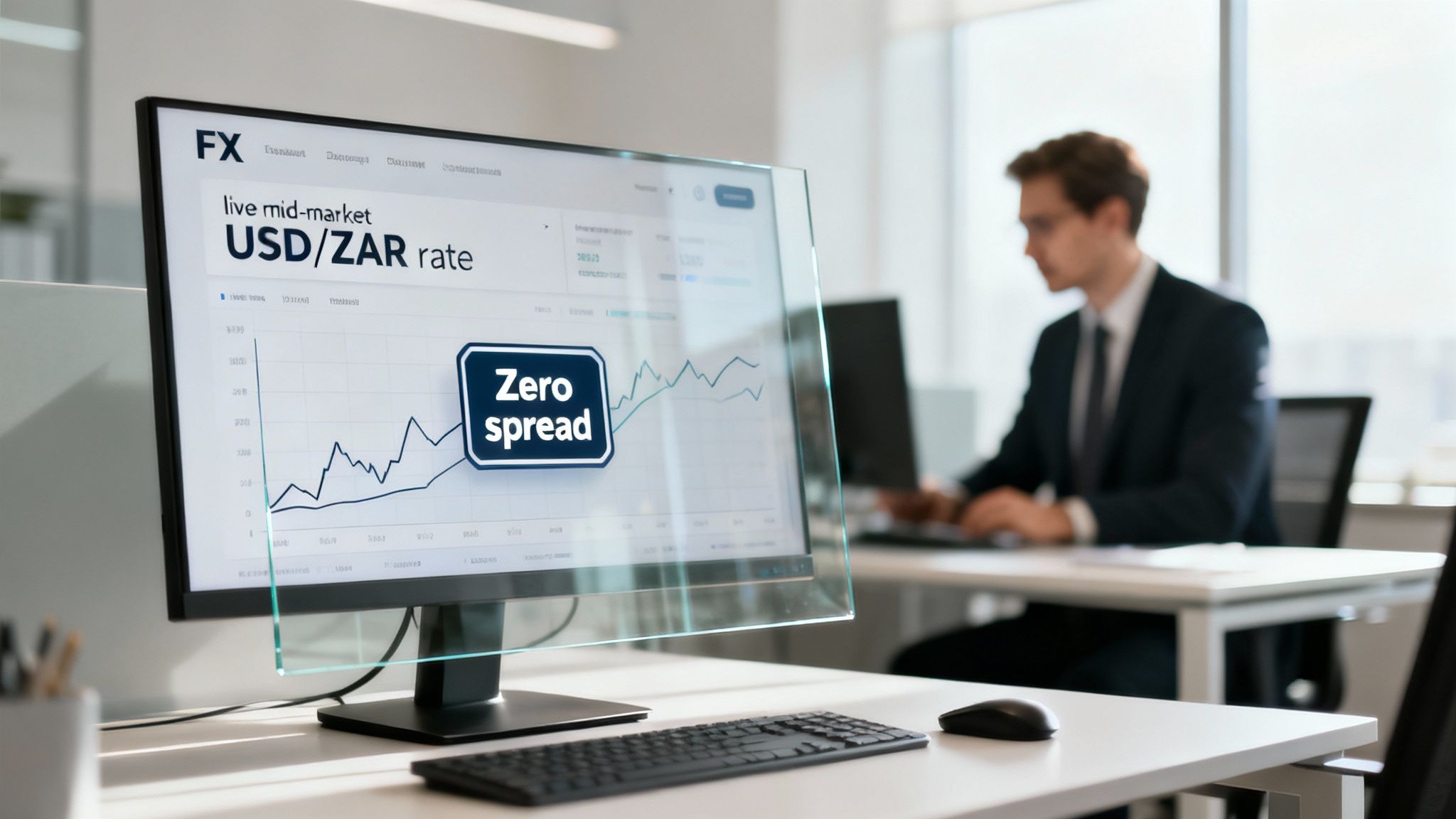
After unpacking all the hidden costs and strategic headaches buried in the spread in the foreign exchange market, the solution starts to look pretty simple. Businesses don't need a smaller spread; they need to get rid of it altogether. A zero-spread model does exactly that, tackling opaque pricing and unpredictable costs head-on by giving you direct access to the real, live mid-market exchange rate.
This isn't a minor tweak—it's a complete overhaul of how international payments are managed. Instead of your bank giving you their marked-up rate, you transact at the same true rate financial institutions use to trade with each other. No hidden fees, no confusing calculations. Just one transparent rate.
What This Means for Your Bottom Line
Let's go back to our South African exporter who was expecting a $100,000 payment. Their bank’s bid rate was so far below the real mid-market rate of 18.50 that they lost R25,000 in the exchange.
Now, let's see what happens if they use a zero-spread platform like Zaro.
In a zero-spread model, the transaction happens at the true mid-market rate. That R25,000 that vanished into the bank’s pocket as a hidden 'spread cost' now stays exactly where it belongs: with the business.
The maths becomes refreshingly straightforward:
- Payment Received: $100,000
- Exchange Rate Used: 18.50 (the real mid-market rate)
- Total Revenue: R1,850,000
There's no loss. The full value of the payment is captured, turning what was once a recurring, unavoidable cost into pure profit. If that business receives twelve of these payments a year, that’s an extra R300,000 in direct, tangible savings.
More Than Just Cost Savings
While the financial upside is immediate and clear, a proper treasury management solution delivers so much more. It gives finance teams the control, visibility, and security they need to confidently manage global finances. It’s a complete ecosystem built for efficiency.
Key benefits for finance teams include:
- Enterprise-Grade Security: With bank-level encryption and secure infrastructure, you know your company’s funds and sensitive data are protected from threats.
- Streamlined Compliance: Integrated Know Your Business (KYB) and anti-money laundering (AML) checks handle regulatory hurdles automatically, lifting a huge administrative weight off your team.
- Complete Financial Control: Features like multi-user access with custom permissions give you full governance. You can ensure team members only access what they need, creating clear oversight.
By pairing zero-spread transactions with these critical treasury controls, South African businesses can finally put an end to hidden FX costs. The result is better operational efficiency and the financial predictability needed to grow with confidence on the global stage.
Common Questions About the Forex Spread
If you're running a business, the world of foreign exchange can feel unnecessarily complex. The spread is one of those concepts that often trips people up. Let's clear the air and tackle some of the most frequent questions South African business owners have about protecting their bottom line on international payments.
What’s the Difference Between a Spread and a Fee?
This is a great question because the two are often confused.
Think of a fee as an upfront, clearly labelled charge you'd see on an invoice – something like a "transaction fee" or "SWIFT payment fee." You know exactly what it is and what you're paying for.
A spread, however, is a much quieter cost. It's baked directly into the exchange rate you're given. It represents the gap between the true wholesale rate (the one banks use) and the marked-up rate your provider offers you. More often than not, this hidden spread ends up costing your business far more than any visible fee ever will.
Is It Really Possible to Get a Zero-Spread Exchange Rate?
Yes, absolutely. For a long time, only massive corporations and financial institutions had the clout to access the real mid-market rate. But that's changed.
Today, modern financial platforms can offer this same privilege to SMEs. A zero-spread model means you're converting your currency at the genuine wholesale rate, with no hidden markup. Instead, you'll typically pay a small, transparent transaction fee. The big advantage here is total clarity—you know precisely what your foreign exchange is costing you.
Why Does the Spread Change for Different Currencies?
The size of the spread all comes down to two main forces: liquidity and volatility.
- Major Currency Pairs: Think of pairs like the Euro and US Dollar (EUR/USD). They are traded in enormous volumes every single day, which means they are highly liquid. All that competition naturally pushes spreads down, keeping them razor-thin.
- Exotic Currency Pairs: On the other hand, currencies with lower trading volumes, which can include some emerging market currencies, are less liquid. For providers, this translates to higher risk, and they compensate for it by charging a wider spread.
The USD/ZAR pair is an interesting case. It sits somewhere in the middle but is notoriously volatile. This volatility can cause spreads to widen in a flash, especially around big economic news or global events.
How Can My Business Avoid Paying Such High Spreads?
The single most effective thing you can do is shift away from traditional providers whose entire business model is built on those opaque markups.
When you partner with a financial platform that gives you direct access to the mid-market rate, you sidestep the spread completely. Beyond that, if you absolutely have to use a provider that charges a spread, timing can be everything. Try to make your transactions during calmer market periods to avoid the wider spreads that come with high volatility.
The most important thing for any South African business to realise is this: the forex spread isn't some fixed, unavoidable cost of doing business. It's a controllable expense that, with the right strategy and financial tools, you can dramatically reduce—or even eliminate altogether.
Ready to stop guessing what your international payments truly cost? With Zaro, you get direct access to the real mid-market exchange rate, crystal-clear fees, and a powerful treasury management platform to put you back in control. See how much you could save at https://www.usezaro.com.