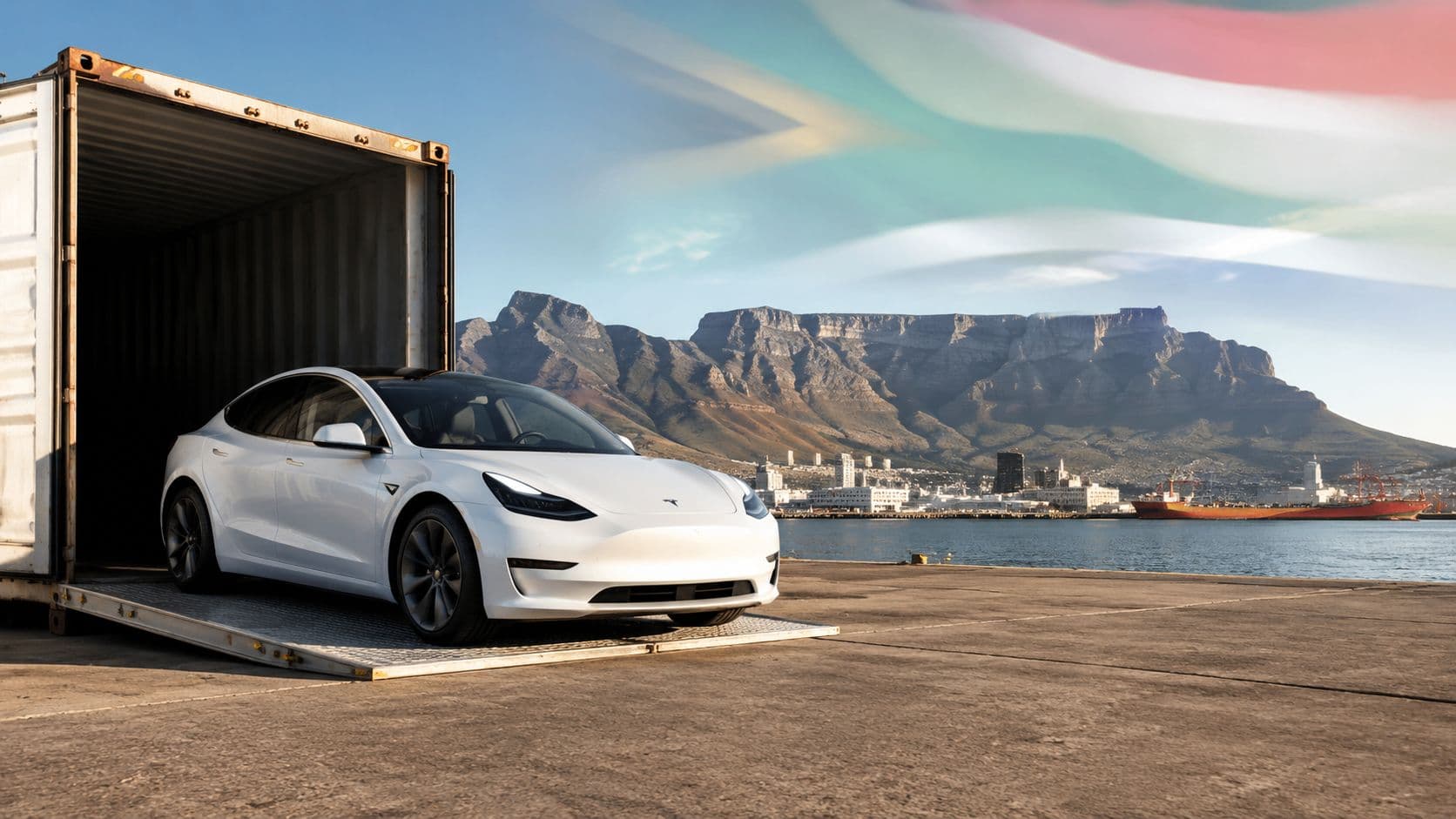
Tesla does not have an official dealership or Tesla-owned service network in South Africa, and the vehicles you see here are privately imported. Globally, Tesla delivered about 1.79 million vehicles in 2024 after 1.81 million in 2023, yet South Africa still sits outside Tesla's direct retail footprint.
Those seeking a Tesla dealership in South Africa are usually already beyond curiosity. You're pricing a Model X or Model 3, asking your accountant about the rand, speaking to a shipping agent, or trying to work out whether this is a sensible luxury purchase or an administrative trap.
That's the right mindset. A Tesla in South Africa can work, but only if you treat it like a high-value cross-border asset purchase, not a normal car sale. The difference matters. With a BMW, Mercedes-Benz, or Porsche bought locally, the system catches many mistakes for you. With a Tesla import, you carry that burden yourself or you pay a specialist to do it.
The Reality of Tesla in South Africa Today
The simple answer is still the correct one. There is no official Tesla dealership South Africa buyers can visit today, and Tesla's own global location directory does not list a South African store, gallery, service centre, or Supercharger presence through its official network on the Tesla Find Us directory.
That absence has shaped the market from the start. South African Tesla ownership has been built through private imports, specialist sourcing, and isolated early vehicles brought in outside a factory-backed local channel. This is why the local conversation often feels confused. People ask about a dealership, but the existing market has behaved more like a boutique import segment than a conventional automotive launch.
What the absence of a dealership actually changes
A missing showroom is the least important part of the story. The bigger issue is that official distribution usually brings a full ownership stack:
- Sales support: Someone local explains trim, spec, payment and delivery.
- Aftersales support: A service centre handles faults, diagnostics and warranty discussions.
- Parts flow: Components move through a recognised local channel instead of ad hoc sourcing.
- Finance and insurance familiarity: Banks and insurers understand the product and process better.
Without that structure, every decision becomes more manual. Buyers need to confirm vehicle origin, transport route, import compliance, registration feasibility, charging setup, and future service options before money moves.
Practical rule: If a seller or broker talks only about getting the car into the country, they're only solving the easiest third of the problem.
Why Tesla's global size doesn't automatically help you locally
Tesla is no longer a niche global manufacturer. It grew from 22,442 deliveries in 2013 to nearly 8 million cumulative deliveries by 2024, with about 1.79 million delivered in 2024, according to Tesla global delivery statistics compiled by Market.us. For South African buyers, that scale can create a false sense of security.
Global scale helps in markets where Tesla operates directly. It doesn't automatically create South African service bays, approved body repair infrastructure, or local parts shelves. That's why a Tesla in Johannesburg, Cape Town or Durban remains a specialist ownership proposition, even though the brand itself is globally mainstream.
The practical conclusion is straightforward. Owning a Tesla in South Africa isn't impossible. It just isn't dealership-led. It's import-led.
Your Two Paths to Tesla Ownership
There are really only two workable routes. You either import directly and manage the process yourself, or you use a specialist broker or import company to coordinate the transaction, logistics and paperwork.

The better option depends less on enthusiasm and more on your tolerance for administrative risk. As Hippo's South African guide to Tesla ownership points out, the key question isn't just whether there's a dealership. It's how ownership works when the car comes in through private import and support for charging, warranty, service and parts must be arranged around that reality.
Path one direct import
Direct import gives you maximum control. You choose the exact car, source market, shipping arrangement and service providers. You also carry the full burden if something goes wrong.
This route suits buyers who are already comfortable with international procurement. If you've imported machinery, art, marine equipment, or other high-value assets before, the process will feel familiar. It's document-heavy, time-sensitive, and unforgiving when names, VIN details or registration data don't align.
Where direct import works well
- Spec control: You can target a specific model, battery configuration or interior.
- Negotiation freedom: You aren't limited to a broker's preferred stock sources.
- Visibility on costs: You see each supplier and each invoice directly.
Where it breaks down
- Compliance risk: One wrong assumption on paperwork or eligibility can delay the whole shipment.
- Logistics burden: Shipping, customs, local handling and final registration don't coordinate themselves.
- Dispute exposure: If the seller, freight agent and local clearing team disagree, you become the project manager.
Path two broker service
A specialist importer or broker acts as the operating layer between you and the process. That doesn't remove risk, but it can reduce the number of moving parts you personally need to control.
Good brokers earn their fees by spotting problems before funds are committed. Poor brokers add cost while leaving key risks unaddressed. The distinction matters.
A serious broker should be able to explain the vehicle source, export process, documentation chain, and local handover path in plain language before asking for a deposit.
A useful way to compare both paths is this:
| Decision factor | Direct import | Broker service |
|---|---|---|
| Control | Highest | Moderate |
| Admin burden | Highest | Lower |
| Transparency | Depends on your own process | Depends on broker quality |
| Risk of procedural mistakes | Higher | Lower if the broker is competent |
| Service fee layer | Lower external fees | Higher because you're paying for coordination |
For most high-net-worth private buyers and for businesses buying an executive vehicle, broker-assisted import is usually the safer route. Direct import makes more sense when you already have trusted shipping, customs and legal support in place.
The Import Process Step by Step
South African buyers often underestimate where Tesla's own process stops and where their own obligations begin. Tesla uses a direct-order model in which the buyer selects the vehicle and then completes pre-delivery tasks in the app, including registration and delivery details, as outlined in Tesla's ordering guidance. For a South African import, that means the paperwork burden starts early, not at the port.

Start with source validation
Before you think about shipping, confirm exactly what you're buying and from whom. That sounds obvious, but overlooking this step often leads to expensive mistakes.
If the vehicle is new, establish the market of sale and whether the handover pathway works for export. If it's used, confirm ownership history, condition, battery status, accident history, and the exact documentation that will accompany the car. Buyers who want a broader overview of cross-border vehicle procurement mechanics can use this kompletny przewodnik importu aut as a useful external reference for how experienced importers think about sequencing, inspections and paperwork.
Build the process in the right order
The cleanest imports follow a disciplined sequence:
Choose the vehicle
Confirm model, source country, VIN-linked paperwork and seller identity.Model the landed cost
Don't work from the sticker price alone. Add logistics, taxes, compliance costs and contingency.Confirm import viability
Check local requirements for homologation, registration and any approvals needed before shipment.Prepare payment controls
High-value international payments need clear beneficiary details, invoice matching and proof of transaction purpose.Book shipping and insurance
Agree the responsibility split in writing. Know who handles loading, marine cover, destination handling and release.Plan local clearance
Appoint a clearing partner before the car lands, not after.Finish roadworthiness and registration
Only once the vehicle clears the legal and technical steps should you plan final delivery.
The mistakes that cause delays
Most delays aren't dramatic. They're clerical.
- Mismatched buyer details: The name on the purchase documents, export records and local registration path must align.
- Incomplete pre-delivery data: Tesla's workflow expects registration and delivery information to be completed accurately before handover can proceed.
- Late compliance checks: Buyers sometimes pay first and only later ask whether the exact vehicle can be registered smoothly in South Africa.
- Weak local coordination: Freight, customs and road registration teams often work in separate silos unless someone manages them tightly.
Buy only after the document path makes sense from seller to South African registration. The car itself matters, but the paper trail matters more.
A disciplined import doesn't feel glamorous. It feels organised. That's what you want.
Calculating the True Cost of Your Tesla
Most buyers start with the wrong number. They look at a foreign listing price or a local headline estimate and assume they're close to their true budget. They usually aren't.
CAR Magazine's South African coverage put the Tesla Model X at roughly R2.07 million to R2.37 million, but that still doesn't settle the actual ownership budget because the landed number must also absorb currency risk, customs duties and other import-related charges, as noted in CAR Magazine's Tesla South Africa coverage.

The number that matters is landed cost
A serious buyer should work from landed cost, not purchase price. Landed cost is the amount spent to get the car into your name, in South Africa, with the vehicle legally positioned for use.
That budget usually includes:
Vehicle acquisition cost
The price paid to the seller or source market.Foreign exchange exposure
The rand can move between quote, payment and settlement.Shipping and transit insurance
The car must travel, and high-value assets should never travel uninsured.Import-related charges
Customs duties and tax treatment must be modelled before payment.Clearing and handling fees
Ports, agents and release processes all have transaction costs.Homologation and registration work
The car must satisfy South African legal use requirements.Charging setup and ownership readiness
A luxury EV without a dependable home charging solution is badly planned capital.
What buyers often forget
The obvious line items are rarely the dangerous ones. The hidden pressure tends to come from secondary costs and timing mismatches.
| Cost area | Why it matters |
|---|---|
| FX movement | A price agreed abroad can become materially more expensive in rand terms before settlement. |
| Delay costs | Storage, admin and rework fees can appear when documents or approvals lag. |
| Insurance complexity | Insurers may want extra clarity on valuation, parts sourcing and repair pathways. |
| Charging installation | The car may arrive before the home setup is ready, which creates immediate inconvenience. |
A better budgeting method
I generally advise clients to build their Tesla budget in three layers rather than one.
First, calculate the base acquisition plan. That's the vehicle, logistics, import and compliance pathway. Second, add the ownership setup plan, which covers charging, insurance and immediate service contingencies. Third, hold a risk reserve for currency movement, documentation friction or post-arrival corrective work.
Budget discipline: If your budget only works when every assumption goes right, the budget doesn't work.
This is also where many Tesla dealership South Africa searches go wrong. People are often trying to solve a distribution question when the underlying issue is financial structuring. The car might be obtainable. The harder question is whether the total position still makes sense after every unavoidable cost is included.
Living with an Imported Tesla in South Africa
The ownership experience becomes real the day the car reaches your home and enters your routine. At that point, the excitement of sourcing and shipping gives way to a simpler question. Can you live with this car conveniently, confidently, and without constant workaround fatigue?
South Africa is the largest EV market in sub-Saharan Africa, but it remains early-stage, and Tesla's model depends on integrated sales, service and charging. In local practice, buyers often need to bridge service coverage and after-sales gaps through third parties, which makes pre-purchase planning essential, as discussed in this South Africa EV market and Tesla context video.

Charging is a home infrastructure decision
For most South African Tesla owners, the centre of gravity is home charging. Public charging can support you, but it shouldn't be the foundation of your ownership plan.
If you're buying a Tesla for daily use, your house or office needs a charging solution that is practical, safe and matched to your parking reality. Buyers who leave this to the end often create unnecessary friction. A premium EV with uncertain charging access quickly stops feeling premium.
A clean setup usually means:
- Dedicated planning: Decide where the car will charge before it lands.
- Electrical assessment: Use a qualified local professional to confirm suitability and installation approach.
- Routine alignment: Match charging behaviour to your actual driving pattern, not an idealised one.
Service is possible but not factory-backed
Imported Tesla ownership becomes more specialised. Without a Tesla-owned local network, you're relying on independent technicians, EV-capable workshops, body repair partners, and imported parts channels.
That doesn't make ownership impossible. It does mean you need a service strategy before the first warning light appears. For parts decisions, especially when weighing OEM versus aftermarket routes for repairable items, this guide for DIY owners on auto parts is useful background reading because it frames the trade-off between originality, cost and availability in a practical way.
If you can't answer where the car will be diagnosed, repaired and insured, you're not ready to import it.
Warranty and insurance need careful reading
Many buyers assume a premium brand automatically means simple warranty support. In an unofficial market, that assumption can be costly. Before purchase, ask specific questions about warranty enforceability, claim channels, and whether the vehicle's import pathway affects support.
Insurance deserves the same scrutiny. An imported Tesla is not just another executive car to many underwriters. It may involve special consideration around valuation, repair routing, and parts replacement timelines. The right insurer isn't merely the cheapest quote. It's the one that understands what the asset is and how it would be repaired after a claim.
Daily life can still be excellent
When buyers plan properly, day-to-day ownership can be smooth. The usual pattern is simple: charge at home, use the car mostly in urban or scheduled driving, maintain relationships with capable technical partners, and avoid assuming a local dealer will solve surprises.
That's the practical version of Tesla ownership in South Africa. Less showroom convenience. More planning. Better results when the owner takes the infrastructure side seriously.
Final Verdict Is Importing a Tesla Worth It?
For some buyers, yes. For many, no.
A Tesla import into South Africa makes sense when the buyer values the product enough to accept a more complex ownership structure. That usually means a high-net-worth individual who wants the car specifically, or a business that understands cross-border procurement and is comfortable managing a non-standard asset.
When it is worth it
Importing can be a rational decision if most of the following are true:
You want a Tesla specifically
Not just any premium EV, but this brand and platform.You can absorb uncertainty
Timing, exchange rate shifts and support complexity won't destabilise the purchase.You have a support network
Importer, clearing agent, insurer and technical contacts are lined up before funds move.You'll use the car in a predictable pattern
Home or office charging will handle most of the duty cycle.
When it probably isn't worth it
It's harder to justify if you need turnkey convenience. It's also a weak fit if you expect the ownership experience to mirror buying a locally represented luxury vehicle.
A poor-fit buyer usually wants three things at once: factory-backed simplicity, immediate service access, and certainty on total cost. In South Africa, an imported Tesla usually asks you to give up at least some of that.
The decision filter I'd use
Use this short filter before proceeding:
- Can you define the full landed budget in rand, including a buffer?
- Do you know who is sourcing, shipping, clearing and registering the vehicle?
- Do you already have a charging plan for home or office?
- Do you know where the car will be serviced and insured?
- Would you still proceed if the process takes longer and costs more than first expected?
If you answer no to more than one of those questions, pause the transaction.
A Tesla import is worth it when the buyer is deliberate, liquid, and operationally prepared. It becomes painful when the decision is emotional but the planning is thin.
The search for a Tesla dealership South Africa often starts with hope that an official retail launch is just around the corner. That's not the decision you need to make today. The fundamental decision is whether you can own this car well under current conditions.
If the answer is yes, proceed carefully and professionally. If the answer is no, wait. In this category, patience is often cheaper than correction.
If your Tesla import involves paying overseas sellers, freight firms, brokers, or other cross-border suppliers, Zaro is worth a look. It gives South African businesses a cleaner way to handle international payments with real exchange rates, stronger cost visibility, and tighter control over foreign transactions, which matters when a single vehicle purchase can involve multiple counterparties across different stages of the deal.