
Sending money overseas should be simple. But for most South African SMEs, it’s a process tangled in high costs, confusing fees, and frustrating delays. The fix isn't about finding a small workaround; it's about fundamentally changing your approach. Moving from old-school banks to modern fintech platforms gives you transparent pricing, real exchange rates, and much faster transfers, turning what was once a painful operational chore into a real competitive edge.
Why Your International Payment Strategy Matters
For any South African SME looking to grow beyond our borders, smooth global operations are non-negotiable. You might be paying a supplier in China for new inventory, settling an invoice with a freelance developer in Europe, or running payroll for a remote team scattered across the globe. In every case, your ability to move money efficiently is critical.
The problem is, the traditional banking system most businesses still default to is often working against them. Think about it: a bank’s fee structure is notoriously murky, and the exchange rate you get is rarely the one you see on Google. That small percentage difference might not look like much on one transaction, but if you're an exporter making regular, large-value payments, those hidden costs bleed your profits dry over the course of a year. It's a direct hit to your cash flow.
Moving Beyond Legacy Systems
The headaches don't stop at the financial cost. Slow transfer times can put a real strain on your supplier relationships, while the mountain of paperwork for compliance checks can tie up your finance team for hours. This is precisely why a strategic rethink is so essential.
The first step is to truly understand the massive gap between how things used to be done and the tools available today. The market for cross-border payments in South Africa is growing fast, and it's not just about personal remittances anymore.
While individuals sending money home still make up a large portion of transfers, business payments are surging. This boom comes from local exporters paying international suppliers and BPOs managing payroll for global contractors—all of whom need a reliable way to transact in a volatile ZAR environment.
This shift signals a clear demand for better solutions. Businesses today need payment platforms that deliver three core things:
- Cost Transparency: You should know exactly what you’re paying, with no hidden fees or surprise exchange rate markups.
- Operational Speed: Your money needs to arrive on time, every time, to keep business relationships strong.
- Simplified Compliance: The administrative load of meeting regulatory requirements should be minimal.
The numbers back this up. In South Africa's cross-border market, outward digital remittances already make up a 64% revenue share in an industry valued at over USD 330 million. It’s a clear signal that businesses are moving towards modern tools. You can learn more about the dynamics of the South African cross-border payments market here.
By choosing technology built to solve these exact problems, you can finally stop treating international payments as a cost centre and start seeing them as a streamlined, efficient part of your global growth engine.
Traditional Banks vs Modern Fintech At a Glance
To put it simply, the old way and the new way are worlds apart. Here’s a quick comparison to show you exactly what we mean.
| Feature | Traditional Banks (via SWIFT) | Modern Fintech Platforms |
|---|---|---|
| Cost | High, often with hidden fees and poor exchange rates. | Low, transparent fees and mid-market exchange rates. |
| Speed | Slow, typically taking 3-5 business days. | Fast, often same-day or within 24 hours. |
| Transparency | Opaque. The final amount received is often a surprise. | Fully transparent. You see the final cost upfront. |
| Process | Manual, paper-heavy, and requires branch visits. | Digital, streamlined, and managed entirely online. |
The difference is clear. While banks have their place, their legacy infrastructure simply wasn't designed for the speed and transparency that a modern global business requires.
Uncovering the Real Costs of Sending Money Abroad
When you send money internationally, the fee you see upfront is rarely the whole story. For South-African SMEs, the true cost is often buried in complex fee structures and less-than-ideal exchange rates, silently chipping away at your bottom line. Getting a handle on these hidden charges is the first step to truly controlling your global payment costs.
The two main culprits that inflate what you pay are intermediary bank fees and exchange rate markups. A bank might advertise a low, flat transfer fee, but the real damage happens behind the scenes in the currency conversion.
The Truth About Exchange Rates
Ever Googled an exchange rate? That rate you see is the mid-market rate, sometimes called the interbank rate. Think of it as the 'wholesale' price of a currency—it’s the rate banks use to trade with each other and it reflects the true value of one currency against another at that exact moment.
The problem is, this is almost never the rate your business actually gets. Instead, banks and traditional payment providers add a markup, known as a spread, to this rate before offering it to you. That spread is pure profit for them and a direct, often hidden, cost to you.
For instance, if the mid-market rate for ZAR to USD is R18.00 to $1, your bank might offer you a rate of R18.36. That 36-cent difference might seem tiny, but on a large payment, it adds up fast.
A seemingly small 2% markup on a R500,000 payment to a supplier in the US means your business is quietly losing R10,000. This isn't a line item on your statement; it’s a cost absorbed directly into the rate.
This lack of transparency makes it incredibly difficult for finance teams to forecast expenses accurately and manage cash flow when paying international partners.
Demystifying the SWIFT Network
The other major hidden cost stems from how old-school bank transfers actually travel. Most international transfers rely on the SWIFT (Society for Worldwide Interbank Financial Telecommunication) network. It's secure, sure, but it's also decades old and surprisingly inefficient.
Think of it like sending a parcel from Cape Town to a small town in Germany. Instead of a direct flight, your parcel might get routed through a depot in Johannesburg, then to Frankfurt, and finally to a local distribution centre before reaching its destination. Each stop along the way adds a handling fee.
The SWIFT network does the same thing with your money. Your payment instruction bounces between several intermediary banks before it finally lands in the recipient's account. Each of these banks can—and often does—deduct a fee right out of the money you sent.
This causes two major headaches:
- Unpredictable Costs: You have no idea how many intermediary banks will be involved or what their fees will be.
- Reduced Final Amount: Your supplier or partner receives less money than you intended to send, which can lead to payment shortfalls and awkward conversations.
This visual below really highlights the difference between the tangled, traditional way of sending money and the direct, modern approach.
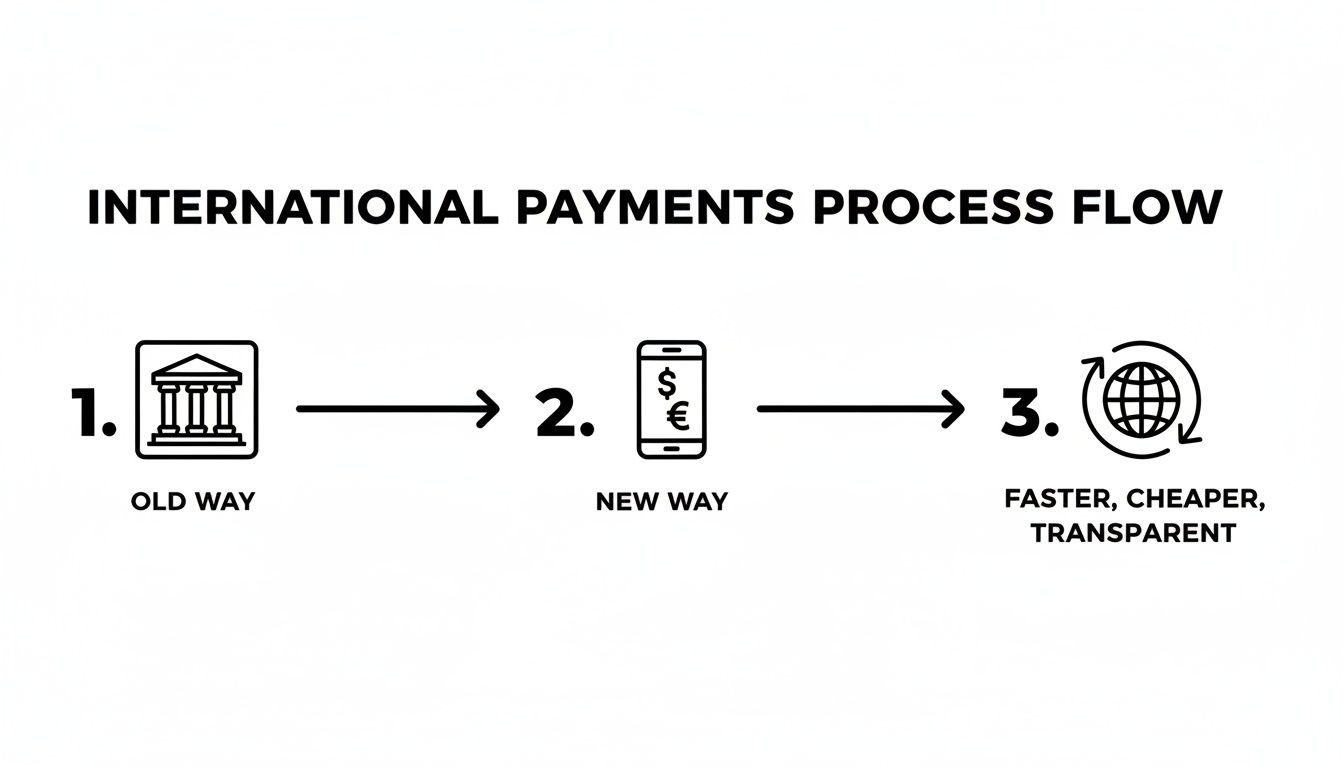
As you can see, modern payment platforms cut out the costly and convoluted intermediary banking system, creating a much cleaner and more affordable path for your funds.
How to Calculate Your Real Cost
To get a true picture of what you're paying, you have to look past the "zero-fee" marketing gimmicks.
When you're assessing any provider for an international payment, always ask for the final, all-in exchange rate. Then, compare it to the live mid-market rate. The difference between the two, multiplied by the total amount you’re sending, is your real cost.
By finding providers who offer transfers at or near the mid-market rate without hidden spreads or unpredictable SWIFT fees, South African SMEs can save thousands of Rands on every single transaction. This protects your profits and helps you build much stronger, smoother relationships with your global partners.
Navigating South African Forex Regulations
If you’re a South African business sending money overseas, staying compliant isn’t just good practice—it's the law. The rules, set mainly by the South African Reserve Bank (SARB), can feel a bit tangled at first. But once you get the hang of the basics, you'll find they're a completely manageable part of doing business globally.
These regulations aren't there to trip you up. They exist to protect South Africa's financial system, stop money laundering, and keep the Rand stable. For your SME, it simply means every international payment needs to be clear, transparent, and have the right paperwork behind it.
The Role of SARB and FICA
Two main players set the rules of the game: SARB and FICA. The SARB lays down the exchange control regulations, which are essentially the traffic rules for money crossing our borders. At the same time, the Financial Intelligence Centre Act (FICA) steps in to fight financial crime, requiring every financial institution to know exactly who their customers are.
Think of it this way: SARB is the air traffic controller for the flow of money, and FICA is the airport security team making sure everyone on board is who they say they are. This is why any payment provider—whether it's a big bank or a modern fintech company—is legally required to ask for detailed information about your business.
This verification process is called Know Your Business (KYB). It’s the business version of the FICA checks you do when opening a personal account, and it's a non-negotiable step before you can send money internationally.
What is Know Your Business (KYB)?
So, what exactly is KYB? It's the due diligence process your payment provider follows to confirm your business is legitimate. They'll verify that your company is properly registered, figure out who owns and runs it, and make sure it’s not being used for anything illegal. It’s a foundational step for keeping the entire financial system trustworthy.
In practical terms, you’ll need to hand over some documents. The specific list might change slightly between providers, but you can generally expect to be asked for:
- Company Registration Documents: Your official CIPC paperwork proving your business is legally registered.
- Proof of Business Address: Something like a recent utility bill to confirm where you operate from.
- Director and Shareholder Information: IDs and proof of address for the key people behind the company.
- Tax Information: Your business VAT number and other relevant tax details.
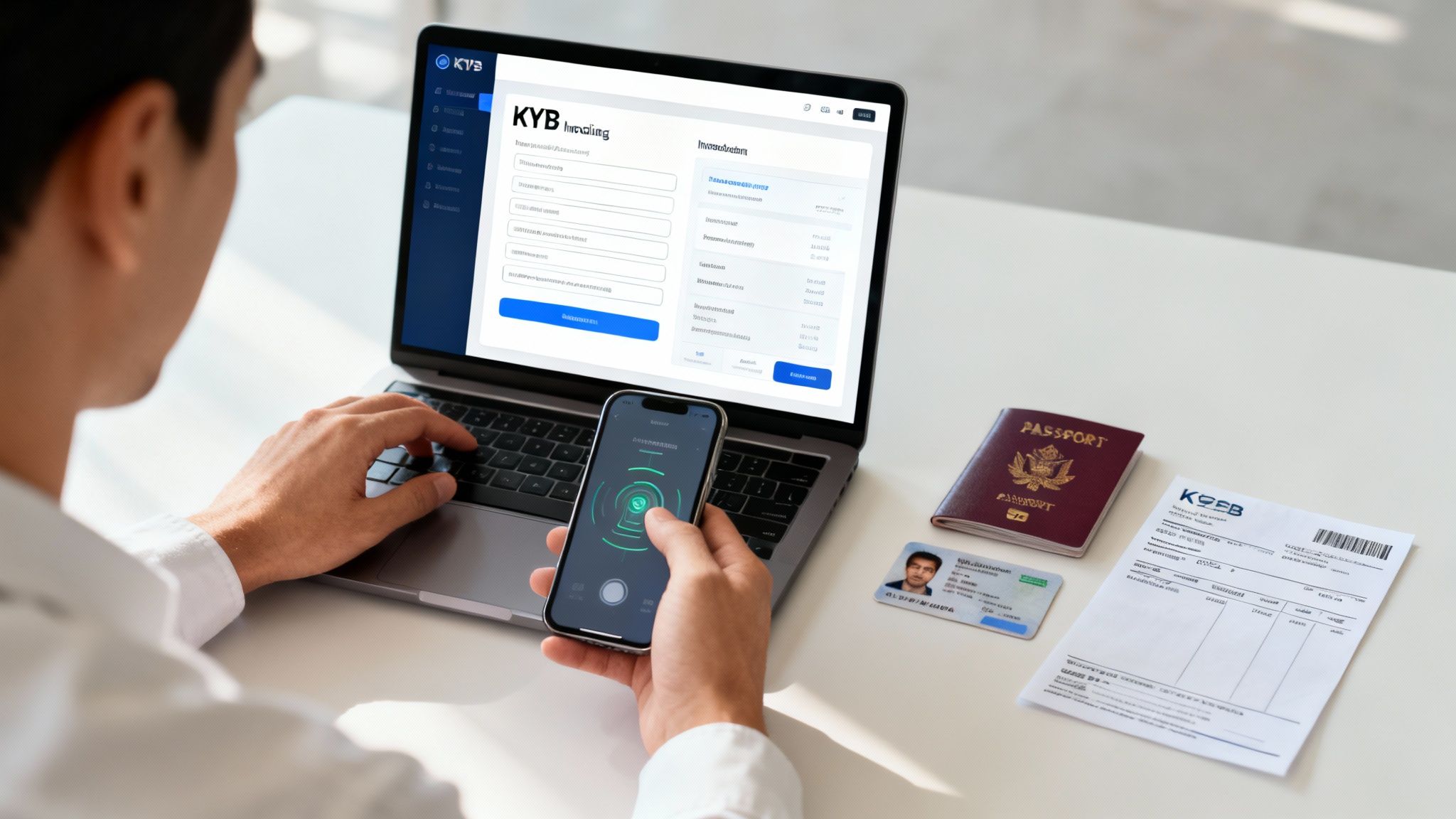
The whole point of KYB is to create a transparent financial world. By checking every business, providers cut down on fraud and make sure cross-border payments are above board, which protects your business and the wider economy.
Sometimes, to satisfy both local regulations and international partners, you might need official translations of your financial records. In certain situations, authorities may require certified translated bank statements to confirm the source of funds or to clarify transaction histories.
The Old Way vs The New Way of KYB
Historically, the KYB process has been a real headache for finance teams. With the traditional banks, it was often a slow-motion nightmare of paperwork. You could easily burn weeks printing documents, getting them certified by a commissioner of oaths, and then waiting for someone to manually check everything. All this bureaucracy just to get approved to make your first international payment.
This is where modern fintech platforms have completely changed the game.
Digital-first providers like Zaro have turned KYB from a weeks-long ordeal into something you can often get done in minutes, right from your desk. By using smart technology to verify your details against official databases in real-time, they've built a much smoother, faster onboarding process. This frees up your finance team from drowning in admin, letting them focus on activities that actually help the business grow. The difference is night and day.
How to Choose Your International Payment Partner

Now that you have a grasp of the hidden costs and regulatory hurdles of international transfers, it's time for the most important part: picking the right partner. This decision is much bigger than just finding the lowest advertised fee. You need a provider that fits how your business actually operates—whether that’s paying a dozen overseas suppliers, running payroll for remote staff, or bringing export revenue back home.
Think of it this way: a great partner turns cross-border payments from a costly headache into a smooth, efficient part of your global strategy. The wrong one, on the other hand, can lead to wasted time, frustrated suppliers, and a real hit to your bottom line. Let's walk through what you should be looking for to make a smart choice.
Prioritise Transparent Pricing and Real Rates
The number one factor has to be cost transparency. You need to know the real exchange rate you're getting, no exceptions. Many providers will shout about "zero-fee" transfers, but they’re just hiding their profit in a poor, marked-up exchange rate (the spread). Always check the rate you're offered against the live mid-market rate to see what you're truly paying.
Any provider that won't show you the real spot rate and be upfront about their charges isn't a transparent partner. The best value comes from providers who offer the mid-market rate with a clear, small fee, so there are no nasty surprises eating into your profit margins.
When you're transferring money internationally often, even tiny percentage differences add up fast. For South African SMEs, those high costs directly chip away at your ability to compete globally. And the need is growing; remittance outflows from South Africa climbed to $1.06 billion by 2022, with a significant rise in payments to key SADC markets. This trend just highlights how crucial efficient payment solutions are. You can dig into more South African financial service trends from Zensar.
Evaluate Speed and Platform Usability
How fast will the money actually get there? In business, a delay of a few days—pretty standard for old-school SWIFT transfers—can damage supplier relationships and throw a spanner in your supply chain. You should be looking for providers that can get funds settled quickly, ideally within 24 hours.
Just as crucial is how easy the platform is to use. Your finance team shouldn't need a week of training just to make a payment. A clean, intuitive interface with simple workflows, easy beneficiary management, and clear reporting saves hours of admin time. If you often pay multiple international contractors, look for essential features like bulk payment tools.
Assess Security and Enterprise Controls
This one's non-negotiable. Your payment partner must use bank-grade security to protect your money and your company's sensitive data. That means things like robust encryption, two-factor authentication (2FA), and secure data protocols are the bare minimum.
But beyond the basics, think about the controls your business needs as it grows. A single login won't cut it for long. A good platform will offer enterprise-level features that support a professional finance team:
- Multi-user access: The ability to add different team members to the account.
- Customisable permissions: The option to set different access levels, like "viewer," "creator," and "approver," to ensure proper financial oversight.
- Audit trails: A detailed log of all platform activity, so you always know who did what, and when.
These controls are vital for good governance and for reducing the risk of internal errors or fraud.
A Practical Checklist for Comparing Providers
Choosing a partner for transferring money internationally needs a bit of homework. Use this straightforward checklist to compare your options and find the best fit for your South African SME.
Evaluation Criteria Checklist:
- Pricing Model: Do they offer the real mid-market exchange rate? Are all their fees shown upfront?
- Transfer Speed: What are the typical settlement times for the countries you pay most often?
- Platform Experience: Is the interface easy to navigate? Does it have the features you need, like bulk payments?
- Security Measures: Do they use bank-grade encryption and offer two-factor authentication?
- Enterprise Controls: Can you set up multiple users with different permissions?
- Compliance Handling: How do they manage KYB and SARB reporting? Is it a slick, digital process?
- Customer Support: Can you get hold of a knowledgeable human when you actually need help?
By methodically vetting providers against these points, you can find a solution that doesn’t just save you money but also helps your business operate more effectively on the world stage. Modern fintech platforms are built to tick all these boxes, offering a powerful alternative to the high costs and slow pace of traditional banks.
What This Looks Like in the Real World
Talk is cheap. It’s one thing to read about the benefits, but it’s another to see how a modern payment platform actually works. Let's walk through what a typical South African business experiences when they switch from their old bank to a solution like Zaro. The difference is clear from the very first step.
Step 1: Onboarding in Minutes, Not Weeks
First things first: getting your business verified. Anyone who has dealt with a bank knows the pain of the "Know Your Business" (KYB) process. It’s usually a mountain of paperwork, certified documents, and then a long, anxious wait for someone to manually review it all. Weeks can go by.
Modern platforms have flipped this completely. The entire KYB process is digital and, frankly, unbelievably fast. We’re talking under 10 minutes in many cases. You just upload your company registration documents and director info straight into the platform. Smart tech then verifies everything against official databases in real-time. The paper-shuffling bottleneck that used to drive finance teams mad is just… gone.
Step 2: Topping Up Your Account and Making a Payment
Once you're verified, you need to get funds into your account. This is as simple as making a local EFT from your company's SA bank account to your Zaro ZAR wallet. No complex international wire instructions, no SWIFT codes to get wrong. The money shows up quickly, just like any other domestic transfer.
With funds in your wallet, you're ready to pay your international supplier. The whole process is designed to be crystal clear.
You can see from the Zaro platform interface just how straightforward it is to manage your money and kick off a transfer.
The clean dashboard shows you exactly what you have and where, with obvious buttons to send money, add funds, or switch between currencies. There’s no hunting through confusing menus like you often find on banking portals.
Step 3: Paying at the Real Exchange Rate
This is where the magic really happens and where you'll see the biggest cost savings. When you set up the payment to your overseas supplier, the platform shows you the live mid-market exchange rate—the actual 'spot' rate—with no hidden markup. You lock in that rate on the spot. What you see is what you get, down to the last cent.
The entire transaction happens without any SWIFT fees or correspondent bank charges. That R50,000 you send is converted at its true value, and you don’t have to worry about those mysterious deductions that cause short payments and supplier headaches.
This level of transparency gives you total predictability. You know exactly how much will land in your supplier's account, which makes managing your cash flow a whole lot easier.
Step 4: Keeping Control and Visibility
A modern payment platform is built for a professional finance team, not just a single person. As your business grows, you need proper governance, and that means having enterprise-grade controls. This typically includes:
- Multi-User Access: You can create separate, secure logins for everyone on your finance team.
- Customisable Permissions: You can assign specific roles—like 'viewer', 'creator', or 'approver'—to maintain a clear separation of duties. A junior accountant can set up a payment, but it won’t go anywhere until the CFO approves it.
- Complete Audit Trails: Every single action is logged. Who did what, and when. This creates a bulletproof record for internal audits and compliance.
This kind of control isn't just a nice-to-have; it's essential for sound financial management. The need for better payment systems is exploding. Formal remittance outflows from South Africa to other SADC countries shot up from R6 billion in 2016 to over R19 billion by 2024. This trend, highlighted in a report on South Africa's cross-border payment trends from the SARB, shows just how many businesses are looking for a better way.
Finally, many platforms also issue corporate debit cards linked to your account. This lets your team pay for international software subscriptions or online services directly, using the same great FX rates and avoiding the punishing fees banks charge on card transactions. When you put it all together, you can see how the right technology turns international payments from a costly, frustrating chore into a simple, controlled part of your business strategy.
Turning Global Payments into a Competitive Edge
Sending and receiving money internationally shouldn't be a roadblock for your South African business; it should be an accelerator for growth. For years, SMEs have been forced to accept murky fees, bad exchange rates, and frustrating delays as just "the cost of doing business" across borders. But things have changed. Sticking with the old way now means you're actively leaving money on the table.
By now, you've seen how the system works. It all starts with understanding the real costs—the ones buried in exchange rate spreads and the hidden fees from intermediary banks. Once you see that, you can confidently ditch the expensive, slow, and paper-heavy processes of traditional banks and find a partner that actually supports your ambition.
A Partner, Not Just a Provider
The right platform does more than just shift funds from A to B. It gives your finance team control and makes them more efficient. Think about all the time wasted on manual compliance paperwork and painfully slow KYB checks. A modern payments partner automates these headaches, freeing up your team to focus on what really matters: managing cash flow, planning for the future, and scaling the business.
This simple change turns cross-border payments from a reactive, frustrating chore into a powerful tool for your global expansion.
Moving past old-school banking isn't just about saving a few Rands on one payment. It’s about building a solid financial foundation that can keep up with your goals, smooth out relationships with international suppliers, and give you the confidence to take on the world.
For many South African SMEs, a key part of that global expansion involves setting up a presence in major hubs. This often includes steps like opening an offshore company and bank account in the UAE, a process that a good payment partner can make significantly easier.
At the end of the day, making the switch to a modern fintech solution is one of the most decisive steps you can take to unlock your company’s true potential on the global stage.
Frequently Asked Questions
Sending money across borders can feel like navigating a maze, so it's natural for South African business owners and finance teams to have questions. Here are straightforward answers to some of the most common ones we hear, designed to help you handle your international payments with more clarity and confidence.
What Is the Best Time to Make an International Transfer?
This is the million-rand question, isn't it? The truth is, there’s no magic day of the week to get the best deal, because exchange rates are constantly on the move. The real key is to avoid being forced into a last-minute transfer.
A much better approach is to keep an eye on currency trends. If you see the Rand gaining a bit of strength against the dollar or euro, that could be your moment to lock in a better rate. Modern payment platforms give you access to live rates, so you can make a strategic move when the time is right, rather than just accepting whatever rate your bank decides to give you on a Tuesday morning.
How Can My Business Avoid Currency Volatility?
Currency swings are a massive headache for any business dealing with international suppliers or clients. One day your profit margin is healthy; the next, a dip in the Rand has eaten into it. The most effective way to protect your business is to stop converting every single transaction back and forth from ZAR.
This is where multi-currency accounts come in. By holding balances in currencies like USD, EUR, or GBP, you can completely change the game.
- Pay international suppliers straight from your foreign currency account, skipping the ZAR conversion entirely.
- Get paid by overseas customers and keep the funds in their original currency until the exchange rate is in your favour.
- Naturally hedge against risk by not having all your cash held in one currency.
This simple shift gives your finance team a huge amount of control. You're no longer just reacting to the market; you're managing your currency exposure strategically.
The goal is to move from being a price-taker, accepting whatever rate the bank gives you, to a strategic manager of your currency exposure. This is a fundamental shift in how you handle global payments.
Are There Limits on How Much Money I Can Transfer Internationally?
Yes, there are limits, but for most legitimate business transactions, they are comfortably high. The South African Reserve Bank (SARB) sets the rules of the road, and your payment provider will have its own internal limits for security and compliance.
For the vast majority of SMEs, these caps are rarely an issue. A provider might set a per-transfer limit of R1,000,000, for instance, which covers most day-to-day operational payments. If you have a particularly large invoice to settle—say for a major equipment purchase—the best thing to do is simply chat with your provider ahead of time. With a little notice and the right paperwork, they can almost always accommodate larger transfers without a fuss.
Ready to stop overpaying on international transfers and take control of your global payments? Zaro offers South African businesses real exchange rates with zero spread, no SWIFT fees, and a powerful platform built for finance teams. See how much you can save by visiting our official Zaro website.